
In This Issue
Longevity
-
 Move Your Way: Why Leisure-Time Activity May Slow Biological Aging More Than Work or Commuting
A new analysis of more than 18,000 adults parses exercise by domain—and finds the clock-slowing benefits aren't distributed evenly. Sweat on your own time appears to matter more than sweat on the job.
Move Your Way: Why Leisure-Time Activity May Slow Biological Aging More Than Work or Commuting
A new analysis of more than 18,000 adults parses exercise by domain—and finds the clock-slowing benefits aren't distributed evenly. Sweat on your own time appears to matter more than sweat on the job.
-
 The Fatty Acid Signature of Healthy Aging to 80
A 15,000-person cohort sharpens which fats in your bloodstream travel with healthspan — not just the years, but the years lived free of major disease.
The Fatty Acid Signature of Healthy Aging to 80
A 15,000-person cohort sharpens which fats in your bloodstream travel with healthspan — not just the years, but the years lived free of major disease.


Move Your Way: Why Leisure-Time Activity May Slow Biological Aging More Than Work or Commuting
A new analysis of more than 18,000 adults parses exercise by domain—and finds the clock-slowing benefits aren't distributed evenly. Sweat on your own time appears to matter more than sweat on the job.
For years, the public-health refrain has been blissfully simple: move more, live longer. But a closer reading of the data has begun to complicate that slogan. Movement, it turns out, is not a monolith. The brisk walk you choose at dusk and the eight hours you spent hauling boxes at work both count as 'physical activity' on a questionnaire — yet inside your cells, they may be doing very different things. A new analysis of more than 18,000 American adults, published in Biology of Sport, suggests that when it comes to slowing the biological clock, the domain of your activity may matter as much as the dose.
- Three clocks, one dataset. Researchers applied KDM-BA, PhenoAge, and Homeostatic Dysregulation biological-age measures to NHANES participants from 2007–2010 and 2015–2018.
- Leisure-time activity stood out. High leisure-time physical activity was associated with a greater likelihood of delayed biological aging on PhenoAge and HD clocks.
- Occupational activity went the other way. High on-the-job activity was linked to a lower likelihood of delayed aging — the so-called physical activity paradox, surfacing again.
- Transport activity was a wash. Walking or biking to get places showed no significant association after adjustment.
- Evidence is moderate, not definitive. This is a cross-sectional, self-reported analysis — suggestive of mechanism, not proof of causation.
The study, led by Huang and colleagues, leans on three of the most-discussed tools in geroscience. The Klemera–Doubal Method Biological Age (KDM-BA) and PhenoAge translate routine bloodwork into an estimated 'biological age' that can run ahead of or behind your chronological one. Homeostatic Dysregulation (HD) takes a different tack, measuring how far a person's biomarker profile drifts from a healthy young reference. Together, these clocks give researchers a triangulated view of how the body is wearing — and a way to ask whether different kinds of movement leave different fingerprints on aging.
Drawing on NHANES data from 18,362 adults, the team split self-reported activity into three buckets: occupational (OPA), transportation (TPA), and leisure-time (LTPA). They then asked a deceptively simple question: within each domain, are people who move more also the people whose clocks are running slow?
The leisure premium
The standout signal belonged to leisure-time activity. Adults reporting high LTPA were more likely to show delayed biological aging on PhenoAge (OR 1.35, 95% CI 1.22–1.49) and on the HD measure (OR 1.18, 95% CI 1.09–1.29). In plain language: people who spent more of their discretionary time moving — the joggers, the swimmers, the weekend hikers — were the people whose blood chemistry looked younger than their birthdays.
Why might recreational movement carry an outsized benefit? The honest answer is that this study cannot say. But the broader literature offers some plausible candidates. Leisure activity tends to be aerobic, varied, and intermittent — punctuated by recovery. It is often chosen rather than imposed, which means it carries psychological reward rather than psychological strain. And the people who do it are, almost by definition, people with the time, autonomy, and resources to do it. That last point is not a footnote; it is one of the central interpretive challenges of the entire field.

Leisure-time movement tends to be aerobic, chosen, and paired with recovery — a very different physiological signature from a full shift of manual labor.
The on-the-job paradox, again
The more uncomfortable finding concerns work. High occupational physical activity was associated with a lower likelihood of delayed aging on both KDM-BA (OR 0.84, 95% CI 0.78–0.91) and PhenoAge (OR 0.86, 95% CI 0.79–0.94). Workers whose days are spent lifting, loading, and standing did not, on these measures, appear to be cashing in their exertion for a younger biological profile.
This is the so-called 'physical activity paradox,' and it has been surfacing in cardiovascular and mortality data for a decade. The proposed mechanisms are tidy on paper: occupational activity is often static, repetitive, low-recovery, and performed under time pressure and low control. It can elevate blood pressure across the working day without the conditioning benefit of bursts of exertion followed by rest. Joint a residual-confounding caveat to that — manual labor correlates with lower income, fewer healthcare resources, and more environmental exposures — and the picture grows harder to disentangle. The clocks may be reading some of that life context rather than the activity itself.
The clocks may be reading some of life's context, not just the movement itself.
Transport: the quiet middle
Transportation activity — the walk to the bus, the bike commute — produced no statistically significant association with delayed aging after adjustment, according to the Huang et al. analysis. That is worth sitting with. It does not mean active commuting is useless; the cardiovascular literature has long supported it. It does mean that in this particular dataset, with these particular clocks, it did not register as a strong independent signal. Volume may have been too low, intensity too modest, or the measure too crude to catch.

Active commuting did not show a clear independent signal in this analysis — a reminder that absence of effect in one study is not absence of benefit.
How to read this, carefully
The evidence here is suggestive, not settled. This is a cross-sectional analysis: it captures a snapshot of activity and biology, not a sequence over time. Physical activity was self-reported, a method known to inflate leisure exercise and under-record the grind of occupational movement. And biological-age clocks, for all their elegance, are still maturing tools whose readings can shift with the algorithm used. The authors themselves frame the work as an exploration of heterogeneity, not a prescription.
Still, the directional consistency across three different clocks is the kind of finding worth tracking. It aligns with a growing intuition in geroscience: that recovery, autonomy, and intensity structure matter — and that 'how much you move' is an incomplete question without 'in what kind of life.' For readers thinking about their own routines, the practical implication is not to quit a physical job or to download a new metric. It is to ask whether the movement you choose for yourself — the part you can shape — has a place in the week. If your work already taxes the body, the case for leisure activity is less about adding load and more about reclaiming the kind of movement that comes with rest, variety, and intent.
The deeper question this study sharpens is one geroscience will be wrestling with for the rest of the decade: when a clock ticks slower, what exactly is it measuring — the exercise, or the life that allows it?
Frequently asked questions
What three biological-age clocks did the researchers use, and what does each one measure?
The researchers used KDM-BA (Klemera–Doubal Method Biological Age), PhenoAge, and Homeostatic Dysregulation (HD). KDM-BA and PhenoAge translate routine bloodwork into an estimated biological age that can run ahead of or behind a person's chronological age, while HD measures how far a person's biomarker profile drifts from a healthy young reference.
What did the study find about leisure-time physical activity and biological aging?
Adults reporting high leisure-time physical activity were more likely to show delayed biological aging on the PhenoAge and Homeostatic Dysregulation measures. The study authors suggest that leisure activity tends to be aerobic, varied, intermittent, and chosen rather than imposed — giving it a different physiological signature from other types of movement.
What is the 'physical activity paradox,' and how did it appear in this research?
The physical activity paradox refers to the finding that high on-the-job physical activity is not associated with the same aging benefits as leisure movement — and may actually work against them. In this study, workers with high occupational physical activity showed a lower likelihood of delayed biological aging on both the KDM-BA and PhenoAge clocks.
Did walking or biking to work show any benefit for biological aging in this study?
No. Transportation activity — such as walking or biking to get places — produced no statistically significant association with delayed biological aging after adjustment. The article notes this could be because the volume was too low, the intensity too modest, or the measure too imprecise, and cautions that an absence of effect in one study is not the same as an absence of benefit.
How reliable are the study's conclusions, and what are its main limitations?
The authors frame the findings as suggestive rather than settled. The study is cross-sectional, meaning it captures a single snapshot rather than tracking people over time, and physical activity was self-reported — a method known to inflate leisure exercise and under-record occupational movement. Biological-age clocks are also still maturing tools whose readings can shift depending on the algorithm used.
Sources

The Fatty Acid Signature of Healthy Aging to 80
A 15,000-person cohort sharpens which fats in your bloodstream travel with healthspan — not just the years, but the years lived free of major disease.
Most longevity headlines chase the wrong number. Living longer is one thing; arriving at 80 still able to climb your own stairs, mow your own lawn and recognize your grandchildren is another. A new prospective study of more than 15,000 older adults takes a careful look at the second number — what researchers call healthy aging — and finds that the fats circulating in your blood appear to leave a readable signature on the odds of getting there intact.
The work, published in The American Journal of Clinical Nutrition, followed 15,333 participants aged 64 or older who were free of major chronic disease at baseline. The endpoint was deliberately strict: survival to age 80 without developing a major chronic disease along the way. A little over 9,000 of them made it.
What the researchers wanted to know was whether the relative mix of fatty acids in plasma — saturated, monounsaturated, and the various polyunsaturated species — tracked with that outcome. The short answer is that it does, but not in the way the breakfast-table debates of the last forty years would have predicted.
What moved the needle, and what didn't
Saturated and monounsaturated fats — the categories that have absorbed most of the cultural argument — showed no meaningful association with healthy aging in this cohort, in either direction. They were, statistically speaking, bystanders.
The polyunsaturated fats were the ones that moved. Participants in the highest quartile of total plasma PUFAs had about 32 percent greater odds of healthy aging compared with those in the lowest quartile, with a clear trend across the distribution. Both omega-3 and omega-6 families contributed.
Within those families, the study points a finger at specific molecules. Docosahexaenoic acid (DHA), the other (non-DHA) omega-3s, and linoleic acid — the dominant omega-6 in most diets — were each positively associated with the odds of aging well. The remaining omega-6 fats, taken together, were not. And a higher ratio of omega-6 to omega-3 fats tracked with lower odds of healthy aging, a finding consistent with a long line of cardiovascular research.
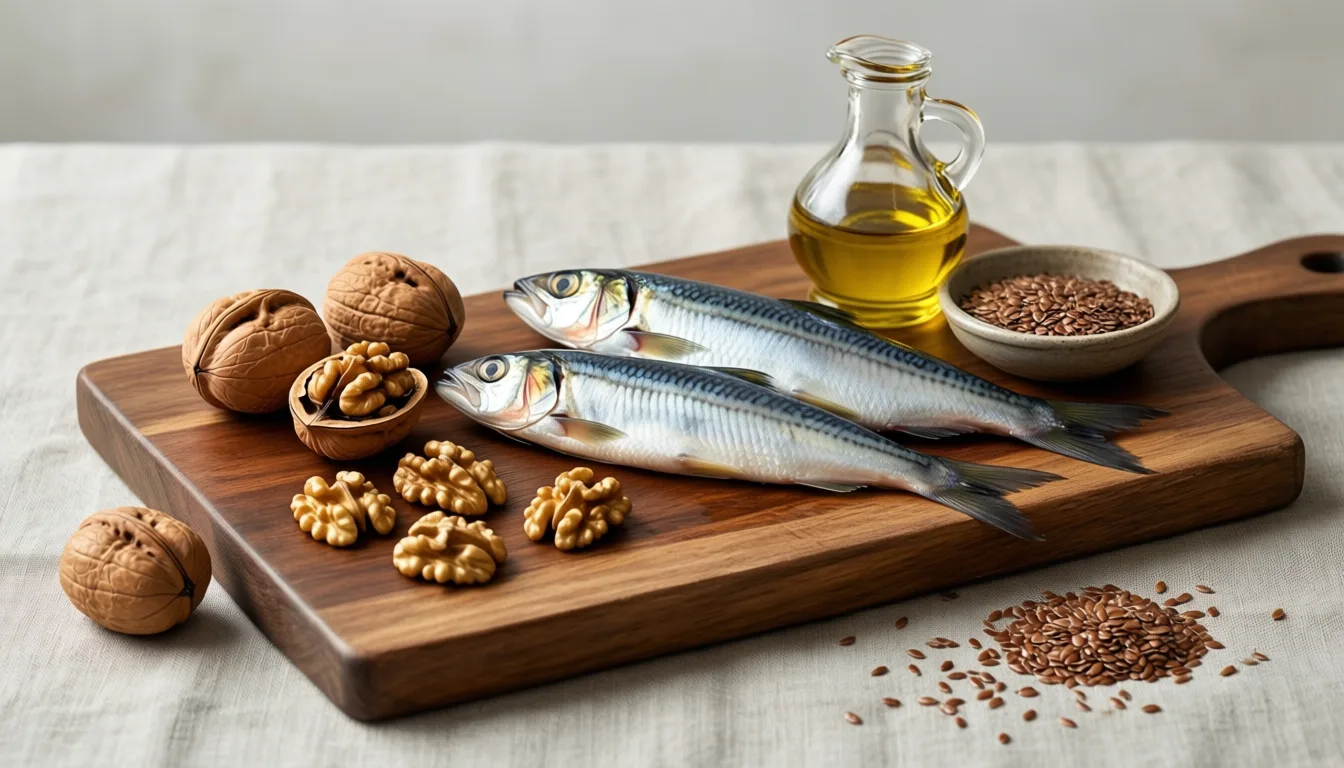
The molecules the study highlights — DHA, other long-chain omega-3s, and linoleic acid — show up in oily fish, walnuts, seeds and common plant oils.
Reading the signature carefully
A few cautions are worth keeping in front of you. This is an observational cohort, not a trial. The plasma fatty acid profile reflects both what people eat and how their bodies process those fats; the study cannot tell you that swallowing more of a particular oil will rewrite your biology. The authors also explored mediation through markers of biological age acceleration, which is suggestive but not proof of mechanism. The editorial weight here is moderate — meaningful, but not a verdict.
Still, the convergence is hard to ignore. The fats that came out looking favorable are the same ones the cardiovascular literature has been pointing toward for years: the long-chain omega-3s found in oily fish, and linoleic acid, the principal polyunsaturated fat in most plant oils and nuts. The fats that came out looking neutral — saturated and monounsaturated — are also broadly consistent with the more measured recent reviews. This is not a revolution. It is a sharpening.
Living longer is one thing. Arriving at 80 still able to climb your own stairs is another.
What a sensible reader does with this
Nothing in the study tells you to take a supplement, and we are not going to either. What it does is reinforce a quietly unfashionable idea: the dietary pattern your physician has probably been recommending for two decades — fish a couple of times a week, nuts and seeds in the rotation, plant oils rather than reformulated industrial fats, less emphasis on the saturated-versus-not skirmish than on what's actually on the plate — looks, in this cohort, like the pattern that travels with healthy aging.
If you are in your sixties or seventies and the question on your mind is whether the next fifteen years will be lived strong and independent or chipped away by chronic disease, this is a useful piece of evidence to bring to your next conversation with your doctor. Particularly if your bloodwork has never included a fatty acid panel, it may be worth asking whether one is appropriate for you. The answer will depend on your history, your medications and your goals, not on a magazine column.

Healthspan, not just lifespan, is the endpoint that matters — and the inputs to it are mostly the boring ones.
- Healthspan, not lifespan. The endpoint was reaching 80 free of major chronic disease — a higher bar than survival alone.
- PUFAs tracked best. Higher plasma polyunsaturated fats were associated with roughly 32% greater odds of healthy aging, top quartile vs. bottom.
- Specific molecules stood out. DHA, other long-chain omega-3s, and linoleic acid each pulled in the favorable direction.
- Saturated and monounsaturated fats were neutral for this outcome — neither hero nor villain in this dataset.
- A high omega-6 to omega-3 ratio was unfavorable, consistent with prior cardiovascular work.
- Observational evidence. Suggestive, not prescriptive. Bring it to your clinician before changing supplements or medications.
The long view, as always, is the useful one. A single study does not move the goalposts. But when a careful prospective cohort of this size lines up neatly with what the cardiology and nutrition literatures have been saying in their calmer moments, the signal is worth respecting. The fats in your bloodstream are a slow-moving readout of years of choices. This study suggests that readout has something to say about whether you arrive at 80 still in command of your own life.
Frequently asked questions
How did this study define 'healthy aging'?
The study defined healthy aging as surviving to age 80 without developing a major chronic disease along the way. The researchers described this as a deliberately strict endpoint — a higher bar than survival alone.
Which types of fat were associated with better odds of healthy aging?
Polyunsaturated fats (PUFAs) were the fats that moved the needle. Participants in the highest quartile of total plasma PUFAs had about 32 percent greater odds of healthy aging compared with those in the lowest quartile. Specifically, DHA, other long-chain omega-3s, and linoleic acid each showed a positive association.
What about saturated and monounsaturated fats — are they harmful for aging?
In this study, saturated and monounsaturated fats showed no meaningful association with healthy aging in either direction. The article describes them as 'statistically speaking, bystanders' and 'neutral — neither hero nor villain in this dataset.'
What foods contain the fatty acids the study highlighted?
The article notes that DHA, other long-chain omega-3s, and linoleic acid show up in oily fish, walnuts, seeds, and common plant oils.
Does this study prove that eating more polyunsaturated fats will improve my odds of healthy aging?
No. The study is an observational cohort, not a clinical trial, and the article is explicit that it cannot prove that changing your intake of any particular fat will change your odds. The plasma fatty acid profile reflects both diet and how an individual's body processes fats, and the article recommends bringing this evidence to a conversation with your doctor rather than changing supplements or diet on the basis of it alone.
Sources
- Plasma fatty acids and the likelihood of healthy aging: a prospective cohort study. — The American journal of clinical nutrition

Is Lean Mass Loss on GLP-1s Overhyped? A Reassessment
A new peer-reviewed review argues the panic over muscle loss with weight-loss drugs may be missing the point. The real question is whether your muscle still works — not what the scale partitions.
Scroll any wellness feed and you will meet the same villain on repeat: GLP-1 medications are supposedly melting people's muscle along with their fat, leaving a generation of users frail and metabolically hollowed out. It's a tidy narrative — and, according to a 2025 review in Molecular Metabolism, possibly the wrong one. The authors argue we may be giving too much weight to lean mass loss, and not nearly enough to whether the muscle that remains actually works.
The concern is understandable. Incretin-based therapies like semaglutide and tirzepatide produce weight loss at a scale that used to be the exclusive territory of bariatric surgery. And every meaningful weight loss intervention — diet, exercise restriction, surgery, illness — comes with some loss of lean tissue alongside fat. When the total weight loss is large, the absolute lean-mass number can look alarming on a DEXA printout.
But the review's central provocation is this: lean mass is a crude proxy for what we actually care about. What predicts whether someone can climb stairs at 70, recover from a hospitalization, or avoid a fall is not how many kilograms of muscle they carry. It is muscle quality — the strength, the metabolic function, and the fat infiltration of the tissue itself.
Quality, not quantity
This distinction matters because the two can move in opposite directions. A person can be heavy and sarcopenic — carrying plenty of muscle mass that is marbled with fat and metabolically sluggish. A leaner person can carry less absolute muscle that is denser, stronger per unit, and more insulin-sensitive. The review synthesizes evidence that muscle quality is a more robust predictor of functional capacity and all-cause mortality than absolute muscle mass.
If that framing holds, then watching the lean-mass line on a body-composition scan drop during GLP-1 therapy and concluding 'this drug is making people frail' may be a bit like watching someone's grocery bill fall and concluding they are starving. The number is real. The interpretation is the question.

What you can do with your body may matter more than what a scan says you carry.
Muscle quality — not absolute mass — is shaping up to be the better predictor of how a body actually functions. Bolte et al., Molecular Metabolism, 2025
The twist in the data
Here is where the review gets genuinely interesting. The authors note that incretin therapies may enhance muscle quality even while promoting lean mass loss. In other words, the same drug that shrinks the lean-mass number on a scan may be improving the working condition of the muscle that remains — less intramuscular fat, better insulin signaling, a tissue that is metabolically younger even if it weighs less.
This is not a victory lap. The review is careful, and so are we: this is a synthesis of emerging evidence, not a closed case. The functional outcomes — strength testing, gait speed, fall rates, long-term independence — are still being characterized in real-world populations on these drugs. The signal is suggestive, not settled. The evidence here is best described as moderate, and the authors frame their argument as a reframe of the debate, not a final answer.
Why the framing got stuck
Part of the reason the lean-mass panic has been sticky is historical. For decades, geriatric medicine has — correctly — treated lean mass preservation as central to healthy aging, because lean mass preservation has been widely considered essential for mitigating fall risk and maintaining functional independence. That instinct is good. It is also being applied to a new clinical situation it wasn't built for: rapid, pharmacologically-driven weight loss in people who started with significant excess fat mass and, often, poor-quality muscle to begin with.
Losing 'muscle' off a baseline of marbled, insulin-resistant tissue is not the same physiological event as losing muscle off a fit 75-year-old. The review's argument is that conflating the two has produced a debate that is louder than the data warrants.

Resistance training and adequate protein remain the through-line in every serious conversation about preserving function during weight loss.
What this means for the rest of us
None of this is permission to be cavalier. The review is written to guide clinicians in tailoring weight loss strategies, and the practical implications still rhyme with what every good metabolic-health conversation has said for years: if you are losing weight — by any method — you want to do it in a way that protects what your muscle can do, not just how much of it shows up on a scan.
That means the boring, durable stuff: resistance training, adequate protein, sleep, and clinician follow-up. It also means looking past the DEXA snapshot to functional measures — grip strength, how easily you get out of a low chair, whether your stairs feel different at month six than they did at baseline. Those are the data points the review is essentially asking us to take more seriously than the scale's partition math.
If you are considering or already taking a GLP-1, the headline isn't 'don't worry about muscle.' It's 'worry about the right thing.' And the right thing, according to this synthesis, is function.
- The reframe: A 2025 Molecular Metabolism review argues the alarm over lean mass loss on GLP-1s may be misplaced.
- Why: Muscle quality predicts function and mortality more robustly than absolute muscle mass.
- The twist: Incretin therapies may improve muscle quality even as total lean mass falls.
- The caveat: Evidence is moderate and still emerging — long-term functional outcomes are being characterized.
- The practical line: Resistance training, adequate protein, and clinician follow-up still matter — track function, not just scans.
- Talk to a clinician: Any weight-loss medication decision is individual; this is education, not a prescription.
Frequently asked questions
Why does a 2025 review in Molecular Metabolism argue the alarm over lean mass loss on GLP-1s may be misplaced?
The review argues that lean mass is a crude proxy for what actually matters — muscle quality, defined as the strength, metabolic function, and fat infiltration of the tissue itself. Because muscle quality is a more robust predictor of functional capacity and all-cause mortality than absolute muscle mass, a drop in the lean-mass number on a DEXA scan does not necessarily mean the body is becoming frail.
Can GLP-1 medications affect muscle quality while also reducing lean mass?
According to the review, incretin therapies may improve muscle quality even as total lean mass falls — with the remaining muscle potentially showing less intramuscular fat, better insulin signaling, and what the article describes as tissue that is metabolically younger. The authors frame this as a suggestive signal, not a settled finding, and note that evidence is moderate and still emerging.
Why does the article say historical concerns about lean mass loss don't translate directly to GLP-1 users?
Geriatric medicine developed its focus on lean mass preservation in the context of fit older adults, where muscle loss directly raises fall risk and reduces independence. GLP-1 users typically start with significant excess fat mass and often poor-quality, insulin-resistant muscle, so the article argues that losing lean tissue from that baseline is a different physiological event than losing muscle from a fit individual.
What functional measures does the article say matter more than a body-composition scan?
The article points to grip strength, how easily a person can rise from a low chair, and whether stairs feel different at month six than they did at baseline as meaningful data points. It also lists gait speed, fall rates, and recovery from illness as the real-world outcomes the next wave of research needs to track over multi-year follow-up.
What practical steps does the article recommend for anyone losing weight on a GLP-1?
The article says resistance training, adequate protein, sleep, and clinician follow-up remain the through-line in every serious conversation about preserving function during weight loss. It also recommends tracking functional measures rather than relying solely on scan-based numbers.
Sources
- Are we giving too much weight to lean mass loss? — Molecular metabolism