
Cardiometabolic Resilience: Who Avoids the Damage, and Why It Matters for You
Two new datasets reframe metabolic risk from inevitability to variability — hunting the protective phenotypes that shrug off vascular damage, and the routine labs that flag your five-year diabetes window.
Some people break the rules of cardiometabolic medicine. They carry the risk factors that are supposed to wreck an artery — three decades of Type 1 diabetes, a BMI that flags every actuarial table, kidneys failing toward transplant — and yet their vessels stay quiet. No calcification. No infarct. No story. For most of the last century, those people were statistical noise. A new Swedish protocol is treating them as the signal.
The shift matters for anyone in their late thirties or forties trying to make sense of a confusing risk picture. You eat well, you train, your labs look fine on paper — but your father had a stent at 52 and your fasting glucose has crept up two points a year. Are you on rails toward the same outcome, or is there real variability in how bodies handle metabolic stress? Two 2025 papers, taken together, suggest the answer is closer to variability than fatalism — and they hint at what to actually measure.
The resilience hunt
The first paper is the rationale and early results from the ESCAPER study, an exploratory project out of southern Sweden that started recruiting in September 2022. Rather than asking why high-risk patients get sick — the default question of cardiovascular medicine for a hundred years — ESCAPER asks the inverse: why don't the ones who should?
The cohort is built around three improbable groups. Type 1 diabetics with more than 30 years of disease and no macrovascular complications or macroalbuminuria. Obese adults with normal cardiac function who take no cardiovascular medications. And kidney-failure patients awaiting transplant whose arteries show no calcification. Each group is paired with controls and put through deep phenotyping: 24-hour blood pressure and ECG, vascular ultrasound, cardiac MRI, ergospirometry in a subgroup, plus biomarker and omics work. Kidney-failure participants also contribute arterial biopsies — actual vessel tissue, not just a blood draw.
The early read on 90 T1D patients and 31 obese participants is modest but telling: risk factors are well-managed, and the T1D subgroup posts a mean BMI of 25.6 — squarely in the normal range. That isn't the answer to the resilience question; it's the start of the question. The interesting biology lives in what the omics, imaging and biopsies reveal next.
For most of the last century, the people who broke the rules were statistical noise. A new protocol treats them as the signal.
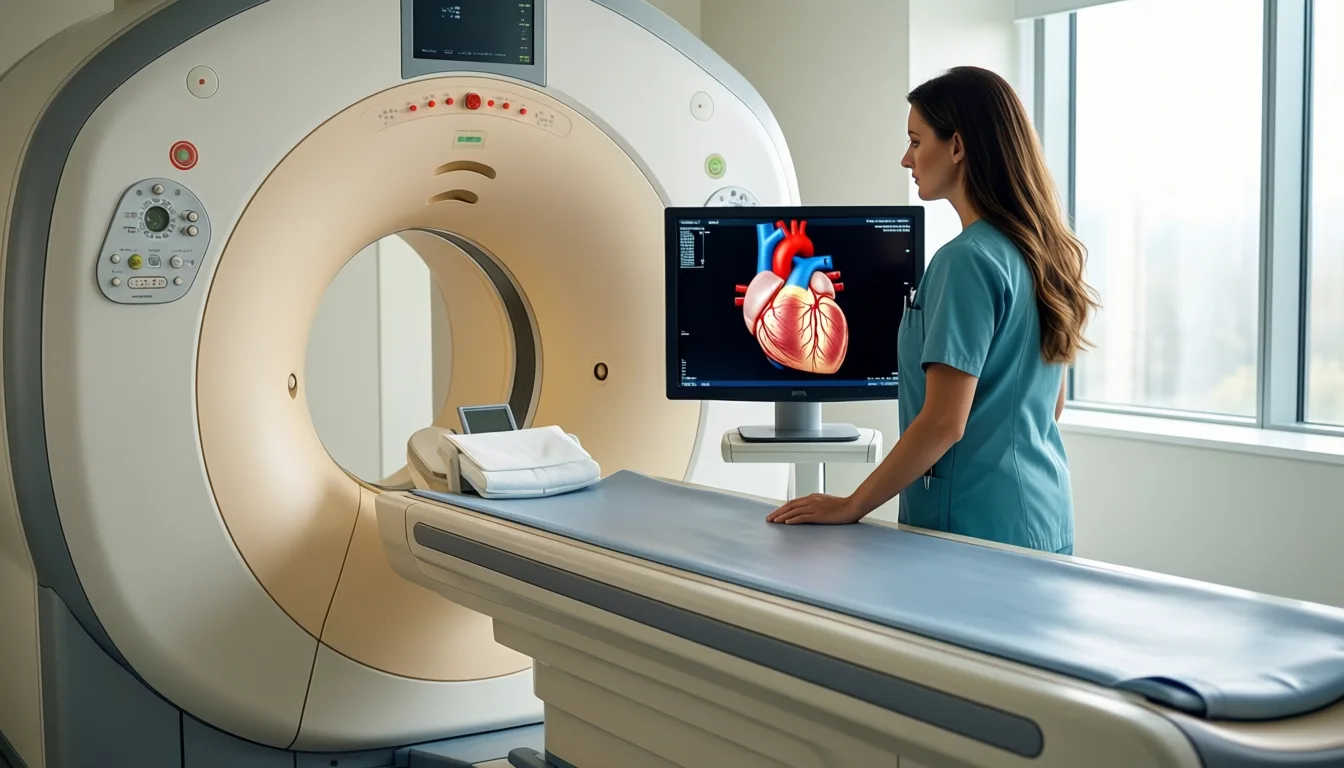
ESCAPER's deep phenotyping stack includes cardiac MRI, vascular ultrasound and ergospirometry — far beyond a standard physical.
What this changes for a 40-year-old
Practically? Not much yet. ESCAPER is an exploratory protocol; no protective mechanism has been confirmed, no drug target has been validated, and the early data are descriptive. What it does change is the framing of the conversation you have with your own physician. "High risk" is not a verdict. There are people with worse inputs than yours who never develop disease, and the field is finally trying to figure out why instead of treating them as outliers to be discarded.
The honest read on the evidence here is moderate. ESCAPER is a well-designed observational effort with strong phenotyping and Swedish registry follow-up — a real strength — but it has not yet produced mechanism-level findings, and observational work on resilience is famously prone to confounding. Translate the hype filter accordingly.
The other half: knowing your window
While ESCAPER asks who escapes, a second 2025 paper asks who's heading in. Researchers used Japanese health check-up data from 31,084 adults aged 30–69, collected between 2008 and 2016, to build prediction equations for five-year diabetes incidence. Participants with baseline diabetes or endocrine disease were excluded, and the population was split evenly into derivation and validation cohorts.
The headline result is unglamorous and useful. In the derivation cohort, five-year diabetes incidence was 5.0%. A model built from age, sex, body mass index, fasting blood glucose and HbA1c — five inputs you almost certainly already have on a recent lab panel — showed good discriminatory ability for predicting who would develop diabetes within five years. No proprietary biomarker. No genetic panel. Just the boring numbers from an annual physical, combined intelligently.
The trade-off worth naming: this is a Japanese cohort, and diabetes risk thresholds, body composition and incidence rates differ across populations. The equation's discriminatory power in a Swedish or American 40-year-old is not established. But the architectural lesson — that routine labs, modeled well, can define a personal five-year window — generalizes.

The Japanese prediction model relies on five inputs already on most annual lab panels.
How to use this — without overreaching
Two practical reframes come out of these papers for a busy 40-year-old optimizing energy, body composition and long-term metabolic health.
First, treat your fasting glucose and HbA1c as a trajectory, not a pass/fail line. The Japanese work suggests the combination of those two values, alongside age, sex and BMI, carries more predictive weight than any single number in isolation. If your HbA1c has drifted from 5.2 to 5.5 to 5.7 across three annual physicals while your BMI ticked up, the equation reads that pattern differently than a one-time 5.7 in a stable weight. Ask your clinician to look at the slope, not the snapshot.
Second, accept that resilience exists but don't bet on being resilient. ESCAPER is hunting for protective biology that may eventually become a drug, a screening test, or a phenotype you can actually identify in yourself. Today, none of that is in clinical use. The actionable layer remains the unglamorous one — sleep, training load, protein intake, alcohol, visceral fat — and the lab cadence to know which direction you're trending.
Neither paper licenses a supplement stack, a fasting protocol, or a specific intervention. Both quietly argue that the next decade of cardiometabolic medicine will be more personalized and less fatalistic than the last. That's the optimization story worth tracking.
- Resilience is real but not yet actionable. ESCAPER is mapping people who avoid vascular disease despite high-risk profiles; no protective mechanism is confirmed yet.
- Your annual labs already hold a five-year signal. A Japanese cohort of 31,084 built a validated diabetes prediction equation from age, sex, BMI, fasting glucose and HbA1c.
- Trajectory beats snapshot. Track glucose and HbA1c trends across years, not single readings.
- Evidence is moderate, not definitive. ESCAPER is exploratory; the Japanese equation is population-specific.
- The boring inputs still win. Sleep, training, body composition and lab cadence remain the levers — talk to a clinician about your personal risk window.
The framing has shifted. Cardiometabolic risk is variable, not fixed; some people genuinely escape damage that the standard models predict, and the routine labs in your file likely encode more about your personal window than you've been told. Neither finding is a green light to skip the cardiologist. Both are reasons to bring better questions to the appointment.
Frequently asked questions
What kinds of patients does the ESCAPER study recruit, and what makes them unusual?
ESCAPER recruits three groups: Type 1 diabetics with more than 30 years of disease and no macrovascular complications or macroalbuminuria, obese adults with normal cardiac function who take no cardiovascular medications, and kidney-failure patients awaiting transplant whose arteries show no calcification. Each group is paired with controls and put through deep phenotyping including cardiac MRI, vascular ultrasound, and biomarker and omics work.
What five data points does the Japanese diabetes prediction model rely on?
The model uses age, sex, body mass index, fasting blood glucose, and HbA1c — five inputs the article notes are already available on most annual lab panels, with no proprietary biomarker or genetic panel required.
Has ESCAPER confirmed a biological mechanism that explains why some high-risk people avoid cardiovascular disease?
No. The article states that no protective mechanism has been confirmed and no drug target has been validated; the early data are described as descriptive. ESCAPER is characterized as an exploratory protocol that has not yet produced mechanism-level findings.
Why might the Japanese prediction equation not apply directly to people from other countries?
The article notes that diabetes risk thresholds, body composition, and incidence rates differ across populations, so the equation's discriminatory power in a Swedish or American adult is not established. The authors describe this as a trade-off worth naming, while arguing that the broader lesson — that routine labs modeled together can define a personal five-year risk window — does generalize.
What does the article suggest is the practical takeaway for someone tracking their own metabolic health?
The article recommends treating fasting glucose and HbA1c as a trajectory rather than a pass/fail line, asking a clinician to look at the slope across multiple annual physicals rather than a single reading. It also advises against assuming personal resilience, since no protective phenotype is yet identifiable in clinical practice, and states that sleep, training load, protein intake, alcohol, and visceral fat remain the actionable levers.
Sources
- The ESCAPER study-exploring protective mechanisms against cardiovascular disease in subjects at high risk: rationale, study protocol, and first results. — Scandinavian cardiovascular journal : SCJ
- Development of risk prediction equations for 5-year diabetes incidence using Japanese health check-up data: a retrospective cohort study. — BMJ open
Join the conversation
Comments are moderated and reviewed before they appear. Be constructive — this is health information.
Add your comment