Diabetes, the Liver, and the Quiet March of MASLD
A three-year cohort of type 2 diabetics tracked who silently progressed to liver fibrosis — and which routine lab markers offered the earliest warning.
For most people with type 2 diabetes, the liver is a quiet organ — present on the lab panel, rarely the headline. Yet metabolic-dysfunction-associated steatotic liver disease, or MASLD, now travels alongside diabetes so often that clinicians increasingly treat them as two faces of the same metabolic story. The harder question is which patients, while feeling no different from one year to the next, are slowly accumulating the scar tissue that defines fibrosis. A three-year cohort published in 2025 set out to answer exactly that, and the markers it surfaced are ones already sitting on most readers' routine bloodwork.
The study, led by Alfadda and colleagues, followed 233 adults with type 2 diabetes and MASLD for a minimum of three years, comparing those whose liver fibrosis progressed against those whose did not. By the end of follow-up, 42 patients — about 18 percent — had progressed, while the remaining 82 percent had not. That split is itself worth pausing on: in a population already carrying two metabolic diagnoses, the majority did not visibly worsen on imaging, but a meaningful minority did, and they did so without dramatic symptoms to announce themselves. The work is summarized in the Journal of Diabetes and its Complications.
What separated the two groups, at baseline, was less exotic than one might expect. Progressors entered the study with significantly higher aspartate aminotransferase (AST) and lower platelet counts — two values printed on nearly every standard chemistry and complete blood count. Alkaline phosphatase (ALP) was also higher in progressors. These are not new biomarkers; they are the same lines a primary care clinician scans every visit. The cohort's contribution is to show that, in this specific population of T2DM patients with MASLD, the combination of elevated AST and reduced platelet count at baseline tracked with who would later show fibrosis progression on FibroScan.
What changed in the people who got worse
Baseline values tell one story; the direction of travel over three years tells another. When the researchers looked at delta changes — how each marker shifted from the first visit to the last — a coherent metabolic picture emerged in the progressors. Rising alkaline phosphatase, rising body mass index, expanding waist circumference, and falling platelet count were each correlated with fibrosis progression. The non-progressors, by contrast, tended to move in the opposite direction on the levers patients and clinicians can actually pull: their BMI and waist circumference fell, their HbA1c and fasting blood sugar improved, their GGT and ALT drifted down, and their HDL-cholesterol rose. Several other lab values, including albumin, creatinine, and bilirubin, also shifted in this group, as reported by Alfadda and colleagues.
It is tempting to read that list as a prescription. It is not. A cohort study of this size can identify which markers traveled together with progression; it cannot prove that nudging any one of them — a kilogram of waist circumference, a tenth of a point of HbA1c — will, on its own, change a person's liver trajectory. The evidence here is moderate, not definitive. What it does support is a more focused conversation with a clinician about whether the metabolic markers that are already being measured are quietly drifting in the wrong direction.
The earliest warning may not be a new test. It may be the AST and platelet line already on your bloodwork.

Two values on a standard panel — AST and platelet count — separated progressors from non-progressors at baseline.
Why FibroScan keeps coming up
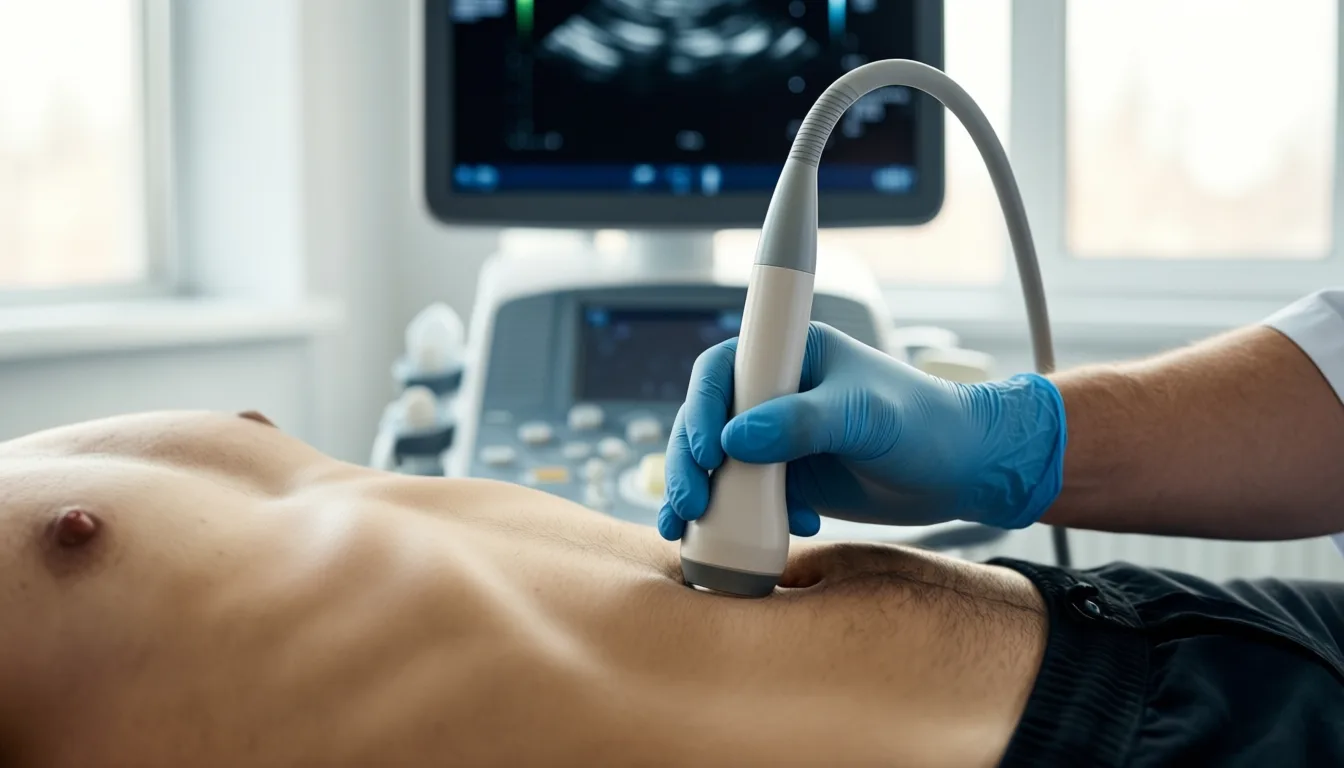
The cohort used transient elastography — the technology most readers will recognize as FibroScan — to measure liver stiffness as a proxy for fibrosis. It is non-invasive, takes minutes, and does not require the needle of a biopsy. For a population of diabetics with MASLD, where roughly one in five quietly progressed across three years in this study, an in-office stiffness measurement is a reasonable way to catch what bloodwork alone cannot fully resolve. The cohort does not establish a universal screening schedule, but it does strengthen the practical case that elastography belongs in the metabolic workup for at-risk patients, alongside the usual diabetes monitoring.
The study also touched, more briefly, on the role of GLP-1 receptor agonists in this cohort. The reported data on this point is limited and should not be read as a head-to-head trial of GLP-1s for fibrosis. The honest summary is that this cohort cannot, on its own, settle the question of which medications change the fibrosis curve — only that the metabolic improvements clinicians already chase in diabetes care (lower HbA1c, smaller waist, better lipids) showed up disproportionately in the people whose livers did not get worse.

Non-progressors tended to lose weight at the waist and improve glycemic control over the same three years.
- One in five progressed. Across three years, 18% of T2DM patients with MASLD showed worsening liver fibrosis on FibroScan; 82% did not.
- Baseline AST and platelets mattered. Higher AST and lower platelet count at the start predicted who would later progress.
- Direction of travel mattered too. Rising ALP, BMI, and waist circumference — and falling platelets — tracked with fibrosis progression over time.
- The non-progressors improved their metabolics. Lower HbA1c, fasting glucose, ALT, GGT and waist size, plus higher HDL, clustered in this group.
- FibroScan is the practical tool. Non-invasive elastography is what surfaced the silent progressors — bloodwork alone could not.
- Evidence is moderate. This is a single cohort identifying associations, not a trial proving that changing any one marker reverses fibrosis.
What makes this work useful for readers focused on metabolic health is not a new biomarker or a novel drug. It is the reminder that the liver's slow progression in diabetes often hides behind values that are already being drawn — and that, for the meaningful minority who progress, the earliest warning may be sitting on a panel nobody flagged. The cohort is small enough, and singular enough, that the right posture is curiosity rather than alarm. But it is a credible nudge to ask whether the liver is part of the conversation at all, and whether the standard tools — the bloodwork, the waist tape, the in-office scan — are being read together rather than in isolation.
Frequently asked questions
What percentage of type 2 diabetes patients with MASLD saw their liver fibrosis get worse over the study period?
About 18 percent of the 233 participants — 42 patients — showed fibrosis progression over a minimum of three years. The remaining 82 percent did not visibly worsen on imaging.
Which routine lab values predicted who would go on to have fibrosis progression?
At baseline, patients who later progressed had significantly higher aspartate aminotransferase (AST), higher alkaline phosphatase (ALP), and lower platelet counts compared to those who did not progress. These values appear on standard chemistry and complete blood count panels.
What changes over time were seen in patients whose fibrosis did not worsen?
Non-progressors tended to see their BMI and waist circumference fall, their HbA1c and fasting blood sugar improve, their GGT and ALT drift down, and their HDL-cholesterol rise. Several other lab values, including albumin, creatinine, and bilirubin, also shifted favorably in this group.
What is FibroScan and why does the article say it matters for this group of patients?
FibroScan uses transient elastography to measure liver stiffness as a non-invasive proxy for fibrosis, taking minutes and requiring no biopsy needle. The article argues it belongs in the metabolic workup for at-risk patients because bloodwork alone cannot fully resolve what elastography can surface.
Does the study prove that improving metabolic markers like HbA1c or waist circumference will reverse liver fibrosis?
No. The authors are explicit that this is a cohort study identifying associations, not a trial proving causation. It cannot demonstrate that changing any single marker will, on its own, alter a person's liver trajectory, and the evidence is described as moderate rather than definitive.
Sources
- Predictors of liver fibrosis progression in cohort of type 2 diabetes mellitus patients with MASLD. — Journal of diabetes and its complications
Join the conversation
Comments are moderated and reviewed before they appear. Be constructive — this is health information.
Add your comment