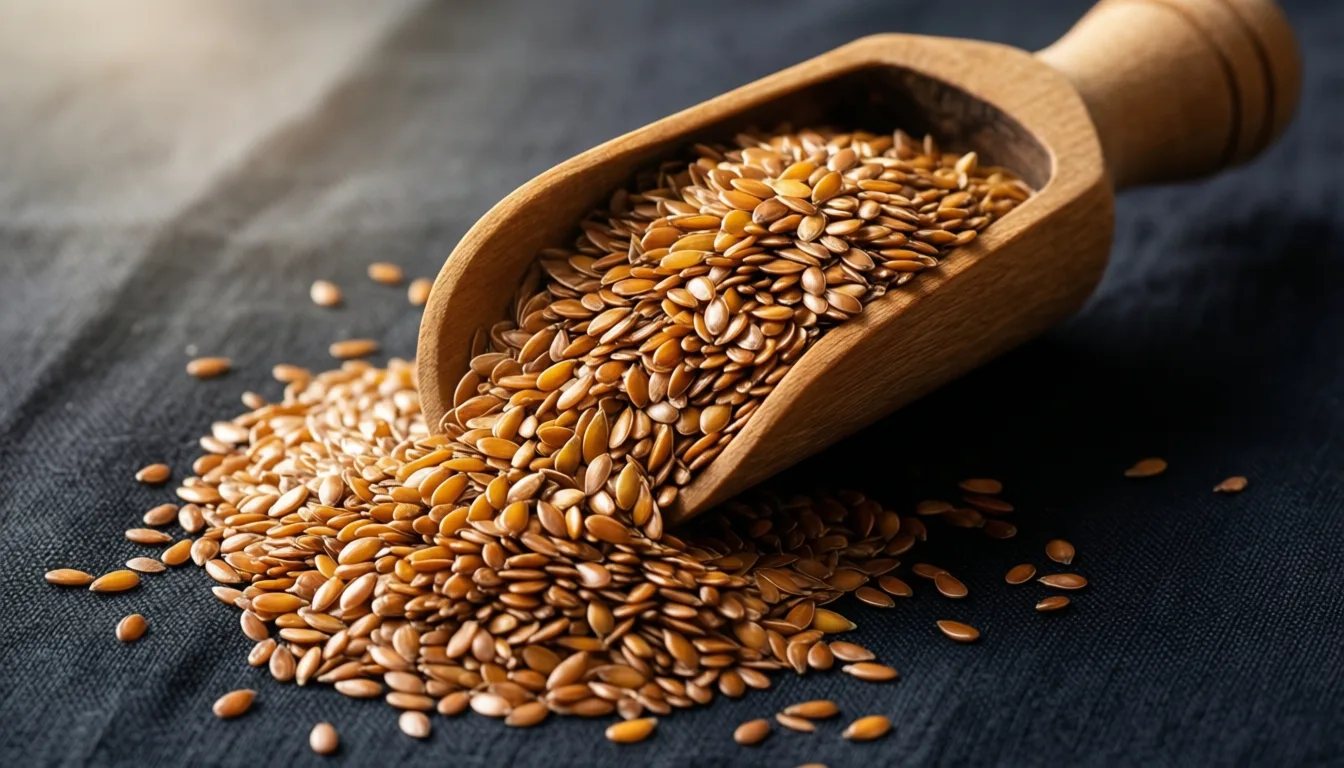
Flaxseed Revisited: The Pantry Staple With a Real Cardiometabolic Case
A 2025 GeroScience synthesis pulls together decades of flaxseed research — and the lipid, pressure, and glycemic signals are more durable than the supplement aisle suggests.
Flaxseed is the kind of ingredient that gets quietly dismissed by people who should know better. It lives on the bottom shelf of the pantry, between the chia and the nutritional yeast, wearing the faint stigma of a 2009 wellness blog. But strip away the marketing residue and what remains is one of the more interesting whole-food interventions in cardiometabolic science — a seed that delivers a plant-based omega-3 (alpha-linolenic acid, or ALA), a concentrated dose of lignans, and a viscous soluble fiber, all in the same tablespoon. A 2025 synthesis in GeroScience argues the evidence has quietly matured, and it's worth a second look — especially for athletes who already obsess over the small inputs that compound over years.
The new review, led by Kunutsor and colleagues, pools decades of trial data and mechanistic work to ask a simple question: across the messy literature, what does flaxseed reliably do to a human body, and what is still speculation? Their answer is more interesting than either the supplement-industry pitch or the reflexive skepticism it usually attracts. Flaxseed supplementation, they conclude, significantly improves multiple cardiometabolic risk factors — body weight and BMI, lipid levels, blood pressure, glycemic measures, inflammatory markers including C-reactive protein and interleukin-6, oxidative stress, and liver enzymes. That is an unusually broad footprint for a single food.
- Three actives, one seed. ALA (a plant omega-3), lignans (phytoestrogens with antioxidant activity), and soluble fiber each plausibly contribute to the observed effects.
- Blood pressure is the standout signal. Reductions of roughly 2–15 mmHg systolic and 1–7 mmHg diastolic, scaled to dose, duration, and starting risk.
- Lipids, glucose, and inflammation move too — modestly, but consistently across trials.
- Hard outcomes remain unproven. The review explicitly notes that direct evidence for preventing hypertension, type 2 diabetes, or kidney disease is still limited.
- It is a food, not a drug. Treat it as a low-cost dietary lever, not a substitute for clinical care.
What's actually in the seed
ALA is the headline. It's the short-chain omega-3 your body converts — inefficiently, but measurably — into the longer-chain EPA and DHA that dominate the marine-oil literature. The conversion penalty is real, which is why flaxseed is not a clean substitute for fish oil in athletes chasing membrane-level EPA. But ALA appears to do work in its own right, particularly on lipid handling and vascular tone.
Then come the lignans. Flaxseed is, by a wide margin, the richest dietary source of secoisolariciresinol diglucoside (SDG), which gut bacteria convert into enterolignans with weak estrogenic and antioxidant activity. And finally the soluble fiber — the same viscous, gel-forming kind that slows gastric emptying, blunts postprandial glucose, and binds bile acids on their way out, nudging the liver to pull more cholesterol from circulation to make replacements. Three mechanisms, one tablespoon. That convergence is part of why the signal is hard to dismiss as noise.

Ground beats whole: the seed coat is tough enough that intact flaxseeds largely pass through undigested, taking their actives with them.
The blood-pressure signal
The pressure data is where the review gets genuinely striking. Across trials, systolic reductions ranged from about 2 to 15 mmHg, and diastolic from 1 to 7 mmHg, with the magnitude scaling to dose, duration, and baseline risk profile. The upper end of that range is in the neighborhood of a first-line antihypertensive — which is the kind of sentence that should immediately trigger caution. The upper end is not the average. It's what shows up in longer trials, at higher doses, in people who started with meaningfully elevated pressure. Lean, well-trained readers with already-low resting pressure should expect substantially less, and arguably need it less.
Still, the directional consistency is what matters. Across heterogeneous protocols and populations, the needle moves the same way. That is not what supplement literature usually looks like.
Three mechanisms, one tablespoon. That convergence is part of why the signal is hard to dismiss as noise.
Lipids, glucose, inflammation
Beyond pressure, the review credits flaxseed with measurable shifts in lipid levels, glycemic measures, and inflammatory markers including C-reactive protein and interleukin-6, alongside changes in body weight, BMI, oxidative stress markers, and liver enzymes. For an endurance athlete, the inflammation piece is the quietly interesting one. CRP and IL-6 are not just cardiovascular risk markers — they're part of the chronic low-grade inflammatory tone that interferes with recovery, sleep architecture, and metabolic flexibility over training blocks. A dietary input that nudges them downward is worth noting, even if the effect size in a healthy athlete is likely smaller than in the metabolically stressed cohorts where most trials were run.
The glycemic effect is mechanistically clean: soluble fiber slows carbohydrate absorption, flattening the postprandial curve. Practical translation: a tablespoon of ground flaxseed in an oatmeal bowl is the kind of small substrate change that doesn't make headlines but is exactly the sort of thing that, repeated daily for a decade, separates outcomes.

The same plant, Linum usitatissimum, has been cultivated for fiber and food for roughly 9,000 years. The modern interest is just the latest chapter.
What the evidence still can't say
This is where the editorial restraint matters. The GeroScience authors are explicit that while risk-factor improvements are well-documented, comprehensive evaluations of flaxseed's direct impact on clinical outcomes — preventing or slowing actual disease — remain limited. The healthy-aging mechanisms they discuss are biologically plausible but not yet established in the way you'd want before making longevity claims with a straight face. Surrogate endpoints moving in the right direction is encouraging. It is not the same as proving that adding flaxseed to your breakfast prevents a heart attack at 67.
Two practical cautions worth flagging without dosing advice: flaxseed's soluble fiber and lignan content can plausibly interact with the absorption of some medications, and the seed contains small amounts of cyanogenic compounds that are not a concern at culinary intakes but are a reasonable reason to be skeptical of mega-dosing. As with anything that moves blood pressure and glucose, anyone on medication for either should loop in their clinician before making it a daily fixture.
The honest summary is the one the review itself lands on: flaxseed has graduated from wellness-aisle curiosity to a defensible, moderate-evidence dietary input with a coherent mechanistic story and a broad cardiometabolic footprint. It is not a miracle. It is something rarer and more useful — a cheap food whose claims mostly survive scrutiny. For an audience that already optimizes the marginal, that's reason enough to give the bottom shelf another look.
Frequently asked questions
What are the three active components in flaxseed that contribute to its effects?
Flaxseed contains ALA (a plant-based omega-3), lignans (phytoestrogens with antioxidant activity), and viscous soluble fiber. Each component works through a distinct mechanism — ALA on lipid handling and vascular tone, lignans through antioxidant activity after gut bacteria convert them, and soluble fiber by slowing gastric emptying, blunting postprandial glucose, and binding bile acids to nudge cholesterol metabolism.
Should I use whole or ground flaxseed?
Ground flaxseed is preferable because the seed coat is tough enough that intact flaxseeds largely pass through undigested, carrying their active components with them unused.
What does the research show about flaxseed and blood pressure?
Across trials, systolic reductions ranged from about 2 to 15 mmHg and diastolic from 1 to 7 mmHg, with the magnitude scaling to dose, duration, and baseline risk profile. The larger reductions appeared in longer trials, at higher doses, and in people who started with meaningfully elevated pressure.
Can flaxseed prevent heart disease or type 2 diabetes?
No — the article is explicit that while risk-factor improvements are well-documented, direct evidence for preventing hypertension, type 2 diabetes, or kidney disease remains limited. Surrogate endpoints moving in the right direction is not the same as proving that flaxseed prevents a clinical event.
Is flaxseed a good substitute for fish oil?
No. The article notes that flaxseed's ALA is converted inefficiently into the longer-chain EPA and DHA found in marine oils, and that conversion penalty is real. Flaxseed is described as a lever on background variables like lipids and inflammatory tone, not a substitute for the EPA and DHA most endurance athletes already track.
Join the conversation
Comments are moderated and reviewed before they appear. Be constructive — this is health information.
Add your comment