
GLP-1s Without Diabetes: New Surgical Data Complicates the 'Weight-Loss Only' Story
A retrospective hip-replacement study suggests non-diabetic GLP-1 users may not face the malnutrition penalty surgeons feared — but the questions are bigger than one paper.
The text from a friend usually arrives somewhere between the 2 a.m. feed and the 6 a.m. one: I'm on semaglutide now, and I have to get my knee done in the spring — am I going to be okay? If you've spent any time in parenting group chats lately, you've seen some version of this. GLP-1 medications, once a quiet corner of diabetes care, have become a household conversation, and a lot of the people taking them aren't diabetic. They're tired, they're carrying weight they couldn't shift, and now they're scheduling the elective surgeries they'd been postponing — hips, knees, gallbladders, hernias. The question their surgeons keep raising, and the one that finally has some data behind it, is whether the rapid weight loss these drugs produce sets people up for trouble in the operating room.
For a long time, the worry was theoretical but loud: if a person loses weight fast on a GLP-1, are they walking into surgery quietly malnourished? Low protein stores, depleted micronutrients, and a delayed-emptying stomach are not what an anesthesiologist wants to meet at 7 a.m. The concern wasn't crazy. It was just unstudied in the exact group that's now growing fastest — people using these drugs solely for weight loss, without diabetes in the picture.
That's the gap a 2025 paper in The Journal of Arthroplasty set out to address. Researchers pulled more than a decade of insurance-claims data, identified non-diabetic patients on a GLP-1 at the time of a primary total hip replacement, and matched them carefully — by age, sex, and a long list of comorbidities — to non-diabetic patients who weren't on the medication. The headline finding, in this retrospective analysis of more than 5,000 matched pairs, is not the disaster some had braced for.
What the study actually found
Within the first 90 days after surgery, patients on a GLP-1 were less likely to develop acute blood-loss anemia and less likely to need a postoperative transfusion than their matched controls, according to the Journal of Arthroplasty analysis. That is not the signal you'd expect from a malnourished cohort. It's a modest, reassuring data point for a question that has been generating a lot of heat and very little light.
What the paper does not do is settle the matter. It's retrospective, it leans on claims data rather than detailed nutritional labs, and it looks at one operation in one population. It can tell us that the feared catastrophe didn't show up at the scale of tens of thousands of hips. It cannot tell us what happens to a specific person — your friend, your sister, you — going into a specific surgery next month.
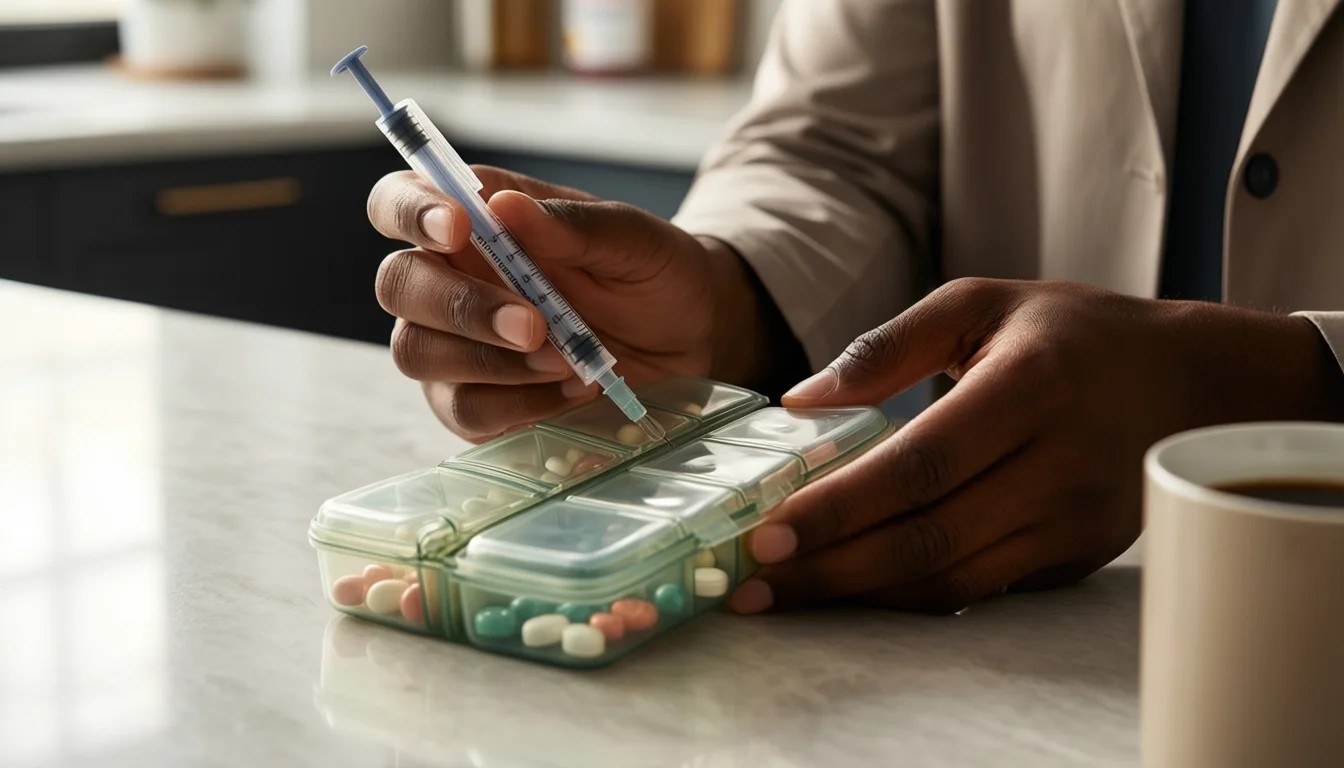
The non-diabetic GLP-1 user is now a routine pre-op conversation, not an edge case.
The feared catastrophe didn't show up at the scale of tens of thousands of hips. That isn't the same as saying nothing can go wrong.
Why the answer still isn't 'don't worry about it'
Two things can be true. The aggregate data can look reassuring, and the practical pre-op questions can still be real. GLP-1s slow gastric emptying — that's part of how they work — and anesthesiology societies have been actively rethinking how to handle that on the morning of surgery. The Arthroplasty paper measured complication rates, not stomach contents at induction; it doesn't override the conversation you should be having with the team putting you to sleep.
There's also the matter of which surgery. Hip replacement is a major, well-studied operation with a fairly standardized recovery. Read across to bariatric procedures, abdominal surgeries, or anything involving the gut, and the calculus may look different. The authors themselves frame their work as filling a specific gap — non-diabetic THA patients — not as a universal green light.
And the population matters. The people in this dataset were already deemed fit enough for elective hip replacement. They are not necessarily representative of someone who started a GLP-1 six months ago and lost weight quickly on a low appetite. Claims databases see complications; they don't see whether someone has been eating enough protein.

Protein adequacy is one of the things surgeons want to know about — and one of the things claims data can't see.
What to actually do with this if surgery is on your calendar
If you're the friend texting at 2 a.m., here is the realistic version. The new data is genuinely encouraging for the specific question it asked, and it pushes back on the strongest version of the malnutrition fear. It does not replace a conversation with your surgeon, your prescriber, and the anesthesiology team — ideally well before the day of the procedure, because they may have a protocol about whether to pause the medication and for how long. Bring your dose, your start date, your weight trajectory, and an honest description of what you've actually been eating. That last part is the one claims databases can't capture and the one your team most needs.
And if you're not facing surgery, file this under the broader, slower story these drugs are still writing. We are watching, more or less in public, a medication class move from a narrow indication into a much wider one. Each new study — like this one — fills in a square. Most of the board is still blank.
- One retrospective study, one operation. In matched non-diabetic patients undergoing primary total hip replacement, GLP-1 use was not linked to higher 90-day complication rates and was associated with lower odds of acute blood-loss anemia and transfusion.
- It addresses a real worry, not all of them. The fear that rapid GLP-1 weight loss would translate into a malnutrition penalty at surgery did not show up at population scale here.
- Gastric emptying is a separate question. Anesthesia teams have their own protocols for GLP-1 users on the morning of surgery; this study doesn't speak to that.
- Don't extrapolate across surgeries. Hip replacement is not gallbladder, bariatric, or bowel surgery. The risk-benefit math may differ.
- Talk to your team early. Tell your surgeon, prescriber, and anesthesiologist that you're on a GLP-1, what dose, and how your weight and appetite have moved.
- This is educational, not medical advice. Decisions about pausing or continuing any medication before surgery belong with your clinicians.
The story of GLP-1s outside diabetes is still being written one careful paper at a time. The newest chapter, for the very specific patient walking into a hip replacement without diabetes, is more reassuring than the loudest predictions. That's worth knowing. It's also worth holding lightly, because the next chapter is already being drafted in operating rooms across the country.
Frequently asked questions
What did the 2025 Journal of Arthroplasty study find about non-diabetic GLP-1 users having hip replacement surgery?
In a retrospective analysis of more than 5,000 matched pairs, non-diabetic patients on a GLP-1 at the time of primary total hip replacement were less likely to develop acute blood-loss anemia and less likely to need a postoperative transfusion than matched controls within the first 90 days after surgery. The authors describe this as a modest, reassuring data point for a question that had generated concern but little evidence.
Does this study mean GLP-1 users don't need to worry about any surgical risks?
No. The article notes that GLP-1s slow gastric emptying, and anesthesiology societies have been actively rethinking how to handle that on the morning of surgery — a question the study did not address. The study measured complication rates, not stomach contents at induction, so it does not replace the conversation patients should have with the team putting them to sleep.
Can the study's findings be applied to surgeries other than hip replacement?
The authors themselves frame their work as filling a specific gap — non-diabetic patients undergoing total hip replacement — and not as a universal green light. The article cautions that the risk-benefit math may look different for bariatric procedures, abdominal surgeries, or anything involving the gut.
What information should a patient on a GLP-1 bring to a pre-op visit?
The article recommends bringing the exact medication, dose, and how long you've been on it, your most recent dose date relative to the surgery date, how much weight you've lost and over what timeframe, an honest account of recent appetite and food intake, and any nausea, reflux, or sensation of food sitting — which is relevant for anesthesia planning.
Why can't the study tell us whether individual GLP-1 users are adequately nourished before surgery?
The study relies on insurance-claims data rather than detailed nutritional labs, so it cannot capture whether patients have been eating enough protein. The article notes that claims databases see complications but cannot see whether someone has been eating adequately — which is one of the things surgeons most want to know.
Join the conversation
Comments are moderated and reviewed before they appear. Be constructive — this is health information.
Add your comment