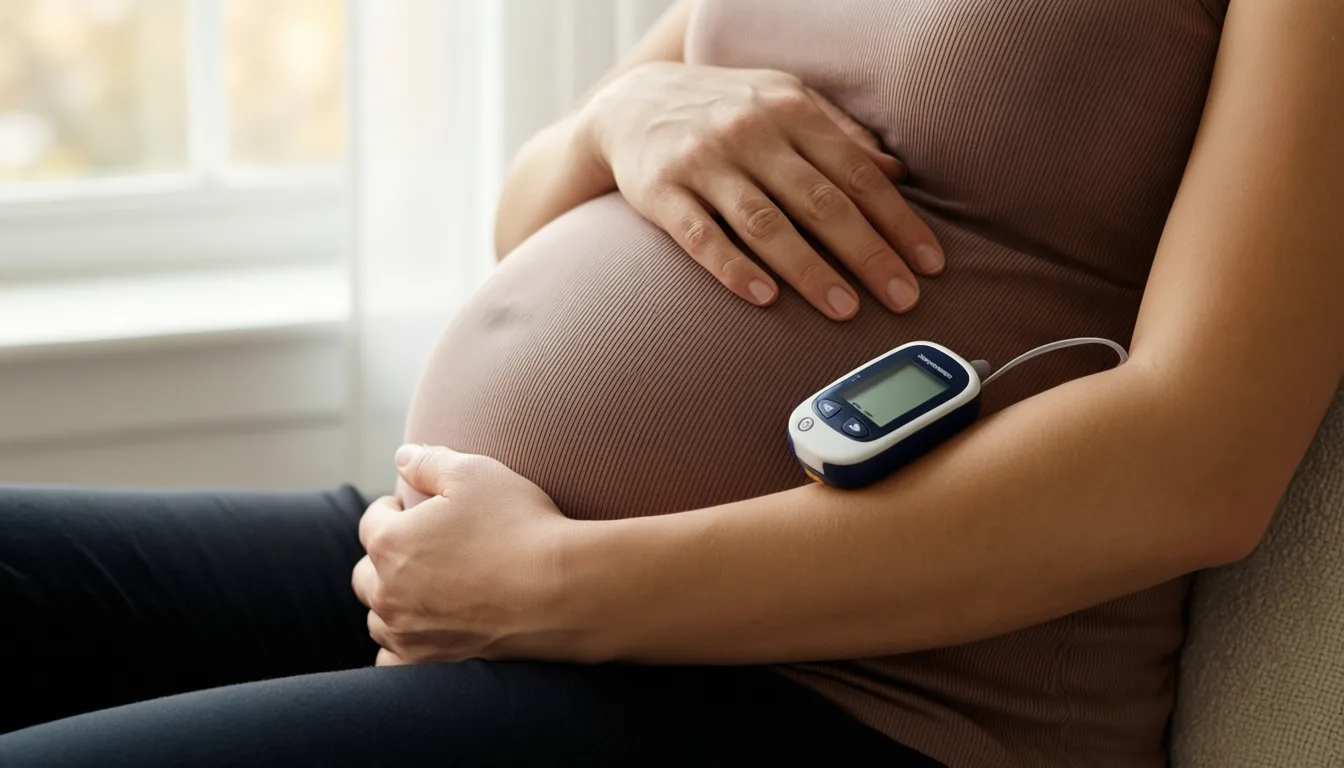
The Glucose Swing Factor: What a New Study Says About BMI and Late-Pregnancy Blood Pressure
A multicenter analysis suggests that early-pregnancy glucose variability may be a hidden link between higher pre-pregnancy BMI and late-onset hypertensive disorders — and a possible lever for prevention.
For years, the conversation around pregnancy and blood sugar has hovered around one diagnosis: gestational diabetes. But a quieter metric — how much your glucose swings up and down across the day — is starting to get its moment. A new multicenter analysis out of Japan suggests that this kind of variability in early pregnancy may be one of the missing links between a higher pre-pregnancy BMI and late-onset hypertensive disorders, the umbrella that includes late preeclampsia. It's an early-stage finding, not a verdict. But it points to something we don't talk about enough: the metabolic terrain of the first trimester might be quietly setting the stage for what happens in the third.
- The headline finding: In 802 pregnancies across 14 centers, high glucose variability in early pregnancy partially mediated the link between higher pre-pregnancy BMI and late-onset hypertensive disorders.
- Why it matters: Late-onset preeclampsia has few good prevention strategies, so any modifiable upstream signal is worth attention.
- It's not just gestational diabetes: The association between variability and hypertensive disorders was actually stronger in pregnancies without GDM.
- What it isn't: A randomized trial, a CGM recommendation, or proof that flattening glucose curves prevents preeclampsia.
- The practical read: Pre-conception metabolic health — and a clinician-guided plan if BMI is elevated — looks more relevant than ever.
What the study actually did
The multicenter retrospective study, published in Scientific Reports, pulled data from 802 pregnancies across 14 facilities. Every participant had a 75-gram oral glucose tolerance test (OGTT) by 20 weeks of gestation — early enough to capture the metabolic baseline before the third-trimester hormonal surge that usually triggers gestational diabetes screening. Researchers then used structural equation modeling, a statistical method that maps out direct and indirect pathways at the same time, to ask a specific question: when a higher pre-pregnancy BMI is linked to late-onset hypertensive disorders of pregnancy (LoHDP), how much of that link runs through glucose variability?
The answer, in the data, was: a meaningful slice of it. Overweight and obese participants had high glucose variability at a rate of 26.1% versus 16.4% in their non-overweight counterparts, and LoHDP at 17.6% versus 7.9%. The modeling found a direct effect of BMI on LoHDP, plus an indirect effect routed through glucose variability — a small but statistically significant detour that helps explain part of the risk.

Steadier meals — protein, fiber, healthy fats — are the kind of intervention researchers have long suggested might smooth glucose curves. Whether that translates to lower preeclampsia risk specifically is still an open question.
Why glucose variability — not just average sugar
Most of us were taught to think about blood sugar as an average: A1C, fasting glucose, the OGTT pass/fail line. Variability is a different lens. It asks how jagged the curve is — the peaks after meals, the dips between them, the rollercoaster versus the gentle hill. Outside of pregnancy, glucose variability has been linked in observational research to vascular stress, oxidative damage, and endothelial dysfunction — the same biological neighborhoods where preeclampsia lives. So a hypothesis has been brewing: maybe it's not only how high glucose goes, but how restless it is, that matters for the placenta and the maternal vascular system.
This study doesn't prove that mechanism, but it adds a meaningful data point. And the most interesting wrinkle is that the variability–LoHDP association was stronger in pregnancies without gestational diabetes (β = 0.25, p < 0.001) than in the overall group. In other words, you can pass the standard GDM screen and still carry a metabolic signal that may be relevant to later blood-pressure complications. That challenges the binary framing many of us bring to pregnancy metabolism: you either have GDM or you don't.
You can pass the standard gestational diabetes screen and still carry a metabolic signal that may matter later in pregnancy.
What this doesn't mean
Here's where the magazine has to pump the brakes, because this is where the internet usually doesn't. This is a retrospective observational analysis, not a trial. Mediation modeling is powerful, but it describes statistical relationships in a snapshot of data — it doesn't prove that lowering glucose variability would lower the rate of late-onset preeclampsia. The cohort is from a specific population, and the effect sizes for the mediated pathway, while real, are modest. The authors themselves frame variability as a potential mediating factor and call for future preventive strategies to be tested.
So no, this is not a green light to buy a continuous glucose monitor in early pregnancy on your own initiative, or to start aggressively cutting carbs without your obstetric team in the loop. Pregnancy nutrition has real guardrails — caloric needs, micronutrients, ketone considerations — and DIY metabolic experimentation isn't the move. What this study does justify is a sharper conversation with your clinician, especially if you're entering pregnancy with a higher BMI or a history of metabolic issues.

Movement, sleep and meal composition are the everyday inputs that influence glucose curves — and the ones a care team can help personalize.
The bigger picture for metabolic-health readers
If you've been following the broader metabolic-health conversation — CGMs, time-in-range, the gospel of stable glucose — this study lands in a familiar place with an unfamiliar audience. Pregnancy research has historically been conservative about importing trendy metabolic concepts, and rightly so: the physiology is different, the stakes are higher, and the evidence base is thinner. The fact that a peer-reviewed multicenter analysis is now using structural equation modeling to map glucose variability as a mediator of a serious pregnancy outcome is a sign the field is starting to take the question seriously.
The takeaway isn't a hack. It's a reframing. Pre-conception is metabolic prep, not just folic acid and prenatal vitamins. Early pregnancy is a window where the body's glucose handling may be quietly telling a story about what's coming in the third trimester. And late-onset preeclampsia — long considered nearly impossible to predict and even harder to prevent — may be slightly less mysterious than it used to be.
Moderate evidence, real signal, no miracle. That's the honest headline.
Pre-conception is metabolic prep — not just folic acid and prenatal vitamins.
Frequently asked questions
What did the study find about glucose variability and late-pregnancy blood pressure problems?
In 802 pregnancies across 14 centers in Japan, researchers found that high glucose variability in early pregnancy partially mediated the link between higher pre-pregnancy BMI and late-onset hypertensive disorders of pregnancy. Overweight and obese participants had high glucose variability at a rate of 26.1% versus 16.4% in non-overweight participants, and late-onset hypertensive disorders at 17.6% versus 7.9%.
If I pass the standard gestational diabetes screening, does that mean glucose variability isn't a concern for me?
Not necessarily. The study found that the association between glucose variability and late-onset hypertensive disorders was actually stronger in pregnancies without gestational diabetes than in the overall group. The article notes this challenges the binary idea that you either have GDM or you don't — you can pass the standard screen and still carry a metabolic signal that may be relevant to later blood-pressure complications.
Does this study mean I should buy a continuous glucose monitor during early pregnancy?
The article explicitly advises against acting on this research on your own. Because the study is a retrospective observational analysis rather than a randomized trial, it does not prove that lowering glucose variability would lower the rate of late-onset preeclampsia, and the article cautions against purchasing a CGM or aggressively cutting carbs without your obstetric team involved.
How is glucose variability different from the blood sugar numbers most people already track?
Most blood sugar measures — like A1C, fasting glucose, or the OGTT pass/fail result — reflect an average, while glucose variability looks at how jagged the curve is across the day, including the peaks after meals and the dips between them. Outside of pregnancy, glucose variability has been linked in observational research to vascular stress, oxidative damage, and endothelial dysfunction, which are the same biological areas where preeclampsia develops.
What are the main limitations of this research that readers should keep in mind?
The study is a retrospective observational analysis, not a randomized trial, so the structural equation modeling describes statistical relationships in a snapshot of data rather than proving that any intervention would change outcomes. The cohort comes from a specific population, the effect sizes for the mediated pathway are described as modest, and the authors themselves call for future preventive strategies to be tested.
Join the conversation
Comments are moderated and reviewed before they appear. Be constructive — this is health information.
Add your comment