
The Metabolic Syndrome Map: What a New Global Snapshot Reveals About Your Risk
A 2026 meta-analysis pools a decade of evidence on how common metabolic syndrome has become — and how much of it tracks back to the lifestyle levers we actually control.
If you have spent any portion of your forties quietly wondering why your waistband is staging a slow rebellion against you, you are not imagining it — and you are very much not alone. A new 2026 systematic review and meta-analysis published in Cureus pooled a decade of observational research and landed on a number that should make all of us sit up a little straighter at our desks: roughly one in three adults worldwide is now living with metabolic syndrome. The good news folded inside that headline is that the same review keeps circling back to the levers we actually have hands on — how much we move, how we eat, how we sleep, how we manage stress. That is a frustrating message and a hopeful one, in roughly equal measure.
- Pooled global prevalence of metabolic syndrome sits around 32%, according to a 2026 PRISMA-guided meta-analysis of ten observational studies and more than 54,000 adults.
- Physical inactivity was consistently linked to higher odds of having metabolic syndrome across the included studies.
- The estimate carries real uncertainty — the 95% confidence interval ran from 22% to 43%, and heterogeneity between studies was very high.
- This is observational evidence, meaning it maps associations, not proof that any single behavior causes (or cures) the syndrome on its own.
- The practical takeaway is unglamorous and durable: move more, sit less, and treat lifestyle behaviors as cardiometabolic medicine worth discussing with your clinician.
What metabolic syndrome actually is
Metabolic syndrome is less a single disease than a cluster — a group of cardiometabolic risk factors that tend to travel together: elevated blood pressure, elevated fasting glucose, higher triglycerides, lower HDL cholesterol, and extra weight carried around the middle. None of those things sound dramatic on their own. Stacked, they meaningfully raise the long-term odds of type 2 diabetes and cardiovascular disease, which is why clinicians treat the constellation as a flag rather than a footnote.
The new Cureus review describes metabolic syndrome as a significant and growing global public health challenge, and notes that until now a comprehensive quantitative synthesis of its worldwide prevalence and the lifestyle behaviors tied to it had been surprisingly thin on the ground. That is the gap this paper tries to fill.
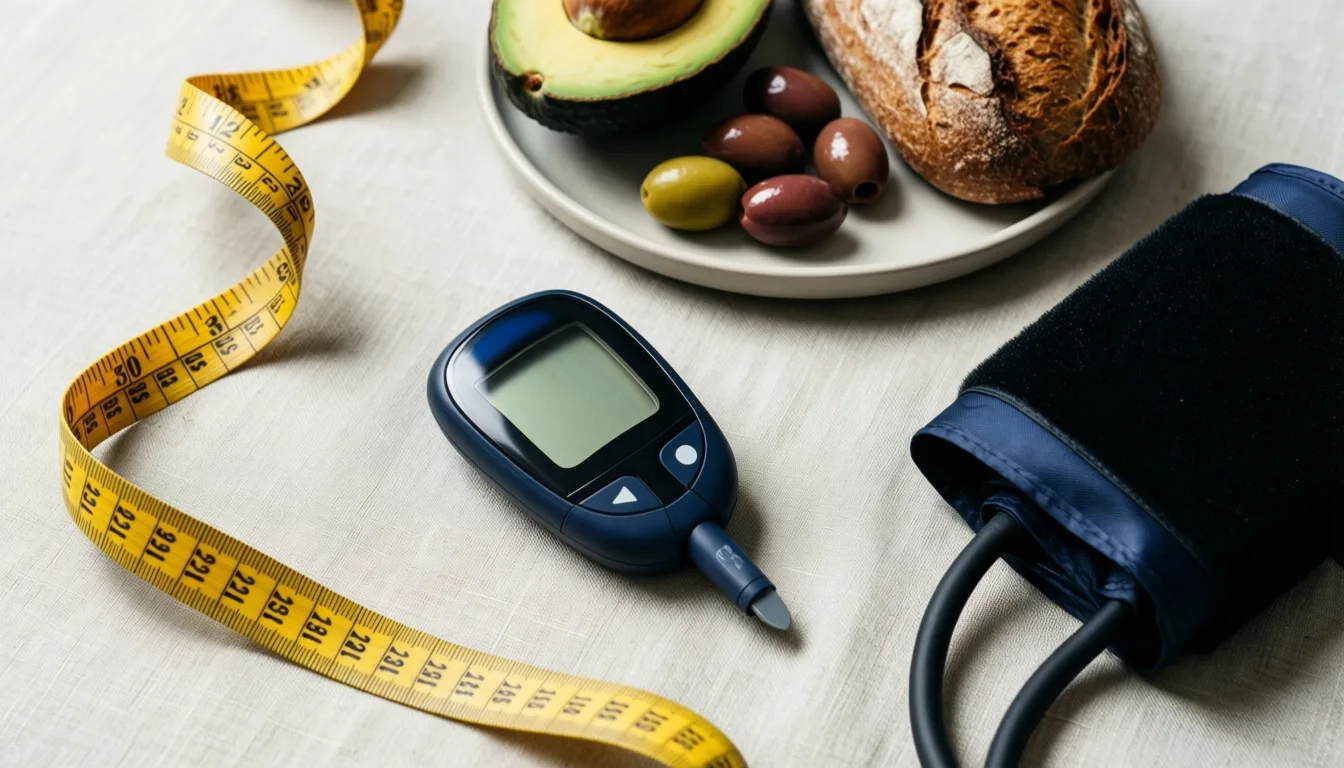
Metabolic syndrome is a cluster, not a single number — which is why the daily habits that touch all of those numbers matter.
The numbers, with their caveats intact
The headline figure from the 2026 meta-analysis is a pooled global prevalence of 32%, drawn from ten observational studies and 54,709 participants. That is a striking number, and worth saying out loud: in the populations these studies sampled, roughly a third of adults met criteria for the syndrome.
But — and this is the part that gets cropped out of most headlines — the 95% confidence interval ran from 22% to 43%. Heterogeneity between studies, measured by the I² statistic, was 98.72%, which is about as high as that number gets. In plain English: the studies varied enormously in where they were conducted, how they defined the syndrome, and who they included. The 32% is the best central estimate the math will give you, but the honest read is that prevalence is high, varies wildly by population, and is climbing in step with the lifestyle patterns of modern adulthood.
That uncertainty is not a reason to dismiss the finding. It is a reason to hold it with the right amount of grip — firmly enough to act on, loosely enough to keep questioning.
The lifestyle thread the review keeps pulling
The most consistent signal across the included studies was about movement. Physical inactivity was consistently associated with increased odds of metabolic syndrome, with a representative odds-ratio range of roughly 1.25 to 2.15 across the studies the authors examined. Adherence to recommended physical activity levels, by contrast, tracked in the protective direction.
An odds ratio is not a prophecy. It is a way of saying: in these populations, people who moved less were meaningfully more likely to meet the criteria. It does not prove that a single morning walk reorganized anyone's triglycerides, and the review is explicit that this is observational evidence — associations pulled from real-world data rather than controlled experiments. That distinction matters, because observational studies cannot fully untangle the chicken-and-egg problem of whether inactivity drives metabolic dysfunction, whether metabolic dysfunction makes movement feel harder, or — most likely — both, in a loop.
Still, the direction and consistency of the finding are the kind of thing clinicians and researchers take seriously. When ten different studies in different settings keep landing in the same general neighborhood, the neighborhood is worth taking a walk through.
One in three adults, give or take. The map is unflattering — and it is also, mostly, modifiable.

The meta-analysis flagged adherence to recommended activity levels — not athletic feats — as the variable that tracked with lower odds.
Why this lands differently in your forties
The review itself does not single out perimenopausal women, and we are not going to put words in its mouth. But the cluster it describes — creeping waist circumference, drifting blood pressure, glucose that does not behave the way it did at 28 — is a cluster a lot of women between 35 and 50 will recognize from their own annual labs. Hormonal shifts in this window change how the body stores fat, how it handles insulin, and how it responds to the same workout that used to work fine. None of that is a personal failing; it is biology recalibrating.
What the Cureus meta-analysis adds to that lived experience is a quantitative reminder that the modifiable inputs still matter, possibly more than ever. The studies it pooled were observational, the heterogeneity was high, and the evidence rating here is honestly moderate — but the through-line is clear enough to be useful.
What to do with this, today
The review does not hand readers a regimen, and neither will we. What it offers is a map: metabolic syndrome is common, it is rising, and the behaviors most strongly tied to it in the pooled data are the ones you already suspected. Sitting less. Moving more, in whatever form you will actually do for years rather than weeks. Knowing your own numbers — waist circumference, fasting glucose, blood pressure, triglycerides, HDL — well enough to spot a trend before it becomes a diagnosis.
If two or three of those numbers have been quietly drifting on your last few annual physicals, that is the conversation worth having with your primary care clinician. Not a panic conversation. A map-reading one.
- Know your five numbers — waist, fasting glucose, blood pressure, triglycerides, HDL — and track them over time, not just one visit.
- Treat movement as the most evidence-backed lever in this review, with the understanding that consistency beats intensity.
- Bring the trend, not the panic, to your clinician — metabolic syndrome is a flag, and flags are useful precisely because they are early.
- Hold the 32% figure loosely: it is a real signal, but the confidence interval and heterogeneity mean your local picture may look quite different.
Frequently asked questions
What exactly is metabolic syndrome?
Metabolic syndrome is a cluster of cardiometabolic risk factors that tend to travel together: elevated blood pressure, elevated fasting glucose, higher triglycerides, lower HDL cholesterol, and extra weight carried around the middle. Stacked together, these factors meaningfully raise the long-term odds of type 2 diabetes and cardiovascular disease, which is why clinicians treat the constellation as a flag rather than a footnote.
How common is metabolic syndrome globally?
A 2026 systematic review and meta-analysis published in Cureus, drawing on ten observational studies and more than 54,000 adults, found a pooled global prevalence of roughly 32% — meaning about one in three adults met criteria for the syndrome in the populations studied. The 95% confidence interval ran from 22% to 43%, so the honest read is that prevalence is high but varies widely by population.
Does being physically inactive actually cause metabolic syndrome?
The research cannot prove causation — the studies in the review are observational, meaning they map associations rather than establish that inactivity definitively causes the syndrome. Physical inactivity was consistently associated with increased odds of metabolic syndrome across the included studies, with an odds-ratio range of roughly 1.25 to 2.15, but the review acknowledges it cannot fully untangle whether inactivity drives metabolic dysfunction, whether metabolic dysfunction makes movement harder, or both in a loop.
Why is the 32% figure described with so much uncertainty?
The studies pooled in the meta-analysis varied enormously in where they were conducted, how they defined metabolic syndrome, and who they included, producing a heterogeneity score (I²) of 98.72% — about as high as that measure gets. The authors used random-effects modeling under PRISMA guidelines, which is a respectable methodology, but the 32% should be treated as a useful central estimate rather than a precise count.
What level of physical activity did the review identify as protective?
The meta-analysis flagged adherence to recommended physical activity levels — not athletic feats — as the variable that tracked with lower odds of metabolic syndrome. The review does not specify a particular regimen, and the evidence is directional guidance based on observational data rather than a personalized prescription.
Join the conversation
Comments are moderated and reviewed before they appear. Be constructive — this is health information.
Add your comment