Plasma p-tau217 Goes Mainstream — But Does One Cutoff Fit Everyone?
A new 2,798-person disparities cohort puts the leading Alzheimer's blood test under a fairness lens. The biomarker held up across groups — the single threshold did not.
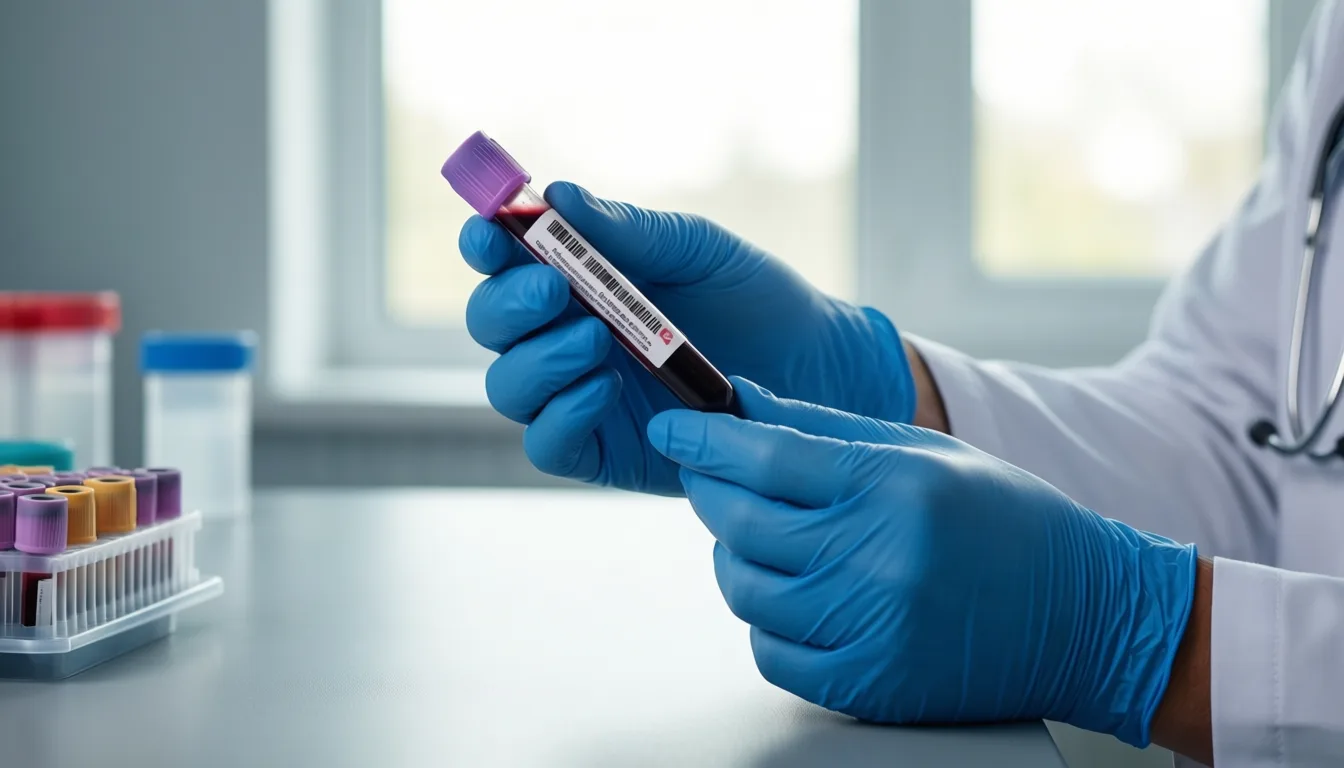
For two decades, confirming Alzheimer's disease meant a spinal tap, a PET scan, or — too often — waiting for autopsy. Plasma phosphorylated tau 217, better known as p-tau217, has changed that math. A few milliliters of blood now carries enough signal to flag the disease's hallmark pathology, and as of this year the assay is moving from research freezers into routine clinical workflows. The marketing has been confident. A new analysis from the Health and Aging Brain Study–Health Disparities (HABS-HD) suggests the science still has homework to do — particularly on the question of whose blood the test was calibrated for.
- The biomarker travels. Higher plasma p-tau217 was associated with greater odds of cognitive impairment in non-Hispanic White, non-Hispanic Black and Hispanic adults alike.
- But accuracy varies. Discriminative performance ranged from an AUC of 0.65 to 0.72 — modest, statistically significant, and uneven across groups.
- One cutoff probably isn't enough. The authors call for race/ethnicity-specific thresholds, not because biology differs by category but because calibration data has historically come from narrow samples.
- Evidence is moderate, not settled. This is a single cross-sectional cohort; clinical decisions still belong with a clinician who can weigh the full picture.
What the blood test actually measures
P-tau217 is a fragment of the tau protein that gets phosphorylated at a specific site when Alzheimer's pathology is underway in the brain. In recent years it has emerged as the most discriminating of the plasma tau species, outperforming earlier candidates and correlating tightly with amyloid PET and CSF measures in research cohorts. That's why commercial labs have been racing it to market: a blood draw is cheaper, faster and far more scalable than imaging.
The catch, familiar to anyone who has watched biomarkers graduate from research to clinic, is calibration. A test that performs beautifully in a Swedish memory-clinic cohort is not automatically the same test when used on a 72-year-old in South Texas. The threshold that separates "likely pathology" from "likely not" is an empirical number, fitted to whatever population the developers studied. Whether that number generalizes is a question, not an assumption.

The HABS-HD cohort was built specifically to study brain aging in populations historically underrepresented in Alzheimer's research.
What HABS-HD found
The HABS-HD analysis, published in Alzheimer's & Dementia, drew on 2,798 participants — non-Hispanic White, non-Hispanic Black and Hispanic adults — and asked a deliberately uncomfortable question: does plasma p-tau217 discriminate cognitive impairment equally well across these groups, and does a single threshold serve them equally?
The first half of the answer is reassuring. Across every group, p-tau217 levels were higher in cognitively impaired participants than in unimpaired ones, and elevated p-tau217 was associated with greater odds of cognitive impairment in all three populations. The biological signal is real and it travels.
The second half is where the story complicates. Discriminative accuracy — the area under the receiver-operating-characteristic curve, a standard measure of how cleanly a test separates cases from non-cases — landed in a range of 0.65 to 0.72. That is modest. A perfect test scores 1.0; a coin flip scores 0.5. Performance was highest in non-Hispanic Black participants and lowest in Hispanic participants, with non-Hispanic White adults in between. The authors concluded that population-specific calibration is needed to support equitable implementation.
The biomarker generalizes. The cutoff, on this evidence, does not.
Why one number rarely fits three populations
It is tempting to read "different thresholds by race and ethnicity" as a claim about biology. It mostly isn't. P-tau217 levels can be nudged by things that vary across populations for non-genetic reasons: kidney function, body mass index, the prevalence of vascular disease and diabetes, and the assay platform itself. When a cutoff is fitted on a sample that overrepresents one group, it inherits that group's distribution of those confounders. Apply the same number elsewhere and the false-positive and false-negative rates drift in ways that aren't equal across patients.
That is the practical concern as p-tau217 testing scales. A modestly performing test (AUC 0.65 in one group, 0.72 in another) used with a one-size cutoff can mean a meaningfully different probability of being told you might have Alzheimer's pathology depending on which clinic processed your blood. In a disease where the next step might be an expensive PET scan, a disease-modifying infusion with real risks, or a difficult family conversation, those gaps matter.

What this changes — and what it doesn't
Nothing in the HABS-HD paper says plasma p-tau217 should be shelved. The opposite, really: a biomarker that holds its association with cognitive impairment across three demographically distinct populations is doing real work. What the analysis pushes back on is the marketing simplification — the implication that a single number on a single report tells a clean story for every patient.
It also doesn't establish that a tuned, group-specific cutoff would solve the problem. The study is cross-sectional, the AUCs are modest, and the right comparator (against amyloid PET or CSF in this same cohort) is the obvious next chapter. Treat this as a credible early signal that calibration is incomplete, not as a finished prescription for how to fix it.
The bigger pattern
P-tau217 is the latest entry in a longer story: biomarkers that graduate from research with confident thresholds, then meet the heterogeneity of actual patients and need re-tuning. Cardiac troponin went through it. So did PSA. The HABS-HD authors are essentially asking the field to do that homework up front this time, before millions of blood draws have been interpreted against a cutoff that was never validated on the people taking the test.
That is a measured ask. It does not undo the genuine progress p-tau217 represents — a blood test that meaningfully tracks Alzheimer's pathology is something the field has wanted for a generation. It just insists that "meaningfully" be defined for everyone the test is sold to.
Frequently asked questions
What is plasma p-tau217 and why is it significant for Alzheimer's detection?
P-tau217 is a fragment of the tau protein that gets phosphorylated at a specific site when Alzheimer's pathology is underway in the brain. It has emerged as the most discriminating of the plasma tau species, correlating tightly with amyloid PET and CSF measures in research cohorts. Because the test requires only a blood draw, it is cheaper, faster, and far more scalable than imaging.
Did the HABS-HD study find that p-tau217 works across different racial and ethnic groups?
Partially. Across all three groups studied — non-Hispanic White, non-Hispanic Black, and Hispanic adults — p-tau217 levels were higher in cognitively impaired participants and elevated levels were associated with greater odds of impairment, confirming the biological signal is real. However, discriminative accuracy varied by group, ranging from an AUC of 0.65 to 0.72, with performance highest in non-Hispanic Black participants and lowest in Hispanic participants.
Why might a single p-tau217 cutoff produce different results for different patients?
The article explains that p-tau217 levels can be influenced by factors that vary across populations for non-genetic reasons, including kidney function, body mass index, the prevalence of vascular disease and diabetes, and the assay platform itself. When a cutoff is fitted on a sample that overrepresents one group, it inherits that group's distribution of those confounders, causing false-positive and false-negative rates to drift unevenly when applied elsewhere.
Does the HABS-HD analysis mean plasma p-tau217 testing should be abandoned?
No — the article states the opposite, noting that a biomarker holding its association with cognitive impairment across three demographically distinct populations is doing real work. What the study challenges is the assumption that a single threshold tells a clean story for every patient, and it calls for population-specific calibration rather than discontinuing the test.
What should a patient ask if their clinician suggests a p-tau217 test?
According to the article, patients should ask which assay their lab uses, what reference range it applies, and how that range was derived. The article also notes the test is one input and not a diagnosis, and that questions about whether a result fits an individual's clinical picture are conversations for a neurologist or memory specialist.
Sources
- Plasma p-tau217 and cognitive impairment: Evaluating biomarker equity across racial/ethnic groups in HABS-HD. — Alzheimer's & dementia (Amsterdam, Netherlands)
Join the conversation
Comments are moderated and reviewed before they appear. Be constructive — this is health information.
Add your comment