
Sitting Still: How Sedentary Time Became a Measurable Cancer Risk
A new wave of population-level research is moving the link between chair-time and cancer from slogan to statistics — and reframing movement as a quiet prevention lever for desk-bound lives.
For years, the phrase sitting is the new smoking functioned as a kind of wellness shorthand — provocative, sticky, and almost impossible to verify. It captured a feeling more than a fact: that modern life had quietly engineered movement out of the day, and that something had to give. What was missing from the slogan was arithmetic. How much cancer, exactly, might trace back to the hours we spend still? Until recently, the honest answer was that nobody had run the numbers carefully enough to say. That is beginning to change.
A growing class of population-attributable-fraction (PAF) studies is now attempting to assign a share of future cancer cases to sedentary behavior the way earlier generations of epidemiologists assigned a share to tobacco, alcohol or excess body weight. The methodology is unglamorous but powerful: combine the best available estimates of how much a behavior raises cancer risk with how common the behavior is in the population, then project forward. The output is a number — imperfect, sensitive to assumptions, but concrete enough to plan policy around.
For readers, the headline is less the specific figure than the shift in register. Sedentary time is moving from lifestyle commentary into the same actuarial conversation as smoking rates and BMI distributions. That is what moderate evidence looks like in this field right now: not a single landmark trial, but a thickening stack of observational studies, mechanistic plausibility, and modeling work pointing the same direction.
What the biology actually suggests
The proposed mechanisms are not exotic. Prolonged sitting appears to blunt insulin sensitivity within hours, nudge circulating glucose and triglycerides upward, and reduce the rhythmic muscle contractions that help clear lipids from the blood. Over years, that pattern is thought to feed into chronic low-grade inflammation and altered sex-hormone metabolism — both of which are plausible routes to higher risk for cancers of the colon, endometrium and breast, the three sites where the sedentary-behavior signal is currently strongest.
None of this implies that a desk job causes cancer the way a pack-a-day habit causes lung cancer. The relative risks attributed to sedentary behavior are modest, and they sit inside a tangle of correlated exposures: diet, sleep, stress, body weight, alcohol, and the simple fact that people who sit more often move less overall. PAF analyses try to disentangle that knot statistically. They do not always succeed cleanly, which is why the evidence rating here is moderate rather than strong.
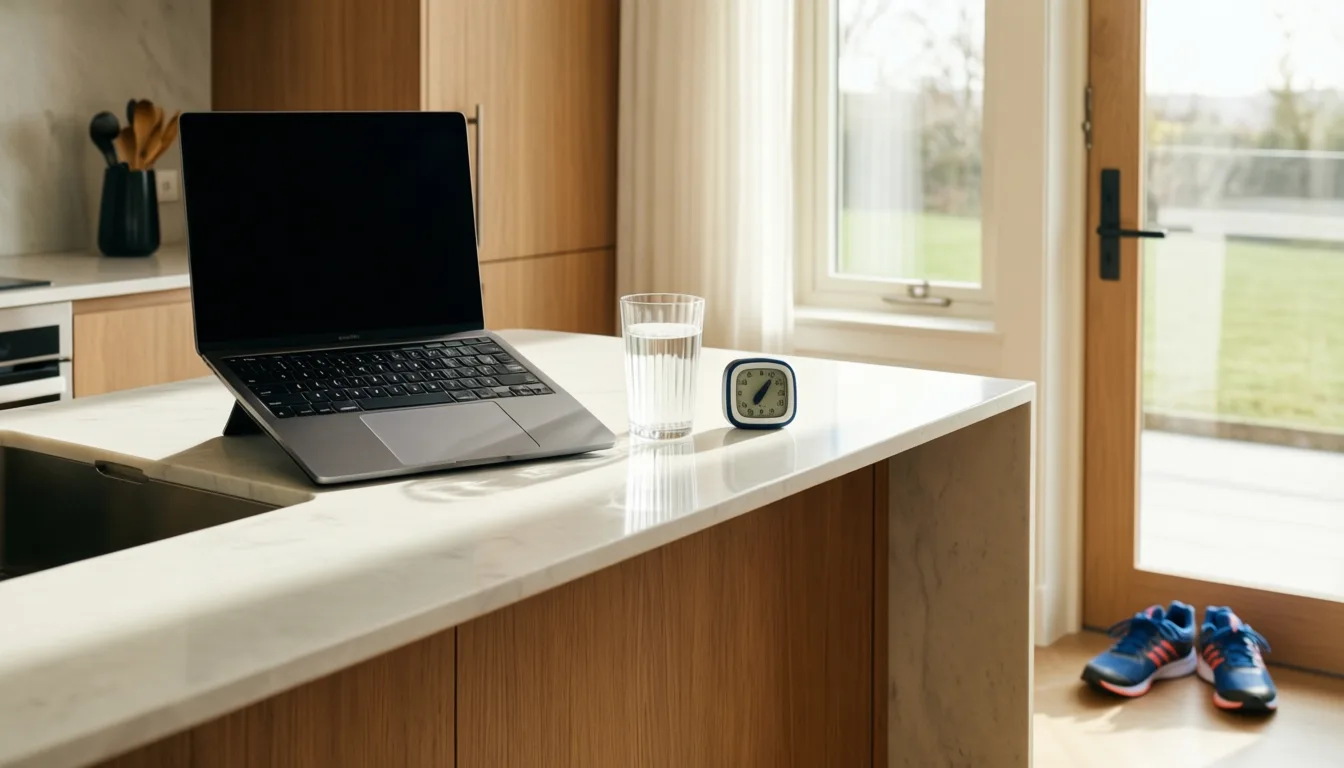
Short, frequent movement breaks are the intervention most consistently studied — easier to sustain than a single long workout bolted onto a sedentary day.
Why this matters for GLP-1 users specifically
Readers on or considering GLP-1 medications have a particular stake in this conversation. The drugs reliably reduce appetite and body weight, and weight loss itself is associated with lower risk for several obesity-linked cancers. But GLP-1 therapy does not, on its own, change how many hours a day a person spends seated. If anything, the early phase of treatment — when energy can dip and food becomes less central — is a moment when sedentary time can quietly expand.
The practical implication is not that medication is undermined by sitting. It is that the cancer-prevention benefit of weight loss and the cancer-prevention benefit of reduced sedentary time appear to be at least partly additive, working through overlapping but distinct pathways: metabolic load on one hand, muscle activity and circulating biomarkers on the other. Treating them as a pair, rather than a single lifestyle bucket, is probably the more accurate frame.
Sedentary time is moving from lifestyle commentary into the same actuarial conversation as smoking rates and BMI distributions.
What "reducing sedentary time" actually looks like in studies
The interventions that show up most often in the literature are unglamorous: standing or walking for two to three minutes every half hour; replacing a fraction of seated time with light activity rather than aiming for a single hard workout; breaking up the longest uninterrupted sitting bouts of the day, which appear to carry disproportionate metabolic cost. The effect sizes on glucose and lipid markers are modest per session but accumulate, and they are accessible to people who would never describe themselves as athletic.
Crucially, structured exercise and reduced sedentary time are not the same lever. A person can hit a daily step or gym target and still spend ten hours seated — and the evidence increasingly suggests those ten hours carry their own risk, partly independent of whether the workout happened. That is the part of the story most readers find genuinely new.

The intervention does not need a gym. Replacing a fraction of seated time with light walking is the version of the prescription most consistently supported.
The limits of the evidence
It is worth being plain about what PAF analyses cannot do. They model populations, not individuals. They depend on self-reported sitting time, which is notoriously imprecise. They assume causal relationships drawn largely from observational data. And projections out to 2040 are sensitive to assumptions about how working patterns, screen use and demographics will evolve — none of which are settled.
The honest reading is that sedentary behavior now meets the threshold of being worth quantifying as a cancer risk factor at the population level, while individual-level certainty remains lower. For a single reader deciding how to spend the next hour, that distinction matters: the case for moving more is good, but it is not the case for panic.
Prevention also still depends on the unglamorous infrastructure of screening, where access and uptake remain uneven. Recent U.S. data, for example, show persistent and in some groups widening disparities in up-to-date cervical cancer screening — a reminder that lifestyle levers like movement sit alongside, not instead of, the clinical care pathway.
- The evidence is moderate, not settled. Population modeling now puts a number on sedentary-linked cancer risk, but individual-level risk remains harder to quantify.
- Colon, endometrial and breast cancers are the sites where the signal is currently most consistent.
- Movement and weight loss are separate levers. GLP-1 therapy does not automatically reduce sitting time, and the two benefits appear to be at least partly additive.
- Breaking up sitting matters as much as exercising. Short, frequent interruptions of seated time show measurable metabolic effects.
- Screening still counts. Behavioral prevention complements but does not replace age-appropriate cancer screening — and access to that screening is itself uneven.
The deeper shift here is cultural. For a long time, sedentary behavior was treated as the absence of exercise — a gap, not an exposure. The emerging framing is different: time spent still is itself a measurable input into long-term health, with its own dose-response curve and its own population-level cost. That reframe does not require alarm. It does suggest that the small, repeated decision to stand up is closer to a clinical act than it used to look.
Frequently asked questions
Which specific cancers are most strongly linked to sedentary behavior?
The article identifies colon, endometrial, and breast cancers as the three sites where the sedentary-behavior signal is currently strongest. These are the cancers where proposed biological mechanisms — including chronic low-grade inflammation and altered sex-hormone metabolism — are considered most plausible routes to elevated risk.
If I already exercise regularly, does that cancel out the risk from sitting most of the day?
According to the article, structured exercise and reduced sedentary time are not the same lever. A person can meet a daily step or gym target and still spend ten hours seated, and the evidence increasingly suggests those hours carry their own risk, partly independent of whether a workout occurred.
What do movement breaks actually look like in the studies?
The interventions most commonly studied are standing or walking for two to three minutes every half hour, replacing a fraction of seated time with light activity rather than a single hard workout, and breaking up the longest uninterrupted sitting bouts of the day, which appear to carry disproportionate metabolic cost. The article notes these are accessible even to people who would not describe themselves as athletic.
Does taking a GLP-1 medication also reduce my sedentary-behavior cancer risk?
The article explains that GLP-1 therapy reduces appetite and body weight but does not, on its own, change how many hours a day a person spends seated. The cancer-prevention benefit of weight loss and the benefit of reduced sedentary time appear to be at least partly additive, working through overlapping but distinct pathways, so the article frames them as a pair rather than a single lifestyle factor.
How confident should I be in the research connecting sitting time to cancer?
The article rates the evidence as moderate, not settled. The population-level modeling puts a number on sedentary-linked cancer risk, but individual-level certainty remains lower because the analyses rely on self-reported sitting time, observational data, and assumptions about future trends that are not yet settled.
Join the conversation
Comments are moderated and reviewed before they appear. Be constructive — this is health information.
Add your comment