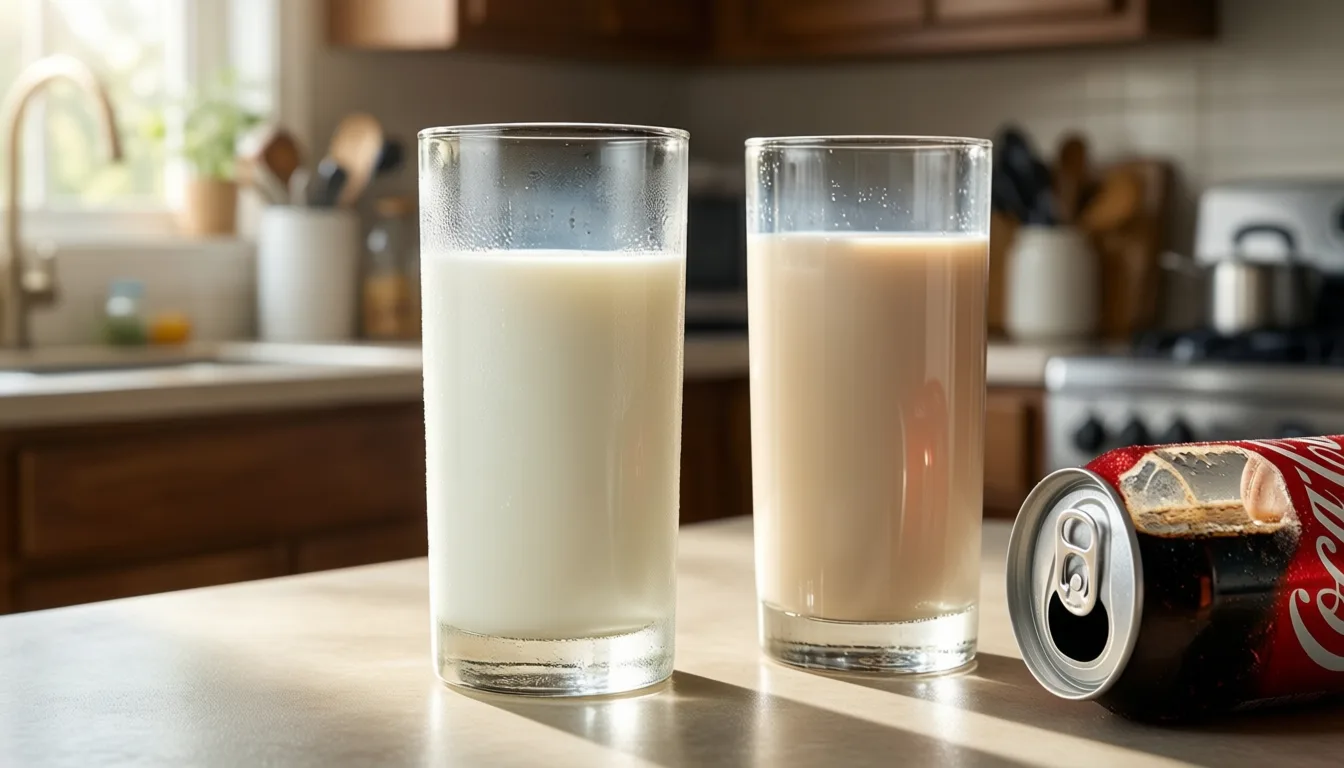
Swapping Soda for Milk—or Soymilk: A Rigorous Trial Takes Aim at Liver Fat
A 24-week randomized trial is directly testing whether trading sugary drinks for low-fat cow's milk or fortified soymilk shrinks the fat hiding in your liver. Here's what tired parents should know now.
The advice sounds almost quaint: stop drinking soda, pour yourself a glass of milk instead. It's the kind of line a pediatrician might offer between weigh-ins, or that a grandmother might deliver while unloading groceries. But for years, the evidence behind that simple swap has been thinner than the prescription suggests — long on plausibility, short on the kind of trials that move guidelines. A new randomized study is finally doing the unglamorous work of testing it head-on, and adding a modern twist: what if the glass holds soymilk instead?
The trial is called STEM — the Soy Treatment Evaluation for Metabolic health trial — and its target is one of the most quietly consequential numbers in metabolic medicine: the fat stored inside your liver cells. Intrahepatocellular lipid, to use its full name, is an early warning light for type 2 diabetes and the cardiometabolic problems that travel with it. It tends to creep up before the scale tells you anything is wrong, and it responds, sometimes dramatically, to what you drink.
That's why sugar-sweetened beverages have become public health's favorite villain. Free sugars delivered in liquid form — soda, sweetened iced tea, the syrupy coffees that get us through the witching hour between bath time and bedtime — are repeatedly linked to abdominal fat and rising cardiometabolic risk. Global guidelines now tell us to cut back. The harder question is what we should drink instead.
Why the milk-versus-soymilk question matters
Low-fat cow's milk has long been the establishment answer. It's nutrient-dense, it's filling, and observational data have given it a generally favorable cardiometabolic résumé. Fortified soymilk is the newer contender — nutritionally comparable on paper, carrying approved health claims related to cholesterol and coronary heart disease risk. But soymilk also sits awkwardly inside the modern argument over ultra-processed foods, which has made nutrition researchers cautious about assuming the two beverages behave the same way once they're inside you.
That uncertainty is exactly the gap STEM was designed to close. The investigators built a 24-week, three-arm, parallel randomized trial in adults with obesity who habitually drink at least one sugar-sweetened beverage a day. Participants — recruited using ethnicity-specific waist and BMI thresholds, a more honest way to define obesity than a single global cut-off — were randomized to replace their usual sugary drinks with either 2% cow's milk, 2% fortified soymilk, or to continue as a comparator, according to the trial's published design.

The swap that sounds simple is, for most households, a logistics problem first.
What makes STEM editorially interesting isn't just the comparison — it's the endpoint. Most beverage trials measure weight, blood pressure, or fasting glucose. STEM is going after liver fat directly, alongside a panel of other cardiometabolic markers. That matters because liver fat is mechanistically upstream of a lot of the problems we usually measure too late. If swapping a daily soda for a glass of milk or soymilk meaningfully moves that needle over six months, it reframes a piece of advice that has, until now, rested largely on inference.
Liver fat is the warning light that flickers on before the scale ever notices.
What we know now — and what we don't
Here's the honest part. STEM is a registered, well-designed trial, and its rationale, design, and baseline characteristics have been published — which is the scientific equivalent of laying the table before serving dinner. The headline outcomes, the ones that will tell us whether milk and soymilk really do reduce intrahepatocellular lipid when they displace sugary drinks, are still ahead. So this is a moment to update your expectations, not your grocery list.
What the design already tells us is meaningful, though. The investigators took the question seriously enough to power a head-to-head comparison rather than pitting each beverage against sugar alone. They picked a real-world dose — habitual consumers, replacing their actual intake — rather than a laboratory contrivance. And they chose an endpoint that maps onto the disease pathway we actually care about. Whichever way the results land, this is the kind of evidence that should change conversations in clinics.
For the parent reading this at 5:47 a.m.
If you are holding a phone in one hand and a bottle in the other, here's the practical translation. You do not need to wait for STEM's final results to act on what's already settled: liquid sugar is the part of the modern diet most clearly tied to liver fat and abdominal weight gain, and reducing it is a reasonable, broadly endorsed goal. What STEM will help clarify is which replacement strategy a clinician should recommend with the most confidence — and whether plant-based options that carry the ultra-processed label still deliver the metabolic upside their nutrition labels suggest.
In the meantime, the smallest useful step is genuinely small. Pick the one sugary drink in your day that you'd miss the least — the afternoon soda, the second sweetened coffee, the juice box you sometimes finish for the toddler — and put a glass of milk or fortified soymilk in its place for a week. That is not a prescription. It is the experiment STEM is running, in miniature, in your own kitchen. And it is the kind of change that, if it sticks, tends to compound.
- STEM is a 24-week, three-arm randomized trial testing whether replacing sugary drinks with 2% cow's milk or 2% fortified soymilk reduces liver fat in adults with obesity.
- The endpoint is intrahepatocellular lipid — fat stored inside liver cells — an early metabolic warning sign for type 2 diabetes and cardiovascular risk.
- The design is unusually rigorous: real-world doses, ethnicity-specific obesity cut-offs, and a head-to-head milk-vs-soymilk comparison rather than each against soda alone.
- Results are still pending. Only the trial's rationale, design, and baseline characteristics have been published so far.
- The actionable piece today: the case against habitual sugary drinks is already strong. Swapping one a day for milk or fortified soymilk is a low-stakes way to start.
- Talk to your clinician before making bigger changes if you have diabetes, fatty liver disease, or are managing a child's nutrition.
Frequently asked questions
What is the STEM trial and what is it trying to find out?
STEM — the Soy Treatment Evaluation for Metabolic health trial — is a 24-week, three-arm randomized study testing whether replacing sugary drinks with 2% cow's milk or 2% fortified soymilk reduces fat stored inside liver cells in adults with obesity who habitually drink at least one sugar-sweetened beverage a day. It is also running a direct head-to-head comparison of cow's milk versus soymilk rather than testing each beverage against soda alone.
What is intrahepatocellular lipid and why does the trial focus on it?
Intrahepatocellular lipid is fat stored inside liver cells, and the article describes it as an early warning sign for type 2 diabetes and the cardiometabolic problems that travel with it. It tends to increase before the scale shows any change, which is why the investigators chose it as their primary endpoint — it sits mechanistically upstream of many of the problems that are usually measured too late.
Are the results of STEM available yet?
No. As of the article's publication, only the trial's rationale, design, and baseline characteristics have been published. The headline outcomes — whether milk or soymilk actually reduce liver fat compared with continuing to drink sugary beverages — are still pending.
Why is soymilk being tested alongside cow's milk instead of simply recommended as an equivalent alternative?
Although fortified soymilk is nutritionally comparable to low-fat cow's milk on paper and carries approved health claims related to cholesterol and heart disease risk, it also falls within the category of ultra-processed foods, which has made researchers cautious about assuming the two beverages behave the same way inside the body. STEM was designed specifically to close that gap with direct trial evidence.
What already-settled evidence does the article say readers can act on before STEM reports its final results?
The article states that the case against habitual sugary drinks is already strong, with liquid sugar repeatedly linked to abdominal fat and rising cardiometabolic risk and global guidelines already advising people to cut back. Replacing one sugary drink a day with milk or fortified soymilk is described as a low-stakes step that does not require waiting for STEM's final outcome data.
Join the conversation
Comments are moderated and reviewed before they appear. Be constructive — this is health information.
Add your comment