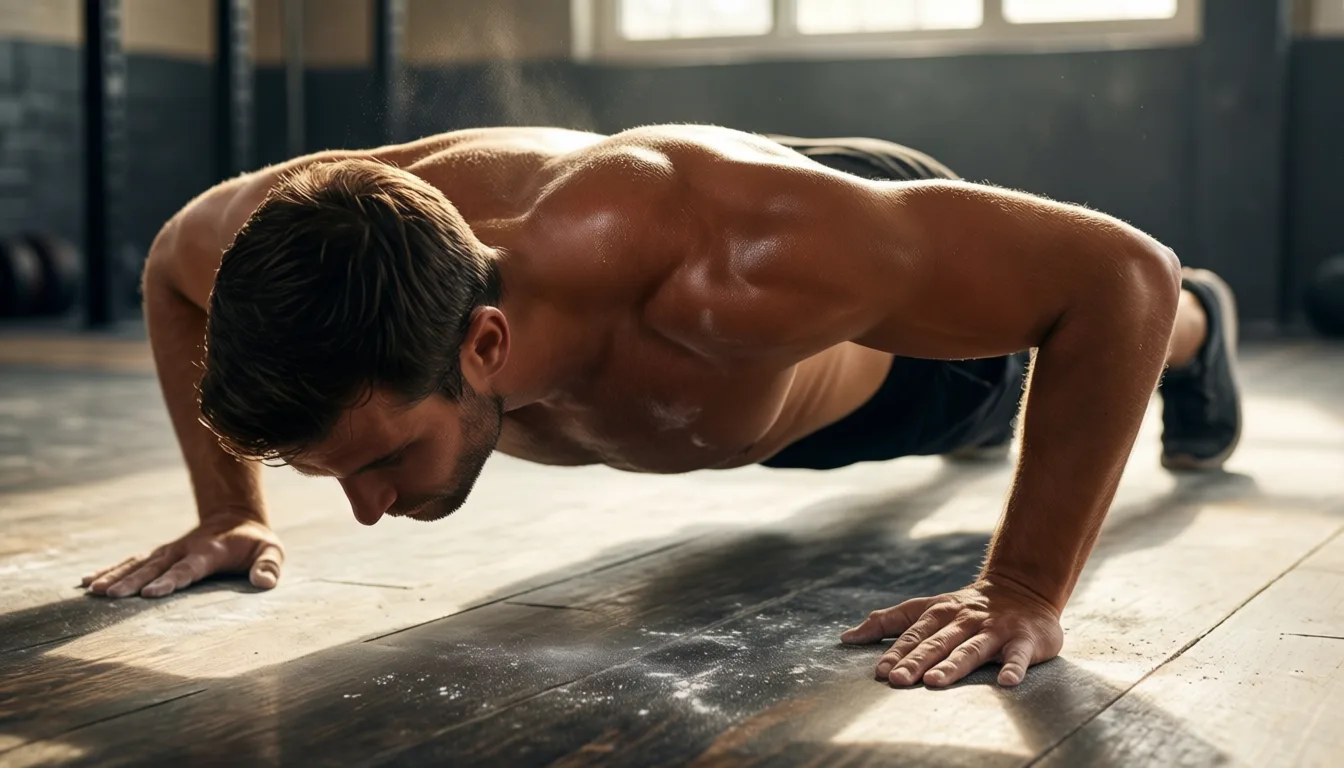
Bodyweight Benchmarks for Longevity: A Field-Ready Fitness Assessment
A new study tested whether push-ups, dips, and a handful of other no-equipment moves could stand in for clinic-grade fitness testing — and hinted at a continuous, self-directed way to track the metrics that matter.
The annual physical is a strange ritual for anyone serious about training. You sit on paper, get weighed, maybe answer a questionnaire about your weekly cardio, and leave with a snapshot that says almost nothing about the systems you actually care about — your aerobic ceiling, your local muscular endurance, your ability to stabilize a single leg under load. Episodic and qualitative is how clinicians describe it. For an endurance athlete, that's another way of saying useless. A new study in Frontiers in Sports and Active Living proposes a different model: a short battery of bodyweight exercises, performed anywhere, that tracks the fitness traits most tightly linked to longevity — and that you can repeat often enough to actually see drift.
The premise is straightforward. Body composition, strength, endurance, and cardiorespiratory fitness are all associated with longer life and better function, but the assessments used to measure them — DEXA, VO2 max on a metabolic cart, isokinetic dynamometry — live inside clinics and labs. So researchers led by Winslow and colleagues asked whether a battery of simple bodyweight moves, scored carefully, could approximate those gold-standard measures well enough to be useful as a self-administered screen. They recruited 152 adults from a convenience sample and ran them through 13 exercises plus reference tests spanning balance, strength, endurance, flexibility, and cardiorespiratory fitness.
The headline finding is one that anyone who has programmed accessory work will nod at: dynamic beats static. Isotonic exercises such as push-ups and floor triceps dips correlated more closely with the reference measures than isometric holds like squats and planks, which ran into ceiling effects. In plain terms, plenty of fit people can hold a plank essentially forever — the test stops discriminating. A timed push-up set, by contrast, keeps separating performers across the bell curve, because each rep imposes a fresh concentric and eccentric demand on a chain of muscles that has to keep producing force.
Why isotonic wins the discrimination contest
The physiology is worth lingering on, because it explains why your training log probably already reflects this. An isometric hold is gated by local muscular endurance and a sizable dose of pain tolerance; once a trained athlete crosses a threshold, the limiter becomes psychological, not physiological. That's the ceiling effect the authors describe — the test loses resolution at the top of the distribution. A repeated isotonic movement keeps generating data: tempo decay, range-of-motion compression, the moment the hips start to sag. Each rep is a small probe of neuromuscular fatigue, and the cumulative count maps more cleanly onto things a lab would measure with a dynamometer or a graded treadmill protocol.
This also helps explain why push-ups, specifically, have shown up in earlier epidemiological work as a candidate marker for cardiovascular risk. They recruit a large fraction of upper-body mass, demand trunk stiffness, and — done to volitional failure — pull in cardiorespiratory load. The new study doesn't make causal claims, and neither should we. But it adds to the case that a handful of carefully chosen movements can stand in for a much more expensive workup.
Plenty of fit people can hold a plank essentially forever. The test stops discriminating long before the athlete does.
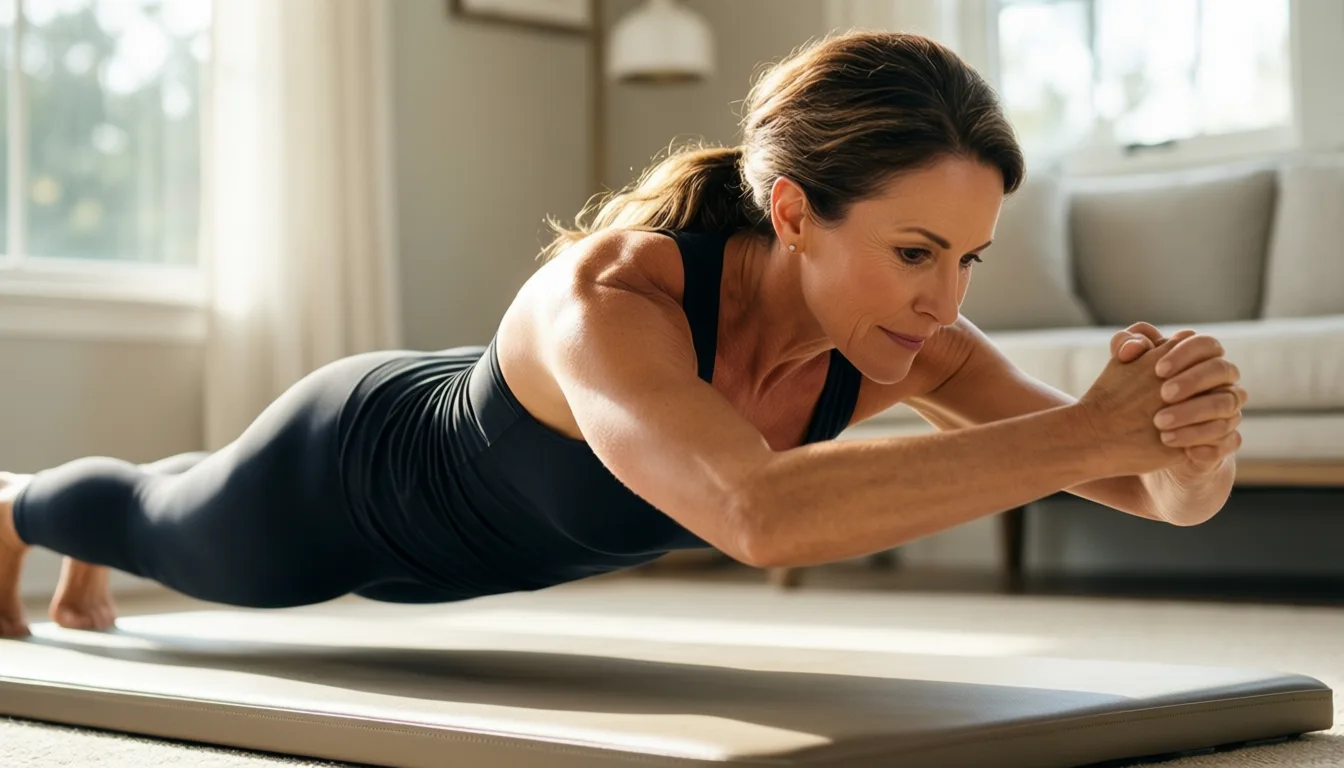
Floor triceps dips were among the isotonic movements that tracked reference measures more cleanly than static holds.
Sex, age, and the shape of the data
Most participants could perform all 13 exercises, which matters: a longevity-relevant assessment needs to be feasible across a broad population, not just trained athletes. The authors did observe sex- and age-related differences in exercise performance, which is precisely what you'd want from a screen that aims to deliver individualized recommendations rather than a single pass/fail. For an endurance athlete, the practical implication is that your baseline should be your baseline — drift over time within your own data is the signal, not your score relative to a 28-year-old's.
The authors propose using the validated battery as the backbone of a comprehensive active assessment that screens for fitness changes and generates individualized recommendations. That's a notable framing shift: away from the once-a-year clinic visit and toward something closer to how athletes already think — a rolling, longitudinal picture of capacity across domains.

The case for self-administered batteries: not a single score, but a curve you can watch over months.
What this means for your training log
Read carefully, the evidence is moderate. This is a single study, in a convenience sample of 152 adults, validating performance against reference measures — not a trial demonstrating that tracking these numbers changes hard outcomes. The link to longevity is inferred from the well-established associations between fitness domains and mortality, not directly tested here. So treat the battery as a candidate framework worth experimenting with, not a prescription. And if you're considering a meaningful change in training or have a medical condition, loop in a clinician.
What's appealing for performance-minded readers is the operational logic. The traits that the authors map — strength, endurance, balance, flexibility, cardiorespiratory fitness — are the same ones you're already periodizing for. A short, repeatable bodyweight battery, taken every few weeks under similar conditions, gives you a low-friction way to check whether your block design is actually moving the needle on each, instead of relying on race-day reveals or a once-yearly lab visit.
- Dynamic beats static for discrimination. Push-ups and floor triceps dips tracked reference measures more cleanly than plank or squat holds, which hit ceilings.
- Feasible across a general population. Most of the 152 adults could perform all 13 exercises, supporting a broad-use screen rather than an athlete-only tool.
- Sex and age matter. Track drift against your own baseline, not someone else's score.
- Evidence is moderate, not definitive. The battery is validated against reference fitness tests, not against long-term outcomes.
- The win is frequency. A repeatable, no-equipment battery beats an annual snapshot for catching real change.
- Talk to a clinician before acting on results if you have underlying conditions or are planning significant training shifts.
The deeper appeal of this work isn't any single exercise. It's the argument that meaningful fitness assessment doesn't have to live behind a clinic door. If a short series of bodyweight movements, scored honestly, can approximate what a lab would tell you about the systems most tied to how long and how well you live — and if you can run that battery in a hotel room on a Tuesday — then the rate-limiting step on knowing your own physiology stops being access. It starts being curiosity.
Frequently asked questions
Why do push-ups and floor triceps dips perform better as assessment tools than plank or squat holds?
Dynamic (isotonic) exercises keep separating performers across the fitness spectrum because each repetition imposes a fresh demand on muscles that must keep producing force, allowing tempo decay, range-of-motion changes, and fatigue to register as data. Static (isometric) holds like planks hit ceiling effects — many fit people can hold them essentially forever, so the test stops discriminating between fitness levels before the athlete actually stops.
How large was the study, and what fitness areas did it cover?
Researchers assessed 152 adults using 13 bodyweight exercises spanning five fitness domains: balance, strength, endurance, flexibility, and cardiorespiratory fitness. Most participants were able to complete all 13 exercises, which the authors note is important for a screen meant to be useful across a broad population.
Should I compare my results to published norms or to other people's scores?
The article recommends tracking drift against your own baseline rather than comparing your score to someone else's. The study observed sex- and age-related differences in performance, and the authors frame the battery as a tool for individualized recommendations, making your personal trend over time the meaningful signal.
Does this battery prove that doing these exercises will help you live longer?
No — the study validates the battery against reference fitness tests like dynamometers and graded treadmill protocols, not against long-term health outcomes. The connection to longevity is inferred from well-established associations between fitness domains and mortality, not directly tested in this research. The article describes the evidence as moderate and the battery as a candidate framework worth experimenting with, not a prescription.
What is the main practical advantage of a repeatable bodyweight battery over an annual clinic visit?
Because the battery requires no equipment and can be performed anywhere, it can be repeated every few weeks under similar conditions, giving a rolling picture of capacity across fitness domains. The article argues this frequency is the key advantage — catching real change in strength, endurance, balance, flexibility, and cardiorespiratory fitness rather than relying on a once-a-year snapshot or race-day reveals.
Sources
- Active assessment of fitness and performance in a general population. — Frontiers in sports and active living
Join the conversation
Comments are moderated and reviewed before they appear. Be constructive — this is health information.
Add your comment