
Cognition Plus Muscle: The Double-Hit That Predicts Mortality in Aging
A large Chinese cohort study suggests that losing both thinking power and lean mass together carries a sharper mortality signal than either alone — and points toward a combined training plan.
The two things most of us quietly fear about getting older — losing our edge upstairs and losing our strength downstairs — turn out to travel together more often than we'd like. A new analysis of a large Chinese cohort of older adults reports that when cognitive impairment and low muscle mass show up in the same person, the association with dying from any cause is sharper than when either appears alone. That is not a headline to panic over. It is a piece of intelligence to plan around.
The study, drawn from the China Longitudinal Healthy Longevity Survey (CLHLS) and published in PLOS ONE, followed 5,625 older adults between 2011 and 2018. Researchers sorted participants into four groups: those with neither problem, those with low muscle mass only, those with cognitive impairment only, and those carrying both. Using Cox proportional hazards models, they asked a simple question — who was more likely to die during follow-up — and reported that the group with both cognitive impairment and low muscle mass faced the highest all-cause mortality risk, with each condition independently associated with worse outcomes as well.
That is the headline finding, and it deserves to be read carefully. This is an observational cohort, not a trial. It tells us that these two conditions tend to predict mortality together, not that one causes the other, and not that fixing one will guarantee a longer life. The evidence here is moderate: a single, large, well-constructed prospective study in one national population. Useful. Not the last word.
Why the pair hits harder than the parts
The mechanisms are not mysterious, even if the math is still being worked out. Muscle is metabolic real estate — it stores glucose, produces signaling molecules, and keeps you upright when the sidewalk is icy. The brain depends on the same vascular and metabolic plumbing, and a body that is losing lean mass tends to be a body that is moving less, eating less protein, and sleeping worse. Each of those, in turn, is unkind to cognition.
Run it the other way and the loop tightens. A mind that is slipping forgets the walk, forgets the protein at lunch, forgets the physical-therapy appointment. The CLHLS authors note that both conditions are heterogeneous — they arise from many underlying causes — which is part of why their combined signal is sturdier than either alone. When two independent warning lights come on at once, the dashboard is telling you something the single light could not.
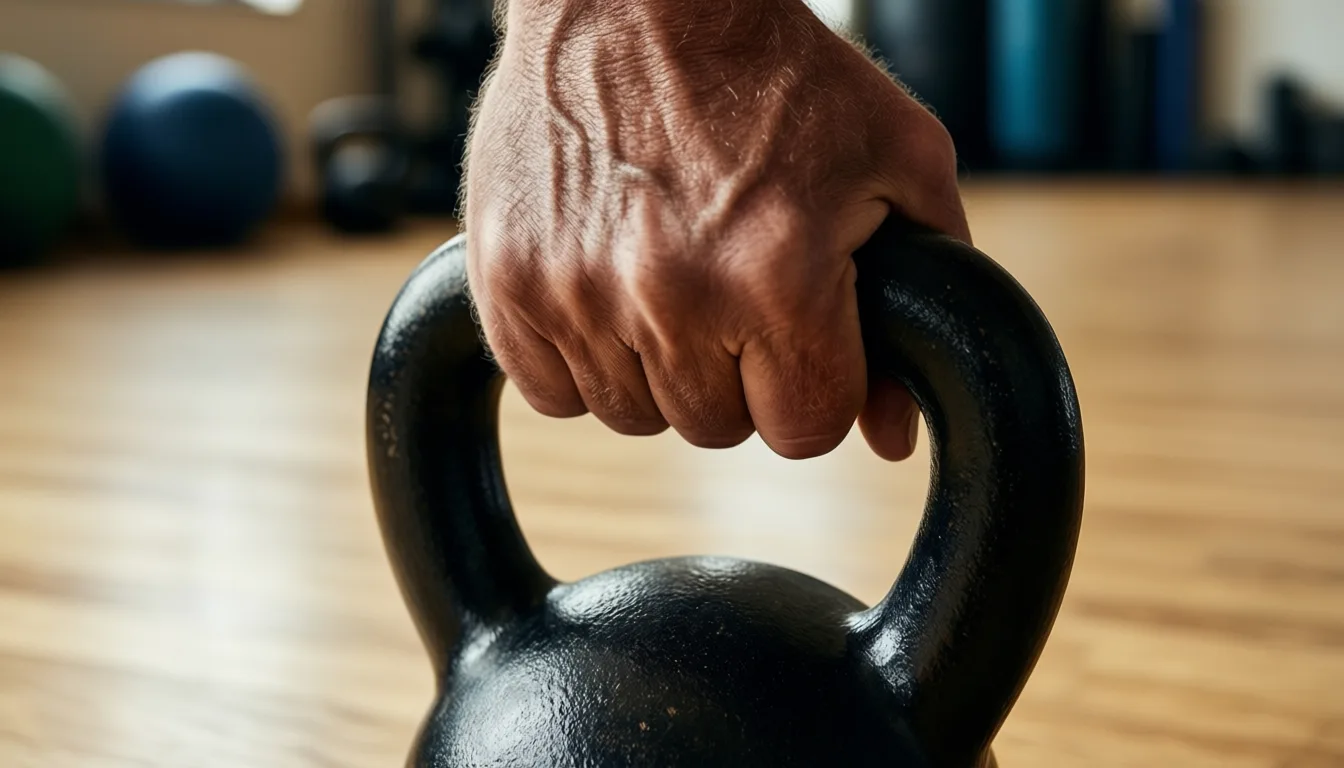
Grip and gait are the cheapest proxies we have for whole-body resilience.
When two warning lights come on at once, the dashboard is telling you something the single light could not.
What this means for a training plan
The practical implication the authors draw is integrated screening — checking for both conditions together rather than treating them as separate clinic visits. For the reader, that translates into something less bureaucratic and more useful: stop training body and brain in separate silos.
Resistance training is the closest thing we have to a broad-spectrum intervention for the muscle side of the equation. It is also, on the cognitive side, one of the better-supported lifestyle levers, though the trial evidence there is less mature than for aerobic work. Combining the two — strength sessions twice or three times a week, plus something that taxes attention and memory (a language, an instrument, a chess habit, a demanding card game) — is consistent with what this cohort study is pointing at, even if no single trial has yet proven the combination extends life.
None of this is a prescription. Anyone over 60 starting or restarting resistance work should run the plan past a clinician, particularly with heart, joint, or balance considerations in play. The point of a study like this is not to hand you a protocol. It is to sharpen the question you bring into the doctor's office.
- The finding. A 2026 CLHLS cohort analysis reports that older adults with both cognitive impairment and low muscle mass had the highest all-cause mortality risk over seven years of follow-up.
- The evidence grade. Moderate — one large, well-constructed prospective cohort. Associations, not proof of cause.
- The mechanism, plausibly. Muscle and brain share metabolic and vascular plumbing; decline in one tends to accelerate decline in the other.
- The lever. Combined resistance training plus genuinely cognitively demanding activity is consistent with the study's logic — though no trial yet shows the pairing extends lifespan.
- The action. Ask a clinician to assess both grip/lean mass and cognition together, not as separate complaints.

Walks that involve conversation tax both the cardiovascular system and the social-cognitive one.
The long view
The longevity literature has a habit of producing single-variable heroes — one nutrient, one drug, one number on a wearable. The more honest finding, year after year, is that the people who stay strong, sharp, and independent into their 80s and 90s are doing several unglamorous things at once. The CLHLS data is another data point in that direction. Muscle and mind are not separate accounts. They draw on the same balance.
That is, in its way, encouraging news. It means the workout that keeps you carrying your own groceries is plausibly buying you something upstairs as well, and the crossword that frustrates you on Sunday morning is not competing with the dumbbells in the basement. They are on the same side. Train them that way.
Frequently asked questions
What did the study find about having both cognitive impairment and low muscle mass?
The study found that older adults carrying both cognitive impairment and low muscle mass faced the highest all-cause mortality risk during follow-up, higher than those with either condition alone. Each condition was also independently associated with worse outcomes.
How many people were in the study, and how long were they followed?
The study followed 5,625 older adults between 2011 and 2018, drawn from the China Longitudinal Healthy Longevity Survey (CLHLS) and published in PLOS ONE. Of those participants, 14.1 percent had both conditions, while 49.7 percent had low muscle mass alone and 6.1 percent had cognitive impairment alone.
Why might these two conditions together be more dangerous than either one on its own?
The article explains that muscle and brain share the same metabolic and vascular systems, so a body losing lean mass tends to move less, eat less protein, and sleep worse — all of which harm cognition. The loop also runs in reverse: a declining mind can forget exercise, protein intake, and therapy appointments, accelerating muscle loss.
What does the article suggest doing in response to this research?
The article recommends stopping the practice of training body and brain in separate silos, suggesting resistance sessions two or three times a week combined with genuinely cognitively demanding activity such as learning a language, playing an instrument, or a demanding card game. It also recommends asking a clinician to assess both grip and lean mass and cognition together rather than as separate complaints.
How strong is the evidence, and what can this study not tell us?
The article grades the evidence as moderate — a single large, well-constructed prospective cohort study, not a clinical trial. It cannot prove causation, cannot show that reversing one condition reverses the mortality risk, and cannot confirm the findings apply identically to non-Chinese populations.
Join the conversation
Comments are moderated and reviewed before they appear. Be constructive — this is health information.
Add your comment