
Does Infection History Drive Frailty? New Evidence From Baltimore
A long-running cohort study suggests the infections you've weathered may leave a quieter, longer shadow on aging than we assumed.
Most of us keep a mental ledger of the big things — the heart scare, the bad knee, the year the blood pressure crept up. We rarely tally the smaller entries: the bout of pneumonia after a hard winter, the urinary tract infection that sent us to urgent care, the shingles episode we'd rather forget. A new analysis from the Baltimore Longitudinal Study of Aging suggests that ledger may matter more than we thought. Taken together, those infections appear to leave a faint but measurable mark on how quickly a body becomes frail — and, in turn, on how long it lasts.
The study, published in The Journals of Gerontology, followed 1,399 participants with a mean age of 65 and used ICD-9 diagnostic codes to reconstruct each person's infection history. Frailty was scored with a 44-item Frailty Index, the kind of composite measure geriatricians use to capture the slow accumulation of small deficits — grip strength, balance, fatigue, lab abnormalities — that adds up to vulnerability. The researchers then asked a simple question with hard implications: does the record of past infections track with how frail a person becomes, and with how long they live?
The answer, reported by Ragusa and colleagues, was yes, modestly but consistently. A history of any infection — and specifically urinary tract infections, viral infections, pneumonia, and herpes-family viruses — was associated with a higher Frailty Index. Among participants 65 and older, infection history was tied to a meaningfully faster slide across the threshold from non-frail into frail territory. And those who carried both an infection history and an elevated Frailty Index had a higher risk of dying during follow-up than peers with neither.
What the numbers actually say
A word on the size of these effects, because the language matters. A hazard ratio of 1.43 for crossing into frailty is not a thunderclap; it is a steady headwind. It says that, all else equal, older adults with a documented infection history were roughly 43 percent more likely to tip from robust into frail over the study window than those without. The mortality signal among people who had both an infection history and an already-elevated Frailty Index was smaller still, but it points in the same direction. This is moderate evidence — an observational cohort, not a randomized trial — and it deserves to be read in that register.
Two intermediaries caught the authors' eye. Plasma leptin, the hormone that helps regulate appetite and energy storage, and body mass index both appeared to act as positive mediators between infection history and frailty. Translation: at least some of the link between past infections and later frailty seems to run through metabolic and inflammatory plumbing — the kind of low-grade, chronic signaling that the longevity field has been circling for a decade under the awkward but useful label of "inflammaging."
Infection history is not a thunderclap. It is a steady headwind.
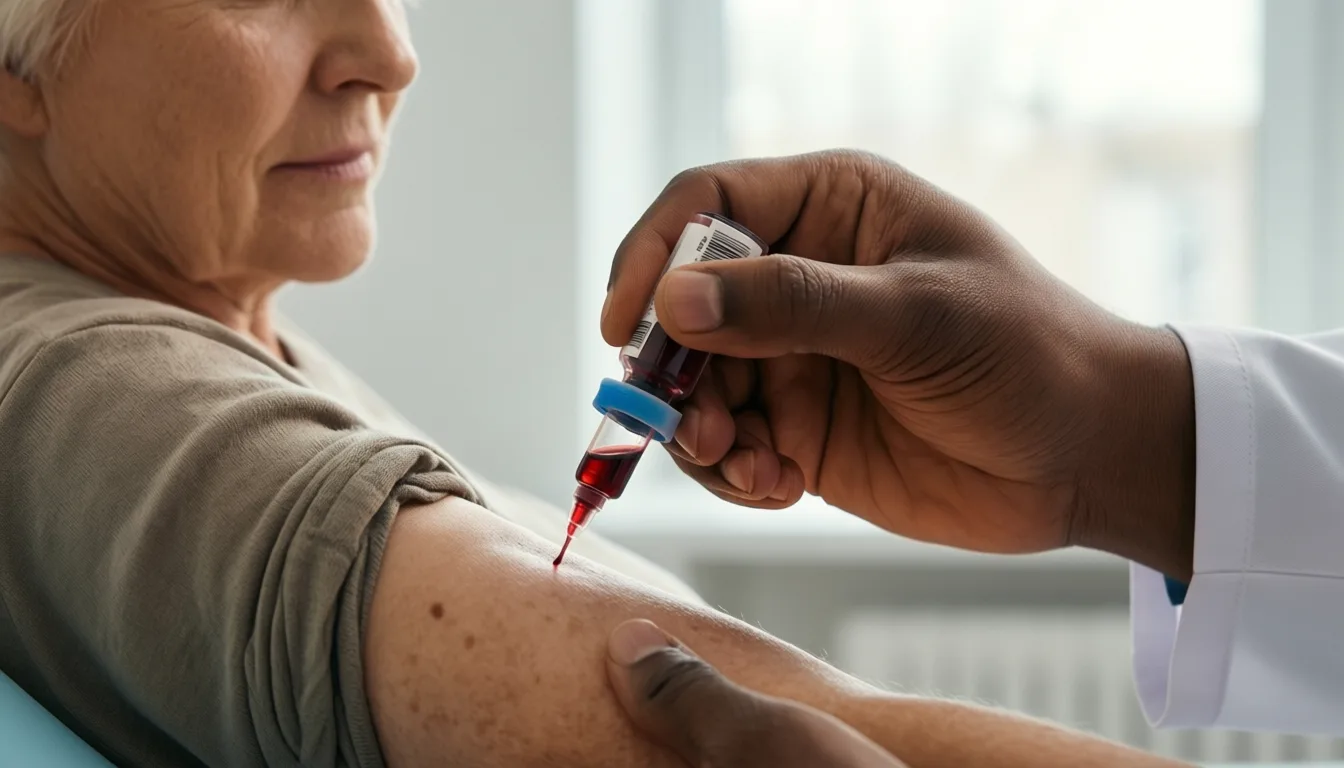
Routine bloodwork can hint at the inflammatory residue infections sometimes leave behind.
Why infections might leave a mark
The biological story is plausible without being settled. Each serious infection asks the immune system to mount a response, clean up afterward, and stand down. In younger bodies, that cycle closes cleanly. In older ones, it tends to leave residue — activated immune cells, smoldering cytokines, latent viruses such as herpes that are never fully evicted and periodically reawaken. Over years, that residue can erode muscle, blunt appetite, and tug at the cardiovascular and metabolic systems that the Frailty Index quietly tallies.
That is the mechanism the Baltimore data are consistent with, though not the only one. People who get more infections may also be people with more underlying vulnerability to begin with — reverse causation that observational studies cannot fully exorcise. The authors adjusted for the obvious confounders, but a cohort analysis is a careful sketch, not a verdict. What it can do, and does here, is sharpen the question for the trials that should follow.

What a sensible reader does with this
For men in our part of life, the takeaway is not alarm. It is housekeeping. If infections leave a faint but real tax on the aging body, the levers most worth pulling are the unglamorous ones we already know: the vaccines a clinician recommends for our age band, sober antibiotic use when an infection is bacterial, prompt attention to the urinary and respiratory complaints we are inclined to wave off, and the basic care of the gums, skin and feet that quietly keep small infections small.
None of that is new advice. What is new is the suggestion that these habits may be doing more than preventing a bad week. They may be slowing the drift toward the kind of frailty that, once it sets in, is stubborn to reverse. That is a long-view argument for short-term diligence, and it sits comfortably with the rest of the longevity playbook — strength training, sleep, protein at every meal, the appointments we'd rather skip.
- Cumulative infections track with frailty. A Baltimore cohort linked any infection history, plus UTIs, pneumonia, and herpes-family and other viral infections, to higher Frailty Index scores.
- The effect is modest, not dramatic. Older adults with an infection history were about 43% more likely to progress into frailty during follow-up.
- Inflammation and metabolism may be the bridge. Leptin and BMI partially mediated the link, consistent with the "inflammaging" hypothesis.
- This is observational evidence. It strengthens a hypothesis; it does not prove cause and effect.
- The lever is prevention. Age-appropriate vaccination, prompt treatment of infections, and basic hygiene are the practical responses — discuss specifics with your clinician.
The Baltimore analysis will not be the last word on this. Larger cohorts, better infection records than ICD-9 codes can offer, and ideally randomized prevention trials are what would move infection load from an interesting correlate to a confirmed longevity lever. Until then, treat the finding as the study's authors do: a careful nudge. The body keeps the score on infections, quietly, for years. The reasonable response is to give it fewer entries to keep.
Frequently asked questions
Which specific types of infections were linked to higher frailty scores in the Baltimore study?
The study found that a history of any infection was associated with a higher Frailty Index, with urinary tract infections, viral infections, pneumonia, and herpes-family viruses specifically identified as contributors.
How large was the effect of past infections on the risk of becoming frail?
Among participants 65 and older, those with a documented infection history were roughly 43 percent more likely to tip from robust into frail over the study window than those without. The authors describe this as a modest, steady effect — not a dramatic one.
What biological mechanism might explain how past infections contribute to frailty?
The article points to a process sometimes called 'inflammaging': infections can leave behind activated immune cells, smoldering cytokines, and latent viruses that periodically reawaken, which over years may erode muscle, blunt appetite, and strain cardiovascular and metabolic systems. Plasma leptin and body mass index appeared to partially mediate the link between infection history and frailty in this study.
Does this study prove that infections cause frailty?
No. The Baltimore analysis is an observational cohort study, not a randomized trial, so it cannot establish cause and effect. The authors note that people who get more infections may also have more underlying vulnerability to begin with — a reverse-causation problem that observational studies cannot fully rule out.
What practical steps does the article suggest in response to these findings?
The article points to age-appropriate vaccination, sober antibiotic use when an infection is bacterial, prompt attention to urinary and respiratory complaints, and basic care of gums, skin, and feet to keep small infections small. It frames these as habits that may slow the drift toward frailty, not just prevent a bad week.
Sources
- Can infections drive frailty? Insights from the Baltimore Longitudinal Study of Aging. — The journals of gerontology. Series A, Biological sciences and medical sciences
Join the conversation
Comments are moderated and reviewed before they appear. Be constructive — this is health information.
Add your comment