
The Fatty Acid Signature of Healthy Aging to 80
A 15,000-person cohort sharpens which fats in your bloodstream travel with healthspan — not just the years, but the years lived free of major disease.
Most longevity headlines chase the wrong number. Living longer is one thing; arriving at 80 still able to climb your own stairs, mow your own lawn and recognize your grandchildren is another. A new prospective study of more than 15,000 older adults takes a careful look at the second number — what researchers call healthy aging — and finds that the fats circulating in your blood appear to leave a readable signature on the odds of getting there intact.
The work, published in The American Journal of Clinical Nutrition, followed 15,333 participants aged 64 or older who were free of major chronic disease at baseline. The endpoint was deliberately strict: survival to age 80 without developing a major chronic disease along the way. A little over 9,000 of them made it.
What the researchers wanted to know was whether the relative mix of fatty acids in plasma — saturated, monounsaturated, and the various polyunsaturated species — tracked with that outcome. The short answer is that it does, but not in the way the breakfast-table debates of the last forty years would have predicted.
What moved the needle, and what didn't
Saturated and monounsaturated fats — the categories that have absorbed most of the cultural argument — showed no meaningful association with healthy aging in this cohort, in either direction. They were, statistically speaking, bystanders.
The polyunsaturated fats were the ones that moved. Participants in the highest quartile of total plasma PUFAs had about 32 percent greater odds of healthy aging compared with those in the lowest quartile, with a clear trend across the distribution. Both omega-3 and omega-6 families contributed.
Within those families, the study points a finger at specific molecules. Docosahexaenoic acid (DHA), the other (non-DHA) omega-3s, and linoleic acid — the dominant omega-6 in most diets — were each positively associated with the odds of aging well. The remaining omega-6 fats, taken together, were not. And a higher ratio of omega-6 to omega-3 fats tracked with lower odds of healthy aging, a finding consistent with a long line of cardiovascular research.
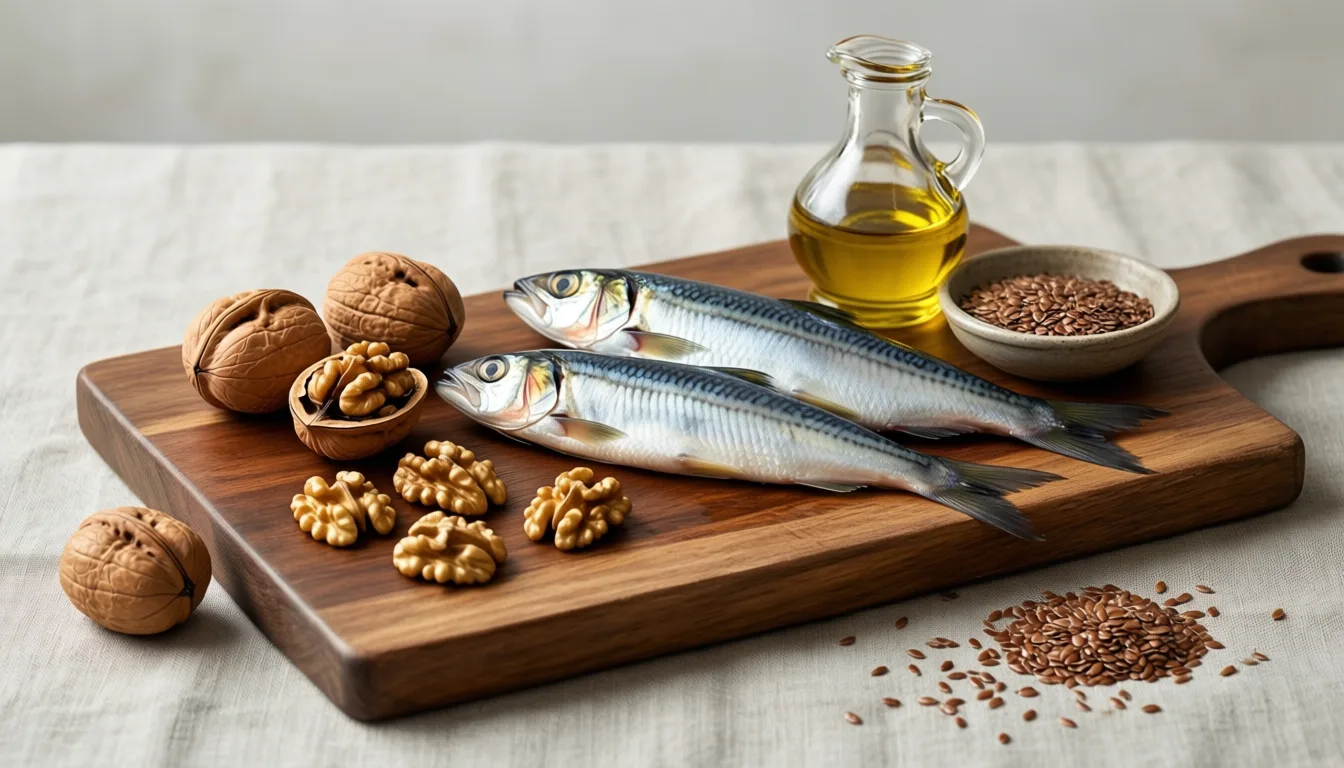
The molecules the study highlights — DHA, other long-chain omega-3s, and linoleic acid — show up in oily fish, walnuts, seeds and common plant oils.
Reading the signature carefully
A few cautions are worth keeping in front of you. This is an observational cohort, not a trial. The plasma fatty acid profile reflects both what people eat and how their bodies process those fats; the study cannot tell you that swallowing more of a particular oil will rewrite your biology. The authors also explored mediation through markers of biological age acceleration, which is suggestive but not proof of mechanism. The editorial weight here is moderate — meaningful, but not a verdict.
Still, the convergence is hard to ignore. The fats that came out looking favorable are the same ones the cardiovascular literature has been pointing toward for years: the long-chain omega-3s found in oily fish, and linoleic acid, the principal polyunsaturated fat in most plant oils and nuts. The fats that came out looking neutral — saturated and monounsaturated — are also broadly consistent with the more measured recent reviews. This is not a revolution. It is a sharpening.
Living longer is one thing. Arriving at 80 still able to climb your own stairs is another.
What a sensible reader does with this
Nothing in the study tells you to take a supplement, and we are not going to either. What it does is reinforce a quietly unfashionable idea: the dietary pattern your physician has probably been recommending for two decades — fish a couple of times a week, nuts and seeds in the rotation, plant oils rather than reformulated industrial fats, less emphasis on the saturated-versus-not skirmish than on what's actually on the plate — looks, in this cohort, like the pattern that travels with healthy aging.
If you are in your sixties or seventies and the question on your mind is whether the next fifteen years will be lived strong and independent or chipped away by chronic disease, this is a useful piece of evidence to bring to your next conversation with your doctor. Particularly if your bloodwork has never included a fatty acid panel, it may be worth asking whether one is appropriate for you. The answer will depend on your history, your medications and your goals, not on a magazine column.

Healthspan, not just lifespan, is the endpoint that matters — and the inputs to it are mostly the boring ones.
- Healthspan, not lifespan. The endpoint was reaching 80 free of major chronic disease — a higher bar than survival alone.
- PUFAs tracked best. Higher plasma polyunsaturated fats were associated with roughly 32% greater odds of healthy aging, top quartile vs. bottom.
- Specific molecules stood out. DHA, other long-chain omega-3s, and linoleic acid each pulled in the favorable direction.
- Saturated and monounsaturated fats were neutral for this outcome — neither hero nor villain in this dataset.
- A high omega-6 to omega-3 ratio was unfavorable, consistent with prior cardiovascular work.
- Observational evidence. Suggestive, not prescriptive. Bring it to your clinician before changing supplements or medications.
The long view, as always, is the useful one. A single study does not move the goalposts. But when a careful prospective cohort of this size lines up neatly with what the cardiology and nutrition literatures have been saying in their calmer moments, the signal is worth respecting. The fats in your bloodstream are a slow-moving readout of years of choices. This study suggests that readout has something to say about whether you arrive at 80 still in command of your own life.
Frequently asked questions
How did this study define 'healthy aging'?
The study defined healthy aging as surviving to age 80 without developing a major chronic disease along the way. The researchers described this as a deliberately strict endpoint — a higher bar than survival alone.
Which types of fat were associated with better odds of healthy aging?
Polyunsaturated fats (PUFAs) were the fats that moved the needle. Participants in the highest quartile of total plasma PUFAs had about 32 percent greater odds of healthy aging compared with those in the lowest quartile. Specifically, DHA, other long-chain omega-3s, and linoleic acid each showed a positive association.
What about saturated and monounsaturated fats — are they harmful for aging?
In this study, saturated and monounsaturated fats showed no meaningful association with healthy aging in either direction. The article describes them as 'statistically speaking, bystanders' and 'neutral — neither hero nor villain in this dataset.'
What foods contain the fatty acids the study highlighted?
The article notes that DHA, other long-chain omega-3s, and linoleic acid show up in oily fish, walnuts, seeds, and common plant oils.
Does this study prove that eating more polyunsaturated fats will improve my odds of healthy aging?
No. The study is an observational cohort, not a clinical trial, and the article is explicit that it cannot prove that changing your intake of any particular fat will change your odds. The plasma fatty acid profile reflects both diet and how an individual's body processes fats, and the article recommends bringing this evidence to a conversation with your doctor rather than changing supplements or diet on the basis of it alone.
Sources
- Plasma fatty acids and the likelihood of healthy aging: a prospective cohort study. — The American journal of clinical nutrition
Join the conversation
Comments are moderated and reviewed before they appear. Be constructive — this is health information.
Add your comment