Frailty Is the New Cardiovascular Risk Factor — And Researchers Are Learning to Engineer Against It
A global expert consensus on exercise for healthy aging arrives alongside trials testing very different anti-frailty levers — from blueberries and protein to a growth-hormone-releasing peptide. Together they reframe frailty as something we can actively push back on.
For decades, the conversation about heart disease has revolved around the same short list: blood pressure, cholesterol, smoking, diabetes, family history. But a quieter variable has been gathering evidence behind the scenes — frailty, the syndrome of slowness, weakness, fatigue and unintended weight loss that has long been treated as simply what happens when people get old. A new wave of research is reframing it as something else entirely: a modifiable risk factor for cardiovascular disease in its own right, and a target we may be able to engineer against with the right combination of training, food, and — in carefully selected cases — medication.
The shift is being driven by two ideas converging at once. The first is that people of the same chronological age can be biologically decades apart, and frailty captures that gap better than a birthday does. The second is that the levers that move frailty — muscle, mitochondria, inflammation, nutrition — are increasingly the same levers researchers believe move cardiovascular risk. A Canadian trial now enrolling older Nova Scotians is built explicitly on that logic, proposing that a comprehensive strategy targeting diet and physical activity to reduce frailty will, in turn, reduce the risk of cardiovascular disease. Frail people, the investigators note, are more likely to develop heart disease, more likely to have complications, and more likely to die of it than fit people of the same age — independent of the traditional risk factors.
The implication is uncomfortable and clarifying at the same time. A perfect lipid panel is not a complete picture if you cannot rise from a chair without using your arms.
- Frailty predicts heart disease independently of the classic risk factors, and it is modifiable — not fixed by age.
- A global expert consensus now treats exercise as a prescribable medicine for older adults, with aerobic, resistance, balance and flexibility components.
- Diet plus movement is being tested as a combined anti-frailty, anti-cardiovascular intervention in older adults.
- Drug-plus-exercise combinations are an emerging research frontier — promising in specific populations, but not yet ready for general use.
- The evidence is moderate, not definitive. Several of the most interesting trials are still underway.
Exercise as a prescription, written carefully
The most authoritative recent statement on how older adults should actually move comes from the International Conference on Frailty and Sarcopenia Research (ICFSR). Their global consensus review argues that physical activity and exercise meaningfully modulate the aging phenotype itself — that movement can prevent or ameliorate lifestyle-related diseases, extend health span, enhance physical function, and reduce the burden of non-communicable chronic diseases including cardiometabolic disease, cancer, musculoskeletal and neurological conditions, and chronic respiratory diseases, as well as premature mortality.
That sentence is doing a lot of work, and it is worth slowing down on. The authors are not claiming exercise is a cure for any one of those conditions. They are claiming it influences the underlying biology of aging — what geroscientists call the cellular and molecular drivers — and that the downstream effect is broad. In their framing, structured exercise prescriptions should be customized and monitored like any other medical treatment, considering dose-response relationships and the specific adaptations necessary for intended outcomes.
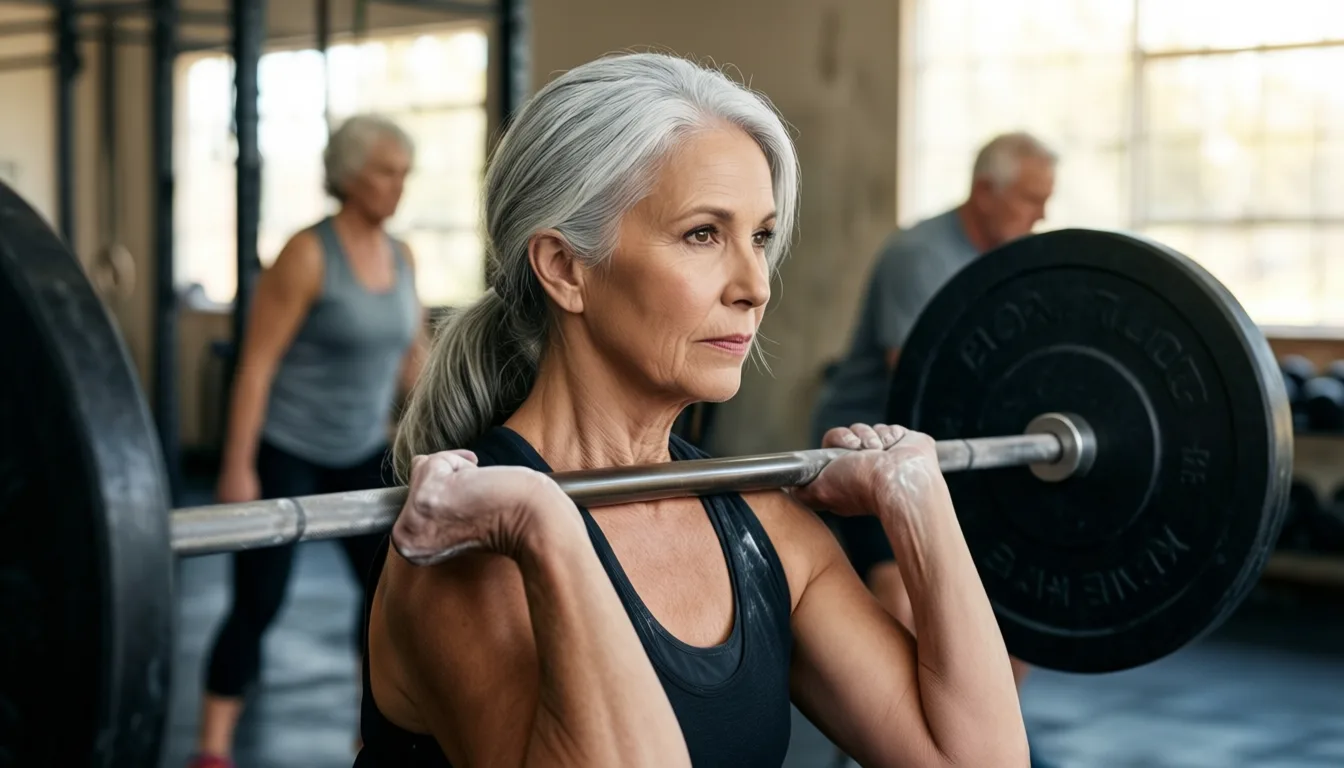
What does the prescription look like? A multifaceted regimen: aerobic, resistance, balance, and flexibility training, delivered through both structured workouts and incidental lifestyle activity. None of these components is optional. Walking is not enough on its own; neither is yoga; neither is the once-a-week resistance class. The consensus is that each addresses a different layer of decline, and that older adults should be assembling all four.

The Nova Scotia trial pairs protein-forward eating with wild blueberries — a polyphenol-rich Atlantic staple — and supervised exercise.
A perfect lipid panel is not a complete picture if you cannot rise from a chair without using your arms.
Blueberries, protein, and the Nova Scotia experiment
The Nova Scotia Health Authority trial, formally listed as NCT06693271, takes the consensus seriously and then adds food. Its premise is that the degree of frailty can be modified by lifestyle interventions — that sedentary lifestyles, food insecurity, and suboptimal dietary habits can exacerbate frailty, whereas diet and exercise interventions can attenuate it. The intervention layers three things: adequate dietary protein (which older adults frequently under-consume), wild blueberries (a regional crop unusually rich in anthocyanins, the polyphenols linked to vascular and metabolic benefits), and a supervised exercise program.
What makes the design notable is its explicit attention to sex differences. The investigators point out that older women are frailer than men and tend to express cardiovascular disease differently than men, but whether the relationships between frailty and CVD are sex-specific is unclear. That is a real gap. Heart disease has historically been studied as a male phenomenon, and frailty has historically been studied as a geriatric one. The Nova Scotia trial is one of the few designed to interrogate the intersection.
One mechanism the researchers are watching is chronic inflammation — the smoldering, low-grade kind sometimes called inflammaging. They hypothesize that shared pathophysiological mechanisms such as chronic inflammation may help explain the links between cardiovascular disease and frailty. If diet and exercise together can lower that inflammatory tone, the cardiovascular benefit may not be separate from the anti-frailty benefit — it may be the same benefit, measured two ways.
The peptide question: tesamorelin, exercise, and accelerated aging
If the Nova Scotia study sits at the food-and-movement end of the spectrum, a trial out of Massachusetts General Hospital sits at the pharmacology end. NCT06554717 is testing tesamorelin, a growth-hormone-releasing hormone analogue already FDA-approved for abdominal fat accumulation in people with HIV, as an adjunct to exercise for physical function. The rationale is that this population offers a kind of natural experiment in accelerated aging. People with HIV experience earlier impairments in physical function compared to the general population, with an earlier presentation and more rapid development of frailty — a multisystemic syndrome characterized by reduced activity, fatigue, slowness, weakness, and weight loss.
Importantly, exercise alone has limits here. The investigators note that while exercise can improve physical function in people with HIV, it is less effective at doing so than in the general population and is difficult to sustain long-term. That is the gap they are trying to close. Tesamorelin has already been shown to increase muscle mass and improve measures of muscle health, but its effects on physical performance and muscle strength have not yet been evaluated. The trial pairs the medication (or placebo) with a coached, home-based exercise program for 24 weeks, then watches what happens during a 24-week off-drug extension.
It is worth being clear-eyed about what this means for readers without HIV. This is not a longevity drug arriving at the pharmacy counter. It is a precise, mechanistic question being asked in a specific population, with the broader implication that drug-plus-exercise combinations may eventually be a category we take seriously for aging itself. For now, the takeaway is conceptual: the same biology — muscle, hormones, inflammation — keeps showing up at the center of the frailty story.
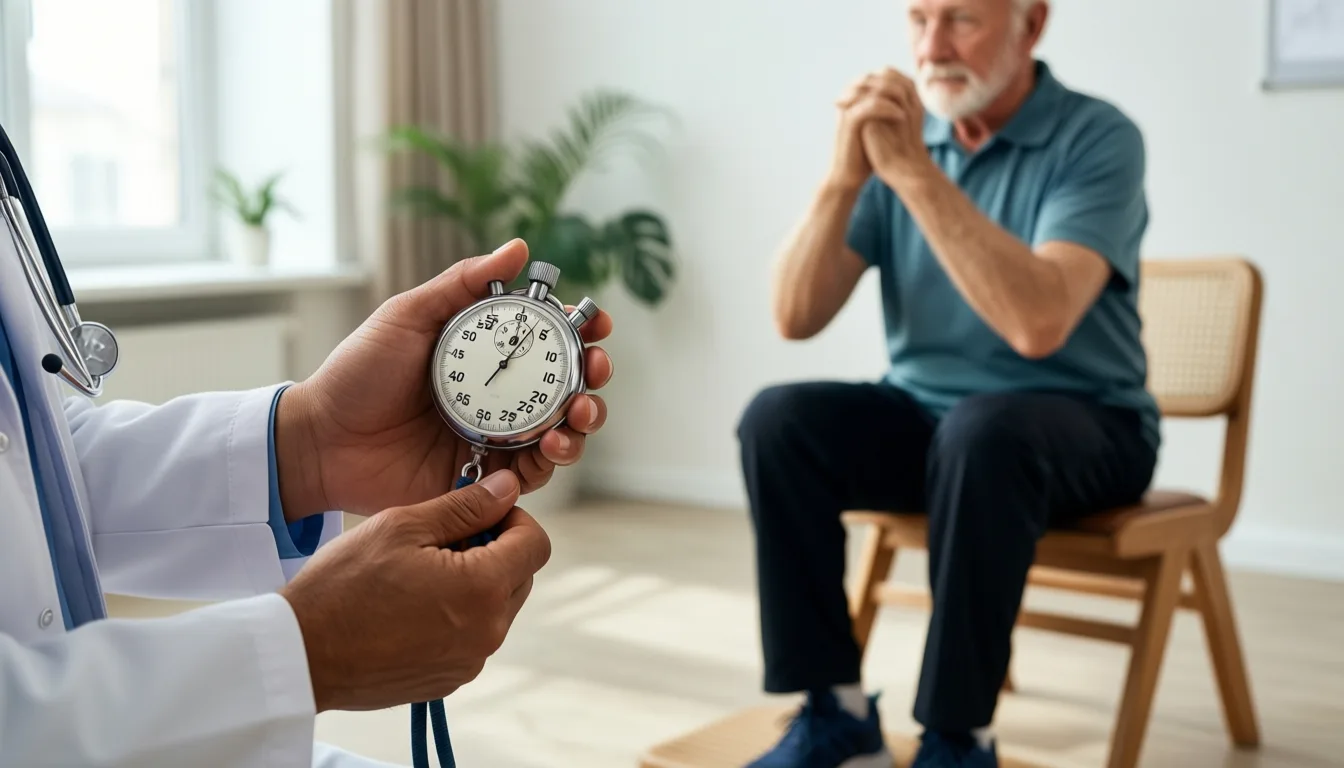
Functional tests — gait speed, grip strength, chair-stand — are how researchers measure frailty when bloodwork alone won't tell the story.
What the moderate evidence actually supports
It is tempting, reading three studies together, to declare frailty solved. It is not. The ICFSR document is a consensus review, not a single randomized trial; the Nova Scotia and Massachusetts General studies are protocols whose primary results are still ahead of us. What is reasonable to say, today, is that the direction of travel is consistent. Frailty looks increasingly like a cardiovascular risk factor that responds to the same levers — movement, nutrition, and in select cases pharmacology — that we already know matter for aging biology more broadly.
The practical implication for readers is less dramatic than the science. The strongest, most replicated tool in the kit is still structured, varied exercise, ideally with a resistance component that most older adults skip. Adequate protein and a diet built around whole, polyphenol-rich foods is the supporting cast that early trials are now formally testing. Medication-plus-exercise combinations are a frontier worth watching, not a shelf to shop from. The women being studied in Nova Scotia, and the participants enrolling in Boston, are doing the work that will tell us, in a few years, how much further we can push.
What has already shifted is the framing. Frailty is no longer the inevitable backdrop of aging. It is a target. And the early signals suggest that the price of admission — sustained, structured movement, deliberate eating, and refusing to be dismissed by a healthcare system that has historically under-measured these things in women — is one many readers are ready to pay.
Frequently asked questions
Why is frailty now being considered a cardiovascular risk factor?
Research shows that frail people are more likely to develop heart disease, more likely to have complications, and more likely to die of it than fit people of the same age — independent of traditional risk factors like blood pressure and cholesterol. Frailty is also increasingly understood to share the same biological levers as cardiovascular risk, including muscle, mitochondria, inflammation, and nutrition.
Is walking enough exercise to address frailty in older adults?
According to the ICFSR global consensus, walking alone is not enough. The recommended prescription includes aerobic, resistance, balance, and flexibility training, delivered through both structured workouts and incidental lifestyle activity, because each component addresses a different layer of decline.
What is the Nova Scotia trial testing as an intervention against frailty?
The trial layers three elements: adequate dietary protein, wild blueberries (which are rich in anthocyanins, a type of polyphenol), and a supervised exercise program. Its premise is that sedentary lifestyles and suboptimal dietary habits can worsen frailty, while diet and exercise interventions can reduce it.
Why does the Nova Scotia trial specifically examine sex differences?
The investigators note that older women are frailer than men and tend to express cardiovascular disease differently, yet whether the relationship between frailty and cardiovascular disease is sex-specific remains unclear. Heart disease has historically been studied as a male phenomenon and frailty as a geriatric one, making their intersection an understudied area.
Why is tesamorelin being studied alongside exercise rather than exercise alone?
The Massachusetts General Hospital trial focuses on people with HIV, who experience an earlier and more rapid development of frailty than the general population. The investigators note that exercise can improve physical function in this group but is less effective than in the general population and difficult to sustain long-term, which is the gap the addition of tesamorelin is designed to address.
Sources
- Investigating the Combined Effects of Protein, Blueberries, and Exercise on Cardiovascular Health and Frailty in Older Nova Scotians — Nova Scotia Health Authority
- Global consensus on optimal exercise recommendations for enhancing healthy longevity in older adults (ICFSR). — The journal of nutrition, health & aging
- Tesamorelin as an Adjunct to Exercise for Improving Physical Function in HIV — Massachusetts General Hospital
Join the conversation
Comments are moderated and reviewed before they appear. Be constructive — this is health information.
Add your comment