
Inflamm-Aging Goes Mainstream: A Cheap Blood Marker and a Gut Bug Hint at Longevity's Next Levers
Two new studies sharpen the picture of chronic low-grade inflammation in aging — one points to a routine blood ratio, the other to a specific gut microbe coaxed by ginseng. Neither is a prescription. Both are worth watching.
For years, researchers have used a slightly awkward phrase — inflamm-aging — to describe the quiet, smoldering inflammation that seems to accompany the body's slow drift toward frailty. It isn't the dramatic inflammation of a sprained ankle or a sore throat. It's the kind you can't feel, the kind that hums in the background while arteries stiffen, bones thin, and the gut lining becomes a little more porous than it used to be. Two recent studies, published in very different corners of the literature, suggest that this hum may finally be moving from theory into something measurable — and, perhaps, something modifiable.
The first is a clinical analysis of more than a thousand patients with heart failure with preserved ejection fraction, or HFpEF — a condition that disproportionately affects older women and has long resisted the cleaner treatment stories of other cardiac diseases. The second is a mouse study, decidedly earlier-stage, that traces ginseng's gut-soothing reputation to a single bacterial species. Together they offer a useful pairing: a biomarker you can already see on a blood panel, and a mechanism the lab is still piecing together. Both deserve careful reading rather than excitement.
A ratio hiding in plain sight
The lymphocyte-to-monocyte ratio — LMR for short — is exactly what it sounds like: a number you get by dividing one type of white blood cell by another. Both show up on a standard complete blood count, which means most women reading this have had the raw ingredients measured many times without ever hearing the ratio discussed. In a new analysis of 1,274 HFpEF inpatients followed for a median of 4.9 years, researchers found that patients in the highest tertile of LMR had a markedly lower risk of death than those in the lowest tertile, with a hazard ratio of 0.42 for overall mortality.
More provocatively, the authors report that the LMR partially mediated the relationship between age and cardiovascular death. In plain terms: some of what we call "aging" in the heart may actually be the slow accumulation of immune dysregulation that this ratio captures. Each standard-deviation increase in age corresponded to nearly a two-fold rise in overall mortality risk in their adjusted model — and a meaningful slice of that risk traveled through inflammation.
This is a single observational study in a specific population, and mediation analyses are notoriously sensitive to which variables are included. The LMR is not yet a clinical decision-making tool, and no professional society currently recommends acting on it. But it is the kind of finding worth knowing about the next time a clinician hands you a printout of your blood work.

The lymphocyte-to-monocyte ratio is already buried in routine blood panels — researchers are now asking what it might be telling us about aging itself.
Some of what we call aging in the heart may be the slow accumulation of immune dysregulation a simple blood ratio can see.
A gut bug, a polysaccharide, and a careful caveat
The second study moves from the clinic to the lab bench, and the evidence drops a notch in strength accordingly. Working in aged mice, researchers tested ginseng neutral polysaccharide — one of the carbohydrate fractions of Panax ginseng — and watched what happened to the animals' gut barrier and systemic inflammation. The intervention alleviated gut leak and low-grade inflammation while enriching a specific commensal bacterium called Alistipes senegalensis.
The mechanism the team proposes is unusually crisp for microbiome science. A. senegalensis produces indole compounds; those metabolites activate the aryl hydrocarbon receptor (AhR) pathway in gut cells; AhR activation increases the expression of tight-junction proteins and nudges gut stem cells into action; and the intestinal barrier becomes less leaky. The chain was reinforced by fecal microbiota transplants, conditioned-medium experiments, and verification in Caco-2/THP-1 cell co-cultures, C. elegans, and enteroids.
That's a serious stack of evidence — for an animal-and-cell model. It is not a human trial. It does not justify buying ginseng supplements with the expectation of fixing a leaky gut, particularly because the active fraction here was a specific neutral polysaccharide isolated in a lab, not the herb you'd find on a shelf. Ginseng can also interact with blood thinners, blood-pressure medications, and diabetes drugs, all of which are common in women over 55.
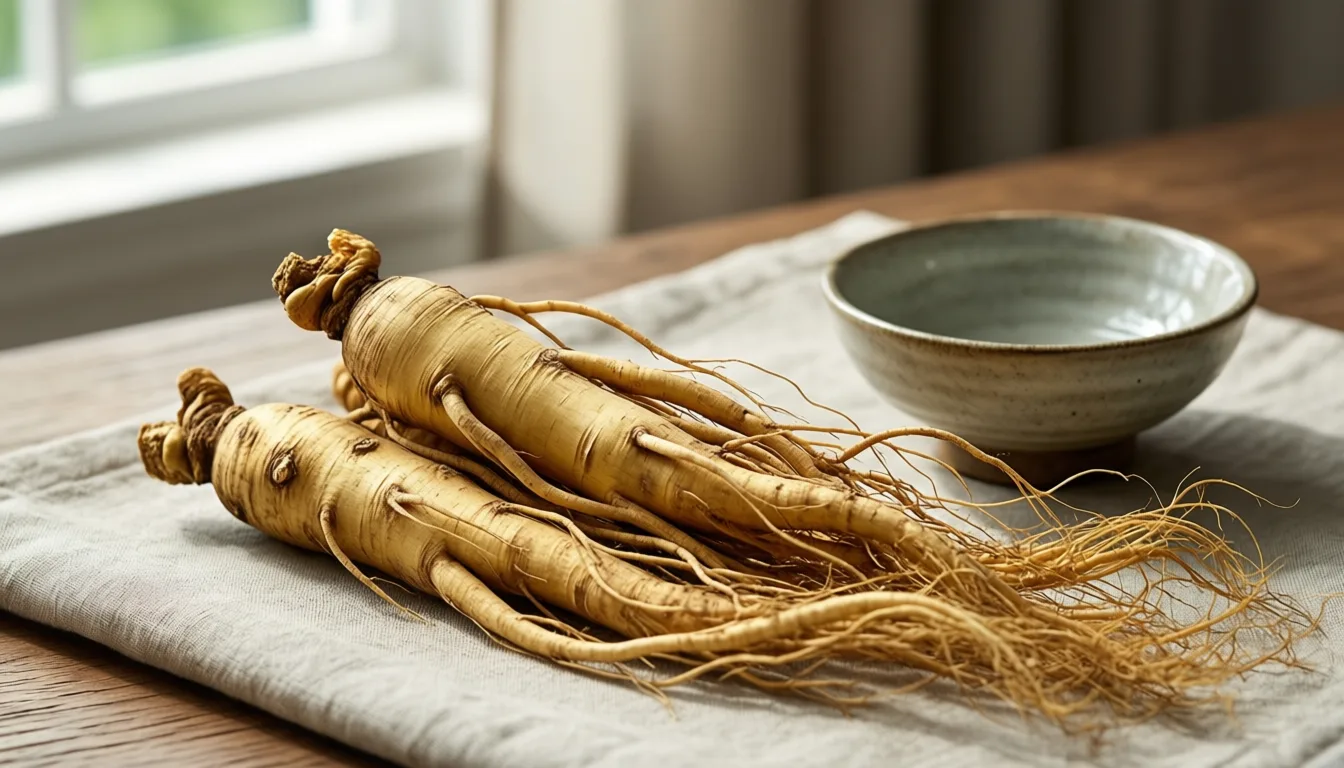
The mouse study isolated a specific neutral polysaccharide from Panax ginseng — not the whole root, and not a supplement off the shelf.
Why these two studies belong in the same conversation
The throughline isn't ginseng, and it isn't a blood ratio. It's the slow consolidation of a hypothesis that chronic low-grade inflammation is one of the central currencies of aging — and that both measurement and modulation are becoming more tractable. One paper hands clinicians a candidate marker that already exists in their lab systems. The other hands biologists a mechanistic story specific enough to design a human trial around. Neither tells a reader what to do tomorrow morning. Both suggest that the next decade of longevity research will be less about exotic compounds and more about the unglamorous interface between immune cells, gut microbes, and time.
- Inflamm-aging is gaining measurable footholds. A standard blood-count ratio (LMR) was linked to cardiovascular mortality in HFpEF patients and partially mediated the age–death relationship.
- The HFpEF study is observational. It suggests an association, not a treatment. No guideline currently recommends acting on LMR.
- The ginseng finding is preclinical. The barrier-repair effect was shown in aged mice and cell models, via a specific gut microbe and the AhR pathway — not in humans.
- Whole-root ginseng supplements are not the studied intervention, and ginseng can interact with common cardiovascular and diabetes medications.
- The bigger story is convergence. Cheap inflammation markers and microbiome-modulating compounds are emerging as plausible — not proven — longevity levers.
- Bring questions to your clinician, not conclusions to a checkout cart.
The temptation with longevity reporting is to round every promising signal up into a recommendation. The honest version is quieter: a blood ratio worth tracking in research settings, a gut microbe worth investigating in humans, and a unifying theory of low-grade inflammation that is becoming harder to dismiss. That's progress. It just isn't a prescription.
Frequently asked questions
What is the lymphocyte-to-monocyte ratio, and do I already have it on my blood work?
The lymphocyte-to-monocyte ratio, or LMR, is calculated by dividing one type of white blood cell by another — both of which appear on a standard complete blood count. Most people have had the raw numbers measured many times without ever hearing the ratio discussed. It is not yet a clinical decision-making tool, and no professional society currently recommends acting on it.
What did the HFpEF study actually find about the LMR and the risk of death?
In an analysis of 1,274 HFpEF inpatients followed for a median of 4.9 years, patients in the highest tertile of LMR had a hazard ratio of 0.42 for overall mortality compared with those in the lowest tertile. The authors also found that LMR partially mediated the relationship between age and cardiovascular death, suggesting that some of what registers as aging-related heart risk may reflect immune dysregulation that the ratio captures. The study is observational and shows an association, not a cause-and-effect relationship.
Can I take ginseng supplements to get the gut-barrier benefits described in the mouse study?
No — the studied intervention was a specific neutral polysaccharide isolated from Panax ginseng in a laboratory setting, not the whole root or a supplement available on a shelf. The research was conducted in aged mice and cell models, not in humans, so it does not support self-prescribing ginseng. Ginseng can also interact with blood thinners, blood-pressure medications, and diabetes drugs, all of which are common in women over 55.
How does the gut mechanism in the ginseng study work?
Researchers found that ginseng neutral polysaccharide enriched a gut bacterium called Alistipes senegalensis, which produces indole compounds. Those metabolites activate the aryl hydrocarbon receptor (AhR) pathway in gut cells, which in turn increases the expression of tight-junction proteins and prompts gut stem cells into action, making the intestinal barrier less leaky.
What is "inflamm-aging" and why does the article treat these two studies together?
Inflamm-aging refers to the quiet, low-grade inflammation that accompanies the body's slow drift toward frailty — not the acute inflammation of an injury, but a background hum that is linked to stiffening arteries, thinning bones, and a more porous gut lining. The article pairs the two studies because both point toward the same hypothesis: that chronic low-grade inflammation is a central currency of aging, and that measuring and potentially modifying it is becoming more feasible. One study offers a candidate biomarker already present in routine lab work; the other offers a mechanistic story detailed enough to eventually design a human trial around.
Sources
- Lymphocyte-To-Monocyte Ratio is Partially Mediated in Age-Related Cardiovascular Mortality in HFpEF: Immunosenescence, Inflamm-Aging, and Longevity. — Reviews in cardiovascular medicine
- Alistipes senegalensis is Critically Involved in Gut Barrier Repair Mediated by Panax Ginseng Neutral Polysaccharides in Aged Mice. — Advanced science (Weinheim, Baden-Wurttemberg, Germany)
Join the conversation
Comments are moderated and reviewed before they appear. Be constructive — this is health information.
Add your comment