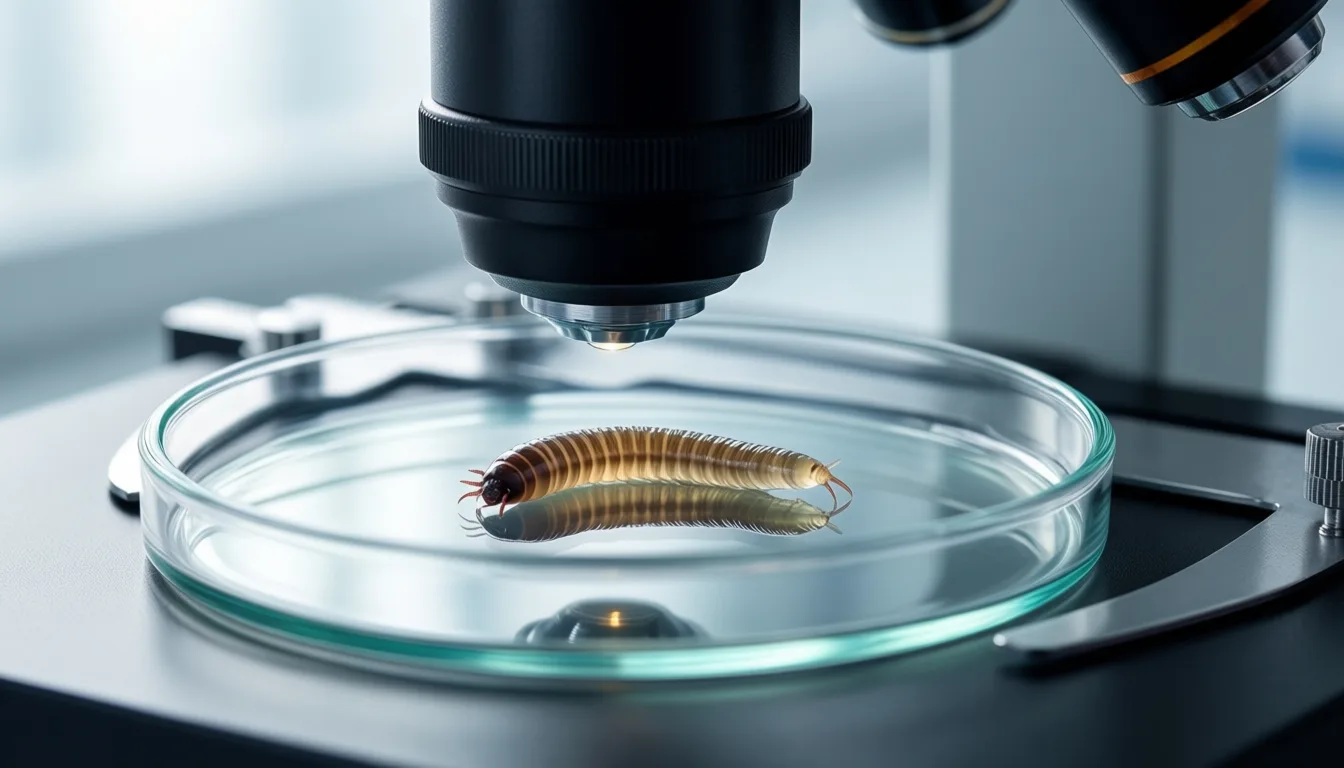
Inheriting Resilience: Could a Parent's Mitochondrial Stress Make You Live Longer?
A new worm study suggests that mild stress in one generation can leave longevity marks on the next. The mechanism is fascinating — and the leap to humans is still a long one.
For more than a century, biologists have flirted with a heretical idea: that the experiences of one generation might leave a fingerprint on the next, written not in DNA letters but in the molecular scaffolding that decides which letters get read. A new paper in Redox Biology pushes that idea into sharper focus. Working with the millimeter-long roundworm Caenorhabditis elegans, researchers report that a carefully measured dose of mitochondrial stress in parent worms not only extends the parents' own lifespan but also hands a longevity advantage down to offspring who were never exposed — and they trace the inheritance to specific chemical tags on histone proteins. It is a striking finding. It is also, importantly, a finding in worms.
- What the study shows: In C. elegans, mild mitochondrial oxidative stress in parents extended lifespan in both the parents and their unexposed progeny.
- How it travels: The effect depended on the mitochondrial unfolded-protein response (UPRmt) and two stress-response transcription factors, DAF-16/FOXO and SKN-1/Nrf2.
- The epigenetic carriers: Two histone marks — H3K4me3 (activating) and H3K27me3 (repressing) — selectively tuned genes tied to oxidative-stress response and longevity.
- What it does not show: Anything about humans. The work is preclinical and conducted entirely in a short-lived invertebrate.
- Why it still matters: It sharpens a mechanistic case for hormesis — the idea that small, well-dosed stressors can build resilience.
Hormesis, in one paragraph
Hormesis is the principle that a stressor lethal at high doses can be beneficial at low ones. Exercise damages muscle fibers; the repair makes you stronger. Brief heat or cold exposure provokes a stress response that, over time, appears to recalibrate cellular housekeeping. Mitochondria — the organelles that turn food and oxygen into usable energy — are central to this story. When they're nudged just hard enough to leak a little reactive oxygen, cells often respond by upgrading their defenses rather than breaking down. The new Redox Biology paper asks a question that hormesis researchers have circled for years: does that upgrade stay with the individual, or can it travel?
What the worms actually did
The team, led by Wan and colleagues, exposed parent worms to mitochondrial hormetic oxidative stress (which they abbreviate mtHOS) and tracked both the exposed animals and their descendants. The exposed parents lived longer, as prior hormesis work would predict. The novel observation was that their progeny — never themselves exposed — also lived longer, a pattern the authors describe as transgenerational epigenetic inheritance of the longevity signal.
Mechanistically, the inheritance depended on a coordinated cast of molecular players. The mitochondrial unfolded-protein response (UPRmt), a quality-control program that kicks in when mitochondria are under strain, had to be active. Two transcription factors — DAF-16, the worm version of the FOXO family, and SKN-1, the worm counterpart of mammalian Nrf2 — had to be working in concert. And at the chromatin level, two opposing histone marks did the bookkeeping: H3K4me3, which generally flags genes for active transcription, and H3K27me3, which generally damps genes down. Together, the authors report, these marks selectively regulated genes tied to oxidative-stress response and longevity, effectively pre-tuning the next generation's stress vocabulary before it had encountered any stress of its own.
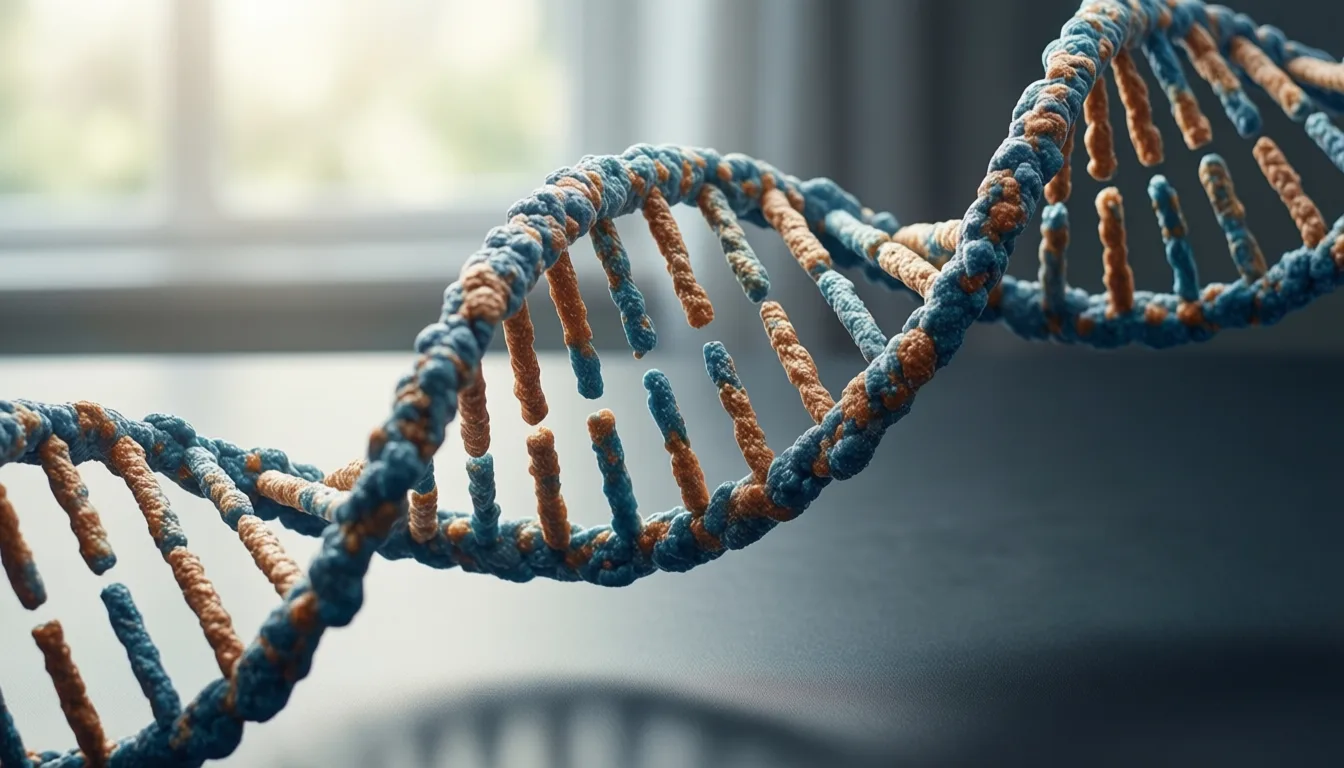
Histones — the spool-like proteins that package DNA — carry chemical marks that tell cells which genes to read loudly and which to whisper.
The worms inherited a tuned stress response without inheriting the stress itself. On the central finding
Why this is more than a curiosity
Transgenerational epigenetic inheritance is well documented in C. elegans and has been demonstrated, less tidily, in some plant and rodent systems. Its existence in mammals — and certainly in humans — remains contested terrain. Worms have biological features that make the inheritance comparatively clean to study: a short life cycle, a transparent body, hermaphroditic reproduction, and a germline that interacts with somatic stress signals more readily than in mammals. None of those features carry over to people.
That caveat aside, the worm result is mechanistically interesting because it identifies which marks matter and which upstream programs the marks depend on. The authors point to a coordinated axis of UPRmt activation plus DAF-16/FOXO and SKN-1/Nrf2 signaling, with H3K4me3 and H3K27me3 serving as the durable record. Those pathways have mammalian counterparts that are already targets of intense longevity research. The worm paper is not evidence that the same inheritance happens in humans; it is evidence that, in at least one organism, the inheritance has an identifiable molecular address.
What it does — and does not — say about exercise, heat and cold
The framing temptation here is obvious. If mild mitochondrial stress in parents can hand resilience to offspring, what about the mild mitochondrial stressors many readers are already curious about — endurance exercise, sauna sessions, cold plunges? The honest answer is that this paper does not test any of those interventions, in any species, in any generation. It tests a defined laboratory stressor in worms.
What the paper does is strengthen the mechanistic plausibility of hormesis as a category. It suggests that the cellular machinery worms use to bank a stress response — UPRmt, FOXO-family and Nrf2-family signaling, histone methylation — is doing something coherent and durable, not just twitching in response to a transient insult. For readers already weighing GLP-1 medications, structured exercise, or thermal exposure as parts of a long-term metabolic strategy, the takeaway is modest but real: the biology of small, repeated stressors is becoming better mapped, and that map is starting to include how the marks persist.

Exercise is the best-studied human hormetic stressor. The worm work does not test it — but it makes the underlying logic harder to wave away.
What would have to be true for this to matter to humans
Several layers of evidence are missing between this worm result and any human implication. First, researchers would need to show that comparable hormetic stressors in mammals produce comparable histone-mark patterns in the germline. Second, they would need to show that those marks survive the extensive epigenetic reprogramming that occurs in mammalian embryos — a process that erases much of what is written. Third, they would need outcome data: not just marks, but measurable differences in healthspan or disease risk in offspring. None of that work is done.
It is also worth being precise about what the worm paper claims and what it does not. The authors describe a sophisticated interplay among oxidative-stress response genes and chromatin remodeling that enhances progeny resilience to future challenges. They do not claim a universal mechanism, a human translation, or a dosing schema. Readers should resist the temptation to fill in those blanks.
Mechanism in worms is a starting line, not a finish line.
A better conversation with your clinician
If this study changes anything for the average reader, it is the texture of the conversation rather than the prescription. Hormesis-adjacent practices — structured exercise, supervised heat or cold exposure, dietary patterns that include periods of mild metabolic stress — already have human evidence behind them at varying strengths. The new paper does not upgrade any of those into proven longevity interventions. It does add another mechanistic reason to take the category seriously, and another reason to be skeptical of products that promise the benefits of stress without any of the stress.
For anyone on or considering a GLP-1 medication, the relevance is indirect but real. GLP-1 therapy changes the body's energy economy, and the lifestyle scaffolding around it — particularly resistance training and aerobic exercise — is where most of the durable metabolic benefit is likely to come from. Mechanistic work like this paper is a reminder that those stressors are doing biochemical work worth respecting, even when their payoff is slow.
- The finding is real but narrow: a worm study, in a well-defined experimental setup, with a clear molecular mechanism.
- The translation to humans is unproven. Mammalian germline reprogramming is a serious barrier the paper does not address.
- Hormesis is a category, not a prescription. Talk to a clinician before adding heat, cold or aggressive exercise protocols, especially on GLP-1s.
Frequently asked questions
What did the study actually find?
Working with the roundworm C. elegans, researchers found that a carefully measured dose of mitochondrial stress in parent worms extended lifespan in both the exposed parents and their offspring who were never themselves exposed to that stress. The team traced this inherited longevity advantage to specific chemical tags on histone proteins, identifying a coordinated pathway involving the mitochondrial unfolded-protein response and two stress-response transcription factors.
What is hormesis, and why does it matter here?
Hormesis is the principle that a stressor lethal at high doses can be beneficial at low ones — for example, exercise damages muscle fibers, but the repair process makes you stronger. The study strengthens the mechanistic case for hormesis by suggesting that the cellular machinery worms use to bank a stress response is doing something coherent and durable, not just reacting to a transient insult.
How exactly does the longevity signal get passed from parent worms to their offspring?
The inheritance required the mitochondrial unfolded-protein response (UPRmt) to be active, along with two transcription factors — DAF-16/FOXO and SKN-1/Nrf2 — working in concert. At the chromatin level, two opposing histone marks — H3K4me3, which flags genes for active transcription, and H3K27me3, which damps genes down — selectively regulated genes tied to oxidative-stress response and longevity, effectively pre-tuning the next generation's stress response before it encountered any stress of its own.
Does this study tell us anything about what humans should do?
No — the work is preclinical and conducted entirely in a short-lived invertebrate, and the article explicitly states it does not show anything about humans. Animal-preclinical evidence like this can identify mechanisms and generate hypotheses, but cannot on its own justify a clinical recommendation.
What would need to happen before this worm finding could have implications for people?
Researchers would first need to show that comparable hormetic stressors in mammals produce comparable histone-mark patterns in the germline. They would then need to show that those marks survive the extensive epigenetic reprogramming that occurs in mammalian embryos — a process the article notes erases much inherited molecular information.
Join the conversation
Comments are moderated and reviewed before they appear. Be constructive — this is health information.
Add your comment