
Intrinsic Capacity: The Resilience Framework Quietly Replacing 'Healthy Aging'
A WHO-aligned way of thinking about reserves — and a simpler test of leg power — gives men past sixty practical handles on staying strong, sharp and independent.
For most of my working life, the phrase doctors reached for was healthy aging — a tidy label that managed to say both everything and nothing. It set a goal without telling you how to measure progress. A quieter idea has been gathering momentum in the geriatric literature, and it is more useful precisely because it is more concrete. The World Health Organization calls it intrinsic capacity: the sum of your physical and mental reserves at any given moment. Pair that with resilience — how well those reserves absorb a shock, whether a bad flu, a fall, or a stretch of bed rest — and you have a framework that treats aging as something you can monitor, not just endure.
A recent narrative review in the Journal of Clinical Medicine pulled together five years of work on these two concepts and argued that, taken together, they form a proactive framework for successful aging rather than a backward-looking tally of disease. Intrinsic capacity, in the WHO formulation the authors lean on, spans five domains: locomotion, vitality, cognition, sensory function, and psychology. Resilience is the dynamic part — your ability to bounce after a stressor lands.
The evidence here is moderate, not settled. The review is narrative, not a meta-analysis; it selected 43 articles from 145 candidates, and most of the underlying work is observational. What it suggests, fairly consistently, is that higher resilience tracks with better health outcomes, fewer chronic diseases, and steadier mental health in adults over sixty. That is a useful signal, not a guarantee, and worth holding at that weight.
- Reserves, not age. Intrinsic capacity measures what you have to spend across five domains — locomotion, vitality, cognition, senses, psychology.
- Resilience is the second half. How quickly you recover from an illness or injury matters as much as your baseline.
- Leg power is a window in. A new study suggests the first ten contractions of a simple fatigue test capture age-related power decline as well as a full lab workup.
- Evidence is moderate. The framework is promising and increasingly mainstream, but most supporting work is observational.
- Action belongs with a clinician. Use these ideas to ask better questions at your next visit, not to self-diagnose.
Why 'reserves' beats 'age'
Chronological age is a blunt instrument. Two men at seventy can sit across the same waiting room with wildly different futures, and the calendar will not tell you which is which. Intrinsic capacity tries to. It asks how far you can walk, how clearly you think, how well you see and hear, how steady your mood, how much vitality you carry into the afternoon. The review argues that folding these assessments into routine geriatric evaluation sharpens clinical decisions and, the authors suggest, supports better outcomes when interventions are targeted accordingly.
Resilience is the companion concept and, to my eye, the more interesting one. Reserves describe what you have on a Tuesday morning. Resilience describes what happens when Wednesday goes sideways — a chest infection, a slip on the stairs, a week in the hospital. Older men with more of it, the literature suggests, lose less ground and regain it faster. That is the part of aging that determines whether independence holds.
Chronological age is a blunt instrument. Two men at seventy can sit in the same waiting room with wildly different futures.
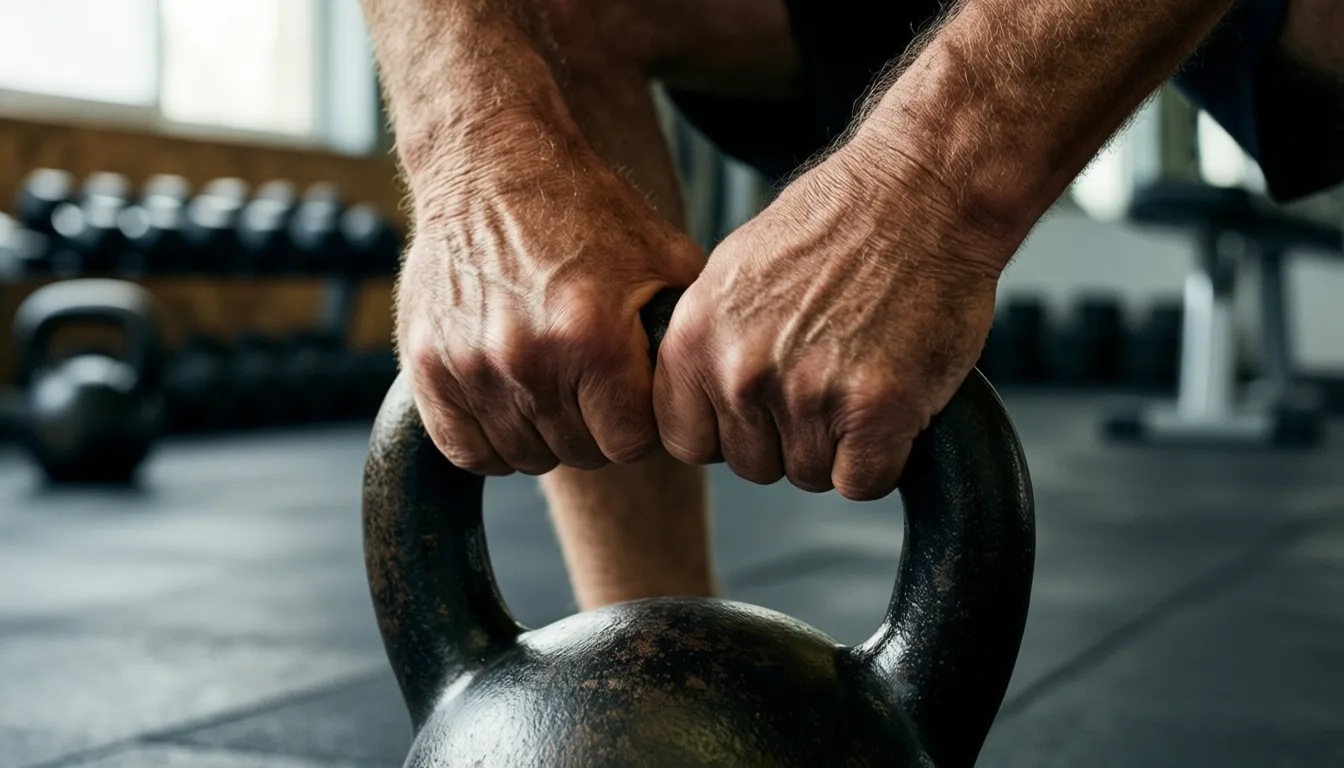
Locomotion is one of five domains in the intrinsic capacity framework — and the one most readily measured outside a clinic.
The leg-power shortcut
Of the five domains, locomotion is the one a reader can most plausibly track between checkups, and within locomotion, muscle power — force multiplied by speed — is the variable that matters most for getting out of a chair, catching a stumble, or climbing a curb with a bag of groceries. The trouble is that the gold-standard measurement, a torque-velocity assessment across many loads and speeds, is a lab procedure. It is time-consuming, hard on the joints, and impractical for the men who would benefit most from being measured.
A study in the Journal of Applied Physiology tested a simpler approach. Researchers compared the full torque-velocity workup to the first ten contractions of a four-minute single-load fatiguing task in young adults, older adults, and very old adults. The two methods tracked each other closely — peak power outputs were strongly correlated, and the estimated age-related decline in power was statistically indistinguishable between protocols in both men and women.
That is the practical headline. A short, single-load test appears to capture the same age- and sex-related differences in peak leg power as a far more elaborate one. The initial ten contractions produced peak power values about 13% lower than the gold standard — a consistent offset, not a distortion of the underlying trend. In plain terms: the shortcut reads a little low, but it reads the same direction and at the same slope.
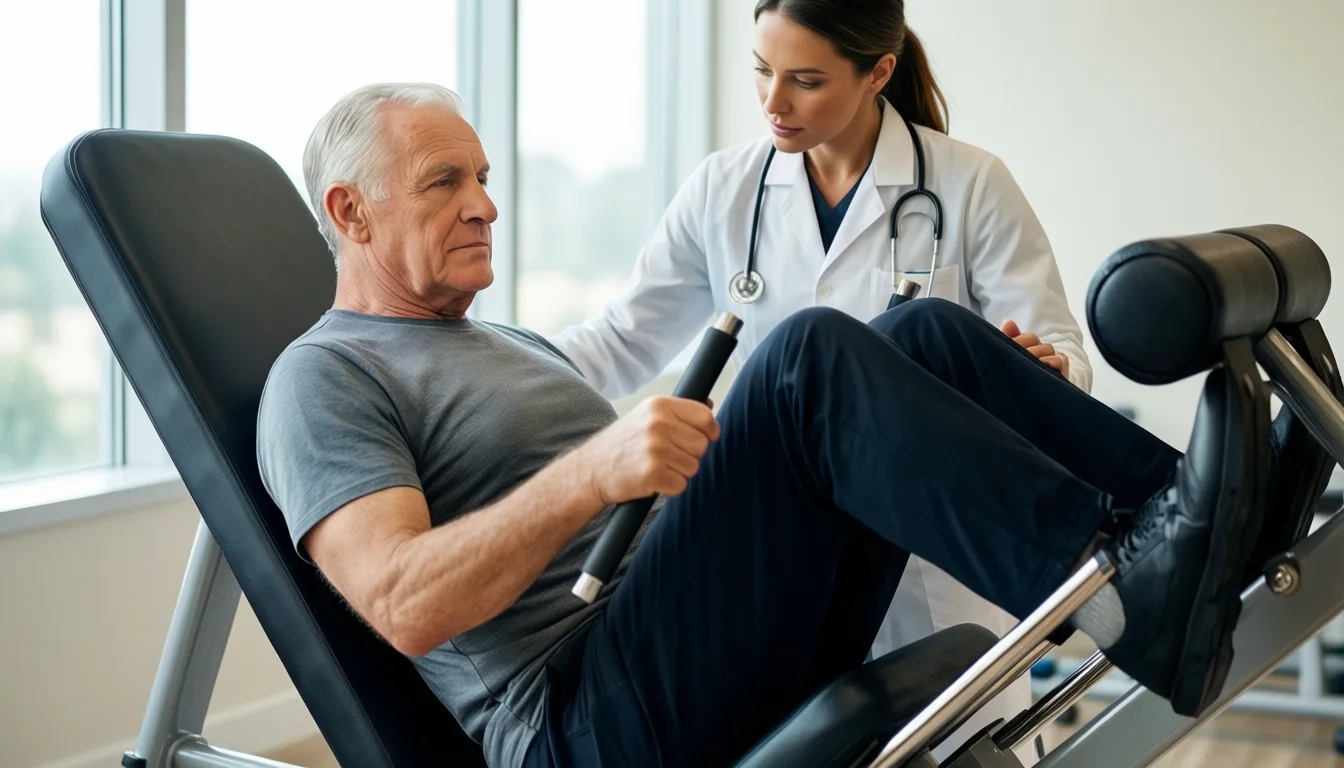
The simplified test was validated on a knee extension machine in a lab — not a home protocol, but a plausible candidate for clinical and gym settings.
What this does — and doesn't — mean for you
A word of restraint here, because the gap between an interesting study and a personal protocol is wider than the headlines usually admit. The fatigue task was performed on a knee-extension dynamometer under supervised conditions. It is not a do-it-yourself exam, and the paper does not claim otherwise. What it offers is a credible path toward field-friendly assessment — the kind a physical therapist, a sports-medicine clinic, or a well-equipped gym could plausibly adopt without buying a lab.
For the reader at home, the more useful move is to bring the vocabulary to your next appointment. Ask your clinician whether your visit covers the five domains of intrinsic capacity, and whether anyone is tracking leg power — not just grip strength or a timed walk — as a marker of locomotion. Those are reasonable questions in 2026. They were exotic a decade ago.
It is also worth being honest about what neither paper proves. The review does not show that improving an intrinsic-capacity score causes longer life or delayed disability; it shows that the score correlates with both. The power study does not show that a simplified test predicts falls, hospitalizations, or independence; it shows that the test agrees with the harder one. These are foundations, not finished buildings. The framework is gaining ground because it is more measurable than its predecessors, which is a good reason to take it seriously and a poor reason to oversell it.
The long view, after thirty years of watching aging research shift its vocabulary, is that intrinsic capacity is the most useful frame to come along in some time — not because it is novel, but because it is measurable. The work in front of us, the work that will determine whether this framework earns its keep, is to turn its domains into routine numbers and its assessments into tools that fit in a clinic visit rather than a research grant. The leg-power study is one early brick in that wall. Expect more. In the meantime, the practical instruction is the dull one I keep returning to: keep moving, keep lifting something heavy, keep your appointments, and ask better questions when you get there.
Frequently asked questions
What are the five domains of intrinsic capacity?
According to the WHO formulation described in the article, intrinsic capacity spans five domains: locomotion, vitality, cognition, sensory function, and psychology. Together, these domains represent the sum of a person's physical and mental reserves at any given moment.
What is resilience, and why does it matter for aging?
In this framework, resilience is the dynamic part of healthy aging — the ability to bounce back after a stressor such as a bad flu, a fall, or a stretch of bed rest. The article notes that older adults with more resilience tend to lose less ground after such events and regain it faster, which is described as the factor that most determines whether independence holds.
How well does the simplified leg power test match the gold-standard lab measurement?
The study found that peak power outputs from the first ten contractions of a single-load fatiguing task were strongly correlated with the full torque-velocity workup, with a correlation of r = 0.96. The simplified test consistently read about 13% lower than the gold standard, but the article describes this as a consistent offset rather than a distortion of the underlying trend.
Can I do the simplified leg power test on my own at home?
No — the article is explicit that the fatigue task was performed on a knee-extension dynamometer under supervised conditions and is not a do-it-yourself exam. It describes the test as a plausible candidate for clinical and gym settings, such as a physical therapy clinic or a well-equipped gym, rather than a home protocol.
Does the research prove that a higher intrinsic capacity score leads to a longer life?
The article is clear that the review does not show that improving an intrinsic capacity score causes longer life or delayed disability — it shows that the score correlates with both. The article describes the framework as a set of foundations, not finished buildings, and cautions against overselling findings that are still largely observational.
Sources
- Resilience and Intrinsic Capacity in Older Adults: A Review of Recent Literature. — Journal of clinical medicine
- Initial contractions of a single-load fatiguing exercise provide a valid assessment of age-related differences in peak power. — Journal of applied physiology (Bethesda, Md. : 1985)
Join the conversation
Comments are moderated and reviewed before they appear. Be constructive — this is health information.
Add your comment