
Life's Essential 8: How a Heart-Health Score Tracks Your Biological Age
A large NHANES analysis suggests the American Heart Association's updated checklist doesn't just predict heart trouble — it lines up with how fast your body is actually aging.
Every few years a new longevity metric arrives with the swagger of a startup pitch — a blood panel, a saliva test, a wrist-worn gadget that promises to count down the years you have left. Most of them ask you to send a vial somewhere and trust the math. So it is a quieter kind of news when the simplest checklist on the cardiology shelf — eight ordinary habits and lab values — turns out to track, with reasonable fidelity, a credentialed measure of how fast your body is aging. That is roughly what a recent analysis of U.S. national survey data reports about the American Heart Association's updated Life's Essential 8. No vial required. Just the things your doctor already nags you about.
The study, published in Scientific Reports, pulled 17,153 adults from the National Health and Nutrition Examination Survey and asked a straightforward question: do people with higher Life's Essential 8 scores show less biological age acceleration than their birthdays would predict? After adjusting for the usual confounders, the answer was yes — higher scores were associated with a younger phenotypic age, with each step up the scale tied to a measurable slowdown in the aging clock (β = −1.22 in the adjusted model).
That is a modest effect, not a miracle, and it is an association rather than proof of cause. But it lands in a useful place for readers our age, because the eight factors are unglamorous and entirely within reach.
What the eight actually are
The American Heart Association's updated checklist covers four behaviors and four measurements: diet, physical activity, nicotine exposure, sleep, body-mass index, blood lipids, blood glucose, and blood pressure. Each is scored on a 0-to-100 scale and averaged. The average score in the NHANES sample was 68 — a polite C — which tells you something about where most American adults actually sit (Chen et al., 2025).
Two additions from the older Life's Simple 7 are worth noting. Sleep is now in the scoring, reflecting a decade of evidence that short or fragmented sleep is not a lifestyle quirk but a cardiovascular variable. And nicotine exposure now includes vaping and secondhand smoke, not just cigarettes — a sensible update for a generation whose grandchildren may be the ones bringing the vapor into the room.
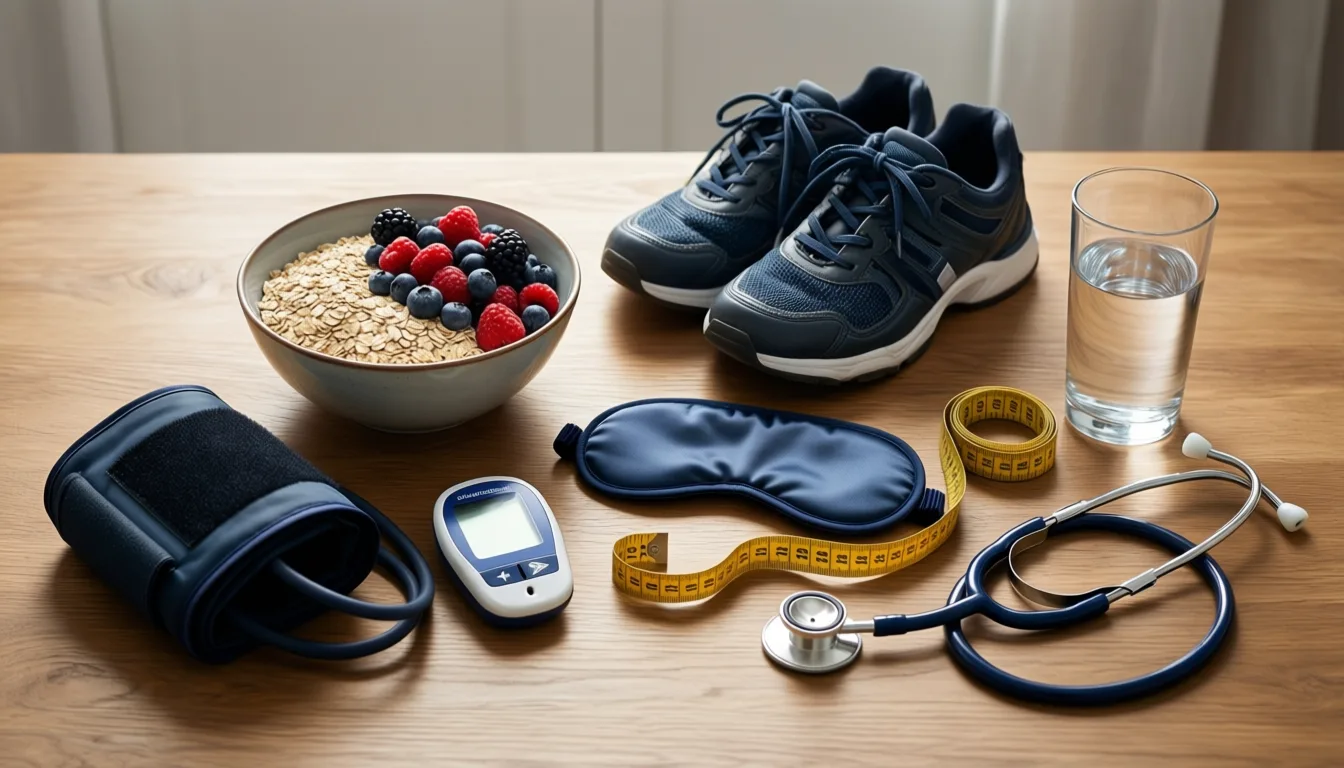
Four behaviors, four measurements. None of them new — but scored together, they map onto something biology seems to notice.
The clock they used
The aging metric here is PhenoAge, an algorithm that combines nine routine lab markers — things like albumin, creatinine, glucose, C-reactive protein, and white blood cell count — to estimate a person's phenotypic age. Subtract chronological age from that and you get PhenoAge advancement: positive means your biology is running ahead of your birthday, negative means behind. In this cohort, the average chronological age was 47.5 and the average PhenoAge was 44.6, suggesting most participants were aging slightly slower than the calendar — a reminder that the metric is calibrated against a population, not a verdict (Chen et al., 2025).
PhenoAge is one of several biological-age estimators in circulation, and reasonable scientists still argue about which one best captures the underlying process. It is a credentialed proxy, not gospel. Treat the relationship as directional: higher score, younger-looking biology, on average.
No vial required. Just the things your doctor already nags you about.
What this is — and isn't
A few honest caveats before anyone reorganizes their life around a number. NHANES is a cross-section: it photographs people once, so it cannot prove that raising your score will lower your biological age. The people scoring highest on Life's Essential 8 also tend to be wealthier, better-educated, and less burdened by the kinds of chronic stress that wear bodies down independently of diet or exercise. The authors adjusted for what they could; no statistical model erases the rest.
The effect size, too, is moderate. We are talking about a measurable but not theatrical slowdown in a laboratory estimate of aging — useful as a signal, not a promise of extra decades. And PhenoAge itself is a research tool, not something your primary care doctor is likely to report at your next physical.
What the study does offer is rare and worth holding onto: a coherent link between a checklist you can actually act on and a biomarker that tries, however imperfectly, to measure the thing we all care about. That is a better deal than most of what gets sold as longevity science.

Five of the eight — blood pressure, lipids, glucose, BMI, and a candid conversation about sleep and nicotine — already live inside an ordinary annual physical.
How to read your own score
The American Heart Association publishes a free online calculator under the My Life Check banner; punch in your numbers and you get a score out of 100. For most readers in this audience the interesting exercise is not the total but the spread: a 90 in blood pressure paired with a 40 in sleep tells you where the next year's attention belongs. The strength of the LE8 framework is that it refuses to let you trade a great cholesterol number for a terrible activity number — every component carries weight.
Talk the score over with your doctor rather than your group chat. The lab values in particular — lipids, glucose, blood pressure — are where a clinician's read matters, especially if you are already on medication that flatters the numbers without changing the underlying biology.
- One checklist, eight inputs. Diet, activity, nicotine, sleep, BMI, lipids, glucose, blood pressure — scored 0 to 100.
- The link is real but moderate. In 17,153 NHANES adults, higher LE8 scores tracked with a younger PhenoAge.
- Association, not causation. A snapshot study cannot prove that raising your score will reverse biological aging.
- Sleep and nicotine now count. The updated AHA scoring reflects newer evidence on both.
- Look at the spread, not just the total. A weak component is the one worth working on next.
- Bring the numbers to a clinician. Especially the lab values — context matters more than the score.
Frequently asked questions
What are the eight factors that make up Life's Essential 8?
The American Heart Association's checklist covers four behaviors — diet, physical activity, nicotine exposure, and sleep — and four measurements: body-mass index, blood lipids, blood glucose, and blood pressure. Each factor is scored on a 0-to-100 scale, and the scores are averaged.
What is PhenoAge, and how does it differ from your actual age?
PhenoAge is an algorithm that combines nine routine lab markers — including albumin, creatinine, glucose, C-reactive protein, and white blood cell count — to estimate a person's biological age. Subtracting your chronological age from your PhenoAge gives a measure of acceleration: a positive number means your biology is running ahead of your birthday, while a negative number means it is running behind.
How strong is the connection between a higher LE8 score and a younger biological age?
The study found each step up the LE8 scale was tied to a measurable slowdown in the aging clock (β = −1.22 in the adjusted model), but the authors describe this as a moderate effect, not a dramatic one. It is also an association from a cross-sectional study, not proof that raising your score will directly reverse biological aging.
What was added to Life's Essential 8 that was not in the older Life's Simple 7?
Sleep is now included in the scoring, reflecting evidence that short or fragmented sleep is a cardiovascular variable rather than merely a lifestyle quirk. Nicotine exposure was also expanded beyond cigarettes to include vaping and secondhand smoke.
How can I find out my own Life's Essential 8 score?
The American Heart Association publishes a free online calculator under the My Life Check banner where you can enter your numbers and receive a score out of 100. The article suggests focusing on the spread across the eight components rather than just the total, since a weak component indicates where future attention would be most useful.
Join the conversation
Comments are moderated and reviewed before they appear. Be constructive — this is health information.
Add your comment