
The New Biomarkers of Biological Age: From the Air You Breathe to the Repeats in Your DNA
Two fresh studies sharpen what 'biological age' actually measures — one tracing it to the air outside your window, the other to quiet patterns deep in the genome of people who reach 100.
For most of my reading life, "biological age" was a phrase that lived in the margins of serious medicine — a useful metaphor, but slippery. You knew it when you saw it: two men born the same week, one walking the dog at a brisk clip, the other winded at the mailbox. What you couldn't do was point to a number and say, with any confidence, that's what's happening under the hood. Two new studies, both published in 2025, make the number a little less slippery. One looks outward, at the air we breathe and the trees we walk past. The other looks inward, at small stretches of repeating DNA in the blood of people who have made it to 100. Neither is the last word. Together, they are a useful map of where the science is actually going.
The outward-looking study comes from a group working with UK Biobank data — a deep well of clinical measurements on hundreds of thousands of British adults. The researchers used a tool called PhenoAge, which estimates biological age from routine blood markers (things a physician already orders), then subtracts your chronological age to get what they call PhenoAgeAccel: a positive number means your body is running ahead of the calendar, a negative number means it's running behind. They ran this on roughly 156,000 people and compared each person's score with the air quality and greenspace around their home address.
The pattern was consistent in the direction you'd guess, if not always in the size you'd hope for. Higher exposure to fine particulate pollution (PM2.5 and the slightly coarser PM10) was associated with faster biological aging. More greenspace within roughly a kilometer of home was associated with the opposite. These are correlations, not causal verdicts — the authors are careful about that — but the dataset is large enough, and the markers concrete enough, that the signal is hard to wave away.
What the air study actually shows — and doesn't
A few things are worth holding steady here. First, PhenoAge is a model, not a verdict. It's a reasonable composite of blood chemistry — inflammation markers, kidney and liver values, glucose, a few others — that tracks mortality risk well in large populations. It does not tell any individual man how long he will live. Second, the effect sizes the team report are modest at the individual level. They become interesting because they show up across a very large group and in the directions biology would predict: dirtier air, faster apparent aging; more green around you, slower.
Third — and this is the part I found most useful — the team did subgroup analyses and reported that non-smokers, former smokers, people who drink, those carrying extra weight, and women appeared more sensitive to the air-and-greenspace exposures. That's a counterintuitive finding worth flagging rather than overselling. It may mean that once smoking dominates the signal, environmental exposures get harder to detect on top of it. It does not mean that current smokers are somehow protected from polluted air. The honest read is that the modifiers of this relationship are still being worked out.
PhenoAge is a model, not a verdict. It tracks risk in populations; it does not hand any one man a number for his calendar.
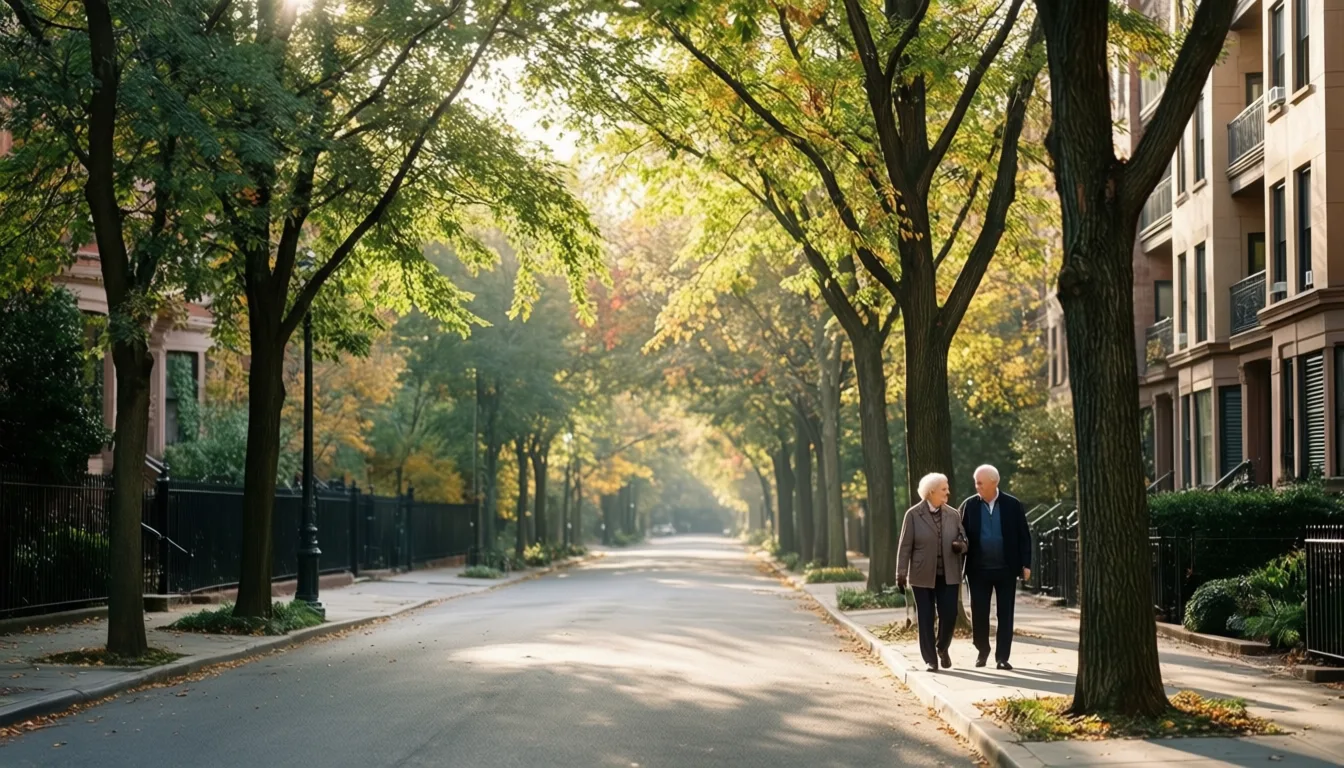
Roughly a kilometer of greenspace around the home was the buffer the UK Biobank team used. Most of us could draw that circle on a map without much trouble.
The view from the inside: what repeats in the genome are telling us
The second study takes the opposite vantage point. A team measured three kinds of repeating DNA sequences in blood leukocytes from 535 people aged 5 to 101: ribosomal repeats (the genes that build the cell's protein factories), a stretch called satellite III on chromosome 1q12, and the telomere repeats at the tips of our chromosomes that have become a kind of folk shorthand for aging.
The interesting group in this work is the centenarians — 106 people aged 90 to 101. Compared with younger groups, they stood out in three ways. Their ribosomal repeat content sat in a notably narrower band — less variation, person to person. Their satellite III content was higher. And, somewhat against the folk version of the telomere story, their telomere repeat content was lower. The authors also report a negative correlation between satellite III and telomere content, and propose two composite parameters (S/T and S/(R*T)) that rise with age and reach their highest values in the oldest cohort.
What to make of it. This is a cross-sectional snapshot — different people at different ages, not the same people followed for decades — so it cannot tell us whether the centenarians arrived at this pattern because of how they aged, or because they were built that way from the start. The sample of very old people is modest. And the measurement technique (non-radioactive quantitative hybridization) is well-established but specialized; replication in other labs and other populations is the next thing to watch for. What the authors are proposing, carefully, is that these parameters may turn out to be useful predictors of life expectancy in late life. That is a hypothesis worth tracking, not a clinical tool to ask your doctor about next week.
Why these two papers belong in the same conversation
For years, the longevity field has had a credibility problem: too many single-mechanism stories, too many supplements sold on the back of a mouse experiment. What's quietly changing is the shape of the evidence. PhenoAge is a population-scale tool built from boring blood markers your physician already understands. The repeat-content work is a population-scale tool built from a few specific, measurable features of the genome. Neither asks you to believe in a miracle. Both are trying to give "biological age" a number you could, in principle, audit.
Read together, they sketch a sensible frame. The outside world — the air on your street, the trees in your line of sight — appears to leave a measurable trace on the blood-chemistry version of biological age. The inside world — the architecture of your own DNA — appears to carry signatures that distinguish people who reach very old age from the rest of us. Both signals are real enough to take seriously and modest enough to keep in proportion.
- Biological age is becoming measurable, cautiously. PhenoAge turns routine bloodwork into a single composite. It's a research tool that tracks risk in large groups, not a personal verdict.
- Air and greenspace correlate with the score. In 156,690 UK adults, higher PM2.5 and PM10 tracked with faster apparent aging; more greenspace within ~1 km tracked with slower. Correlation, not proof of cause.
- Centenarians carry a distinct DNA-repeat signature. Lower telomere content, higher satellite III, and a tight band of ribosomal repeat content set the 90–101 cohort apart.
- The folk telomere story needs an asterisk. "Longer telomeres = longer life" is too simple; in this snapshot, the longest-lived had lower telomere repeat content.
- Subgroup effects are still being sorted. Non-smokers, drinkers, those with higher BMI, and women showed greater sensitivity to environmental exposures — a finding to watch, not to act on.
- Nothing here changes the basics. Don't smoke, keep moving, sleep, eat like an adult, and talk to a clinician about your own numbers. The new biomarkers refine the picture; they don't replace it.

Both studies were built on routine blood samples — a reminder that some of the most informative work in aging is still being done with familiar tools.
The honest summary, for a man my age and yours, is this. We are getting better at measuring how we are aging, and the measurements are starting to point at two places at once: the environment we choose (or are stuck with) and the genome we were issued. Neither of these papers tells you to buy anything. Both suggest that the smaller, duller decisions — where you walk, how clean the air is on that walk, what your standard bloodwork actually says — are quietly the ones the science keeps circling back to. That is not a thrilling headline. It happens to be a durable one.
Frequently asked questions
What is PhenoAge and how does it calculate biological age?
PhenoAge estimates biological age from routine blood markers — things like inflammation markers, kidney and liver values, and glucose — that a physician already orders. It then subtracts a person's chronological age to produce a score called PhenoAgeAccel, where a positive number means the body is running ahead of the calendar and a negative number means it is running behind.
What did the UK Biobank study find about air pollution and biological aging?
In roughly 156,690 UK adults, higher exposure to fine particulate pollution (PM2.5 and PM10) was associated with faster biological aging, while more greenspace within approximately one kilometer of home was associated with slower biological aging. The authors describe these as correlations, not causal verdicts.
How did the DNA of centenarians differ from younger people in the repeat-content study?
Compared with younger groups, the 106 people aged 90 to 101 had ribosomal repeat content within a notably narrower band, higher satellite III content, and lower telomere repeat content. The authors also identified two composite parameters that rise with age and reached their highest values in this oldest cohort.
Does the research confirm that longer telomeres mean a longer life?
The article flags this as a finding that complicates the popular story: centenarians actually showed lower telomere repeat content compared with younger groups, which runs against the common shorthand that longer telomeres equal longer life. The authors note a negative correlation between satellite III and telomere content in their data.
Which groups showed the greatest sensitivity to air quality and greenspace exposures?
The UK Biobank team's subgroup analyses found that non-smokers, former smokers, people who drink, those carrying extra weight, and women appeared more sensitive to air-and-greenspace exposures. The article suggests this may be because smoking so strongly dominates the biological signal that environmental exposures become harder to detect on top of it.
Sources
- Associations between environmental air pollution, greenspace and apparent biological aging: a cross-sectional study. — GeroScience
- Variation in the Content of Three Tandem Repeats of the Human Genome (Ribosomal, Satellite III, and Telomere) in Peripheral Blood Leukocyte DNA of People of Different Ages (5-101 Years). — Journal of aging research
Join the conversation
Comments are moderated and reviewed before they appear. Be constructive — this is health information.
Add your comment