
The New Map of Aging: How Multiomics and Ribosome Biology Are Rewriting Longevity Science
A wave of 2025 research is pushing aging biology past single-pathway thinking — toward an integrated, system-level model that includes surprising new players like rRNA methylation and the slow failure of cellular recycling.
For two decades, longevity science has been organized around a short list of usual suspects — mTOR, sirtuins, senescent cells, telomeres — each pursued as if it might be the master switch hiding inside the machine. The work of 2025 suggests something more interesting and more humbling: there is no single switch. Aging is a weather system, not a thermostat, and a cluster of new papers is finally giving researchers the instruments to read it that way. The result is the early outline of a new map — one that integrates epigenomes with proteomes, pulls comparative genomics from 141 bird species into the conversation, and finds unexpected leverage points inside the ribosome itself.
The clearest articulation of this shift comes from a 2025 Epigenomics perspective arguing that traditional reductionist approaches, while valuable, simply cannot capture aging's systemic nature. The author makes the case for multiomics — the integration of genomics, transcriptomics, epigenomics, proteomics, and metabolomics — as a framework to study aging as an interconnected network rather than a sequence of isolated failures. Epigenetic alterations, in this view, are not just hallmarks of aging but powerful biomarkers of biological age, and the new generation of multiomic aging clocks, cross-tissue atlases, and single-cell spatial technologies are beginning to decode the process at a resolution that was unthinkable five years ago.
That framing matters because it changes what counts as a target. A pathway-centric view asks: which lever extends life? A systems view asks: which configurations of the network are youthful, and how do they drift? The same perspective extends a concept the author introduced in earlier work — pathological epigenetic events that are reversible, or PEERs: epigenetic alterations linked to early-life exposures that predispose to aging and disease but may be therapeutically modifiable. If that hypothesis holds, the most consequential interventions of the next decade may not target aging itself, but the early-life inscriptions that bias the system toward decline.
- The frame is shifting. 2025 work argues aging must be read as an integrated multiomic network, not a stack of isolated pathways.
- Ribosomes are not neutral. A specific rRNA methyltransferase, DIMT-1, regulates lifespan in C. elegans germline tissue later in life.
- Autophagy decline has structure. A 2024 review maps where, mechanistically, the cellular recycling system falters with age.
- Birds are a new lens. Comparative genomics across 141 bird species surfaces convergent longevity genes tied to metabolism and cell-cycle control.
- Evidence rating: early. Most of this is preclinical, comparative, or conceptual. Promising signal — not clinical guidance.
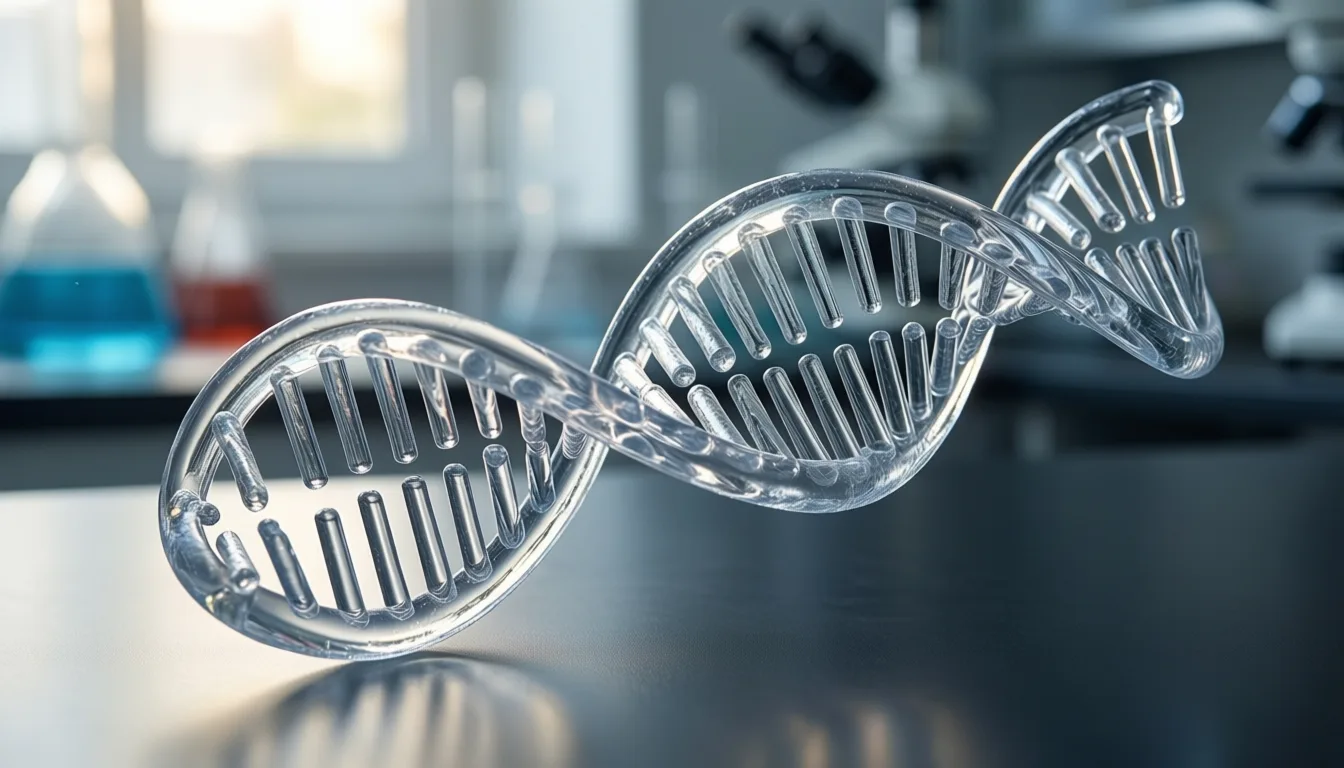
The ribosome — long treated as a passive translator — is emerging as an active regulator of which proteins get made in late life.
The ribosome stops being neutral
For most of molecular biology's history, the ribosome was treated as a faithful stenographer: a uniform machine that translated whatever mRNA arrived. That picture is breaking. A 2025 Nature Communications study examined ribosomal RNA methylation as a regulator of translation in aging organisms and identified an unexpected player. In a directed RNAi screen in C. elegans, the authors found that the 18S rRNA N6'-dimethyl adenosine methyltransferase DIMT-1 functions in the germline after mid-life to regulate lifespan and stress resistance.
The mechanism is elegant. Depleting dimt-1 doesn't shut translation down; it biases it. Loss of DIMT-1 leads to selective translation of transcripts important for stress resistance and lifespan regulation, including the cytochrome P450 daf-9, which synthesizes a steroid that signals from the germline to the soma — and the lifespan extension depends on that daf-9 pathway. Specialized ribosomes, in other words, appear to be a mechanism by which the germline tells the rest of the body how to age. Whether anything analogous operates in mammals is unknown. But the conceptual move — from ribosome-as-printer to ribosome-as-editor — is the kind of reframing that tends to outlive the specific paper that introduced it.
Aging is a weather system, not a thermostat — and we are finally building the instruments to read it that way.
The slow failure of cellular recycling
If the ribosome story is about which proteins get made, the autophagy story is about which ones get cleared. Autophagy — the cellular recycling process that degrades protein aggregates, damaged mitochondria, and other cytoplasmic debris — has long been linked to longevity in model organisms. The challenge has been that autophagy is a complex, multistep process orchestrated by more than 40 autophagy-related proteins with tissue-specific expression patterns and context-dependent regulation, which makes it genuinely difficult to determine how it fails with age.
A 2024 Cells review walks through the pathway step by step and catalogs the age-dependent molecular changes reported at each stage. The picture that emerges is not a single broken part but a slow loss of coordination — a system in which initiation, cargo recognition, vesicle formation, and lysosomal fusion each accumulate small defects that compound. The review also synthesizes evidence that genetic manipulations of autophagy-related genes can affect lifespan and healthspan in model organisms and age-related disease models, which is why so many geroprotective candidates — from rapamycin to dietary restriction mimetics — keep landing on autophagy as a downstream node. Understanding precisely where the pathway falters may matter more for future therapeutics than identifying yet another upstream regulator.

Birds span an extraordinary range of lifespans for their size — a natural experiment researchers are now mining at the genome scale.
What 141 bird genomes are telling us
The fourth piece of the new map comes from an unlikely place: comparative ornithology. Birds are an evolutionary anomaly — many species live far longer than mammals of equivalent body mass, which makes them a natural experiment in longevity. A 2025 Aging Cell study leveraged this by analyzing the genomic resources of 141 bird species to look for molecular signatures of extremely long and short lifespans.
The result is what the authors call a lifespan network. Birds with similar lifespans exhibit convergent evolution in specific genes regardless of body mass and phylogenetic relationship, enabling the construction of a protein–protein interaction network that highlights the interplay between metabolism and cell cycle control as key processes in avian lifespan regulation. Convergence across distantly related lineages is one of the strongest signals evolutionary biology can offer — if independent species keep landing on the same genes, those genes are probably doing real work. The authors argue the approach provides evidence for shared mechanisms of lifespan regulation across organisms and enables the identification of new candidates for studying aging, particularly in humans. That last clause is the careful one: candidates, not cures.
What the new map actually says
Read together, these four papers describe a research program rather than a result. The multiomics perspective supplies the framework. The DIMT-1 study supplies an unexpected mechanism inside a system — translation — that most longevity researchers had treated as background. The autophagy review supplies a structured account of how a key proteostasis pathway degrades. And the avian network supplies an evolutionary cross-check, showing which pathways nature itself has repeatedly tuned for longer life.
None of this is clinical. The worm study is a worm study; the bird study is a comparative genomics analysis; the autophagy work is mechanistic; the multiomics piece is explicitly a perspective. What is changing is the shape of the questions researchers can now ask — and the kinds of biomarkers, clocks, and targets that follow from asking them. For readers tracking the field, the signal worth holding onto is not any single molecule. It is that the era of one-pathway longevity stories is closing, and the era of network-level aging biology has, quietly, begun.
Frequently asked questions
What is multiomics, and why are researchers applying it to aging?
Multiomics is the integration of genomics, transcriptomics, epigenomics, proteomics, and metabolomics into a unified framework. Researchers are applying it to aging because traditional reductionist approaches cannot capture aging's systemic nature, and the goal is to study aging as an interconnected network rather than a sequence of isolated failures.
What role did DIMT-1 play in the C. elegans lifespan study?
DIMT-1 is an 18S rRNA methyltransferase that was found to function in the germline after mid-life to regulate lifespan and stress resistance. Depleting it does not shut down translation but biases it, selectively promoting translation of transcripts important for stress resistance and lifespan regulation, including the cytochrome P450 daf-9, which synthesizes a steroid that signals from the germline to the rest of the body.
Why is autophagy decline with age difficult to study?
Autophagy is a complex, multistep process orchestrated by more than 40 autophagy-related proteins with tissue-specific expression patterns and context-dependent regulation. Rather than a single broken part, age-related decline reflects a slow loss of coordination in which initiation, cargo recognition, vesicle formation, and lysosomal fusion each accumulate small defects that compound.
What did analyzing 141 bird genomes reveal about longevity?
The study found that birds with similar lifespans exhibit convergent evolution in specific genes regardless of body mass and phylogenetic relationship, pointing to metabolism and cell cycle control as key processes in avian lifespan regulation. The authors argue this convergence across distantly related lineages suggests shared mechanisms of lifespan regulation across organisms.
What are PEERs, and why might they be significant for future aging interventions?
PEERs — pathological epigenetic events that are reversible — are epigenetic alterations linked to early-life exposures that predispose individuals to aging and disease but may be therapeutically modifiable. If the hypothesis holds, the article suggests the most consequential interventions of the next decade may target these early-life inscriptions rather than aging itself.
Sources
- The emerging role of multiomics in aging research. — Epigenomics
- The 18S rRNA methyltransferase DIMT-1 regulates lifespan in the germline later in life. — Nature communications
- Molecular Mechanisms of Autophagy Decline during Aging. — Cells
- Avian Lifespan Network Reveals Shared Mechanisms and New Key Players in Animal Longevity. — Aging cell
Join the conversation
Comments are moderated and reviewed before they appear. Be constructive — this is health information.
Add your comment