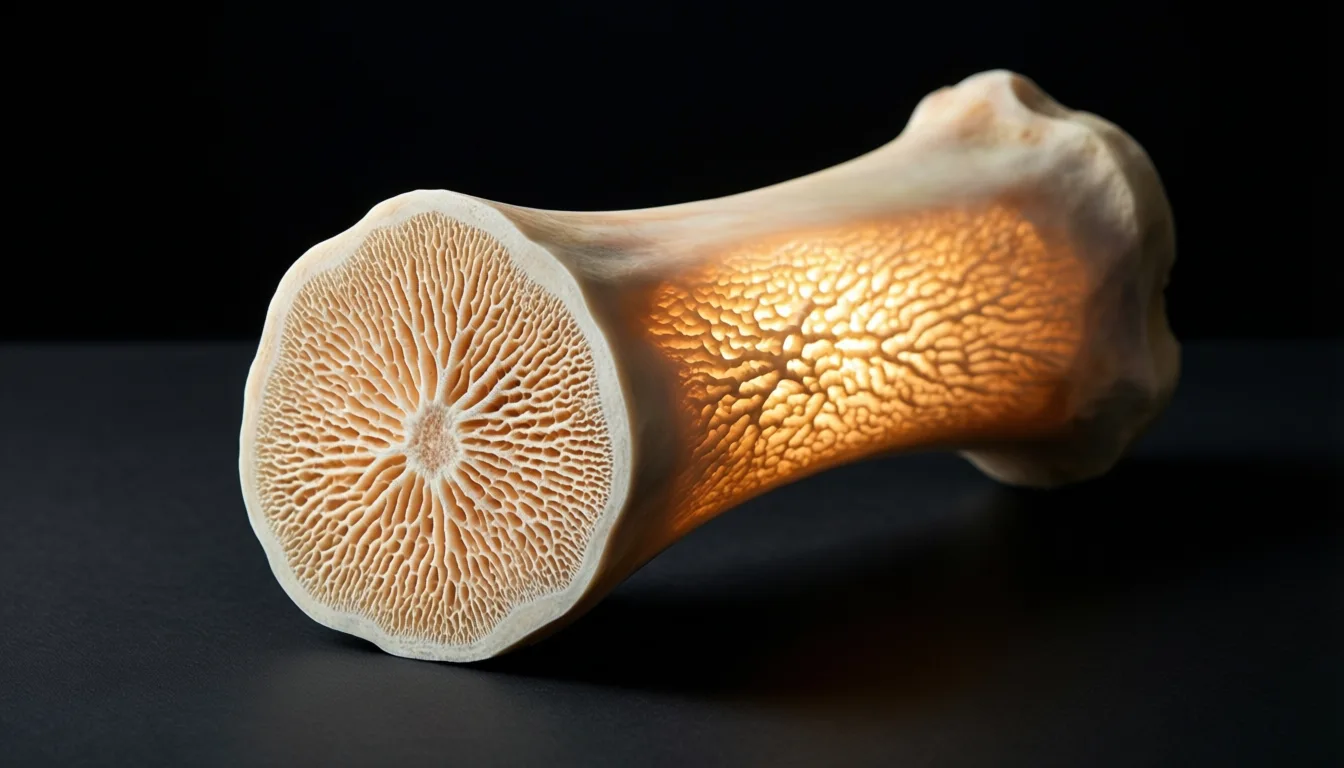
Senolytics Go Mainstream: Killing Zombie Cells to Save Aging Bones
Two 2025 studies converge on a striking thesis — that clearing senescent cells, with drugs or even intermittent pressure, may halt age-related bone loss in mice. Here's what the preclinical signal actually says.
The cells refuse to die. They linger in aging tissue like guests who will not leave the party, secreting a low-grade chemical smog that inflames their neighbors and corrodes the architecture around them. Biologists call them senescent — colloquially, zombie cells — and over the past decade they have emerged as one of the most tractable villains in the biology of aging. In 2025, two converging lines of research sharpened that story considerably for one tissue in particular: bone. A review in Biomolecules mapped the expanding pharmacopeia of senolytic drugs being aimed at osteoporosis, while a paper in Nature Biomedical Engineering reported something stranger and more cinematic — that intermittent hypobaric pressure, applied to aged mice, selectively kills senescent cells and rescues their crumbling skeletons.
- The thesis. Senescent cells accumulate in aging bone and appear to drive osteoporosis in preclinical models.
- Two modalities. Senolytic drugs (natural compounds, Bcl-2 inhibitors, HSP90 inhibitors and more) and, newly, intermittent hypobaric pressure both target these cells.
- A new mechanism. Hypobaric pressure activates a TMEM59 → calpain-2 → LAMP2 pathway, triggering lysosome-dependent death in senescence-prone cells.
- Strong animal data. Intermittent pressure extended lifespan and reversed osteoporosis phenotypes in aged mice.
- Important caveat. The evidence is animal-preclinical; human senolytic trials have so far diverged from the rodent results.
Why bone became the proving ground
Bone is, in a sense, the perfect tissue in which to interrogate cellular senescence. It is constantly remodeled by a tightly choreographed duet between osteoblasts that build matrix and osteoclasts that resorb it; when that choreography slips with age, the result is osteoporosis — porous, fracture-prone skeletons that fail under loads they once shrugged off. Senescent osteocytes and marrow stromal cells appear to tilt the balance toward resorption, partly through the inflammatory cocktail known as the senescence-associated secretory phenotype, or SASP.
The 2025 Biomolecules review by Chen and colleagues catalogues the drug classes now being tested against this process: natural compounds, kinase inhibitors, Bcl-2 family inhibitors, MDM2/p53 disruptors, HSP90 inhibitors, p53-binding inhibitors, and HDAC inhibitors. The authors are clear about the shape of the evidence. In genetically modified and preclinical animal models, eliminating persistent senescent cells delays and even prevents osteoporosis. In humans, the picture is messier — clinical results have diverged from preclinical evidence, and the reviewers urge that senolytics be evaluated critically rather than enthusiastically.
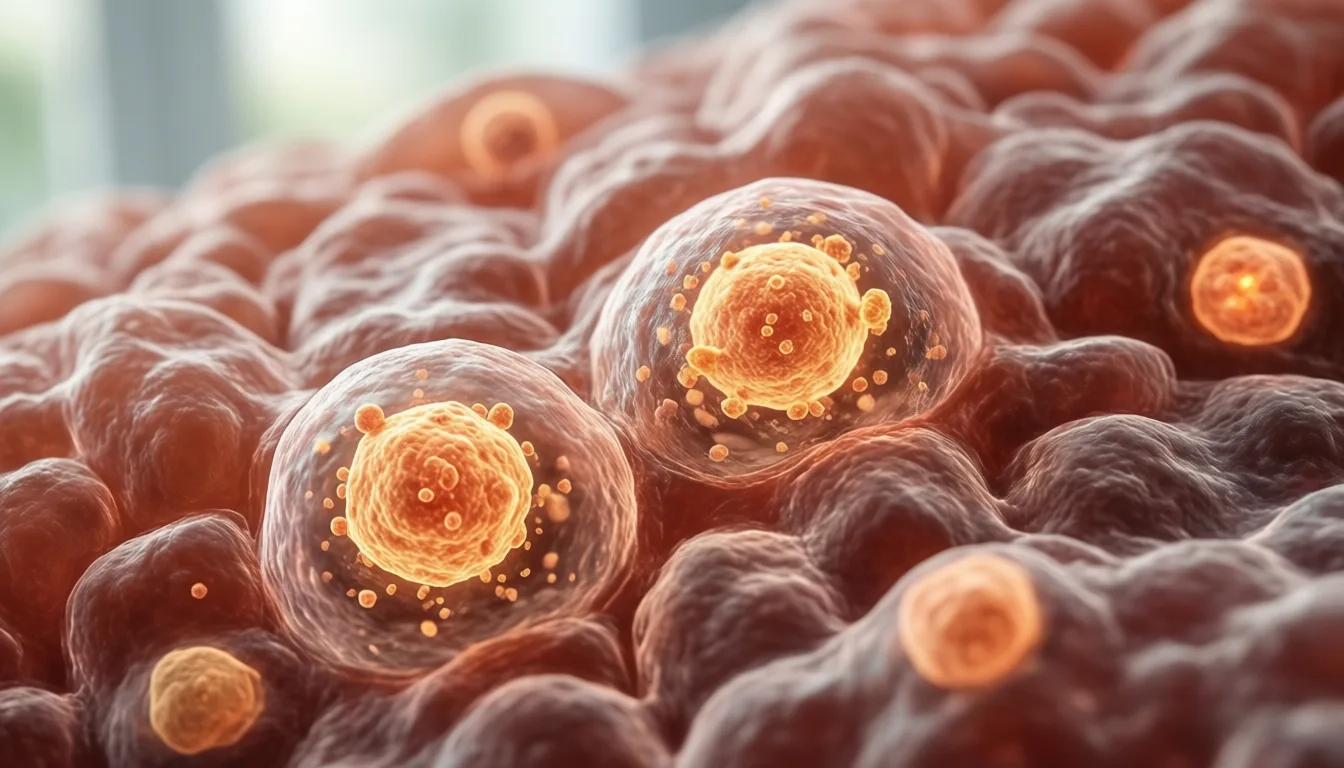
Senescent cells make up a small fraction of aging tissue but exert outsized effects through inflammatory secretions.
The pressure experiment
The more startling 2025 result comes from Meng and colleagues, writing in Nature Biomedical Engineering. Their question was almost mischievous: could a physical condition — not a molecule — act as a senolytic? They subjected cells to hypobaric pressure at −375 mmHg, without hypoxia, and watched what happened. The cells died, but not by any of the familiar routes. Instead, they underwent lysosome-dependent cell death, a relatively obscure pathway in which the cell's own digestive compartments rupture from within.
The mechanism the authors unpicked is elegant. Hypobaric pressure activates a transmembrane protein called TMEM59, which the team identifies as a previously unknown pressure-activated ion channel. That gates a calcium influx, which switches on the protease calpain-2, which in turn cleaves LAMP2 — a structural protein that keeps lysosomal membranes intact. With LAMP2 chewed up, lysosomes leak, and the cell digests itself.
The cells with the most lysosomes are the ones most likely to be torn apart from inside — and senescent cells, conveniently, are packed with them. Reading of Meng et al., Nature Biomedical Engineering, 2026
That last detail is the hinge of the whole argument. Senescent cells are notoriously lysosome-rich, which is why they stain so vividly for beta-galactosidase in classic senescence assays. A mechanism that exploits lysosomal abundance is therefore intrinsically selective: it preferentially kills the cells you want to clear and largely spares the rest. When the researchers translated their bench finding into a regimen of intermittent hypobaric exposure in aged mice, they reported two outcomes that will get any longevity reader's attention — the treatment substantially extended lifespan and rescued the osteoporosis phenotype, alongside a reduction in SASP markers.

The intervention is mechanical, not pharmacological — a pressure cycle rather than a pill.
How excited should we actually be?
The honest answer is: cautiously, and along two separate axes. The drug story has been brewing for a decade, and the 2025 review is essentially a status report on a field still waiting for its first unambiguous human win. Senolytic combinations like dasatinib-plus-quercetin and the flavonoid fisetin have produced striking results in mice and ambiguous-to-disappointing results in early human studies; the Biomolecules authors flag this gap explicitly and call for more rigorous validation before any of these compounds is treated as a bone therapy.
The pressure story is newer, more mechanistically novel, and — for that reason — even further from any clinical recommendation. A single preclinical paper, however elegant, establishes a hypothesis, not a therapy. The translational questions are obvious and unanswered: what pressure profile is safe in humans, who would be eligible, what tissues beyond bone respond, and whether the lifespan extension reported in mice reflects a clean senolytic effect or a tangle of confounders that look like one. The authors themselves position the work as a proof of concept that physical conditions can act as senolytics, not as a turnkey intervention.
The bigger frame
Step back from the specifics and what these two papers share is a maturing view of senescence as a druggable — and now, perhaps, a physically targetable — axis of aging. For years the senolytic field has been preoccupied with finding molecules that hit Bcl-2 or p53 networks selectively enough to spare healthy cells. The Meng paper widens the aperture: if lysosomal load is itself a vulnerability, then any intervention that destabilizes lysosomes preferentially in senescent cells is, in principle, a senolytic. That is a conceptual gift to the field, regardless of whether intermittent pressure ever reaches a clinic.
For osteoporosis specifically, the convergence matters. Bone disease has long been treated as a problem of mineral metabolism and remodeling signals — bisphosphonates, denosumab, romosozumab. The senolytic frame reinterprets at least some of that pathology as collateral damage from a small population of misbehaving cells. If the preclinical signal holds up in humans — a real if — the next generation of bone drugs may look less like remodelers and more like cellular janitors.
For now, the most defensible posture is the one the reviewers themselves recommend: treat senolytics as one of the most promising and least proven ideas in longevity medicine, and watch the next round of trials closely.
Frequently asked questions
What makes senescent cells harmful to aging bone specifically?
Senescent osteocytes and marrow stromal cells appear to tilt the balance between bone-building osteoblasts and bone-resorbing osteoclasts toward resorption. They do this partly through an inflammatory cocktail of secretions known as the senescence-associated secretory phenotype, or SASP. Even though they make up a small fraction of aging tissue, their outsized inflammatory effects can corrode the surrounding architecture.
Why does hypobaric pressure kill senescent cells more than healthy ones?
The mechanism exploits the fact that senescent cells are unusually rich in lysosomes — the cell's own digestive compartments. The pressure triggers a pathway that ruptures lysosomes from within, so cells with the most lysosomes are most likely to be destroyed. Because senescent cells are packed with lysosomes by nature, the effect is intrinsically selective.
What is the chain of events that hypobaric pressure sets off inside a cell?
Hypobaric pressure activates a transmembrane protein called TMEM59, which the researchers identified as a previously unknown pressure-activated ion channel. That channel allows calcium to enter the cell, which switches on the protease calpain-2, which then cleaves LAMP2 — a structural protein that normally keeps lysosomal membranes intact. Once LAMP2 is degraded, lysosomes leak and the cell digests itself.
Have senolytic drugs shown the same promising results in humans as in animals?
No. The article notes that clinical results have diverged from preclinical evidence, and combinations like dasatinib-plus-quercetin and the flavonoid fisetin have produced striking results in mice but ambiguous-to-disappointing results in early human studies. The Biomolecules reviewers explicitly call for these compounds to be evaluated critically rather than enthusiastically, and for more rigorous validation before any is treated as a bone therapy.
What drug classes are currently being tested as senolytics for osteoporosis?
According to the 2025 Biomolecules review described in the article, the classes being tested include natural compounds, kinase inhibitors, Bcl-2 family inhibitors, MDM2/p53 disruptors, HSP90 inhibitors, p53-binding inhibitors, and HDAC inhibitors — more than seven distinct categories in total.
Sources
- The Role of Senolytics in Osteoporosis. — Biomolecules
- Intermittent hypobaric pressure induces selective senescent cell death and alleviates age-related osteoporosis. — Nature biomedical engineering
Join the conversation
Comments are moderated and reviewed before they appear. Be constructive — this is health information.
Add your comment