
Senotherapeutics 2.0: A Reishi Molecule, Rapamycin's Shadow, and the AI Hunt for Anti-Aging Drugs
A reishi-derived compound matched rapamycin in worms and rejuvenated aged mice. A parallel review maps how machine learning is industrializing the search for the next generation of senolytics.
For two decades, rapamycin has been the benchmark against which every aspiring longevity drug is measured — the molecule that bent the lifespan curve in worms, flies, and mice, and made geroscience a serious discipline. So when a team of Chinese researchers reported in Nature Communications this year that a compound extracted from the reishi mushroom extended lifespan and healthspan in C. elegans as effectively as rapamycin, the claim deserved a careful look. What they found is one of the more interesting preclinical signals of the year — and a useful case study in how the senotherapeutics pipeline is being rebuilt around high-content screens and machine learning.
The compound is ganoderic acid A, or GAA, a triterpenoid that gives Ganoderma lucidum its bitter edge and much of its traditional reputation. Reishi has been a staple of East Asian herbal pharmacopeias for centuries, which is exactly the kind of provenance that should make a longevity reader cautious: the gap between ethnobotanical folklore and a validated geroprotector is wide, and littered with overhyped extracts. What is different here is the route by which GAA surfaced. The Chen et al. team did not start with reishi; they started with a high-content screen for compounds that suppress markers of cellular senescence at low toxicity, and GAA emerged from that funnel.
Senescent cells are the central villain of modern geroscience. They stop dividing but refuse to die, accumulate in aged tissues, and secrete a stew of inflammatory signals — the senescence-associated secretory phenotype, or SASP — that drives much of the functional decline we associate with getting older. Drugs that selectively kill these cells (senolytics) or quiet their secretions (senomorphs/senostats) are collectively called senotherapeutics, and they are arguably the most active frontier in translational longevity research.
What the mushroom molecule actually did
In C. elegans, GAA extended both lifespan and healthspan to a degree comparable with rapamycin — the appropriate framing here is parity in a worm model, not superiority in humans. The mouse data are where things get more textured. The investigators tested GAA in three separate aging models: mice given irradiation to induce premature aging, naturally aged mice, and mice fed a Western diet to drive metabolic decline. Across all three, GAA reduced the accumulation of senescent cells and blunted physiological decline across multiple organs, and aged mice on the compound showed improved physical function and better metabolic flexibility.
Mechanistically, the team reports that GAA binds directly to TCOF1, a nucleolar protein involved in ribosome biogenesis, and that this interaction helps maintain ribosome homeostasis — a pathway increasingly implicated in cellular senescence. That is a more specific molecular story than most natural-product longevity claims offer, and it gives the finding something to be falsified against.
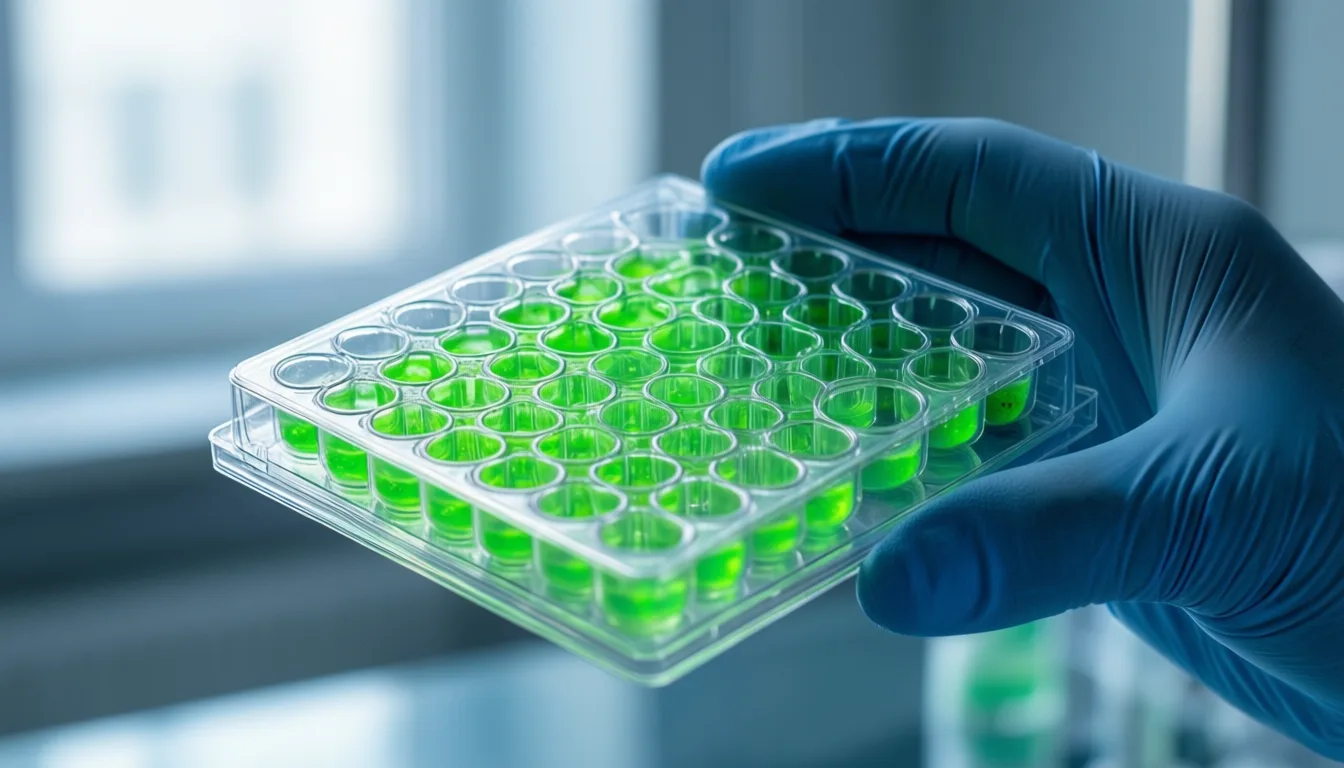
High-content screening — imaging thousands of compound-treated cells at once — is what surfaced GAA from a crowded field of candidates.
Parity with rapamycin in a worm is a headline. Parity in a human is a hypothesis. On reading preclinical longevity data
The bigger shift: AI is rebuilding the pipeline
GAA is interesting on its own, but it is more interesting as an artifact of how senotherapeutic discovery is changing. A parallel 2025 review in Advances in Pharmacology lays out the broader picture: the field is moving from hand-curated candidate lists toward machine-learning-driven discovery using random forests, support vector machines, neural networks, and predictive modeling, layered on top of omics data and phenotypic screens.
The review is candid about why this matters. Senotherapeutic translation has been hampered by three persistent problems: the absence of clean biomarkers for senescence, fragmented understanding of the molecular pathways linking senescent cells to disease, and a thin pharmacopeia of selective drugs. AI/ML tools attack all three by triaging huge compound libraries, integrating multi-omics signatures of senescence, and surfacing candidates a human curator would miss. The review also flags the obvious caveats — data quality is uneven, model interpretability is a real bottleneck, and predictive performance in a screen does not equal efficacy in a patient.
Read together, the two papers describe a maturing pipeline rather than a breakthrough drug. High-content phenotypic screening picks GAA out of a haystack; mechanistic work pins it to TCOF1; mouse models suggest broad-spectrum effects; and the methodological scaffolding around all of this is increasingly computational. It is the kind of compounding infrastructure that, over a decade, tends to produce real drugs.

Machine-learning models are increasingly the first filter through which candidate senotherapeutics pass.
What this means for a longevity reader in 2026
The honest framing is this: GAA is a credible preclinical signal, not a clinical recommendation. Worms are not people. Mice given a defined, characterized compound at a defined dose by trained investigators are not consumers buying reishi extracts of variable potency from the wellness aisle. The dose, formulation, and purity used in the published work are not the dose, formulation, or purity in any commercial supplement, and human pharmacokinetics, safety windows, and chronic-use effects for GAA at geroprotective levels have not been established.
The intellectually exciting part is what the paper implies about the search process. If a high-content screen can pull a previously-overlooked triterpenoid out of a natural-product library and pin it to a specific ribosomal-homeostasis mechanism, the same approach — accelerated by the ML methods catalogued in the companion review — is likely to surface more candidates with cleaner profiles than the first-generation senolytics like dasatinib-plus-quercetin or fisetin.
- Preclinical only. GAA's lifespan and healthspan effects were shown in worms and mice; no human trial data exist yet.
- Rapamycin parity is in worms. The comparison is meaningful as a benchmark, not as a clinical claim.
- A real mechanism. GAA binds TCOF1 and helps maintain ribosome homeostasis — a specific, testable hypothesis.
- Three mouse models, consistent direction. Irradiated, naturally aged, and Western-diet mice all showed reduced senescent-cell burden.
- The pipeline is the story. AI/ML-driven discovery is reshaping how senotherapeutic candidates are found and prioritized.
- Don't self-prescribe. Commercial reishi supplements are not the studied compound at the studied dose; discuss any longevity intervention with a clinician.
Frequently asked questions
What is ganoderic acid A, and how was it identified as a potential longevity compound?
Ganoderic acid A (GAA) is a triterpenoid extracted from the reishi mushroom (Ganoderma lucidum) that gives it its bitter edge and much of its traditional reputation. It was not identified by starting with reishi; instead, it emerged from a high-content screen designed to surface compounds that suppress markers of cellular senescence at low toxicity.
What does it mean that GAA showed 'parity with rapamycin,' and why is that comparison limited?
In C. elegans (roundworms), GAA extended both lifespan and healthspan to a degree comparable with rapamycin — the appropriate framing is parity in a worm model, not superiority in humans. The article is explicit that parity with rapamycin in a worm is a headline, while parity in a human remains a hypothesis.
What mouse models were used in the GAA research, and what did they show?
Researchers tested GAA in three mouse aging models: mice given irradiation to induce premature aging, naturally aged mice, and mice fed a Western diet to drive metabolic decline. Across all three, GAA reduced the accumulation of senescent cells and blunted physiological decline across multiple organs, with aged mice also showing improved physical function and better metabolic flexibility.
What is the molecular mechanism by which GAA is thought to work?
The research team reports that GAA binds directly to TCOF1, a nucleolar protein involved in ribosome biogenesis, and that this interaction helps maintain ribosome homeostasis — a pathway increasingly implicated in cellular senescence. The article notes this is a more specific molecular story than most natural-product longevity claims offer.
Can someone take commercial reishi supplements to replicate the effects seen in this research?
The article cautions that commercial reishi supplements are not the studied compound at the studied dose, noting that the dose, formulation, and purity used in the published work differ from what is available in the wellness aisle. Human pharmacokinetics, safety windows, and chronic-use effects for GAA at geroprotective levels have not been established, and no human trial data exist yet.
Sources
- High-content screening identifies ganoderic acid A as a senotherapeutic to prevent cellular senescence and extend healthspan in preclinical models. — Nature communications
- Next-gen senotherapeutics: AI/ML-driven strategies for aging and age-related disorders. — Advances in pharmacology (San Diego, Calif.)
Join the conversation
Comments are moderated and reviewed before they appear. Be constructive — this is health information.
Add your comment