
Three Quiet Signals of How You're Actually Aging
New 2025 population research points to surprisingly accessible markers — what's in your urine, the length of your reproductive years, and a single honest question about your health — that track biological age.
Somewhere between the birthday on your driver's license and the body you actually live in, a second clock is running. Researchers call it biological age, and for years measuring it has required expensive panels and proprietary algorithms. But a cluster of large studies published in 2025 quietly suggests something more useful for the rest of us: the signals that track how well a woman is aging may already be sitting in her medical history, her diet, and the answer she gives when someone asks how she's feeling. None of these are miracle metrics. Taken together, though, they sketch a more honest portrait of who is aging well — and why.
- Phytoestrogens in urine — particularly enterolignans from seeds, whole grains, and vegetables — were associated with slower biological aging in a U.S. population sample.
- Reproductive lifespan — the years between menarche and menopause — tracked with frailty trajectories in more than 300,000 Chinese women.
- A single self-rated health question showed a dose-response link to cardiometabolic disease in older adults, with each step down in self-rating roughly doubling the odds.
- The evidence is moderate, not definitive: these are observational studies that show association, not proof of cause.
- The practical message is consistent: diet quality, reproductive history, and self-perception deserve a seat at the longevity table alongside lab panels.
Signal one: what's quietly circulating from your diet
Phytoestrogens are plant compounds — isoflavones from soy and legumes, enterolignans produced when gut bacteria ferment seeds, whole grains, and certain vegetables — that loosely mimic estrogen in the body. They've been studied for decades in the context of menopausal symptoms, with mixed results. The newer question is whether they leave a fingerprint on aging itself.
A 2025 cross-sectional analysis of 7,981 adults in the U.S. National Health and Nutrition Examination Survey took a careful look. Researchers measured six urinary phytoestrogens and compared them with three accepted indicators of biological age built from twelve clinical biomarkers. After adjusting for demographics, lifestyle, and chronic disease history, higher urinary total phytoestrogens and enterolignans were associated with less accelerated biological aging across multiple measures. Isoflavones showed a narrower but still favorable signal.
What this is not: proof that adding a soy latte will turn back the clock. The study is a snapshot, not a trial, and urinary phytoestrogens reflect both what people eat and how their gut microbiome processes it. What it does suggest is that the broadly plant-forward diets cardiologists and dietitians have been recommending for years may show up, biochemically, as a slower aging signature.
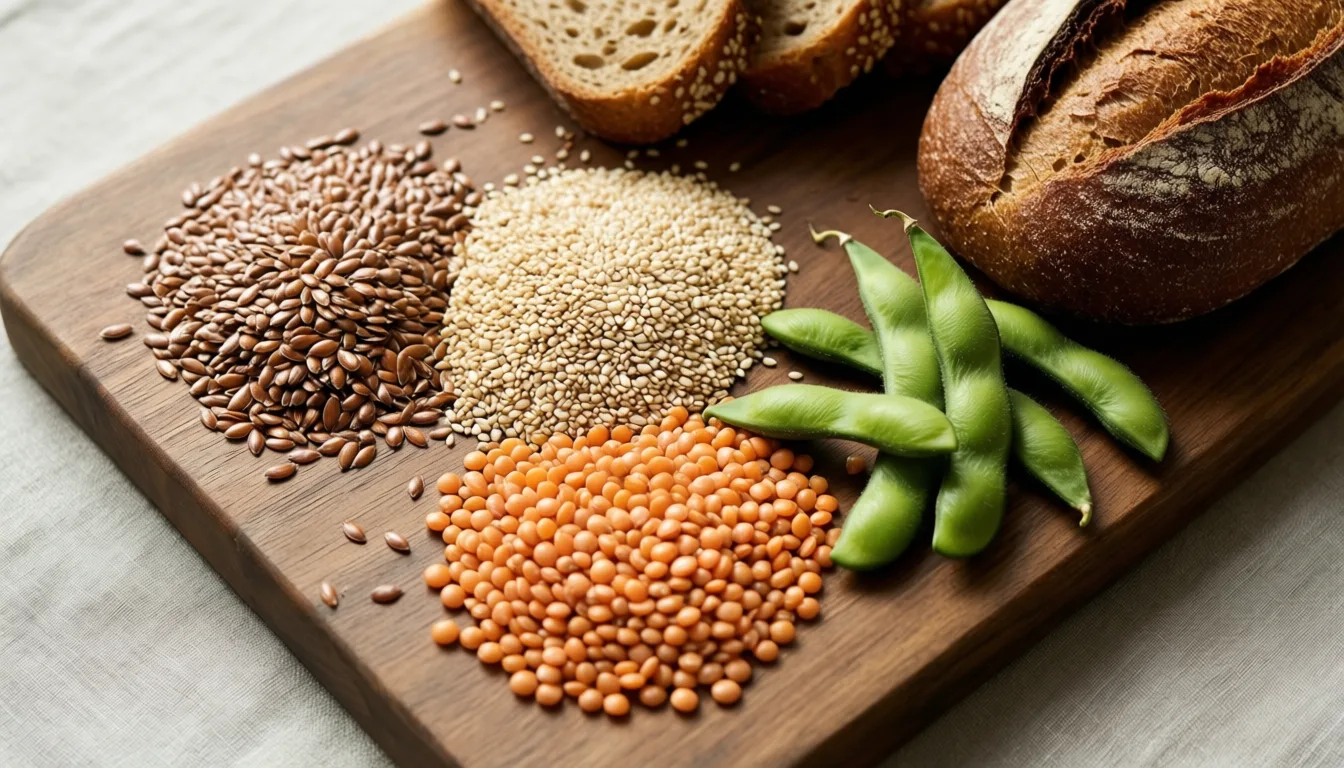
Enterolignans, the phytoestrogen subgroup most consistently tied to slower biological aging in the NHANES analysis, come largely from seeds, whole grains, and fibrous vegetables.
Signal two: the length of your reproductive years
The second signal is one women often know without being asked: the age periods began, the age they ended, and the span between. In a 2025 analysis of 302,471 women from the China Kadoorie Biobank, researchers used a 28-variable frailty index as a proxy for biological age and looked at how reproductive milestones tracked with it. Age at menarche, age at menopause, and the resulting reproductive lifespan were each associated with frailty status and with frailty trajectories measured at multiple time points.
The implication is not that any single woman's calendar predetermines her trajectory — frailty indices capture dozens of inputs and most of them are modifiable. But the durable signal across hundreds of thousands of women suggests that reproductive history carries information clinicians could use earlier, not just as a footnote in a menopause chart. For a 55-year-old asking what her individual aging risk looks like, the years between her first period and her last are part of the answer.
The signals that track how well a woman is aging may already be sitting in her medical history, her diet, and the answer she gives when someone asks how she's feeling.

Signal three: the question almost no one asks carefully
The third signal is the simplest, and arguably the most underused. Ask an older adult to rate their health as good, neutral, or bad, and the answer does real predictive work. In a 2025 cross-sectional study of 9,762 adults aged 65 and older from the Chinese Longitudinal Healthy Longevity Survey, self-rated health showed a graded, dose-response relationship with cardiometabolic multimorbidity — defined as having two or more of coronary heart disease, stroke, diabetes, hypertension, or dyslipidemia.
Compared with people who rated their health as good, those who rated it bad had roughly four times the odds of cardiometabolic multimorbidity; those in the middle had roughly twice the odds. Each one-level drop in self-rating roughly doubled the odds. The association was stronger in men than in women in this sample, but it held across age groups and urban-rural divides.
What's striking is not the size of the effect — researchers have known for decades that self-rated health predicts mortality — but how consistently this one question outperforms its simplicity. It seems to integrate something instruments miss: fatigue patterns, subtle declines, the felt sense of one's own body. For women 55 and older who have spent years being told their symptoms are nothing, this is a quiet form of vindication. The instinct that something is off appears to be measuring something real.
What to do with three imperfect signals
None of these findings alone would justify a change in clinical guidelines, and the researchers behind them don't claim otherwise. The phytoestrogen study cannot separate diet from microbiome from confounding lifestyle factors. The reproductive lifespan analysis is drawn from one national cohort and may not generalize cleanly to women in other settings. The self-rated health work is cross-sectional, meaning it captures a moment rather than tracking change over time.
And yet, read together, they point in a coherent direction. Aging well in midlife and beyond appears to be tracked — imperfectly but meaningfully — by what you eat, the reproductive years your body has lived through, and the honest answer to a question most annual physicals ask too fast to hear. The most useful response is not a supplement order or a panic about menarche. It is a conversation: with a primary care clinician, a gynecologist familiar with menopause care, and ideally a registered dietitian. Bring the questions these studies raise; ask which apply to you.
The biological clock is real. It is also, on the evidence we currently have, more legible than the wellness industry tends to admit — and more responsive to ordinary, unglamorous decisions than any one molecule on its own.
Frequently asked questions
What are enterolignans and where do they come from?
Enterolignans are a subgroup of phytoestrogens produced when gut bacteria ferment seeds, whole grains, and certain vegetables. They were the phytoestrogen type most consistently tied to slower biological aging in the NHANES analysis.
How does self-rated health connect to cardiometabolic disease risk?
In a study of adults aged 65 and older, people who rated their health as bad had roughly four times the odds of cardiometabolic multimorbidity compared to those who rated it good, and each one-level drop in self-rating roughly doubled the odds. The association held across age groups and urban-rural divides, though it was stronger in men than in women.
What does reproductive lifespan mean in the context of aging?
Reproductive lifespan refers to the span of years between a woman's first period and menopause. In a study of over 300,000 women, age at menarche, age at menopause, and the resulting reproductive lifespan were each associated with frailty status and frailty trajectories measured at multiple time points.
Do these studies prove that eating more plant foods or knowing your reproductive history will slow aging?
No — all three studies are observational and show associations across large populations, not causation in any individual. The researchers themselves note the findings cannot justify changes in clinical guidelines on their own.
What practical questions do the authors suggest bringing to a clinician based on these signals?
The article suggests asking whether your diet is supplying plant compounds linked to slower aging, whether your reproductive history should prompt more aggressive cardiometabolic risk screening, and whether a feeling that something is 'not quite right' is being treated as meaningful data.
Sources
- Elevated urinary phytoestrogens are associated with delayed biological aging: a cross-sectional analysis of NHANES data. — Scientific reports
- [Association of age at menarche, age at menopause, and reproductive lifespan with frailty index in Chinese adult women]. — Zhonghua liu xing bing xue za zhi = Zhonghua liuxingbingxue zazhi
- Self-reported health as a predictor of cardiometabolic multimorbidity in Chinese older adults: a national cross-sectional study. — Frontiers in public health
Join the conversation
Comments are moderated and reviewed before they appear. Be constructive — this is health information.
Add your comment