
The Tobacco Aging Simulator: Seeing Your Face 15 Years Out
A new dermatologist-trained AI turns smoking risk into a portrait — predicting how cigarettes might reshape your face over the next decade and a half.
Okay, real talk: most of us know smoking is bad for our skin. But "bad" is kind of fuzzy. It lives in the same vague drawer as "eat your vegetables" and "get more sleep." So here's the question I kept asking while reading a new paper out of the journal Dermatology and Therapy: what if you could actually see what 15 more years of cigarettes might do to your face? Not a TikTok filter. Not a carnival-mirror gag. A scientifically built portrait, trained by dermatologists, made just for you.
That's the pitch behind a new facial aging simulator described by a team of researchers and clinicians, who combined the elicited knowledge of 28 expert dermatologists with an AI image-generation model to predict how tobacco might reshape a person's face over a 15-year horizon. The work was published in 2025 in Dermatology and Therapy, and the authors frame it as a deliberate counterpoint to the viral, vibes-based aging filters floating around social media.
Here's the basic idea, explained like a smart friend who just learned it. Step one: ask a lot of dermatologists — 28 of them — to translate what they see in clinic into probabilities. Given a person's age, sun habits, BMI, sunscreen use, and how many "pack-years" of smoking they've racked up, how likely are they to hit specific stages of wrinkling, sagging, or pigmentation? Step two: feed those probabilities into an image-generation model (the team calls it AMGAN) that was trained on photos of 600 individuals scored by 15 expert graders. Step three: hand it your photo, and let it render a plausible future face.
What a "pack-year" actually means
Quick gloss, because this term does a lot of work in the paper. A pack-year is one pack a day for one year. Two packs a day for ten years? Twenty pack-years. Half a pack a day for twenty years? Ten pack-years. It's the cumulative dose, basically — the way oncologists and dermatologists measure how much tobacco a body has been swimming in over time.
The simulator uses pack-years as its main lever for tobacco. To show what the tool can do, the researchers ran a demonstration on a 43-year-old subject's photo, holding sun exposure, sunscreen, and BMI steady while varying cumulative smoking between less than 10 and more than 20 pack-years. The output: side-by-side personalized predictions of how aging signs — wrinkles, pigmentation, and the like — might progress in each scenario.
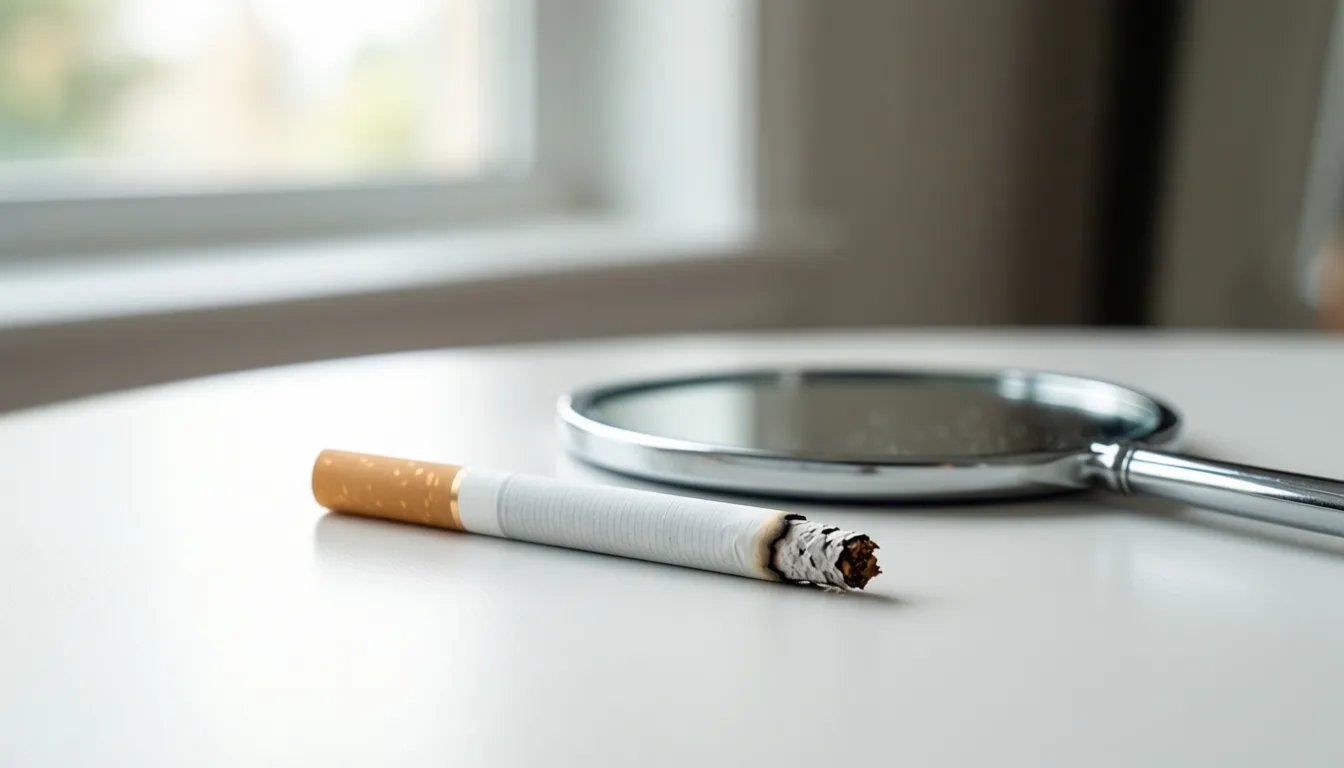
The simulator translates cumulative tobacco exposure — measured in pack-years — into a personalized 15-year facial forecast.
What if you could actually see what 15 more years of cigarettes might do to your face?
Why dermatologists, not just data
Here's the part I found genuinely clever. Pure image AI is great at noticing patterns but kind of clueless about why a face ages a certain way. A lot of internet "aging filters" basically smush a generic old-person texture onto your selfie. That's not medicine. That's a sticker.
By starting with what 28 dermatologists actually know — the probability that, say, a 50-year-old with 20 pack-years of smoking will hit a specific wrinkle grade — and then letting the image model render those probabilities onto your specific face, the researchers are trying to build something more grounded. The paper positions this approach as a scientifically validated alternative to the social-app simulators that lack transparent methodology. Translation: they're showing their work.
What this study is — and what it isn't
Okay, the honest caveats. This is a methods paper describing and demonstrating a tool, not a clinical trial proving that showing people their future face makes them quit smoking. The authors illustrate the simulator's capabilities using a single 43-year-old subject's facial image, with other variables held constant. That's a demo, not a population study.
It also doesn't tell us how accurate the 15-year predictions actually turn out to be, because — well, 15 years haven't passed yet. The probabilities come from expert consensus and a training dataset of 600 people. That's a reasonable starting point, but it's not the same as following thousands of smokers for a decade and a half and comparing the AI's forecast to their real faces.
So when you see headlines promising "AI predicts your smoking face," the more careful read is: a dermatologist-informed model can now generate personalized, scientifically grounded visualizations of plausible tobacco-driven aging. Whether those visualizations change behavior — and whether they match reality down the road — are open questions the field still has to answer.

The likely first home for tools like this: dermatology offices and public-health counseling, not consumer apps.
The bigger idea hiding in here
Step back and the interesting thing isn't really the cigarette angle. It's the template. The same framework — elicit expert probabilities, train an image model on graded photos, render a personalized forecast — could in principle be pointed at sun damage, sleep, alcohol, air pollution, you name it. Anything where the link between behavior and visible aging is well-characterized enough for clinicians to assign probabilities to outcomes.
That's a quietly big shift in how we might communicate long-horizon health risk. Numbers on a page are easy to ignore. A face that looks like yours, fifteen years from now, is harder to scroll past.
- What's new: A facial aging simulator combining 28 dermatologists' expert knowledge with an AI image generator trained on 600 graded faces.
- What it does: Predicts personalized 15-year facial aging signs based on tobacco use (measured in pack-years) plus sun exposure, sunscreen, and BMI.
- Evidence level — moderate: It's a published, methodologically transparent tool, but the demonstration uses a single subject and long-term predictive accuracy hasn't been tested against real outcomes.
- Why it matters: It turns abstract smoking risk into a concrete personalized image, which could be a powerful tool for clinical counseling and public health.
- What to watch: Independent validation, broader subject testing, and whether the same template gets applied to sun, sleep, or pollution.
- Bottom line for readers: Tools like this are educational previews, not medical advice. If you're thinking about your skin or quitting smoking, the conversation belongs with a clinician.
If you're tempted to chase down a consumer version of this — slow down. The paper describes a research tool, not an app you can download tomorrow. But the direction of travel is pretty clear: personalized, dermatologist-grounded previews of how today's habits show up on tomorrow's face. Bring that to your next derm visit, not your group chat.
Frequently asked questions
What is a pack-year, and how does the simulator use it?
A pack-year equals one pack of cigarettes smoked per day for one year, making it a measure of cumulative tobacco exposure over time. The simulator uses pack-years as its main lever for tobacco, generating personalized 15-year facial aging predictions as that number varies.
How does this simulator differ from the aging filters found on social media apps?
Unlike social-app filters that apply a generic old-person texture to a selfie, this tool starts with probability estimates from 28 expert dermatologists and renders those probabilities onto a specific person's face. The paper positions it as a scientifically validated alternative with transparent methodology, in contrast to filters that lack it.
Besides smoking, what other factors does the simulator take into account?
In addition to pack-years of tobacco use, the simulator factors in a person's age, sun exposure habits, BMI, and sunscreen use.
Does this study prove that seeing a simulated future face will help someone quit smoking?
No. The paper is a methods study describing and demonstrating the tool, not a clinical trial measuring behavior change. Whether these visualizations actually influence quitting is described as an open question the field still has to answer.
Where are tools like this expected to be used first?
The article identifies dermatology offices and public-health counseling as the likely first home for tools like this, rather than consumer apps. The authors also note that the same framework could in principle be applied to other behaviors linked to visible aging, such as sun damage, sleep, or air pollution.
Join the conversation
Comments are moderated and reviewed before they appear. Be constructive — this is health information.
Add your comment