
Train the Body, Save the Mind: New Trials Lock In Fitness as Cognitive Medicine
Baseline IGNITE data tie cardiorespiratory fitness to sharper thinking in older adults — and three new trials are testing whether lifting, finger drills and rural exercise programs can turn that link into real cognitive gains.
The looksmaxing conversation has always circled the visible scaffolding — jawline, posture, skin, the V-taper. But the most premium upgrade you can chase in your sixties and beyond isn't on your face; it's behind it. A wave of new research is pushing exercise out of the wellness aisle and into a category that feels closer to medicine: a structured intervention with measurable returns on memory, processing speed and the kind of sharp executive control that keeps a life — and a presence — feeling young.
The case starts with IGNITE, a large observational study whose baseline analysis was published in the British Journal of Sports Medicine. Researchers measured cardiorespiratory fitness (CRF) directly — a graded treadmill test, not a self-report — in 648 older adults averaging nearly 70 years old, then ran a comprehensive neuropsychological battery and modelled five cognitive domains: episodic memory, processing speed, working memory, executive function and visuospatial ability. Higher CRF was associated with better performance across all five domains, even after controlling for the usual demographic suspects.
Two details from that paper deserve to be underlined. First, age and APOE4 status — the gene variant that raises Alzheimer's risk — didn't blunt the relationship, suggesting the fitness–cognition link held across people often written off as genetically fated. Second, the association was stronger in women, in people with fewer years of formal education, and in those taking beta-blockers, particularly for processing speed. That last group is interesting because beta-blockers blunt the heart-rate response to exercise; the fact that the cognitive correlation persisted there hints that what fitness does for the brain isn't reducible to one tidy mechanism.
Why this is only moderate evidence — and still worth acting on
IGNITE's baseline analysis is cross-sectional. It tells us that fitter older adults score better on cognitive tests at a single point in time; it cannot, on its own, prove that pushing your VO₂max up will pull your memory along with it. That's the gap a cluster of registered trials is now trying to close — and the reason this story is rated moderate rather than settled.
At Western University, a 26-week randomised trial is testing whether creatine supplementation and resistance training, alone and together, can move the needle on cognition, brain health and physical function in older adults with mild cognitive impairment. The 2×2 design — creatine or placebo crossed with weightlifting or a balance-and-tone control — is exactly what the field has been missing. Prior work has suggested resistance training helps the aging brain and that creatine, which naturally declines with age, supports muscle and bone. Whether the two stack in people whose cognition is already slipping is the open question.

Resistance training is moving from longevity adjunct to cognitive intervention in registered trials.
A second trial, at Eastern Mediterranean University, is asking a more granular question: does how you move your hands matter? Finger movements activate a surprisingly large patch of cortex — sensorimotor strips, the supplementary motor area, Broca's, premotor and prefrontal regions — and asymmetrical, simultaneous two-hand movements have been shown to lift cognitive processes and cerebral blood flow more than one-handed work. The study compares bimanual drills, finger exercises and VR-mediated versions head-to-head in people with mild cognitive impairment. If a VR rig can deliver the same cortical activation as a clinician-led session, the implications for home practice — and for adherence — are obvious.
The third piece sits at the public-health end of the spectrum. Most exercise research has been done in urban, well-resourced cohorts. A trial out of the Universidad de Zaragoza is randomising 240 adults over 65 in rural areas to a 12-week, three-times-weekly multicomponent exercise program, followed by nine months of video-assisted sessions, with frailty, mental health and physical function as primary outcomes. It's the kind of pragmatic design that tells you whether a protocol survives contact with real lives, not just lab calendars.
The most premium upgrade you can chase in your sixties isn't on your face; it's behind it.
What a looksmaxer should actually take from this
The optimization-minded reader will already see the shape of the protocol. Cardiorespiratory fitness — the variable IGNITE measured — is built by sustained, structured aerobic work: zone-two volume, with intervals layered in. Resistance training, the lever being tested at Western, is what protects muscle mass, bone density and the metabolic environment your brain marinates in. The bimanual and VR work suggests that complex movement — coordination, novelty, asymmetry — may add something that pure cardio and pure lifting don't. And the rural-frailty trial is a reminder that consistency, delivered through whatever channel actually works for your life, is the variable that does most of the labour.
None of this is a prescription. The trials above are running; their endpoints aren't in. What the current evidence supports is a directional bet: a body kept fit across aerobic, strength and coordination domains appears to come with a sharper brain, and the mechanism is plausible enough that intervention trials are being funded to test it. That's the right register for this story — not a miracle, not a hedge, but a serious lead worth building habits around while the data mature.
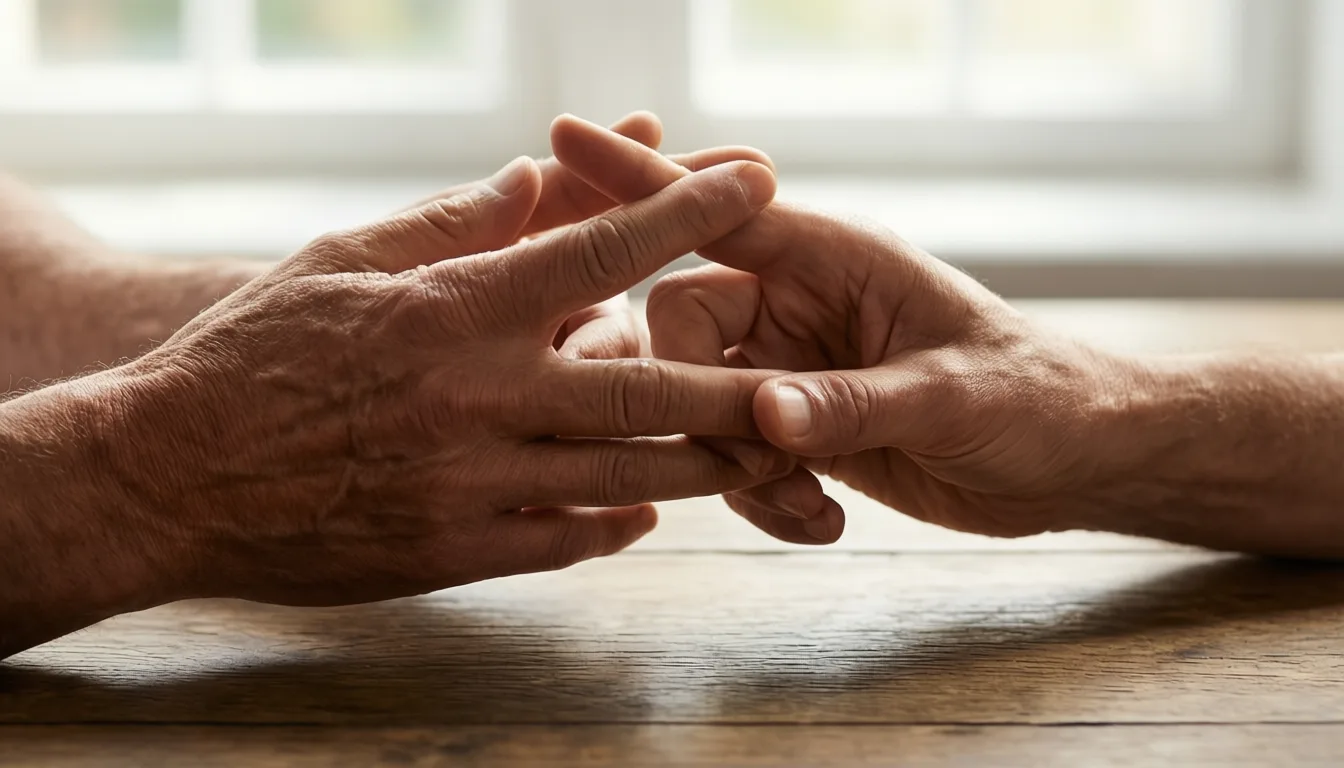
Asymmetric bimanual drills recruit a wide cortical network — a trial is testing whether VR can deliver the same effect.
- The link is consistent, not causal yet. IGNITE's baseline data tie fitness to cognition across five domains, but it is a cross-sectional snapshot.
- APOE4 didn't blunt the effect. The fitness–cognition association held regardless of the Alzheimer's-risk gene variant in this sample.
- Three trials are stress-testing the causal claim: creatine + lifting in MCI, bimanual/VR finger drills in MCI, and a rural multicomponent exercise program in adults over 65.
- Combine modalities. Aerobic capacity, resistance work and coordination-heavy movement each show distinct mechanistic rationales.
- Adherence beats intensity. The pragmatic, video-assisted rural design is built around the variable that actually moves outcomes.
- Talk to a clinician before supplementing or starting structured training, especially if you take beta-blockers or have a cognitive diagnosis.
For a desk that usually writes about skin barriers and posture, the throughline here is familiar: the most durable upgrades are the structural ones. Train the cardiovascular system that perfuses the brain. Build the muscle that defends metabolic health for decades. Add movement that is complex enough to demand cortical work. The face you present at 75 is partly a function of the work you do at 55; the mind behind it appears to follow the same rule.
Frequently asked questions
What cognitive abilities did the IGNITE study link to cardiorespiratory fitness?
IGNITE researchers tested five domains: episodic memory, processing speed, working memory, executive function, and visuospatial ability. Higher cardiorespiratory fitness was associated with better performance across all five domains in adults averaging nearly 70 years old.
Does carrying the APOE4 gene variant cancel out the brain benefits of being fit?
According to the IGNITE baseline analysis, APOE4 status did not blunt the relationship between cardiorespiratory fitness and cognitive performance. The fitness-cognition link held regardless of whether participants carried the Alzheimer's-risk gene variant.
Why doesn't the IGNITE study prove that exercising will improve your memory?
IGNITE's baseline analysis is cross-sectional, meaning it captured data at a single point in time. It shows that fitter older adults score better on cognitive tests but cannot prove that increasing your own fitness will raise your cognitive scores.
What is the Western University trial testing, and who is it designed for?
The 26-week randomised trial is testing whether creatine supplementation and resistance training, alone and in combination, can improve cognition, brain health, and physical function. It uses a 2x2 design and is specifically designed for older adults who already have mild cognitive impairment.
What types of exercise does the article suggest may each offer distinct brain benefits?
The article points to three modalities with separate mechanistic rationales: aerobic work to build cardiorespiratory fitness, resistance training to protect muscle mass and the metabolic environment the brain relies on, and coordination-heavy movement such as asymmetric bimanual drills, which recruit a wide cortical network.
Sources
- Cardiorespiratory fitness is associated with cognitive function in late adulthood: baseline findings from the IGNITE study. — British journal of sports medicine
- Creatine and Resistance Training in Older Adults With Mild Cognitive Impairment — Western University, Canada
- Comparison of the Effects of Bimanual, Finger and VR Exercises in PwMCI — Eastern Mediterranean University
- Effects of Physical Exercise on Frailty, Mental and Physical Health of Older Adults in Rural Areas. — Universidad de Zaragoza
Join the conversation
Comments are moderated and reviewed before they appear. Be constructive — this is health information.
Add your comment