
In This Issue
Metabolic Health
-
 The Muscle Problem GLP-1s Can't Solve: Why Exercise After Weight Loss Still Wins
A new randomized trial suggests a year of structured exercise after weight loss boosts the body's own appetite-quieting GLP-1 — something the injectable drugs don't appear to do. Here's what that means for anyone serious about keeping the weight off.
The Muscle Problem GLP-1s Can't Solve: Why Exercise After Weight Loss Still Wins
A new randomized trial suggests a year of structured exercise after weight loss boosts the body's own appetite-quieting GLP-1 — something the injectable drugs don't appear to do. Here's what that means for anyone serious about keeping the weight off.
-
 The Next GLP-1 Era: A Daily Pill, a Surprise Spine Signal, and a Cancer Question Worth Watching
A once-daily oral GLP-1, fresh data linking the class to lower lumbar disease risk, and a network meta-analysis hinting at a nuanced colorectal cancer question. Here's what the moderate evidence actually says.
The Next GLP-1 Era: A Daily Pill, a Surprise Spine Signal, and a Cancer Question Worth Watching
A once-daily oral GLP-1, fresh data linking the class to lower lumbar disease risk, and a network meta-analysis hinting at a nuanced colorectal cancer question. Here's what the moderate evidence actually says.


The Muscle Problem GLP-1s Can't Solve: Why Exercise After Weight Loss Still Wins
A new randomized trial suggests a year of structured exercise after weight loss boosts the body's own appetite-quieting GLP-1 — something the injectable drugs don't appear to do. Here's what that means for anyone serious about keeping the weight off.
For the millions of people now taking a GLP-1 medication, the central promise is elegantly simple: the drug quiets appetite, the scale moves, and a problem that felt intractable begins to yield. What the prescription cannot do — and what a new randomized trial brings into sharper focus — is teach the body to produce more of that same appetite-quieting hormone on its own. That job, it turns out, still belongs to exercise.
The study, published in Obesity in 2026, followed 195 adults who had just lost an average of 13.1 kg on a low-calorie diet. Researchers then randomized them to one of four paths for a full year: usual activity, a structured program of moderate-to-vigorous exercise, the GLP-1 receptor agonist liraglutide at 3.0 mg per day, or exercise plus the drug. The question was narrow but consequential — would any of these maintenance strategies change how much GLP-1 the body itself secretes after a meal?
The answer was striking in its asymmetry. After a year, the exercise group's late-phase postprandial GLP-1 response had climbed by 37%, a within-group increase of 25% over those doing usual activity. In the groups taking the GLP-1 drug, by contrast, endogenous secretion was unchanged versus placebo. The medication mimics the hormone; it does not appear to train the gut to make more of it.
The drug mimics the hormone. It does not appear to train the gut to make more of it.
That distinction matters because the late-phase postprandial GLP-1 signal is part of how the body naturally tells itself the meal is over. A larger endogenous response after eating is one plausible mechanism by which exercise may blunt the appetite rebound that so often follows weight loss — the biological undertow that drags people back toward their starting weight. The trial's authors are careful to frame this as exploratory, and the readout is a hormonal response rather than a long-term weight outcome, but the directional finding is consistent and biologically coherent.
The muscle problem hiding inside the success story

Resistance training is increasingly framed as a companion therapy to incretin drugs, not an optional extra.
The exercise finding lands at the same moment a second, quieter conversation is gathering force in the clinical literature: what GLP-1 and dual GIP/GLP-1 drugs may be doing to muscle, particularly in older adults. A 2025 perspective in Diabetes walks through the emerging concern around sarcopenic obesity — a condition the authors note affects an estimated 28.3% of people aged over 60 — and how the new drug class intersects with it.
The perspective is not anti-medication. It credits incretin therapies with meaningful reductions in weight, improvements in physical function, and gains in quality of life. But it flags a real trade-off: rapid pharmacologic weight loss carries the risk of loss of muscle mass and an increased rate of adverse events, especially in older patients whose muscle reserves are already thinning with age. The authors urge clinicians to weigh benefits against those risks and to think carefully about patient identification, monitoring, and how — and when — to discontinue.
Read together, the two papers point in the same direction. The drugs are powerful tools for getting weight off. Exercise looks increasingly necessary for keeping it off in a body that still works the way you want it to.
What the trial actually tested — and didn't
It is worth being precise about the scope. The exercise finding comes from an exploratory analysis, not the trial's primary weight-maintenance endpoint, and the measured outcome was the GLP-1 response to a three-hour liquid mixed meal test, not a head-to-head verdict on long-term weight regain. The intervention itself was substantial — 52 weeks of moderate-to-vigorous activity — not a casual uptick in step count. And the comparator drug was liraglutide at 3.0 mg, an earlier-generation GLP-1 agonist; the newer, more potent agents (semaglutide, tirzepatide) were not tested here.
None of that erases the signal. It does mean the right way to talk about it is as a plausible, biologically grounded mechanism that fits with a wider body of work on exercise and appetite regulation — not as proof that exercise beats the drugs on weight outcomes. The evidence is moderate, and the language should be too.

A mixed meal is the standard way researchers measure how the gut releases GLP-1 in real eating conditions.
How to think about it if you're on — or considering — a GLP-1
For readers already on an incretin, none of this argues for stopping. It argues for pairing. The clinical concern about muscle is loudest in older adults and in anyone losing weight quickly, and the obvious counterweight — resistance training plus adequate protein, alongside aerobic work — is the same advice that holds up across most of the maintenance literature. The new trial adds a second reason to take it seriously: the exercise itself may be doing hormonal work the drug isn't.
For readers considering the drugs, the framing shift is subtle but important. Exercise has often been pitched as the thing you do instead of medication, or the thing you graduate to once the medication has done its job. The emerging picture is closer to the opposite: exercise is the substrate the medication is built on top of, and the part most likely to determine what the body looks and functions like a year or five years from now.
As always, these are conversations to have with a clinician who knows your history — including how fast you're losing weight, what your baseline muscle and function look like, and what you want the next decade of your life to feel like. The drugs are real medicine. So, in a quieter and less marketable way, is the squat rack.
- Exercise raised endogenous GLP-1; the drug didn't. A year of structured exercise increased late-phase postprandial GLP-1 by 37% in an exploratory RCT analysis; liraglutide left endogenous secretion unchanged.
- The finding is exploratory, not a weight verdict. The measured outcome was a hormonal response to a meal test, not long-term weight regain — directionally meaningful, not definitive.
- Muscle is the quiet trade-off. A 2025 Diabetes perspective flags loss of muscle mass and adverse events as real risks with GLP-1 and GIP/GLP-1 drugs, especially in older adults.
- Sarcopenic obesity is more common than most people realize. An estimated 28.3% of adults over 60 are affected, raising the stakes for how weight is lost — not just whether it is.
- Pair, don't substitute. Resistance training and aerobic activity are the most plausible counterweights to muscle loss and the strongest lever for maintaining the loss.
- Talk to your clinician about monitoring. Particularly around rate of loss, muscle and function, and any plan for tapering or discontinuation.
Frequently asked questions
What did the study find about exercise and the body's own GLP-1 production?
After a year of structured moderate-to-vigorous exercise, participants' late-phase postprandial GLP-1 response increased by 37%, which was 25% greater than those doing usual activity. By contrast, the groups taking the GLP-1 drug liraglutide showed no change in endogenous GLP-1 secretion compared to placebo.
Does taking a GLP-1 medication train the gut to produce more of the hormone on its own?
Based on this trial, it does not appear to. The medication mimics the hormone, but liraglutide at 3.0 mg did not increase the amount of GLP-1 the body itself secreted after a meal. The article notes this distinction matters because the natural postprandial GLP-1 signal is part of how the body tells itself a meal is over.
Is the exercise finding proof that exercise is better than GLP-1 drugs for weight loss?
No — the article is explicit that the finding comes from an exploratory analysis and the measured outcome was a hormonal response to a meal test, not long-term weight regain. The authors describe it as a plausible, biologically grounded mechanism consistent with broader work on exercise and appetite regulation, not a head-to-head verdict on weight outcomes.
Why are GLP-1 drugs a particular concern for older adults?
A 2025 perspective cited in the article flags that rapid pharmacologic weight loss carries a risk of muscle mass loss and increased adverse events, especially in older patients whose muscle reserves are already thinning with age. The article also notes that sarcopenic obesity — a condition combining muscle loss and excess body fat — affects an estimated 28.3% of adults over 60.
If someone is already taking a GLP-1 medication, what does the article suggest about exercise?
The article argues for pairing exercise with the medication, not stopping it. It frames resistance training and aerobic activity as the most plausible counterweights to muscle loss and as a lever for maintaining weight loss, noting that exercise may be doing hormonal work the drug is not.
Sources

Obesity Is Aging You Faster — and the Biomarkers Now Prove It
New research in young adults links long-term obesity to measurable biological aging — and points to metabolism as the load-bearing pillar of longevity.
Here's the question I kept circling: can your body be older than your birthday says? Researchers have been hinting at it for years, and a new study in young adults — people in their late twenties — just made the case harder to wave away. The short version: long-term obesity appears to leave fingerprints on the molecular clocks scientists use to estimate biological age. The longer version is more interesting, and more useful, than the headlines suggest.
If you've ever wondered why two people the same age can look — and feel — a decade apart, this is the kind of research that tries to answer it. A multiple-events case-control study embedded in a long-running Chilean birth cohort followed 205 adults, all around 28 to 31 years old, whose height and weight had been tracked since they were babies. That last part matters. Instead of asking "what do you weigh now?" the researchers could ask "how long has your body been carrying excess weight?" — a much sharper question.
They sorted participants into three groups: a healthy-BMI-for-life group, a persistent-obesity-since-adolescence group (about 13 years of obesity on average), and a persistent-obesity-since-childhood group (nearly 27 years). Then they looked at two of the most respected biological aging readouts we have: DNA methylation age (think of it as a chemical timestamp on your genes) and telomere length (the protective caps on your chromosomes that shorten as cells divide). They also measured a panel of aging-related cytokines, growth factors, and adipomyokines — the chatty molecules that tissues use to talk to each other.
Instead of asking what you weigh now, the researchers asked how long your body has been carrying it.
The headline finding: long-term obesity was associated with the adulthood expression of biomarkers tied to antagonistic and integrative aging hallmarks — the categories scientists use to describe the body's stress-response and system-wide aging signals. In plain English, the bodies of people who'd been living with obesity the longest were showing molecular patterns you'd more typically expect to see later in life.
A few important caveats before we go further. This is one study, in one cohort, of 205 people. It's a case-control design, which is good for spotting associations but can't prove that obesity caused the aging signatures. The participants are all young adults from one country. And the evidence rating here is moderate, not airtight — meaning the signal is real and worth paying attention to, but the full picture is still coming into focus.
Why metabolism became the main character
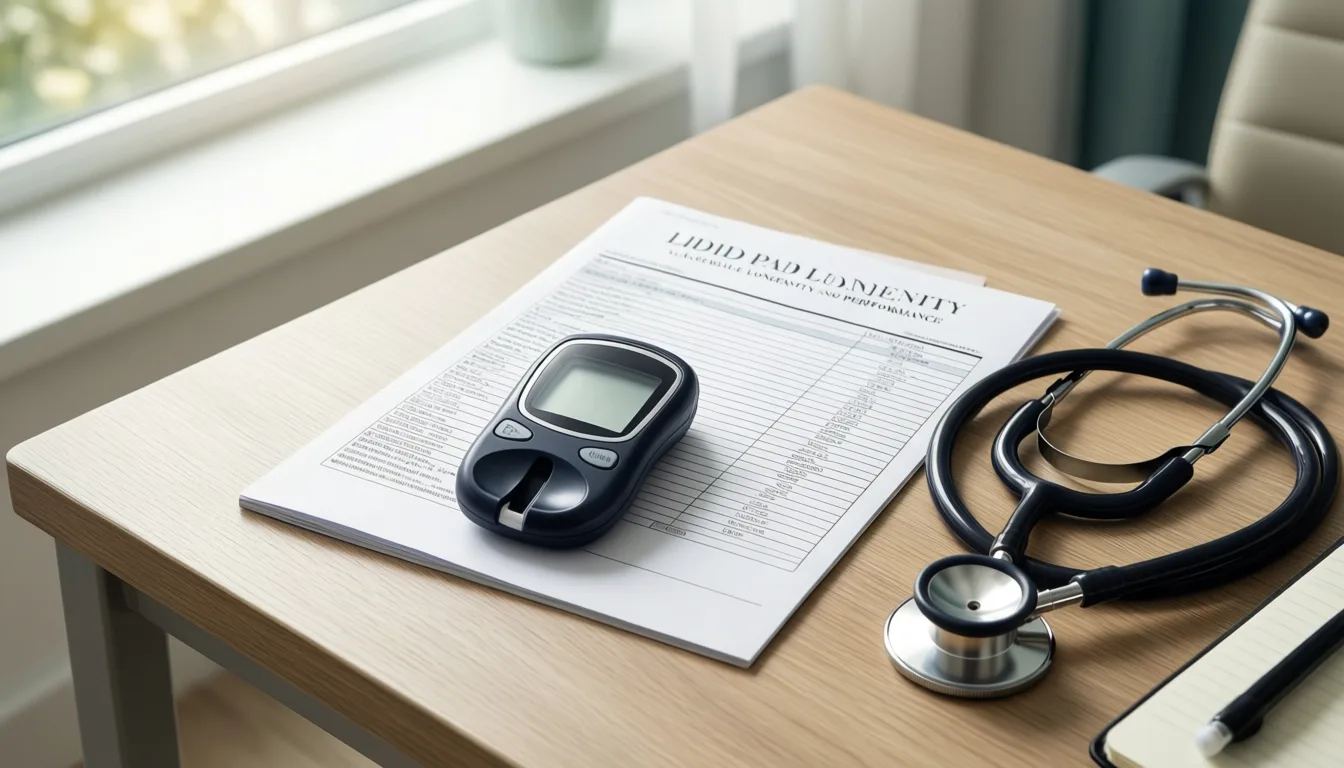
Routine metabolic markers — glucose, lipids — are getting a longevity rebrand.
Pair that aging-markers study with a companion piece — a 2026 review in Reviews in Cardiovascular Medicine — and a bigger story snaps into focus. The review argues that vascular aging is an independent risk factor for vascular disease, with cellular and molecular mechanisms closely tied to disturbances in glucose and lipid metabolism. Translation: the way your body handles sugar and fat may be quietly setting the pace at which your blood vessels age.
Why does that matter for longevity? Because your vasculature is everywhere. Stiffening arteries and aging endothelial cells (the thin layer lining your blood vessels) don't just raise heart-attack risk — they affect how every organ gets oxygen and nutrients. The review frames metabolic dysfunction not as a side quest but as a central engine of the aging process, and it makes a case for early clinical recognition and targeted intervention as essential to managing vascular senescence.
Your vasculature is everywhere — which is why metabolism is starting to look like the load-bearing pillar of healthy aging.
What's actually new here
None of this means obesity is destiny, and none of it means a healthy BMI is a longevity guarantee. What's genuinely new is the resolution. For a long time, the connection between body weight and aging was mostly inferred from disease outcomes — heart disease, diabetes, certain cancers showing up earlier in people with obesity. Now researchers can point to specific molecular signatures in people who haven't developed those diseases yet. That's the difference between watching the smoke and finally seeing the fire.
It also reframes a debate that's been stuck for years. Arguments about "healthy at every size" versus "weight is everything" tend to flatten a complicated picture. The cleaner story emerging from this research is that duration of metabolic stress — how long the body has been managing dysregulated glucose, lipids, and adiposity — may matter more than any single snapshot on a scale.

Movement, sleep, and food quality all feed into the same metabolic story.
- Duration matters. A new study suggests how long someone has lived with obesity — not just current weight — tracks with biological aging markers in young adults.
- The clocks are molecular. Researchers used DNA methylation age and telomere length, two well-regarded biological-age readouts, plus aging-related signaling molecules.
- Metabolism is the throughline. A companion review ties glucose and lipid dysregulation to vascular aging, an independent driver of long-term disease risk.
- Evidence is moderate, not settled. One cohort, 205 people, observational design — directionally important, not the final word.
- Action lives with your clinician. If metabolic health is on your mind, the useful next step is a check-in about glucose, lipids, and cardiovascular risk — not a DIY protocol.
So what do you do with all this on a Tuesday morning? Honestly, less than the internet will tell you. The reasonable takeaway isn't a new supplement stack or a punishing routine. It's that the boring stuff — how you eat, move, sleep, and manage stress over years, not weeks — is doing real work at the molecular level. And if metabolic health is somewhere on your mind, a conversation with a clinician about your glucose, lipids, and cardiovascular risk is a far better starting line than any biohack on your feed.
The most exciting part of this research, to me, isn't the warning. It's the reframe. Biological age isn't fixed. The clocks are reading your inputs. That's not a miracle cure — but it is, quietly, a lot of hope.
Frequently asked questions
What biological markers did researchers use to measure aging in this study?
The researchers used two well-regarded readouts: DNA methylation age, described as a chemical timestamp on your genes, and telomere length, the protective caps on chromosomes that shorten as cells divide. They also measured a panel of aging-related cytokines, growth factors, and adipomyokines — signaling molecules that tissues use to communicate with each other.
Who were the participants, and how were they divided into groups?
The study followed 205 adults between 28 and 31 years old whose height and weight had been tracked since infancy as part of a long-running Chilean birth cohort. Participants were sorted into three groups: a healthy-BMI-for-life group, a persistent-obesity-since-adolescence group averaging about 13 years of obesity, and a persistent-obesity-since-childhood group averaging nearly 27 years.
Why does the length of time someone has lived with obesity matter more than their current weight?
The article argues that duration of metabolic stress — how long the body has been managing dysregulated glucose, lipids, and adiposity — may matter more than any single snapshot on a scale. Because participants had been tracked since infancy, researchers could ask how long the body had been carrying excess weight rather than simply what someone weighs today, which the article calls a much sharper question.
How does metabolism connect to vascular aging according to the article?
A companion review cited in the article argues that vascular aging is an independent risk factor for vascular disease, with mechanisms closely tied to disturbances in glucose and lipid metabolism. Because the vasculature affects how every organ receives oxygen and nutrients, the review frames metabolic dysfunction not as a side issue but as a central engine of the aging process.
How strong is the evidence, and what are the study's limitations?
The article rates the evidence as moderate, not airtight. It flags several caveats: this is one study of 205 people from a single Chilean cohort, the case-control design can identify associations but cannot prove that obesity caused the aging signatures, and the participants are all young adults from one country.
Sources
- Long-Term Obesity and Biological Aging in Young Adults. — JAMA network open
- Glucose and Lipid Metabolic Mechanisms in Vascular Aging and Related Therapeutic Strategies. — Reviews in cardiovascular medicine

The Next GLP-1 Era: A Daily Pill, a Surprise Spine Signal, and a Cancer Question Worth Watching
A once-daily oral GLP-1, fresh data linking the class to lower lumbar disease risk, and a network meta-analysis hinting at a nuanced colorectal cancer question. Here's what the moderate evidence actually says.
If you've been half-listening to the GLP-1 conversation between feedings and laundry cycles, here's the short version of where it's going next: the shot is about to have a pill-shaped sibling, the class keeps turning up unexpected benefits in places nobody was looking, and a careful new analysis is asking a real but narrow question about one specific drug at one specific dose. None of it is a miracle. All of it matters if you or someone you love is managing type 2 diabetes or obesity in the middle of a very full life.
- An oral GLP-1 is close. Orforglipron is a small-molecule pill with roughly 79% bioavailability — no food or water restrictions required.
- Head-to-head, it looked strong. In a phase 3 trial, the 36 mg dose outperformed oral semaglutide 14 mg on both A1c and weight.
- A spine signal worth noting. In a large matched cohort, GLP-1 users with type 2 diabetes had lower 5-year rates of lumbar degenerative disease.
- A narrow cancer question. Across 68 trials, only high-dose injectable semaglutide showed a colorectal tumor signal — not the class as a whole.
- This is education, not a prescription. Any decision about starting, switching, or stopping these drugs belongs with your clinician.
The pill that's been a long time coming
For all the cultural noise around GLP-1 receptor agonists, the day-to-day reality has been stubbornly inconvenient: weekly injections, or an oral semaglutide regimen that asks you to take it on an empty stomach with a sip of water and then wait. For a new parent who counts a hot coffee as a win, that's a real barrier.
Orforglipron is trying to change that. According to a recent clinical review, it's a small-molecule oral GLP-1 with roughly 79% bioavailability and no food or water restrictions. Mechanistically, the authors note it stimulates cyclic AMP without recruiting β-arrestin — which, in plain English, may mean less of the receptor desensitization that can blunt other drugs over time. That's a theoretical advantage, not a proven one, and worth holding lightly.
The efficacy numbers are where it gets interesting. In the ACHIEVE-3 head-to-head trial in type 2 diabetes, orforglipron 36 mg reduced A1c by 2.2% versus 1.4% for oral semaglutide 14 mg, and body weight by 9.2% versus 5.3%. In ATTAIN-2, which enrolled people with both obesity and type 2 diabetes, the same dose delivered about 10.5% mean weight loss. That's meaningful, though shy of the headline numbers some injectables have produced in obesity-only populations.

Convenience isn't a luxury for tired parents — it's often what determines whether a treatment actually gets taken.
The safety picture, the review notes, looks like the rest of the class: gastrointestinal side effects dominate, generally manageable with slow dose escalation, plus a non-dose-dependent heart-rate bump and a small signal for mild pancreatitis. The authors also flag a class-level concern about ventricular arrhythmia risk in people with heart failure with reduced ejection fraction on conventional GLP-1 RAs — context for a clinician conversation, not a reason for self-diagnosis at 2 a.m.
The most useful thing a pill can do is get taken. That's the quiet superpower here.
A surprise from the lower back
One of the things that makes this class genuinely interesting — and genuinely hard to write about responsibly — is how often it turns up downstream benefits researchers weren't initially hunting for. The latest comes from spine health.
A propensity score-matched cohort study using the TriNetX global network looked at 196,435 matched pairs of adults with type 2 diabetes, comparing GLP-1 RA users to non-users. At three years, GLP-1 users had a modestly lower incidence of lumbar degenerative disease (11.9% vs 13.3%). By five years, the gap widened to 14.6% vs 18.7%, and lumbar spine surgery rates were also lower in users (0.5% vs 0.6%).
A few honest caveats. This is observational data — propensity matching reduces confounding but doesn't eliminate it. Weight loss itself is good for spines, so we don't yet know how much of this signal is the drug versus the pounds versus something more biological. Still, it's a finding worth filing away, especially if back pain is one of the quieter costs of carrying extra weight through years of pregnancy, recovery, and toddler-hoisting.

An observational signal — promising, not proof. Researchers call for more investigation before claiming GLP-1s as disease-modifying for spinal health.
The colorectal question, in proportion
Now the harder conversation. A recent network meta-analysis pooled 68 randomized controlled trials covering 207,200 participants, comparing colorectal tumor incidence across GLP-1 receptor agonists and SGLT2 inhibitors. The reason to look at all is that people with obesity and metabolic disease already carry higher baseline colorectal cancer risk, and prior signals had been inconsistent.
The finding is narrower than a scary headline would suggest. Only semaglutide was associated with increased colorectal tumor incidence compared to controls, and in a dose-stratified analysis, high-dose injectable semaglutide (2.4 mg weekly) was the specific regimen driving the signal. Other GLP-1 RAs and SGLT2 inhibitors in the analysis did not show the same association.
What this means in real life: it's a hypothesis-generating finding, not a verdict. RCTs were not designed to detect cancer endpoints over long horizons, and absolute event numbers in trials like these are small. It's also a reminder that "GLP-1" is not one drug — these molecules differ, and so may their long-term safety profiles. If you're on semaglutide for weight management, the responsible move is a conversation with your prescriber about screening cadence and your personal risk, not a panicked stop.
The honest bottom line
The GLP-1 story is still being written, and the next chapter looks like this: more convenient delivery, more downstream benefits showing up in places like the lumbar spine, and more granular safety questions that demand specificity rather than sweeping claims. The evidence here is moderate — strong enough to take seriously, not strong enough to rewrite anyone's care plan on a Tuesday afternoon.
If you take one thing into your next clinician visit, let it be this: the conversation is no longer just "GLP-1, yes or no." It's which molecule, which dose, which delivery, and which trade-offs make sense for the life you're actually living — the one with the half-folded laundry and the 3 a.m. wake-ups and the long view of your own health you're trying to protect.
Frequently asked questions
What makes orforglipron different from current oral GLP-1 options?
Orforglipron is a small-molecule pill with roughly 79% bioavailability that requires no food or water restrictions before taking it, unlike oral semaglutide, which must be taken on an empty stomach with only a sip of water followed by a waiting period. Its mechanism may also reduce receptor desensitization over time, though the article describes this as a theoretical advantage rather than a proven one.
How did orforglipron compare to oral semaglutide in clinical testing?
In the ACHIEVE-3 head-to-head trial in people with type 2 diabetes, the 36 mg dose of orforglipron reduced A1c by 2.2% and body weight by 9.2%, compared to 1.4% and 5.3% for oral semaglutide 14 mg. In a separate trial called ATTAIN-2, which enrolled people with both obesity and type 2 diabetes, the same 36 mg dose produced about 10.5% mean weight loss.
Does the colorectal cancer concern apply to all GLP-1 medications?
No. The analysis of 68 randomized controlled trials found that only semaglutide was associated with increased colorectal tumor incidence, and specifically only at the high-dose injectable form of 2.4 mg weekly. Other GLP-1 drugs and SGLT2 inhibitors included in the analysis did not show the same association.
What did researchers find about GLP-1 drugs and back health?
A large observational study using matched pairs of adults with type 2 diabetes found that GLP-1 users had lower rates of lumbar degenerative disease at both three and five years compared to non-users, and also lower rates of lumbar spine surgery. The article cautions that this is observational data and that it remains unclear how much of the benefit comes from the drug itself versus weight loss.
What side effects are associated with orforglipron?
The article states that orforglipron's safety profile resembles the rest of the GLP-1 class: gastrointestinal side effects are most common and are generally manageable with slow dose escalation. Additional signals include a non-dose-dependent heart-rate increase and a small signal for mild pancreatitis.
Sources
- Orforglipron: A Novel Oral GLP-1 Agonist for the Treatment of Obesity and Diabetes. — Cardiology in review
- Association of GLP-1 Receptor Agonist Use With Risk of Lumbar Degenerative Disease and Spine Surgery in Patients With Type 2 Diabetes: A Propensity Score-matched Cohort Study. — Global spine journal
- The different colorectal tumor risk related to GLP-1 receptor agonists and SGLT2 inhibitors use: a network meta-analysis of 68 randomized controlled trials. — International journal of surgery (London, England)