
The Exposome: Why Your ZIP Code May Outweigh Your Supplement Stack
A new review in Atherosclerosis argues that the air you breathe, the noise outside your window, and the climate you live in may shape cardiovascular risk more than the contents of your medicine cabinet.
For a generation of men who have learned to track resting heart rate, fasting glucose, and LDL particle counts, it is humbling to read a research paper suggesting that the single biggest lever on cardiovascular risk may be something you cannot swallow, measure on a wristband, or argue about on a podcast. It is the place you live. A 2025 review in Atherosclerosis by Daiber, Rajagopalan, Kuntic and Münzel pulls together a decade of work on what researchers now call the exposome — the lifelong sum of environmental exposures, from highway noise to soil contaminants to heat waves — and makes a measured case that these factors deserve a seat at the same table as cholesterol and blood pressure.
The word itself is awkward, and the authors know it. Coined roughly sixteen years ago as a counterpart to the genome, the exposome describes everything that is not your DNA: the air you have breathed since childhood, the water that has run through your taps, the noise that wakes you at 3 a.m., the heat your body has had to dissipate, plus the socioeconomic and lifestyle currents that shape all of it. The review frames this against a sobering backdrop. Chronic non-communicable diseases — heart disease chief among them — now account for roughly two-thirds of global deaths each year, driven both by an aging population and by the steady drip of environmental insults.
That number is not a forecast. It is the present tense.
A reframe, not a revolution
The optimization crowd has spent the better part of two decades drilling down into the individual: genotype, biomarker, microbiome, sleep stage. The exposome literature pulls the camera back. It argues that the same body, placed in two different environments, will age along two different curves — and that the gap between those curves is not small.
Daiber and colleagues are careful not to oversell. Their review is a synthesis, not a randomized trial, and they note repeatedly that the exposome interacts with genetic predisposition and with diseases a person already has. A 70-year-old with well-controlled hypertension living near a busy freeway is not the same risk profile as a healthy 40-year-old in the same house. Vulnerability compounds.
Still, the through-line is consistent. Air pollution, traffic noise, contaminated water and soil, mental stress, and the rising temperatures of a changing climate are each associated with premature death and lost healthy life years, measured in the currency epidemiologists call disability-adjusted life years. The authors describe the exposome as having a specific external component (what you personally encounter) and a general external component (the broader social and economic conditions you live within), with finer subdivisions for organ-specific effects and for what they call the pollutome — the slice of exposure that is pollution, bounded in space and time.
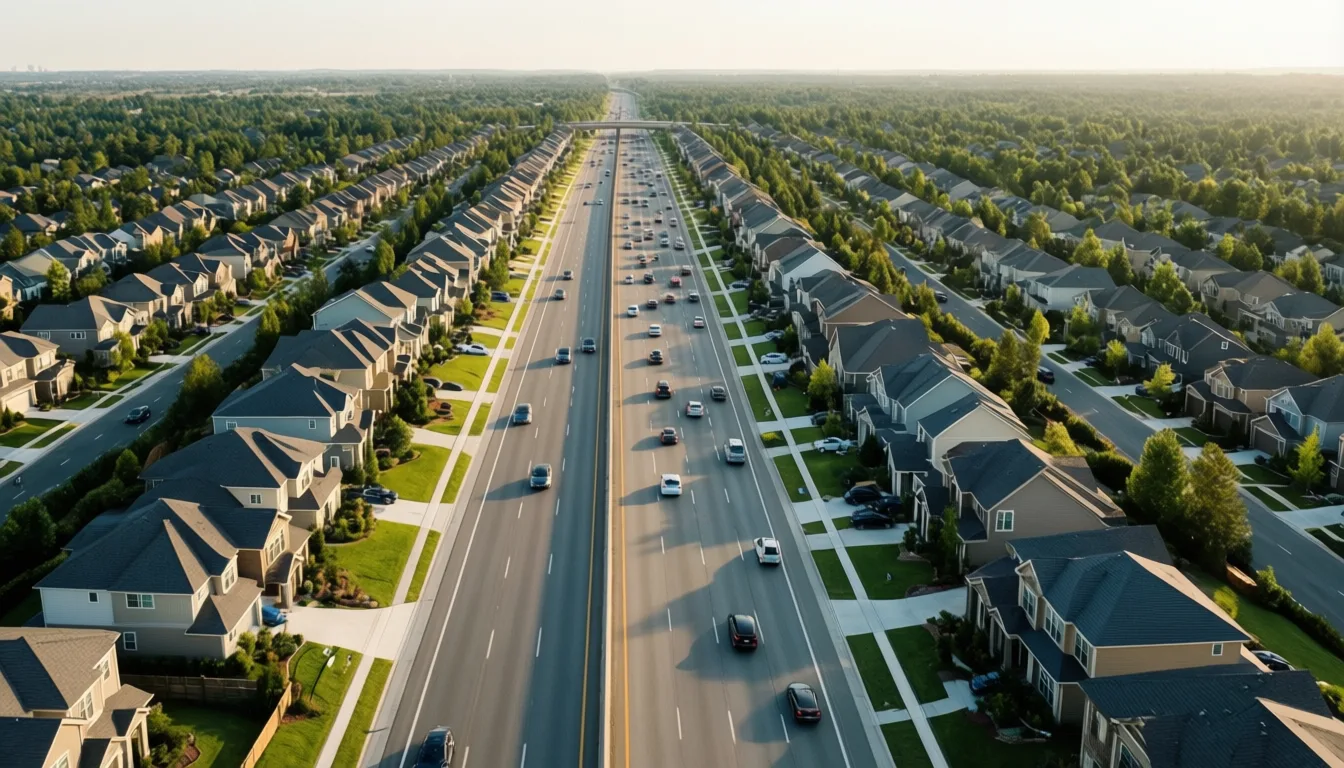
The exposome literature treats proximity — to traffic, to industry, to green space — as a measurable health variable, not a footnote.
The same body, placed in two different environments, ages along two different curves.
What the review actually claims — and what it doesn't
It is worth being precise here, because the gap between a review paper and a tabloid headline is where most health confusion is born. The Atherosclerosis review consolidates observational and mechanistic evidence linking environmental exposures to cardiovascular disease. It discusses how the exposome is measured, what biomarkers researchers have identified, and how those biomarkers track with disease development and progression. It does not claim that moving house will subtract a decade from your cardiovascular age, and it does not propose a clinical protocol.
What it does suggest, with appropriate caution, is that a meaningful share of cardiovascular risk in older adults is environmental, modifiable in principle, and currently under-addressed in the way medicine is practiced and the way readers like you think about your own health. The evidence base, the authors note, is strongest for air pollution and noise; thinner, though growing, for soil contaminants and heat. We would rate the overall picture as moderate — convincing in aggregate, still maturing in the details.
- Environment is a cardiovascular variable. The 2025 review consolidates evidence that air, noise, soil and climate exposures contribute meaningfully to heart disease risk.
- Two-thirds of global deaths now come from chronic non-communicable diseases, with environmental exposures among the drivers identified in the review.
- Vulnerability compounds. Older adults and those with existing conditions appear more sensitive to the same exposures than healthy younger people.
- The evidence is moderate, not settled. Most data are observational; the authors describe associations and pathways, not prescriptions.
- Awareness is the first lever. Knowing your local air quality and noise environment is a reasonable starting point; specific interventions are a conversation for your clinician.
For the man already doing the basics
If you are reading this magazine, you are probably already moving your body, watching your blood pressure, and at least skeptical of the supplement-of-the-month. The exposome literature is not an argument to abandon any of that. It is an argument to widen the field of view.
The practical implication, as we read it, is modest but real. A man in his sixties or seventies thinking carefully about the next twenty years might reasonably add to his mental checklist: what is the air like where I sleep, what is the noise like where I sleep, and how exposed am I to extreme heat in a summer that keeps getting hotter? None of these questions has a pill answer. All of them have an awareness answer, and some of them have a behavioral one — when to close a window, when to run a filter, when to stay indoors on a bad-air day, when to call the doctor if a heat wave is coming and you take a medication that affects how you handle it.
That last point matters. Anyone with established cardiovascular disease, or on medications that alter blood pressure, fluid balance, or heart rate, should treat decisions about heat, exertion, and air quality as medical questions, not lifestyle questions. The right person to walk through them with is your own clinician, who knows your history.

Indoor air monitors and local AQI forecasts are inexpensive ways to make an invisible exposure visible.
The long view
Sixteen years is a short life for a scientific concept. The exposome is still, in some ways, an organizing idea looking for the right tools to measure itself. But the direction of travel in the recent literature is clear enough: the environment is not background. It is a variable, and for cardiovascular risk in particular, it appears to be a sizeable one.
For a reader who has spent years tightening up the inside — diet, exercise, sleep, labs — the next frontier may be looking at the outside. Not as a reason to despair about what you cannot control, but as a reminder that some of the highest-leverage decisions about staying strong, sharp, and independent into your eighties may be quieter ones: where you sleep, what you breathe, and how seriously you take a hot week in July.
Frequently asked questions
What exactly is the exposome?
The exposome describes everything that is not your DNA: the air you have breathed since childhood, the water that has run through your taps, the noise that wakes you at night, the heat your body has had to dissipate, plus the socioeconomic and lifestyle currents that shape all of it. The concept was coined roughly sixteen years ago as a counterpart to the genome.
Who is most vulnerable to the health effects of environmental exposures?
Older adults and those with existing conditions appear more sensitive to the same exposures than healthy younger people — what the review describes as vulnerability compounding. A 70-year-old with well-controlled hypertension living near a busy freeway, for example, is not the same risk profile as a healthy 40-year-old in the same house.
Which environmental exposures have the most solid evidence behind them?
According to the review, the evidence is strongest for air pollution and noise, while the case for soil contaminants and heat is described as thinner, though growing. The authors characterize the overall picture as moderate — convincing in aggregate but still maturing in the details.
What practical steps does the article suggest for someone who wants to act on this information?
The article points to awareness as the first lever, noting that indoor air monitors and local AQI forecasts are inexpensive ways to make an invisible exposure visible. Behavioral choices mentioned include knowing when to close a window, run an air filter, or stay indoors on a bad-air day.
Should I handle decisions about heat and air quality differently if I have heart disease or take certain medications?
The article states that anyone with established cardiovascular disease, or on medications that alter blood pressure, fluid balance, or heart rate, should treat decisions about heat, exertion, and air quality as medical questions rather than lifestyle questions. The right person to walk through those decisions with is your own clinician, who knows your history.
Sources
- Cardiovascular risk posed by the exposome. — Atherosclerosis
Join the conversation
Comments are moderated and reviewed before they appear. Be constructive — this is health information.
Add your comment