
The Oral GLP-1 Era Begins: Two Pills Move Toward the Mainstream
Two new trials in The Lancet put the first credible oral, non-peptide GLP-1 drugs on the runway — a shift that could change who actually gets access to this class.
For four years, the GLP-1 story has been a story about needles. Semaglutide, tirzepatide, the weekly auto-injector tucked in the fridge door — that has been the price of entry to the most consequential metabolic drug class in a generation. Two trials published back-to-back in The Lancet just changed the shape of that conversation. Orforglipron, an oral non-peptide GLP-1 receptor agonist, met its primary endpoint in a phase 3 head-to-head against an established oral diabetes pill. Elecoglipron, a different small-molecule GLP-1 from a different developer, cleared a phase 2b placebo-controlled study. Two distinct molecules, two real trials, one direction of travel: the era of the GLP-1 pill is no longer theoretical.
- Two oral GLP-1 candidates posted positive trials in The Lancet — orforglipron (phase 3) and elecoglipron (phase 2b).
- Orforglipron was tested against dapagliflozin, an existing oral diabetes drug, on a non-inferiority design — not against injectable semaglutide or tirzepatide.
- Both molecules are small-molecule, non-peptide GLP-1 agonists, which is what allows oral dosing without the food-and-water restrictions of oral semaglutide.
- The trials enrolled adults with type 2 diabetes, not the general weight-loss population — read efficacy and safety in that context.
- Approval is not the same as availability. Phase 3 wins move a drug toward regulators; price, supply and prescribing patterns determine who actually gets it.
What the trials actually tested
The first study, ACHIEVE-2, is the one to anchor on. It is a 40-week, phase 3, multicentre, randomised non-inferiority trial across 73 sites in six countries. Adults with type 2 diabetes already on at least 1500 mg/day of metformin, with HbA1c between 7.0% and 10.5%, were randomised 1:1:1:1 to once-daily oral orforglipron at 3 mg, 12 mg or 36 mg — or to dapagliflozin 10 mg, a widely used SGLT2 inhibitor. The primary endpoint was change in HbA1c at week 40, with a non-inferiority margin of 0.3%.
Two design choices matter here. First, the comparator is an oral drug, not an injectable GLP-1. That tells you something about the commercial and clinical positioning: orforglipron is being framed as the next oral option for patients whose metformin alone isn't enough, not as a head-to-head challenger to weekly semaglutide. Second, the trial is open-label between drugs but dose-blinded within the orforglipron arms — a pragmatic compromise that lets the regulator see a clean dose-response while accepting the practical reality of comparing a daily tablet to a different daily tablet.
The second study, SOLSTICE, is earlier-stage and answers a different question. It is a phase 2b, double-blind, placebo-controlled trial of elecoglipron across nine countries, enrolling adults with type 2 diabetes managed by diet and exercise, metformin, or an SGLT2 inhibitor. Participants were randomised to fixed daily doses of 5, 15 or 25 mg, or to escalation regimens targeting 50 mg and 75 mg. Crucially, elecoglipron is described as having no food or fluid restrictions — the operational problem that has limited oral semaglutide's uptake.
Two distinct molecules, two real trials, one direction of travel: the era of the GLP-1 pill is no longer theoretical.
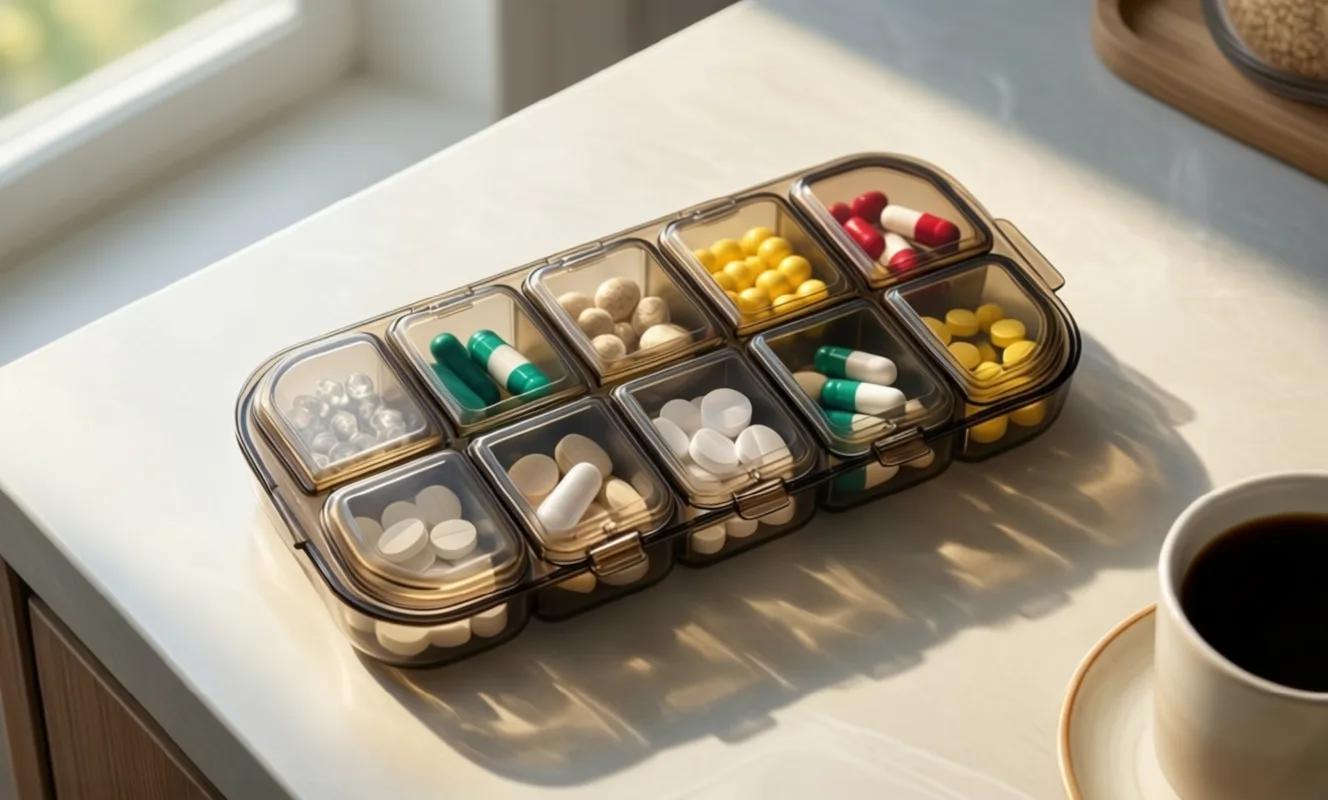
The practical case for an oral GLP-1 isn't sophistication — it's adherence. A daily tablet slots into a routine most people already have.
Why "non-peptide, small molecule" is the whole story
If you have ever wondered why semaglutide is an injection and oral semaglutide is a finicky tablet that demands an empty stomach and a 30-minute fast, the answer is chemistry. Semaglutide is a peptide — a chain of amino acids — and peptides are what your gut is built to demolish. Getting a peptide to survive the stomach requires either an injection or, in the case of oral semaglutide, an absorption enhancer plus strict fasting conditions that most patients find difficult to maintain.
Orforglipron and elecoglipron are different animals. Both are described in their respective trial reports as oral, non-peptide, small-molecule GLP-1 receptor agonists. They bind the same receptor, but they are built like conventional pills — stable, absorbed without elaborate workarounds, and in elecoglipron's case explicitly free of food or fluid restrictions. That is the mechanism behind the headline. A small molecule that hits the GLP-1 receptor is a more forgiving product than a peptide that has to be smuggled past your digestive enzymes.
What this changes for a 40-year-old paying attention
Honest answer: not much, this quarter. Phase 3 readouts are a milestone toward regulatory submission, not a prescription. ACHIEVE-2 is registered as completed on ClinicalTrials.gov; the next steps are regulatory review and labelling, not a shelf at your pharmacy. Elecoglipron is a stage behind that.
What does change is the trajectory. For the first time, two independent programmes have produced positive controlled-trial data for orally dosed GLP-1 agonists that aren't constrained by peptide chemistry. If both clear regulators, the bottleneck on this class shifts from "will you accept a weekly injection" to "will your insurer cover the tablet" — a different and probably more tractable problem for most patients.
Three caveats worth keeping in front of you. One, both trials were run in adults with type 2 diabetes, not in the broader population of people pursuing weight loss; the obesity-indication studies for these molecules are separate work, and the evidence rating for oral GLP-1s as a weight-management tool remains earlier-stage. Two, orforglipron's comparator was dapagliflozin, not injectable semaglutide or tirzepatide — non-inferiority against an SGLT2 inhibitor doesn't tell you how an oral GLP-1 stacks up against the best injectable in class. Three, longer-term safety, cardiovascular outcomes and durability data accrue over years, not 40 weeks.

Non-peptide chemistry is what makes once-daily oral dosing feasible without the absorption gymnastics of earlier oral GLP-1s.
How to read the next twelve months
Watch three things. First, the full ACHIEVE-2 results and any companion trials comparing orforglipron to injectable GLP-1s rather than to SGLT2 inhibitors — that comparison is the one that determines whether oral is a substitute or a stepping-stone. Second, the safety and tolerability signal from SOLSTICE's dose-escalation arms; GI tolerability is the historic Achilles' heel of this class, and how a small molecule behaves across 5 mg to 75 mg matters. Third, regulatory timelines. A phase 3 win starts a clock; it does not end one.
The right posture for an informed reader right now is neither dismissive nor pre-ordering. The class works. Oral delivery without peptide chemistry now has controlled-trial support from two independent molecules. That is a meaningful upgrade to the 2026 landscape — and it is also exactly where the cautious version of the story stops.
Frequently asked questions
Are these pills approved yet?
No. Orforglipron has positive phase 3 data in type 2 diabetes from ACHIEVE-2, which is a step toward regulatory submission, not an approval. Elecoglipron is a stage earlier, with phase 2b data from SOLSTICE.
Were these trials about weight loss?
No. Both studies were conducted in adults with type 2 diabetes. Obesity-indication studies for these molecules are separate programmes and aren't covered by these papers.
How is orforglipron different from oral semaglutide?
Oral semaglutide is a peptide formulated with an absorption enhancer and requires fasting conditions. Orforglipron and elecoglipron are small-molecule, non-peptide GLP-1 receptor agonists — elecoglipron's trial report specifies no food or fluid restrictions.
Did orforglipron beat injectable GLP-1s?
That comparison wasn't tested. ACHIEVE-2 compared orforglipron to dapagliflozin, an oral SGLT2 inhibitor, on a non-inferiority design — not to semaglutide or tirzepatide.
Should I ask my doctor about switching?
This article is educational, not medical advice. Neither drug is available outside of trials yet, and decisions about diabetes or metabolic therapy belong with a clinician who knows your history.
One more reframe before you close the tab. The interesting question over the next two years isn't whether oral GLP-1s exist — that's now answered. It's whether they perform close enough to the injectables to make the needle optional for most patients, and whether the systems that pay for these drugs treat "oral and cheaper to manufacture" as a reason to broaden access or as a reason to charge the same. The science just shipped. The access question is the one to watch.
Sources
- Orforglipron compared with dapagliflozin in adults with type 2 diabetes and inadequate glycaemic control with metformin (ACHIEVE-2): a multicentre, randomised, non-inferiority, open-label, phase 3 trial. — Lancet (London, England)
- Elecoglipron, an oral small molecule GLP-1 receptor agonist in adults with type 2 diabetes (SOLSTICE): a multicentre, phase 2b, randomised, placebo-controlled trial. — Lancet (London, England)
Join the conversation
Comments are moderated and reviewed before they appear. Be constructive — this is health information.
Add your comment