
The Sarcopenia–Atherosclerosis Loop: Why Muscle Loss and Vascular Aging Feed Each Other
A new mechanistic review argues that after 50, the cardiovascular system and the skeletal muscle system age as one. Protecting muscle, in other words, may be vascular medicine in disguise.
For decades, cardiology and geriatrics have lived in separate clinics down separate corridors. One specialty watched the arteries; the other watched the legs. A new mechanistic review in Frontiers in Endocrinology argues that this division has cost us something important: the recognition that, after midlife, the body's plumbing and the body's scaffolding are degrading together — and accelerating each other. The paper sketches a bidirectional loop in which shrinking muscle drives vascular disease, and stiffening vessels in turn starve muscle of the perfusion it needs to repair itself. If the model holds, the cleanest longevity prescription of the next decade may sound less like a pharmacy order and more like a training program.
- It's a loop, not a ladder. Muscle loss and atherosclerosis appear to be mutually reinforcing, not sequential.
- Insulin resistance is the hinge. Skeletal muscle is the body's largest glucose sink; lose it and metabolic chaos spreads to the endothelium.
- Inflammation and ectopic fat travel together. Lipid that should sit in muscle migrates into vessels and viscera, fueling plaque.
- The review is mechanistic, not interventional. The model is compelling; head-to-head trials of integrated regimens are still scarce.
- Protecting muscle after 50 is cardiovascular hygiene. Resistance training and anti-inflammatory eating plausibly hit both targets at once.
Two diseases, one engine
The framing is the news here. Sarcopenia — the age-related erosion of muscle mass, strength and quality — has historically been catalogued as a frailty problem: a story about falls, hospital stays and lost independence. Atherosclerosis has been catalogued as a lipid problem: a story about LDL, plaque and infarction. The review by Yu and colleagues consolidates evidence that the two conditions share a common metabolic engine, and that treating them as separate organ failures may be a category error.
The shared engine, as the authors describe it, has four cylinders: insulin resistance, chronic low-grade inflammation, ectopic lipid deposition, and hormonal dysregulation. Each of these is familiar individually. The contribution of the paper is to show how they couple — how a deficit in one tissue propagates, by way of these mediators, into damage in the other.
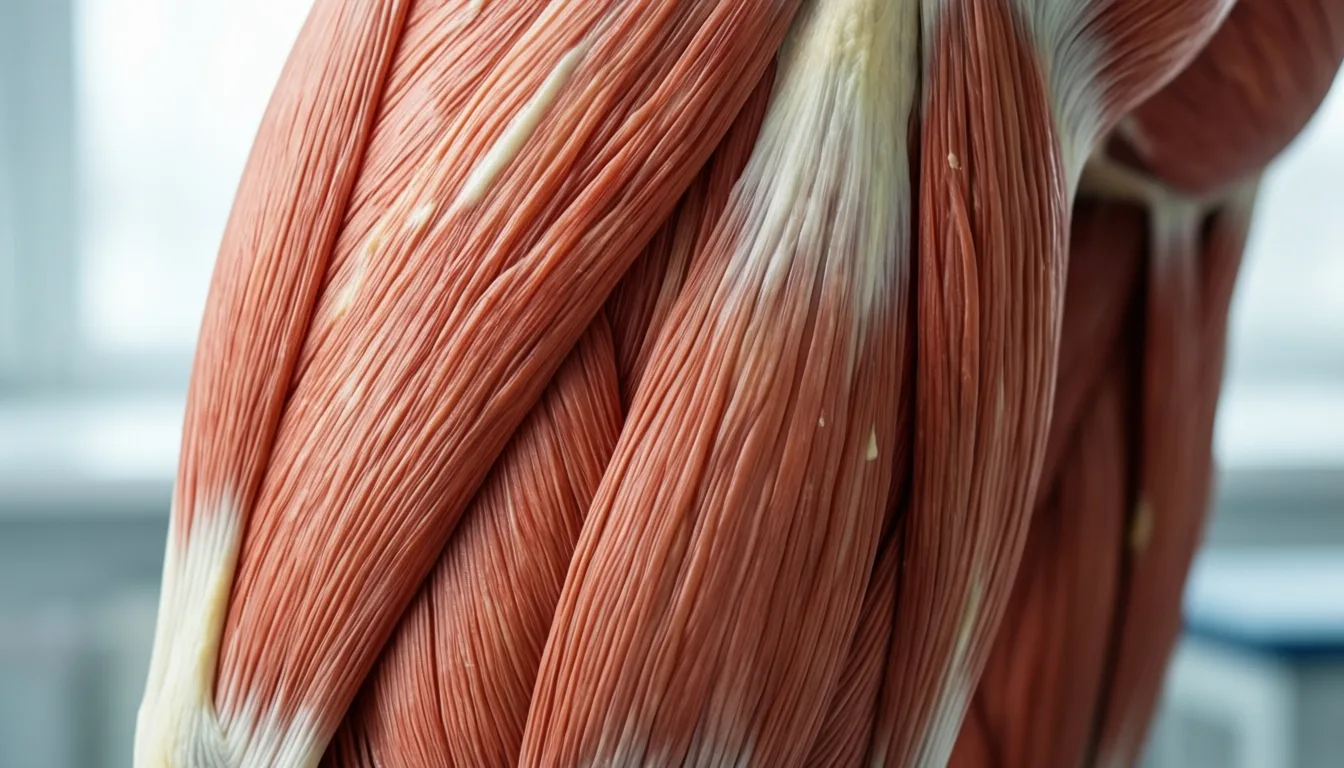
Fat that should be stored elsewhere accumulates between muscle fibers — a signature of the metabolic crosstalk the review describes.
How muscle loss damages arteries
Skeletal muscle is, by mass, the largest insulin-sensitive organ in the body. When it shrinks or becomes infiltrated with fat, the body's capacity to clear glucose drops. The review traces how this muscle dysfunction exacerbates systemic insulin resistance and inflammatory cascades that accelerate endothelial damage and atherogenesis. In plainer terms: a less metabolically capable muscle bed leaves more glucose and free fatty acids circulating, which irritates the inner lining of vessels, recruits inflammatory cells, and lays the groundwork for plaque.
This reframes a familiar clinical picture. The patient with quietly declining grip strength and a creeping waist circumference is not on two independent trajectories. They are on one.
A less metabolically capable muscle bed leaves more glucose and lipid in circulation — and the endothelium pays the bill.
How arteries damage muscle
The return arc of the loop is the part most readers will not have heard articulated before. Once atherosclerosis is established, perfusion suffers — not only in the dramatic territories that cause heart attacks and strokes, but in the diffuse microcirculation that nourishes working muscle. The review argues that atherosclerotic vascular impairment compromises microcirculatory function, inducing muscle ischemia and metabolic decline. Starved of oxygen and nutrient delivery, muscle fibers atrophy and accumulate dysfunctional mitochondria, which in turn worsens insulin handling. The loop closes.
This is why the authors frame the comorbidity within the broader vocabulary of geroscience — the hallmarks of aging, the shared upstream drivers — rather than as a coincidence of two common diseases that happen to peak in the same decade of life.

Resistance training is one of the few interventions that plausibly targets muscle and vasculature simultaneously.
What might break the cycle
Because the mechanisms converge, the interventions might too. The review surveys candidates that concurrently target shared pathways in muscle and vasculature: combined aerobic and resistance exercise, anti-inflammatory dietary patterns, and a handful of pleiotropic pharmacotherapies whose effects on lipid handling, insulin signaling and inflammation may matter as much as their original indications.
It is worth being honest about what this paper is and is not. It is a mechanistic synthesis — a map of a hypothesis space — not a randomized trial of an integrated regimen against usual care. The strength of the underlying biology is real; the strength of the clinical evidence for treating the loop as a single target is still emerging. Readers shopping for certainty will not find it here. Readers shopping for a coherent framework that explains why the same person tends to lose a step and a pulse pressure point in the same year will.
The practical reframe
For the longevity-minded reader who already tracks ApoB and VO2max, the actionable shift is conceptual rather than tactical. The review does not introduce a new molecule or a new screening test. It argues, instead, that the strength training already on your calendar is not a vanity project running parallel to your cardiovascular program — it is part of your cardiovascular program. And conversely, that letting muscle quietly erode in your sixties is not a cosmetic concession; it is, on the model the authors propose, a slow-motion lipid disorder.
That is a useful inversion to carry into a conversation with a clinician. The authors explicitly advocate a paradigm shift from organ-specific management toward a holistic, geroscience-based approach. Whether that paradigm shift survives contact with the next decade of trials is the open question. The mechanistic case, for now, is the most coherent one on offer.
- Treat strength training as cardiovascular care, not a separate fitness goal.
- Watch intramuscular fat, not just visceral fat — the review flags ectopic lipid as a shared driver.
- Ask about insulin sensitivity, not only LDL, when discussing risk after 50.
- Be wary of weight-loss strategies that sacrifice lean mass; on this model, that trades one risk for another.
- Expect integrated trials testing muscle-and-vessel endpoints together — the next interesting data will come from there.
Frequently asked questions
What is the sarcopenia–atherosclerosis loop?
It is a bidirectional cycle in which shrinking muscle drives vascular disease, and stiffening, plaqued vessels in turn starve muscle of the blood flow it needs to repair itself. The two conditions share a common metabolic engine with four components: insulin resistance, chronic low-grade inflammation, ectopic lipid deposition, and hormonal dysregulation. Rather than two independent diseases that happen to peak in the same decade, the review frames them as mutually reinforcing organ failures.
How does losing muscle mass harm the arteries?
Skeletal muscle is the body's largest insulin-sensitive organ, and when it shrinks or becomes infiltrated with fat, the body's capacity to clear glucose drops. This leaves more glucose and free fatty acids circulating, which irritates the inner lining of blood vessels, recruits inflammatory cells, and lays the groundwork for plaque. The review describes this as muscle dysfunction exacerbating systemic insulin resistance and inflammatory cascades that accelerate endothelial damage and atherosclerosis.
How does atherosclerosis then hurt muscle?
Once atherosclerosis is established, it compromises not only major arteries but the diffuse microcirculation that nourishes working muscle, inducing muscle ischemia and metabolic decline. Starved of oxygen and nutrient delivery, muscle fibers atrophy and accumulate dysfunctional mitochondria, which in turn worsens insulin handling. This is how the loop closes — vascular damage feeds back into further muscle loss.
Is there strong clinical trial evidence for treating these two conditions as a single target?
No. The review is described as a mechanistic synthesis — a map of a hypothesis space — not a randomized trial of an integrated regimen against usual care. The authors acknowledge that the strength of the clinical evidence for treating the loop as a single target is still emerging. Head-to-head trials of integrated regimens remain scarce.
What does this mean for someone who already follows a cardiovascular health program?
The review's practical shift is conceptual: strength training already on your calendar is not a separate fitness goal running parallel to your cardiovascular program — it is part of your cardiovascular program. Conversely, the authors argue that letting muscle quietly erode in your sixties is not a cosmetic concession but, on their model, a slow-motion lipid disorder. The review also flags that weight-loss strategies that sacrifice lean mass may trade one risk for another.
Sources
- Unraveling the metabolic pathways between atherosclerosis and sarcopenia. — Frontiers in endocrinology
Join the conversation
Comments are moderated and reviewed before they appear. Be constructive — this is health information.
Add your comment