
The Sarcopenia Signal: Why Your Nerves, Not Just Your Muscles, Drive Age-Related Decline
A new systematic review reframes age-related strength loss as a problem of failing wires, not shrinking cables — and it changes what screening and training after 60 should look like.
For most of the last century, the textbook story of aging muscle was a story about muscle. Fibers thinned, mitochondria sputtered, protein synthesis slowed, and somewhere around the seventh decade the body began the long negotiation we call sarcopenia. But a growing body of electromyography research is quietly rewriting that script. The first thing to fail, it turns out, may not be the muscle at all. It may be the wire that talks to it.
That, at least, is the through-line of a 2025 systematic review in GeroScience that pulled together 53 EMG studies on motor unit and neuromuscular junction (NMJ) function across aging and sarcopenia. The authors describe a recognizable sequence: early instability at the NMJ — the tiny synapse where a motor neuron hands off its electrical message to a muscle fiber — followed by the loss of motor units, then a period of compensatory remodeling in which surviving neurons attempt to adopt orphaned fibers. Overt atrophy and weakness, the clinical signs we currently use to diagnose sarcopenia, appear later in the cascade, not at its start. The implication is that by the time a grip-strength test catches the problem, the upstream pathology has been running for years.
The evidence here is moderate, not definitive. A systematic review is a synthesis, not a randomized trial, and EMG-derived parameters — jitter, jiggle, motor unit number estimation (MUNE) — remain specialized measurements more familiar to neurologists than to the geriatric clinics where sarcopenia is usually identified. Still, the convergence is hard to ignore: across dozens of studies, aging neuromuscular junctions show transmission instability and motor unit loss before muscle atrophy becomes clinically obvious.
The wires before the cables
To appreciate why this matters, it helps to picture the architecture. A single motor neuron in the spinal cord branches outward to innervate a cluster of muscle fibers; together they form a motor unit, the smallest functional element of voluntary movement. The NMJ is the junction at each fiber where acetylcholine crosses a microscopic gap and triggers contraction. If that junction becomes unreliable — if release is jittery, if receptors are sparser, if the structural folds that amplify the signal flatten — the muscle fiber is, in effect, partially deafferented. It is still there. It just isn't being called on properly.
The review describes two biomarkers that may track this process from a blood draw rather than a needle EMG: C-terminal agrin fragment, a byproduct of NMJ remodeling, and neurofilament light chain, a marker of axonal injury. Neither is ready for the corner lab, and neither has been validated as a screening tool in healthy aging populations. But both suggest a near-future in which sarcopenia risk could be assessed before a patient ever notices they are slower up the stairs.
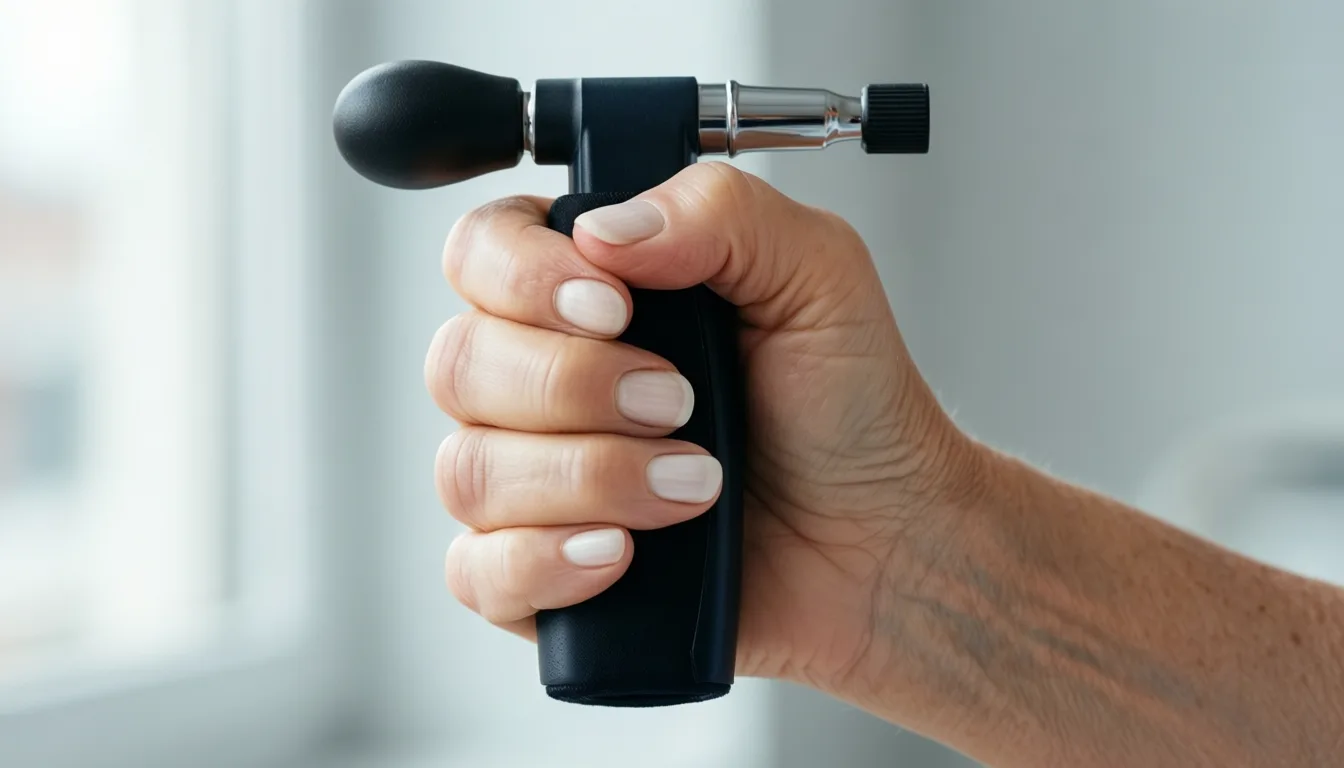
Grip strength is a late signal. By the time it dips, the upstream neuromuscular cascade has been underway for years.
What this means for training
If the NMJ is the early failure point, then interventions that preserve neural drive should matter as much as those that build cross-sectional area. The review notes that resistance and endurance training, nutritional support, and electrostimulation-based approaches have each shown signals of attenuating NMJ decline, while physical inactivity and hormonal changes — menopause among them — appear to accelerate it. None of this overturns the existing consensus that lifting heavy things, regularly, is the single most evidence-backed intervention for sarcopenia. What it does is sharpen the rationale. Heavy, intent-driven contractions are not just hypertrophic stimuli; they are demands placed on the motor unit itself, the kind of demand that may help maintain the synapse.
The corollary is less flattering. Low-effort movement — the daily-step minimum, the gentle group class — is unlikely to be enough on its own. Programming that recruits high-threshold motor units, whether through external load or through ballistic and power-oriented work, is plausibly the part of training doing the neural work. We are not in a position to prescribe sets and reps from this evidence base, and any individual program should be designed with a clinician or qualified coach who understands a person's medical history. But the direction of travel is clear: train the nerve, not just the muscle.
By the time a grip-strength test catches it, the upstream pathology has been running for years.
Screening, and the intrinsic-capacity frame
The neuromuscular reframing also dovetails with how the WHO has been pushing healthy-aging assessment. Intrinsic capacity (IC) — a composite of locomotion, cognition, vitality, sensory function, and psychological state — is meant to catch decline earlier and more holistically than disease-by-disease screening. A 2025 cross-sectional study of 4,274 adults in the Queenstown cohort in Singapore found that 29.2% had at least one IC deficit, rising stepwise from 10.3% in adults aged 20–39 to 74.5% in those 80 and older, with locomotion the most commonly affected domain.
That study isn't an NMJ paper, but it is a useful sanity check on the population scale of the problem and on what already predicts it. Low handgrip strength was associated with 1.68-fold odds of an IC deficit, and frailty with nearly 11-fold odds — both consistent with a model in which neuromuscular integrity is doing quiet, foundational work behind the scenes of healthy aging. Grip strength is a crude proxy, but it is cheap, fast, and already in use; pairing it with a locomotion screen may be the most realistic near-term application of this science in primary care.

Power and intent-driven loading are increasingly seen as the part of training that taxes the motor unit itself.
- The nerve fails first. A 2025 systematic review of EMG studies suggests NMJ instability and motor unit loss precede the muscle atrophy clinicians currently use to diagnose sarcopenia.
- The evidence is moderate. Findings come from a synthesis of 53 studies using specialized EMG measures; they are convergent but not yet trial-grade.
- Biomarkers are emerging. C-terminal agrin fragment and neurofilament light chain may eventually allow earlier risk detection, but neither is ready for routine use.
- Training should target neural drive. Resistance and endurance work, and possibly power-oriented loading, are the interventions with the strongest signal for preserving NMJ function.
- Screening is catching up. WHO intrinsic-capacity frameworks and handgrip testing already capture much of the downstream signal — and locomotion deficits are the most common in adults over 60.
- This is not medical advice. Anyone considering a meaningful change to training, supplementation, or screening should do so with a clinician who knows their history.
The big story here is not that we have a new treatment for sarcopenia. We don't. It is that the unit of analysis is shifting. For a long time, age-related decline has been framed as a slow leak from a muscle bucket, and the response has been to pour more in — more protein, more reps, more time under tension. The neuromuscular reframing suggests a different metaphor. The bucket isn't leaking. The pump is wearing out. That is a harder problem, but it is a more honest one, and it points toward earlier action, better screening, and training designed for the nervous system that drives the muscle, not just the muscle itself.
Frequently asked questions
Why is grip strength considered a late indicator of sarcopenia according to this research?
The article explains that NMJ instability and motor unit loss occur before muscle atrophy becomes clinically obvious, meaning the upstream neuromuscular cascade has been underway for years by the time a grip-strength test detects a problem. Grip strength reflects overt weakness, which appears later in the cascade rather than at its start.
What are the two blood biomarkers mentioned, and can they be tested today?
The article identifies C-terminal agrin fragment, a byproduct of NMJ remodeling, and neurofilament light chain, a marker of axonal injury, as emerging biomarkers. Neither is ready for routine clinical use, and neither has been validated as a screening tool in healthy aging populations.
What does the article say about low-intensity movement like daily steps or gentle group classes?
The article states that low-effort movement is unlikely to be enough on its own to address neuromuscular decline. Programming that recruits high-threshold motor units, through external load or ballistic and power-oriented work, is described as the part of training doing the neural work.
What factors does the article say can accelerate NMJ decline?
The article specifically names physical inactivity and hormonal changes, including menopause, as factors that appear to accelerate neuromuscular junction decline.
How large was the systematic review described in the article, and what did it find?
The 2025 systematic review published in GeroScience synthesized 53 EMG studies on motor unit and neuromuscular junction function across aging and sarcopenia. It describes a recognizable sequence of early NMJ instability, followed by motor unit loss, then compensatory remodeling by surviving neurons, with overt atrophy and weakness appearing later in the cascade.
Sources
- Exploring motor unit and neuromuscular junction dysfunction in aging and sarcopenia: insights from electromyography in systematic review. — GeroScience
- Intrinsic capacity deficits across the lifespan in a nationally representative community cohort: findings from the Queenstown study. — Archives of gerontology and geriatrics
Join the conversation
Comments are moderated and reviewed before they appear. Be constructive — this is health information.
Add your comment