
In This Issue




The Exposome: Why Your ZIP Code May Outweigh Your Supplement Stack
A new review in Atherosclerosis argues that the air you breathe, the noise outside your window, and the climate you live in may shape cardiovascular risk more than the contents of your medicine cabinet.
For a generation of men who have learned to track resting heart rate, fasting glucose, and LDL particle counts, it is humbling to read a research paper suggesting that the single biggest lever on cardiovascular risk may be something you cannot swallow, measure on a wristband, or argue about on a podcast. It is the place you live. A 2025 review in Atherosclerosis by Daiber, Rajagopalan, Kuntic and Münzel pulls together a decade of work on what researchers now call the exposome — the lifelong sum of environmental exposures, from highway noise to soil contaminants to heat waves — and makes a measured case that these factors deserve a seat at the same table as cholesterol and blood pressure.
The word itself is awkward, and the authors know it. Coined roughly sixteen years ago as a counterpart to the genome, the exposome describes everything that is not your DNA: the air you have breathed since childhood, the water that has run through your taps, the noise that wakes you at 3 a.m., the heat your body has had to dissipate, plus the socioeconomic and lifestyle currents that shape all of it. The review frames this against a sobering backdrop. Chronic non-communicable diseases — heart disease chief among them — now account for roughly two-thirds of global deaths each year, driven both by an aging population and by the steady drip of environmental insults.
That number is not a forecast. It is the present tense.
A reframe, not a revolution
The optimization crowd has spent the better part of two decades drilling down into the individual: genotype, biomarker, microbiome, sleep stage. The exposome literature pulls the camera back. It argues that the same body, placed in two different environments, will age along two different curves — and that the gap between those curves is not small.
Daiber and colleagues are careful not to oversell. Their review is a synthesis, not a randomized trial, and they note repeatedly that the exposome interacts with genetic predisposition and with diseases a person already has. A 70-year-old with well-controlled hypertension living near a busy freeway is not the same risk profile as a healthy 40-year-old in the same house. Vulnerability compounds.
Still, the through-line is consistent. Air pollution, traffic noise, contaminated water and soil, mental stress, and the rising temperatures of a changing climate are each associated with premature death and lost healthy life years, measured in the currency epidemiologists call disability-adjusted life years. The authors describe the exposome as having a specific external component (what you personally encounter) and a general external component (the broader social and economic conditions you live within), with finer subdivisions for organ-specific effects and for what they call the pollutome — the slice of exposure that is pollution, bounded in space and time.
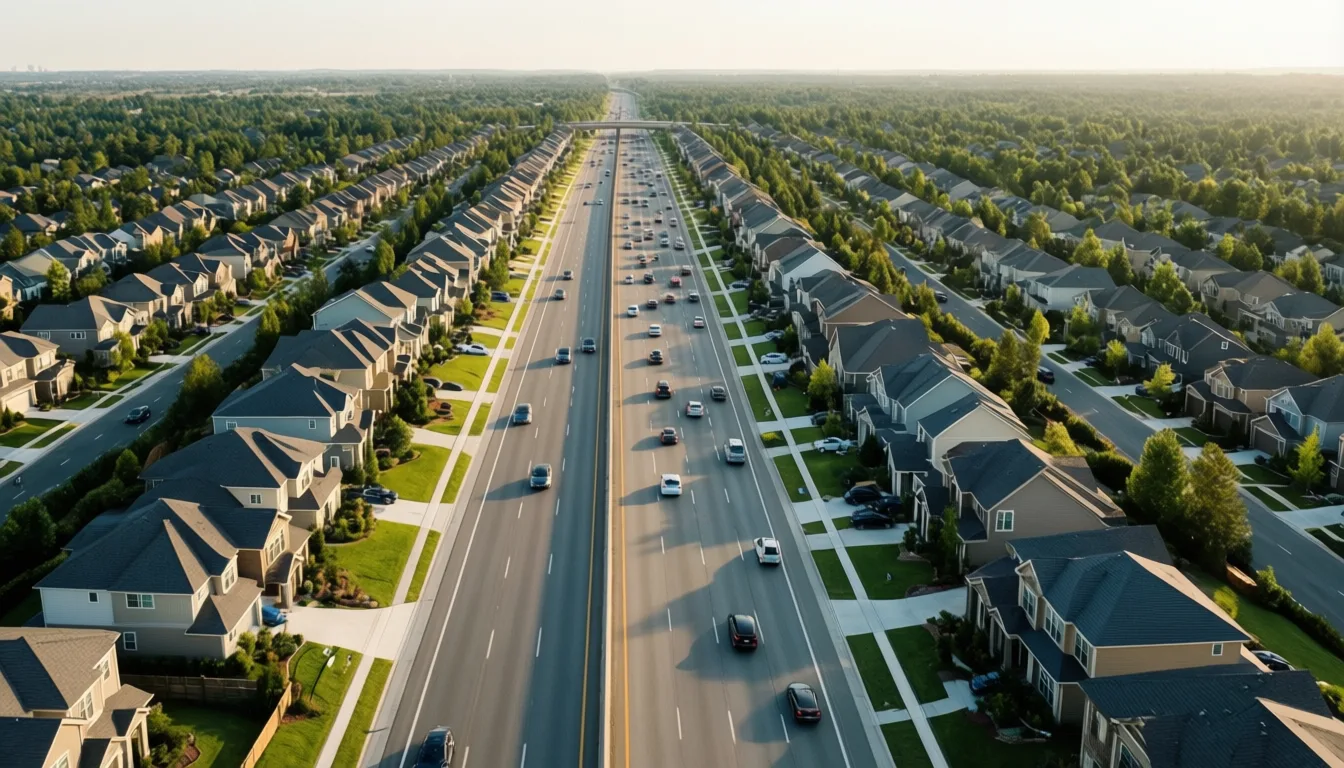
The exposome literature treats proximity — to traffic, to industry, to green space — as a measurable health variable, not a footnote.
The same body, placed in two different environments, ages along two different curves.
What the review actually claims — and what it doesn't
It is worth being precise here, because the gap between a review paper and a tabloid headline is where most health confusion is born. The Atherosclerosis review consolidates observational and mechanistic evidence linking environmental exposures to cardiovascular disease. It discusses how the exposome is measured, what biomarkers researchers have identified, and how those biomarkers track with disease development and progression. It does not claim that moving house will subtract a decade from your cardiovascular age, and it does not propose a clinical protocol.
What it does suggest, with appropriate caution, is that a meaningful share of cardiovascular risk in older adults is environmental, modifiable in principle, and currently under-addressed in the way medicine is practiced and the way readers like you think about your own health. The evidence base, the authors note, is strongest for air pollution and noise; thinner, though growing, for soil contaminants and heat. We would rate the overall picture as moderate — convincing in aggregate, still maturing in the details.
- Environment is a cardiovascular variable. The 2025 review consolidates evidence that air, noise, soil and climate exposures contribute meaningfully to heart disease risk.
- Two-thirds of global deaths now come from chronic non-communicable diseases, with environmental exposures among the drivers identified in the review.
- Vulnerability compounds. Older adults and those with existing conditions appear more sensitive to the same exposures than healthy younger people.
- The evidence is moderate, not settled. Most data are observational; the authors describe associations and pathways, not prescriptions.
- Awareness is the first lever. Knowing your local air quality and noise environment is a reasonable starting point; specific interventions are a conversation for your clinician.
For the man already doing the basics
If you are reading this magazine, you are probably already moving your body, watching your blood pressure, and at least skeptical of the supplement-of-the-month. The exposome literature is not an argument to abandon any of that. It is an argument to widen the field of view.
The practical implication, as we read it, is modest but real. A man in his sixties or seventies thinking carefully about the next twenty years might reasonably add to his mental checklist: what is the air like where I sleep, what is the noise like where I sleep, and how exposed am I to extreme heat in a summer that keeps getting hotter? None of these questions has a pill answer. All of them have an awareness answer, and some of them have a behavioral one — when to close a window, when to run a filter, when to stay indoors on a bad-air day, when to call the doctor if a heat wave is coming and you take a medication that affects how you handle it.
That last point matters. Anyone with established cardiovascular disease, or on medications that alter blood pressure, fluid balance, or heart rate, should treat decisions about heat, exertion, and air quality as medical questions, not lifestyle questions. The right person to walk through them with is your own clinician, who knows your history.

Indoor air monitors and local AQI forecasts are inexpensive ways to make an invisible exposure visible.
The long view
Sixteen years is a short life for a scientific concept. The exposome is still, in some ways, an organizing idea looking for the right tools to measure itself. But the direction of travel in the recent literature is clear enough: the environment is not background. It is a variable, and for cardiovascular risk in particular, it appears to be a sizeable one.
For a reader who has spent years tightening up the inside — diet, exercise, sleep, labs — the next frontier may be looking at the outside. Not as a reason to despair about what you cannot control, but as a reminder that some of the highest-leverage decisions about staying strong, sharp, and independent into your eighties may be quieter ones: where you sleep, what you breathe, and how seriously you take a hot week in July.
Frequently asked questions
What exactly is the exposome?
The exposome describes everything that is not your DNA: the air you have breathed since childhood, the water that has run through your taps, the noise that wakes you at night, the heat your body has had to dissipate, plus the socioeconomic and lifestyle currents that shape all of it. The concept was coined roughly sixteen years ago as a counterpart to the genome.
Who is most vulnerable to the health effects of environmental exposures?
Older adults and those with existing conditions appear more sensitive to the same exposures than healthy younger people — what the review describes as vulnerability compounding. A 70-year-old with well-controlled hypertension living near a busy freeway, for example, is not the same risk profile as a healthy 40-year-old in the same house.
Which environmental exposures have the most solid evidence behind them?
According to the review, the evidence is strongest for air pollution and noise, while the case for soil contaminants and heat is described as thinner, though growing. The authors characterize the overall picture as moderate — convincing in aggregate but still maturing in the details.
What practical steps does the article suggest for someone who wants to act on this information?
The article points to awareness as the first lever, noting that indoor air monitors and local AQI forecasts are inexpensive ways to make an invisible exposure visible. Behavioral choices mentioned include knowing when to close a window, run an air filter, or stay indoors on a bad-air day.
Should I handle decisions about heat and air quality differently if I have heart disease or take certain medications?
The article states that anyone with established cardiovascular disease, or on medications that alter blood pressure, fluid balance, or heart rate, should treat decisions about heat, exertion, and air quality as medical questions rather than lifestyle questions. The right person to walk through those decisions with is your own clinician, who knows your history.
Sources
- Cardiovascular risk posed by the exposome. — Atherosclerosis

Beyond Semaglutide: The Next Wave of GLP-1 Combinations and Genetic Response Predictors
New research is beginning to explain why GLP-1 drugs work brilliantly for some and modestly for others — and what comes after the first generation of blockbusters.
For a class of drugs that has dominated headlines, GLP-1 receptor agonists are still surprisingly mysterious. Two people can start the same weekly injection, follow the same lifestyle advice, and end the year with very different bodies — one down 20% of their starting weight, the other barely budging on the scale. That gap has always been the awkward subtext of the GLP-1 era. Now researchers are beginning to fill it in, with early signals that genetics may help predict who responds, that the metabolic benefits may be downstream of weight loss itself, and that the next wave of drugs may not be single molecules at all, but combinations.
- Response varies — and may be partly genetic. A variant in the NBEA gene is associated with how much weight people lose on GLP-1s in two large cohorts.
- Weight loss appears to do the heavy lifting. In a randomized trial, improvements in proinsulin processing tracked weight change, not GLP-1 exposure per se.
- Combinations are the next frontier. A preclinical MOGAT2 inhibitor amplified weight loss when added to semaglutide or tirzepatide — in mice.
- The evidence is moderate. Human genetic findings need replication; combination data so far are animal-only.
- Decisions still belong with your clinician. None of this changes prescribing today, but it reshapes the conversation about expectations.
Why one drug, two outcomes
Clinicians who prescribe GLP-1s have known for years that response is uneven. Trial averages — the 15% or 20% weight-loss figures that make magazine covers — hide a wide distribution. Some patients sit at the top of the curve. Others lose almost nothing despite dutiful adherence, and end up wondering whether the failure is theirs.
A 2025 analysis published in Diabetes, Obesity & Metabolism offers one of the first credible biological explanations. Researchers mining the NIH All of Us cohort of more than 6,500 GLP-1 users built a genetic score around neurobeachin (NBEA), a gene encoding a protein kinase A anchor protein expressed heavily in the brain. People whose score crossed the "responsive" threshold were 82% more likely to be among the top weight-loss responders on liraglutide, a finding that held up when tested again in the UK Biobank. The same score also flagged a non-response signal: liraglutide users on the other end of the distribution were about 50% more likely to lose no weight at all.
The semaglutide signal was directionally similar but weaker, with odds ratios of roughly 1.6 in discovery and 2.2 in validation. That nuance matters. It suggests the genetic effect is real but drug-specific, and that NBEA alone will not become a clean yes-or-no test. What it does provide is a foothold — a first plausible mechanism for why the same dose lands so differently in different bodies.

Large biobank cohorts are starting to surface genetic signals behind GLP-1 response variability.
Is it the drug, or the weight loss?
A second 2025 study, this one a randomized trial of 100 adults with obesity, asks a quieter but equally important question: when GLP-1s improve metabolic markers, is the drug doing the work, or is the weight loss?
Participants were randomized to liraglutide plus metformin or metformin alone for 24 weeks, with standardized diet and exercise. Both groups improved; the GLP-1 group improved more. But when researchers looked specifically at proinsulin processing — a marker of how cleanly the pancreas converts its precursor hormone into mature insulin — the change tracked body-weight and visceral-fat reduction rather than GLP-1 exposure itself, even after adjusting for age, sex, baseline BMI and treatment arm.
The implication is subtle but useful. GLP-1s may be best understood, at least for some endpoints, as efficient delivery vehicles for weight loss rather than as drugs with broad standalone metabolic magic. That framing aligns with what many endocrinologists already suspected, and it sharpens expectations: a patient who loses little weight on a GLP-1 is unlikely to capture the full downstream metabolic benefit, regardless of how the drug is theoretically supposed to work.
GLP-1s may be best understood as efficient delivery vehicles for weight loss — not standalone metabolic magic.
The combination era
If single-agent GLP-1s have a ceiling — set partly by genetics, partly by tolerability — the obvious next move is to stack mechanisms. Tirzepatide, which combines GLP-1 and GIP receptor activity in one molecule, already hints at the upside. The early pipeline is going further.
One example: VB-87531, a small-molecule inhibitor of MOGAT2, an enzyme involved in resynthesizing dietary triglycerides for transport to the liver. In diet-induced obese mice, VB-87531 reduced weight and food intake on its own. More interesting, when paired with either semaglutide or tirzepatide, the combination produced greater weight loss and appetite suppression than the MOGAT2 inhibitor alone, alongside lower insulin and leptin and higher FGF21 and PYY — a hormonal profile that, on paper, looks favorable.
The caveat is large and worth stating plainly: this is preclinical work in mice. The history of obesity pharmacology is littered with compounds that dazzled in rodents and disappointed in humans. VB-87531 is not a treatment; it is a hypothesis. But the underlying logic — combine a centrally acting appetite drug with a peripherally acting fat-handling drug — is exactly the direction the field is moving, and several similar pairings are in earlier human exploration.

The next generation of weight-loss therapy is likely to be combinations, not solo acts.
What this means for the conversation with your doctor
None of this changes a prescription today. There is no NBEA test you can order, no MOGAT2 combination on a pharmacy shelf, and no guidance that the proinsulin finding should alter how a clinician chooses between liraglutide, semaglutide or tirzepatide. What is changing is the framing.
For readers already on a GLP-1, the most practical takeaway is that uneven response is biological, not a personal failing — and that the metabolic gains tend to follow the weight loss, which is why sticking with lifestyle scaffolding still matters even on a powerful drug. For readers considering one, it is worth asking your clinician how response will be monitored, what a reasonable trial period looks like, and what the plan is if you fall on the lower end of the curve. Those are the questions the next few years of research are designed to answer.
The GLP-1 story started as a blockbuster. It is quietly turning into something more interesting: a precision-medicine story, in which the right drug, the right combination and the right expectations may eventually be matched to the right patient.
Frequently asked questions
Why do some people lose dramatically more weight on GLP-1 drugs than others?
Response to GLP-1 drugs is uneven, and trial averages hide a wide distribution of outcomes. A 2025 genetic analysis found that a score built around the NBEA gene — which encodes a protein expressed heavily in the brain — was associated with whether someone landed at the top or bottom of that distribution on liraglutide.
If I'm not losing much weight on a GLP-1, will I still get the metabolic benefits?
According to a randomized trial of 100 adults cited in the article, improvements in proinsulin processing — a marker of how cleanly the pancreas converts its precursor hormone into mature insulin — tracked weight and visceral-fat reduction rather than GLP-1 exposure itself. This suggests that a patient who loses little weight on a GLP-1 is unlikely to capture the full downstream metabolic benefit.
What are combination GLP-1 therapies, and are any available now?
The article describes a preclinical compound called VB-87531, a MOGAT2 inhibitor that produced greater weight loss and appetite suppression in obese mice when added to either semaglutide or tirzepatide. There is currently no such combination on a pharmacy shelf — this research is animal-only and represents a direction the field is exploring, not an available treatment.
Is there a genetic test I can take to predict how well a GLP-1 will work for me?
No such test is currently available for clinical use. The NBEA findings come from large real-world cohorts with independent validation, but the article states the results are still observational and not yet ready for clinical application.
If I respond poorly to a GLP-1, is that my fault for not following the plan?
The article is explicit that uneven response is biological, not a personal failing. The discovery of genetic factors like the NBEA score provides what the article calls a first plausible mechanism for why the same dose lands so differently in different bodies.
Sources
- Neurobeachin (NBEA) is a novel gene associated with GLP-1 receptor agonist associated weight loss. — Diabetes, obesity & metabolism
- Weight loss mediates improvement in proinsulin processing during GLP-1 receptor agonist treatment. — Diabetology & metabolic syndrome
- The inhibitor VB-87531 synergizes with tirzepatide and semaglutide for greater weight loss in DIO mice. — Biochemical and biophysical research communications

The MIND Diet Goes to China — and Reaches the Muscles
A 13,422-person analysis hints the brain-friendly eating pattern may also help older adults hold onto muscle and physical function.
The MIND diet built its reputation upstairs — a Mediterranean-DASH hybrid engineered to slow cognitive decline. But the body keeps score in more than one ledger. A new analysis of more than 13,000 older adults in China suggests the same plate that protects neurons may also help preserve something equally precious after sixty: muscle. The signal is moderate, the design is cross-sectional, and the implications are quietly significant for anyone thinking about how to age without shrinking.
For the looksmaxing crowd, muscle isn't vanity — it's architecture. It holds posture, fills a frame, and underwrites the kind of mobility that reads as youth long before any skincare routine does. Sarcopenia, the age-related loss of muscle mass and function, is the slow erosion under all of it. Which is why a recent dataset out of the Chinese Longitudinal Healthy Longevity Survey is worth a careful look: it ties a culturally adapted MIND-style eating pattern to lower odds of low muscle mass and better physical performance in community-dwelling older Chinese adults.
What the study actually did
The investigators drew on 13,422 participants from the 2018 CLHLS wave and scored each one on a Chinese-modified MIND diet — call it cMIND — that swaps in foods more familiar to Chinese kitchens while preserving the original framework's emphasis on greens, whole grains, legumes, nuts, fish, and restraint around red meat and sweets. Muscle mass was estimated using a validated appendicular skeletal muscle mass formula rather than DEXA, and physical performance was captured with a four-item scale referencing SARC-F, the standard sarcopenia screening tool. Logistic and linear regression models, adjusted for sociodemographic, lifestyle, and health confounders, did the heavy lifting on the analysis.
The headline finding: participants in the highest tertile of cMIND adherence had roughly 21% lower odds of low muscle mass compared with those in the lowest tertile (OR 0.79), after full adjustment. Physical performance scores also tracked higher with stronger adherence. Across subgroup and sensitivity analyses, the direction of the association held.

The cMIND pattern keeps the original's plant-forward bones and translates them through a Chinese pantry.
Why the link is biologically plausible
The mechanism story is intuitive even if it isn't proven here. The cMIND pattern is dense in polyphenols, omega-3s, fiber, and plant protein — inputs that, in other literature, have been associated with lower systemic inflammation and better anabolic signaling in aging muscle. The pattern also displaces the ultra-processed calories that crowd out protein and micronutrients in many older adults' diets. None of that mechanism is litigated by this paper; the authors report associations, not pathways.
That distinction matters. Cross-sectional data can show that people who eat this way also have more muscle and better function. It cannot show that the eating built the muscle. Healthier eaters tend to move more, sleep better, and have more resources — confounders the authors adjusted for, but cannot fully neutralize.
The plate that protects neurons may also help preserve the scaffolding that holds a body upright at eighty.
What it means for a glow-up protocol
Read this honestly and the takeaway is modest but real: a Mediterranean-leaning, plant-forward, fish-friendly pattern is now associated with muscle preservation in a very large Asian cohort, not just cognitive outcomes in Western ones. That broadens the evidence base for treating the MIND template as a general aging-well play rather than a brain-only one. For readers building a long-horizon appearance and function stack, food choice is upstream of almost everything that shows on a body — skin tone, fullness, posture, gait.
What this paper does not justify: claiming the cMIND diet builds muscle, treating it as a substitute for resistance training and adequate protein intake, or extrapolating odds ratios from older Chinese adults to a thirty-year-old optimizer. The protein and training side of sarcopenia prevention remains the load-bearing wall; diet pattern is the frame around it.

Resistance training remains the primary lever for muscle in aging — diet patterns are a complement, not a replacement.
- Signal, not proof. A 13,422-person CLHLS analysis links a Chinese-modified MIND diet to lower odds of low muscle mass and better physical performance in older adults.
- Effect size is meaningful but modest. Top-tertile adherence was associated with about 21% lower odds of low muscle mass versus the lowest tertile, after adjustment.
- Design limits the conclusions. Cross-sectional data shows association, not causation; muscle mass was estimated by formula, not imaging.
- Mechanism is plausible but unproven here. Anti-inflammatory and nutrient-density pathways are likely contributors, not demonstrated ones.
- Stack it, don't swap it. Pair MIND-style eating with resistance training and sufficient protein; the diet pattern complements, it doesn't replace.
- Talk to a clinician before overhauling your diet, especially if you have kidney disease, take anticoagulants, or are managing chronic conditions.
The premium move here isn't to chase a new acronym. It's to notice that the same unfussy, plant-forward, fish-and-greens-and-whole-grains template keeps showing up at the top of the leaderboard across cognition, cardiometabolic risk, and now — tentatively — muscle. That convergence is the actual story. The body, it turns out, prefers a coherent strategy.
Frequently asked questions
What is the cMIND diet, and how does it differ from the original MIND diet?
The cMIND diet is a Chinese-modified version of the MIND diet that swaps in foods more familiar to Chinese kitchens while preserving the original framework's emphasis on greens, whole grains, legumes, nuts, fish, and restraint around red meat and sweets. The core plant-forward structure remains the same; the adaptation is primarily about making the food choices culturally accessible.
What did the study actually find about muscle mass in older adults?
Among 13,422 older Chinese adults, those in the highest tier of cMIND adherence had roughly 21% lower odds of low muscle mass compared with those in the lowest tier, after adjusting for sociodemographic, lifestyle, and health factors. Physical performance scores also tracked higher with stronger adherence to the diet pattern.
Does this study prove the cMIND diet builds or protects muscle?
No. The study uses a cross-sectional design, which can show that people who eat this way also have more muscle and better function, but cannot show that the eating built the muscle. The authors report associations, not pathways, and the article explicitly calls this a signal rather than proof.
Should I replace my resistance training with the cMIND diet to prevent muscle loss?
The article is clear that resistance training remains the primary lever for muscle in aging and that the diet pattern complements it rather than replaces it. The protein and training side of sarcopenia prevention is described as the load-bearing wall, with diet pattern as the frame around it.
Why might the MIND diet pattern be linked to better muscle outcomes?
The article describes the mechanism as plausible but unproven by this study. The cMIND pattern is dense in polyphenols, omega-3s, fiber, and plant protein, which in other literature have been associated with lower systemic inflammation and better anabolic signaling in aging muscle, and it also displaces ultra-processed calories that crowd out protein and micronutrients.
Sources
- Associations of chinese-modified MIND diet with low muscle mass and physical performance among old adults in china: findings from the CLHLS 2018 national survey. — Aging clinical and experimental research