
The MIND Diet Goes to China — and Reaches the Muscles
A 13,422-person analysis hints the brain-friendly eating pattern may also help older adults hold onto muscle and physical function.
The MIND diet built its reputation upstairs — a Mediterranean-DASH hybrid engineered to slow cognitive decline. But the body keeps score in more than one ledger. A new analysis of more than 13,000 older adults in China suggests the same plate that protects neurons may also help preserve something equally precious after sixty: muscle. The signal is moderate, the design is cross-sectional, and the implications are quietly significant for anyone thinking about how to age without shrinking.
For the looksmaxing crowd, muscle isn't vanity — it's architecture. It holds posture, fills a frame, and underwrites the kind of mobility that reads as youth long before any skincare routine does. Sarcopenia, the age-related loss of muscle mass and function, is the slow erosion under all of it. Which is why a recent dataset out of the Chinese Longitudinal Healthy Longevity Survey is worth a careful look: it ties a culturally adapted MIND-style eating pattern to lower odds of low muscle mass and better physical performance in community-dwelling older Chinese adults.
What the study actually did
The investigators drew on 13,422 participants from the 2018 CLHLS wave and scored each one on a Chinese-modified MIND diet — call it cMIND — that swaps in foods more familiar to Chinese kitchens while preserving the original framework's emphasis on greens, whole grains, legumes, nuts, fish, and restraint around red meat and sweets. Muscle mass was estimated using a validated appendicular skeletal muscle mass formula rather than DEXA, and physical performance was captured with a four-item scale referencing SARC-F, the standard sarcopenia screening tool. Logistic and linear regression models, adjusted for sociodemographic, lifestyle, and health confounders, did the heavy lifting on the analysis.
The headline finding: participants in the highest tertile of cMIND adherence had roughly 21% lower odds of low muscle mass compared with those in the lowest tertile (OR 0.79), after full adjustment. Physical performance scores also tracked higher with stronger adherence. Across subgroup and sensitivity analyses, the direction of the association held.
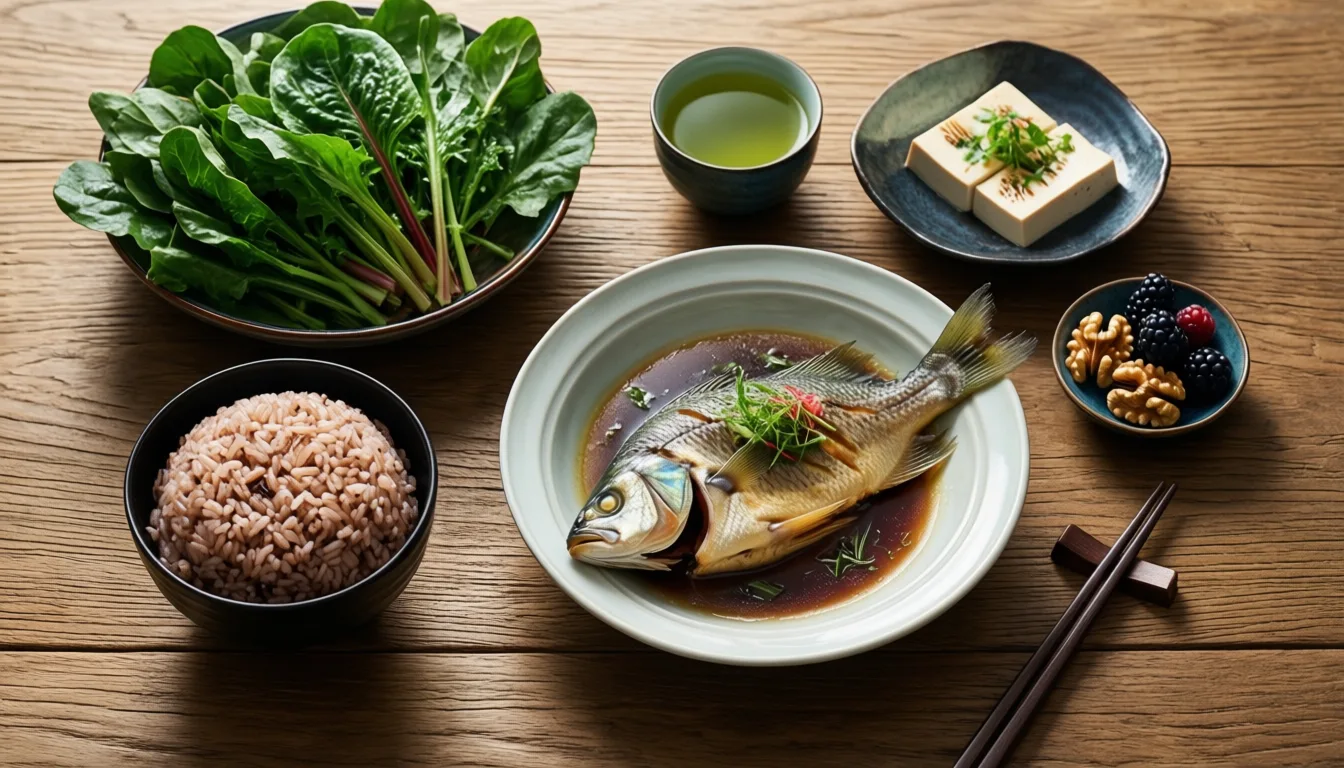
The cMIND pattern keeps the original's plant-forward bones and translates them through a Chinese pantry.
Why the link is biologically plausible
The mechanism story is intuitive even if it isn't proven here. The cMIND pattern is dense in polyphenols, omega-3s, fiber, and plant protein — inputs that, in other literature, have been associated with lower systemic inflammation and better anabolic signaling in aging muscle. The pattern also displaces the ultra-processed calories that crowd out protein and micronutrients in many older adults' diets. None of that mechanism is litigated by this paper; the authors report associations, not pathways.
That distinction matters. Cross-sectional data can show that people who eat this way also have more muscle and better function. It cannot show that the eating built the muscle. Healthier eaters tend to move more, sleep better, and have more resources — confounders the authors adjusted for, but cannot fully neutralize.
The plate that protects neurons may also help preserve the scaffolding that holds a body upright at eighty.
What it means for a glow-up protocol
Read this honestly and the takeaway is modest but real: a Mediterranean-leaning, plant-forward, fish-friendly pattern is now associated with muscle preservation in a very large Asian cohort, not just cognitive outcomes in Western ones. That broadens the evidence base for treating the MIND template as a general aging-well play rather than a brain-only one. For readers building a long-horizon appearance and function stack, food choice is upstream of almost everything that shows on a body — skin tone, fullness, posture, gait.
What this paper does not justify: claiming the cMIND diet builds muscle, treating it as a substitute for resistance training and adequate protein intake, or extrapolating odds ratios from older Chinese adults to a thirty-year-old optimizer. The protein and training side of sarcopenia prevention remains the load-bearing wall; diet pattern is the frame around it.

Resistance training remains the primary lever for muscle in aging — diet patterns are a complement, not a replacement.
- Signal, not proof. A 13,422-person CLHLS analysis links a Chinese-modified MIND diet to lower odds of low muscle mass and better physical performance in older adults.
- Effect size is meaningful but modest. Top-tertile adherence was associated with about 21% lower odds of low muscle mass versus the lowest tertile, after adjustment.
- Design limits the conclusions. Cross-sectional data shows association, not causation; muscle mass was estimated by formula, not imaging.
- Mechanism is plausible but unproven here. Anti-inflammatory and nutrient-density pathways are likely contributors, not demonstrated ones.
- Stack it, don't swap it. Pair MIND-style eating with resistance training and sufficient protein; the diet pattern complements, it doesn't replace.
- Talk to a clinician before overhauling your diet, especially if you have kidney disease, take anticoagulants, or are managing chronic conditions.
The premium move here isn't to chase a new acronym. It's to notice that the same unfussy, plant-forward, fish-and-greens-and-whole-grains template keeps showing up at the top of the leaderboard across cognition, cardiometabolic risk, and now — tentatively — muscle. That convergence is the actual story. The body, it turns out, prefers a coherent strategy.
Frequently asked questions
What is the cMIND diet, and how does it differ from the original MIND diet?
The cMIND diet is a Chinese-modified version of the MIND diet that swaps in foods more familiar to Chinese kitchens while preserving the original framework's emphasis on greens, whole grains, legumes, nuts, fish, and restraint around red meat and sweets. The core plant-forward structure remains the same; the adaptation is primarily about making the food choices culturally accessible.
What did the study actually find about muscle mass in older adults?
Among 13,422 older Chinese adults, those in the highest tier of cMIND adherence had roughly 21% lower odds of low muscle mass compared with those in the lowest tier, after adjusting for sociodemographic, lifestyle, and health factors. Physical performance scores also tracked higher with stronger adherence to the diet pattern.
Does this study prove the cMIND diet builds or protects muscle?
No. The study uses a cross-sectional design, which can show that people who eat this way also have more muscle and better function, but cannot show that the eating built the muscle. The authors report associations, not pathways, and the article explicitly calls this a signal rather than proof.
Should I replace my resistance training with the cMIND diet to prevent muscle loss?
The article is clear that resistance training remains the primary lever for muscle in aging and that the diet pattern complements it rather than replaces it. The protein and training side of sarcopenia prevention is described as the load-bearing wall, with diet pattern as the frame around it.
Why might the MIND diet pattern be linked to better muscle outcomes?
The article describes the mechanism as plausible but unproven by this study. The cMIND pattern is dense in polyphenols, omega-3s, fiber, and plant protein, which in other literature have been associated with lower systemic inflammation and better anabolic signaling in aging muscle, and it also displaces ultra-processed calories that crowd out protein and micronutrients.
Sources
- Associations of chinese-modified MIND diet with low muscle mass and physical performance among old adults in china: findings from the CLHLS 2018 national survey. — Aging clinical and experimental research
Join the conversation
Comments are moderated and reviewed before they appear. Be constructive — this is health information.
Add your comment