
In This Issue



GLP-1 Drugs Get a Reality Check: What Tirzepatide, Semaglutide, and Liraglutide Are Actually Doing
A wave of 2025 analyses is dissecting the real mechanisms behind the headline weight loss — and the picture is messier, smarter, and more interesting than the marketing.
Walk into any commercial gym in 2026 and you'll hear the same three syllables drifting between sets: tir-zep-a-tide. The GLP-1 class — semaglutide, liraglutide, and the dual GIP/GLP-1 agonist tirzepatide — has stopped being a diabetes story and become a cultural one. But strip away the before-and-after reels and the cardiology rumors, and a more interesting question shows up under the bar: what are these drugs actually doing, mechanistically, once you back out the pounds? A run of 2025 analyses just took a serious crack at that question, and the answers are more nuanced than the marketing — and more useful for anyone trying to think clearly about metabolic health.
- Tirzepatide's A1c win isn't mostly about the weight. A mediation analysis of three SURPASS trials suggests the majority of its glycemic edge over placebo is weight-loss independent.
- GLP-1s in type 1 diabetes are a modest add-on, not a cure. A meta-analysis of 25 RCTs shows small A1c and weight benefits when stacked on insulin — and no rescue of failing beta cells.
- The muscle question is real but not catastrophic. In T2D patients with sarcopenia, GLP-1s strip fat hard; the skeletal muscle picture is mixed and warrants tracking.
- A retrospective signal on Alzheimer's risk favors GLP-1s over metformin in diabetics — interesting, hypothesis-generating, not yet causal.
- Vascular effects extend beyond big arteries. Liraglutide preserved endothelial function in septic mouse ophthalmic arteries via reduced oxidative stress — preclinical, but mechanistically telling.
The A1c story is bigger than the scale
Here's the line most people get wrong at the squat rack: "It works because you eat less, so you lose weight, so your blood sugar drops." Half right. A 2025 mediation analysis pooled three SURPASS randomized trials — 2,831 participants on tirzepatide versus placebo or semaglutide — and asked how much of the drug's HbA1c reduction was actually caused by the weight loss. The answer, depending on the comparator and the background therapy: surprisingly little. Against placebo as monotherapy, only roughly 12–27% of the A1c difference was mediated by weight loss; on a background of insulin, it climbed to 25–45%. The rest is the molecule doing molecule things — incretin signaling, insulin sensitivity, hepatic glucose handling.
Against semaglutide, the picture flips: 54–71% of tirzepatide's incremental A1c advantage was weight-loss dependent, which fits the clinical impression that dual GIP/GLP-1 agonism just drags more fat off than GLP-1 alone. Translation for the curious lifter: tirzepatide isn't just a better appetite suppressant. It's a better glucose drug independent of what the scale says — and most of its edge over semaglutide is the extra pounds.
The glycemic benefit isn't just calories in, calories out — receptor pharmacology is doing real work.
Type 1 diabetes: a useful add-on, not a rewrite
Type 1 is a different beast. Beta cells are gone or going; insulin is the floor, not the ceiling. So the question of whether GLP-1s belong in the T1D toolkit has been live for years. A 2025 systematic review pulled together 25 RCTs and gave the cleanest answer yet. Versus placebo on top of insulin, GLP-1 RAs delivered a mean A1c reduction of 0.23%, a 3.93 kg weight drop, and a 5.74 unit/day cut in total insulin dose. Time-in-range didn't budge meaningfully, and the odds of severe hypoglycemia were similar between groups — important, because that's the failure mode everyone fears.
The honest read: this is a modest, real benefit for the right T1D patient, not a beta-cell rescue. The same analysis noted that adding a GLP-1 did not prevent progressive C-peptide loss, and glucagon counter-regulation to hypoglycemia stayed intact. You're not regrowing islets. You're trimming weight, shaving insulin, and nudging A1c — useful, not miraculous. And this is a clinician's decision, not a DIY one.
You're not regrowing islets. You're trimming weight, shaving insulin, and nudging A1c — useful, not miraculous.
The muscle question every lifter actually cares about
Here's the part of the conversation that matters in our world. If a drug strips 15–20% body weight, what's coming off — and what's staying on? A 2025 meta-analysis specifically zoomed in on T2D patients with sarcopenia across nine RCTs and 1,089 participants. The fat-side findings were unambiguous: GLP-1 RAs significantly reduced BMI, fat mass, and body fat ratio. Visceral fat moved in the right direction. Body weight overall trended down without reaching the threshold the authors set.
The muscle picture, per the authors' framing, is more Dionysus-and-Apollo than victory parade: signals are mixed, heterogeneity is real, and the dataset is small enough that anyone shouting either "GLP-1s spare muscle" or "GLP-1s gut muscle" is overstating what we know. The practical takeaway for the gym-literate reader: if a peptide is doing the calorie-deficit heavy lifting, the resistance training, the protein floor, and the sleep all matter more, not less. None of that is new science. It's just the part the influencers skip.

The brain signal, and the vascular one
Two more 2025 entries pushed the GLP-1 story further off-label. The first: a retrospective database analysis of more than 2.5 million diabetic patients comparing metformin, GLP-1 agonists, sulfonylureas, and short-acting insulin for Alzheimer's risk. The headline result raised eyebrows — metformin use was associated with a statistically significant increased likelihood of AD diagnosis compared to GLP-1 use (HR 2.228), undercutting the long-running assumption that metformin was the neuroprotective champ. Diabetes itself raised AD risk versus non-diabetics. Retrospective data can't prove causation — channeling bias and confounding-by-indication are live concerns — but the GLP-1-favoring signal lines up with mechanistic work on incretin signaling in the brain. Worth watching, not worth prescribing on.
The second: a mechanistic mouse study showed liraglutide preserved endothelium-dependent vasodilation in ophthalmic arteries of septic mice, blunting oxidative stress markers and NOX2 overexpression. This is preclinical, in a single vascular bed, in a sepsis model — about as far from a clinical recommendation as research gets. But it adds to a coherent picture: GLP-1 receptor activation has vascular and anti-inflammatory effects that aren't explained by glucose or weight. Whether that translates to humans, in any tissue that matters, is the next decade's question.

The honest summary
The GLP-1 class is doing more than suppressing appetite — that part of the hype is grounded. Tirzepatide's glycemic muscle isn't all about the scale. The T1D add-on case is real but modest. The muscle question deserves serious tracking, not panic. The Alzheimer's and vascular signals are intriguing and early. None of it makes these drugs casual supplements. They're prescription medications with real effects, real side effects, and real unknowns — and the smartest thing a lifter can do with this evidence is read it carefully, train hard, eat enough protein, and bring any actual clinical question to an actual clinician.
Tirzepatide isn't just a better appetite suppressant. It's a better glucose drug — independent of what the scale says.
Frequently asked questions
How much of tirzepatide's blood sugar improvement is actually caused by weight loss?
Surprisingly little when compared to placebo — the article cites a 2025 mediation analysis finding that only roughly 12–27% of tirzepatide's HbA1c reduction versus placebo (as monotherapy) was mediated by weight loss. The rest is attributed to the drug's direct effects on incretin signaling, insulin sensitivity, and hepatic glucose handling.
Can people with Type 1 diabetes benefit from GLP-1 drugs?
According to a 2025 systematic review of 25 randomized controlled trials cited in the article, adding a GLP-1 receptor agonist on top of insulin produced a modest A1c reduction of 0.23%, a 3.93 kg weight drop, and a reduction in total daily insulin dose. However, the article is clear that this is a modest, real benefit for the right patient — not a beta-cell rescue — and that GLP-1 add-on did not prevent progressive C-peptide loss.
Do GLP-1 drugs cause muscle loss?
The article says the evidence is mixed. A 2025 meta-analysis focused on Type 2 diabetes patients with sarcopenia found clear benefits on the fat side — reduced BMI, fat mass, and visceral fat — but described the skeletal muscle picture as having mixed signals and real heterogeneity. The authors note the dataset is too small to definitively conclude whether GLP-1s preserve or sacrifice lean mass.
Is there any evidence GLP-1 drugs affect Alzheimer's risk?
The article describes a retrospective database analysis of more than 2.5 million diabetic patients that found GLP-1 use was associated with a lower likelihood of Alzheimer's diagnosis compared to metformin. However, the article explicitly cautions that retrospective data cannot prove causation and that channeling bias and confounding are live concerns — describing the finding as 'worth watching, not worth prescribing on.'
Why does tirzepatide outperform semaglutide on blood sugar control?
The article explains that when tirzepatide is compared directly to semaglutide, 54–71% of tirzepatide's incremental A1c advantage is weight-loss dependent, fitting the idea that its dual GIP/GLP-1 mechanism removes more fat than GLP-1 agonism alone. The article frames tirzepatide as not just a better appetite suppressant, but also a better glucose drug independent of scale changes.
Sources
- HbA1c reduction with tirzepatide in people with type 2 diabetes: The contribution of weight loss assessed by a mediation analysis. — Diabetes, obesity & metabolism
- Glucagon-like peptide-1 receptor agonists as add-on therapy to insulin for type 1 diabetes mellitus: a systematic review and meta-analysis. — Hormones (Athens, Greece)
- Dionysus or apollo, skeletal muscle mass changes in type 2 diabetes with sarcopenia receiving GLP-1 receptor agonist: systematic review and meta-analysis. — Diabetology & metabolic syndrome
- Utility of Pharmacological Agents for Diabetes Mellitus in the Prevention of Alzheimer's Disease: Comparison of Metformin, Glucagon-Like Peptide-1 (GLP-1) Agonists, Insulin, and Sulfonylureas. — Cureus
- Liraglutide preserves endothelial function in ophthalmic arteries of septic mice via prevention of oxidative stress. — Experimental eye research

The Cognitive-Reserve Math: How Education and Movement Buy Brain-Healthy Years
A new multistate study of nearly 2,000 older Chileans puts real numbers on the years of cognitive-impairment-free life that schooling and physical activity may add.
Okay, real talk: most longevity advice about your brain sounds like a horoscope. Stay curious! Keep moving! Learn a language! Cool — but how much does any of that actually buy you? A new study out of Chile finally puts a number on it, and the number is bigger than I expected.
Here's the setup. Researchers tracked 1,959 Chileans aged 60 and up between 2017 and 2019, watching how their cognitive states changed over time. Then they ran the data through something called a multistate model — basically a way of estimating not just how long people live, but how many of those years they spend with their thinking still sharp. That metric has a name: cognitive-impairment-free life expectancy, or CIFLE for short. Think of it as the brain-health version of "healthy years" on top of total years.
The big finding: higher education was associated with an average increase of 4.7 years of cognitive-impairment-free life, and 4.5 extra such years specifically for women. That is not a rounding error. That is a meaningful slice of someone's later life spent recognizing their grandkids, managing their own finances, and finishing the crossword.
The cognitive-reserve idea, in plain English
The theory behind all this is called cognitive reserve. The shorthand: your brain builds up a kind of buffer over a lifetime of learning, problem-solving, and staying engaged. When age-related wear and tear shows up later, a bigger buffer means the damage takes longer to show on the outside. Education is the classic proxy for that buffer — not because a diploma is magic, but because years of school tend to track with a lifetime of mentally demanding work, reading, and social complexity.
What's new here isn't the theory. It's the math. Until recently, "cognitive reserve helps" was the kind of thing experts would nod about without being able to tell you, in years, what "helps" means. This study tries to answer that question directly — at least for one country, in one time window.

Education is a stand-in for a lifetime of mental engagement — the buffer researchers call cognitive reserve.
Where movement comes in
Here's the part I keep thinking about. Education is largely set by the time you're an adult — you can't retroactively go to more school in your 30s and 40s in any meaningful biological sense. So what about the people who didn't get those years? Are they just out of luck?
Apparently not. The researchers found that physical activity added 5.5 years of cognitive-impairment-free life expectancy for women with lower educational attainment — enough that the authors describe it as a "powerful compensatory effect" and a mechanism for narrowing the gender gap in brain-healthy years. In other words: movement seems to be doing some of the same protective work that schooling does, and it's available later in life.
Why might that be? The leading explanations are unglamorous and overlapping: better blood flow to the brain, lower vascular risk, improved sleep, less inflammation, more social contact when you walk with a friend or take a class. None of these are miracle mechanisms. They're the same boring levers that protect the heart — which, it turns out, are also the levers that protect the thing the heart is feeding.
Movement seems to be doing some of the same protective work that schooling does — and it's available later in life.

The footnote that matters: where you live
One more piece of the study deserves attention, because it complicates the cheerful headline. The same paper reports that older adults in regions outside Chile's metropolitan area faced up to a 30% higher risk of cognitive impairment. National averages, the authors note, mask very different local realities.
That is a polite way of saying: your zip code is doing some of the heavy lifting that we like to credit to personal choices. Access to clinics, walkable neighborhoods, clean air, schools, social services — all of these shape both the education line and the physical-activity line in the data. Cognitive reserve isn't only a personal project. It's also, partly, an infrastructure project.
How seriously to take the numbers
A few honest caveats, because this is one study and the evidence here is moderate, not settled. The data come from a two-year window in a single country, which is short for a question about decades-long brain aging. The protective factors are observational associations — the researchers can't prove that going for walks causes the extra years; people who exercise also tend to differ in income, diet, social connection, and baseline health. And the model estimates life expectancy from current patterns, which always smuggles in assumptions.
What the study does well is give a shape to something that's usually hand-waved. "Education and exercise protect your brain" is true but slippery. "Roughly 4 to 5 extra years of clear thinking" is something you can actually plan around.
- Education tracked with ~4.7 extra cognitive-impairment-free years in this Chilean cohort — a proxy for a lifetime of mental engagement, not a magic diploma effect.
- Physical activity added about 5.5 such years for women with less schooling, suggesting movement can partly compensate for missed cognitive-reserve building earlier in life.
- Geography mattered a lot. Living outside the metro region carried up to a 30% higher risk of cognitive impairment, a reminder that environment shapes brain aging too.
- The evidence is moderate, not definitive. These are associations from one panel study over two years; the effect sizes are striking but should be read as direction, not a prescription.
- The practical translation is unsexy and consistent: regular movement, ongoing learning, and social engagement remain the most defensible bets. Talk to a clinician before changing an exercise routine, especially later in life.
The takeaway I'm sitting with: cognitive reserve isn't a vibe. It's a buffer you can measure, and at least in this snapshot of nearly 2,000 lives, the things that grow it are stubbornly familiar. Keep learning. Keep moving. And maybe pay a little more attention to the neighborhoods and systems that make those two things easier — or harder — for the people aging around you.
Frequently asked questions
What does 'cognitive-impairment-free life expectancy' actually mean?
Cognitive-impairment-free life expectancy, or CIFLE, is a metric that estimates not just how long people live, but how many of those years they spend with their thinking still sharp. The article describes it as the brain-health version of 'healthy years' on top of total years.
How many extra years of clear thinking did higher education add in the study?
Higher education was associated with an average of 4.7 extra cognitive-impairment-free years, and 4.5 extra such years specifically for women. The article frames this as a meaningful slice of later life spent recognizing family members, managing finances, and staying mentally engaged.
Can physical activity compensate for less education when it comes to brain health?
According to the study, physical activity added about 5.5 cognitive-impairment-free years for women with lower educational attainment, which the researchers describe as a 'powerful compensatory effect.' The article notes that movement appears to do some of the same protective work that schooling does, and importantly, it is available later in life.
Why does where you live affect your risk of cognitive impairment?
The study found that older adults outside Chile's metropolitan area faced up to a 30% higher risk of cognitive impairment. The article explains this reflects differences in access to clinics, walkable neighborhoods, clean air, schools, and social services — factors that shape both education and physical activity levels.
How reliable are the study's findings?
The article cautions that the data come from a two-year window in a single country, which is a short timeframe for questions about decades-long brain aging. The protective associations are observational, meaning researchers cannot prove that exercise or education directly causes the extra years, and people who exercise tend to differ in other ways such as income and diet.
Sources
- Cognitive health and protective factors: from a life expectancy approach. — Social science & medicine (1982)
The Metabolic Syndrome Map: What a New Global Snapshot Reveals About Your Risk
A 2026 meta-analysis pools a decade of evidence on how common metabolic syndrome has become — and how much of it tracks back to the lifestyle levers we actually control.
If you have spent any portion of your forties quietly wondering why your waistband is staging a slow rebellion against you, you are not imagining it — and you are very much not alone. A new 2026 systematic review and meta-analysis published in Cureus pooled a decade of observational research and landed on a number that should make all of us sit up a little straighter at our desks: roughly one in three adults worldwide is now living with metabolic syndrome. The good news folded inside that headline is that the same review keeps circling back to the levers we actually have hands on — how much we move, how we eat, how we sleep, how we manage stress. That is a frustrating message and a hopeful one, in roughly equal measure.
- Pooled global prevalence of metabolic syndrome sits around 32%, according to a 2026 PRISMA-guided meta-analysis of ten observational studies and more than 54,000 adults.
- Physical inactivity was consistently linked to higher odds of having metabolic syndrome across the included studies.
- The estimate carries real uncertainty — the 95% confidence interval ran from 22% to 43%, and heterogeneity between studies was very high.
- This is observational evidence, meaning it maps associations, not proof that any single behavior causes (or cures) the syndrome on its own.
- The practical takeaway is unglamorous and durable: move more, sit less, and treat lifestyle behaviors as cardiometabolic medicine worth discussing with your clinician.
What metabolic syndrome actually is
Metabolic syndrome is less a single disease than a cluster — a group of cardiometabolic risk factors that tend to travel together: elevated blood pressure, elevated fasting glucose, higher triglycerides, lower HDL cholesterol, and extra weight carried around the middle. None of those things sound dramatic on their own. Stacked, they meaningfully raise the long-term odds of type 2 diabetes and cardiovascular disease, which is why clinicians treat the constellation as a flag rather than a footnote.
The new Cureus review describes metabolic syndrome as a significant and growing global public health challenge, and notes that until now a comprehensive quantitative synthesis of its worldwide prevalence and the lifestyle behaviors tied to it had been surprisingly thin on the ground. That is the gap this paper tries to fill.
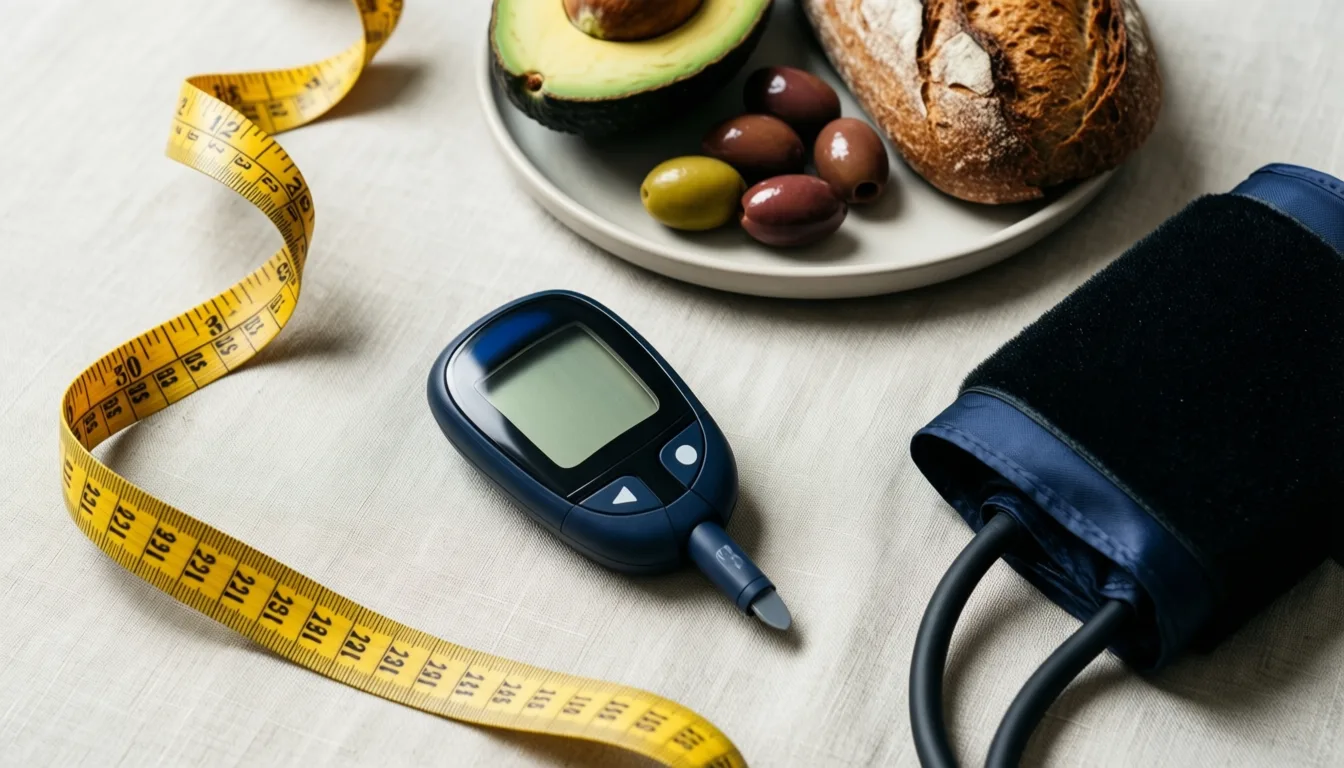
Metabolic syndrome is a cluster, not a single number — which is why the daily habits that touch all of those numbers matter.
The numbers, with their caveats intact
The headline figure from the 2026 meta-analysis is a pooled global prevalence of 32%, drawn from ten observational studies and 54,709 participants. That is a striking number, and worth saying out loud: in the populations these studies sampled, roughly a third of adults met criteria for the syndrome.
But — and this is the part that gets cropped out of most headlines — the 95% confidence interval ran from 22% to 43%. Heterogeneity between studies, measured by the I² statistic, was 98.72%, which is about as high as that number gets. In plain English: the studies varied enormously in where they were conducted, how they defined the syndrome, and who they included. The 32% is the best central estimate the math will give you, but the honest read is that prevalence is high, varies wildly by population, and is climbing in step with the lifestyle patterns of modern adulthood.
That uncertainty is not a reason to dismiss the finding. It is a reason to hold it with the right amount of grip — firmly enough to act on, loosely enough to keep questioning.
The lifestyle thread the review keeps pulling
The most consistent signal across the included studies was about movement. Physical inactivity was consistently associated with increased odds of metabolic syndrome, with a representative odds-ratio range of roughly 1.25 to 2.15 across the studies the authors examined. Adherence to recommended physical activity levels, by contrast, tracked in the protective direction.
An odds ratio is not a prophecy. It is a way of saying: in these populations, people who moved less were meaningfully more likely to meet the criteria. It does not prove that a single morning walk reorganized anyone's triglycerides, and the review is explicit that this is observational evidence — associations pulled from real-world data rather than controlled experiments. That distinction matters, because observational studies cannot fully untangle the chicken-and-egg problem of whether inactivity drives metabolic dysfunction, whether metabolic dysfunction makes movement feel harder, or — most likely — both, in a loop.
Still, the direction and consistency of the finding are the kind of thing clinicians and researchers take seriously. When ten different studies in different settings keep landing in the same general neighborhood, the neighborhood is worth taking a walk through.
One in three adults, give or take. The map is unflattering — and it is also, mostly, modifiable.

The meta-analysis flagged adherence to recommended activity levels — not athletic feats — as the variable that tracked with lower odds.
Why this lands differently in your forties
The review itself does not single out perimenopausal women, and we are not going to put words in its mouth. But the cluster it describes — creeping waist circumference, drifting blood pressure, glucose that does not behave the way it did at 28 — is a cluster a lot of women between 35 and 50 will recognize from their own annual labs. Hormonal shifts in this window change how the body stores fat, how it handles insulin, and how it responds to the same workout that used to work fine. None of that is a personal failing; it is biology recalibrating.
What the Cureus meta-analysis adds to that lived experience is a quantitative reminder that the modifiable inputs still matter, possibly more than ever. The studies it pooled were observational, the heterogeneity was high, and the evidence rating here is honestly moderate — but the through-line is clear enough to be useful.
What to do with this, today
The review does not hand readers a regimen, and neither will we. What it offers is a map: metabolic syndrome is common, it is rising, and the behaviors most strongly tied to it in the pooled data are the ones you already suspected. Sitting less. Moving more, in whatever form you will actually do for years rather than weeks. Knowing your own numbers — waist circumference, fasting glucose, blood pressure, triglycerides, HDL — well enough to spot a trend before it becomes a diagnosis.
If two or three of those numbers have been quietly drifting on your last few annual physicals, that is the conversation worth having with your primary care clinician. Not a panic conversation. A map-reading one.
- Know your five numbers — waist, fasting glucose, blood pressure, triglycerides, HDL — and track them over time, not just one visit.
- Treat movement as the most evidence-backed lever in this review, with the understanding that consistency beats intensity.
- Bring the trend, not the panic, to your clinician — metabolic syndrome is a flag, and flags are useful precisely because they are early.
- Hold the 32% figure loosely: it is a real signal, but the confidence interval and heterogeneity mean your local picture may look quite different.
Frequently asked questions
What exactly is metabolic syndrome?
Metabolic syndrome is a cluster of cardiometabolic risk factors that tend to travel together: elevated blood pressure, elevated fasting glucose, higher triglycerides, lower HDL cholesterol, and extra weight carried around the middle. Stacked together, these factors meaningfully raise the long-term odds of type 2 diabetes and cardiovascular disease, which is why clinicians treat the constellation as a flag rather than a footnote.
How common is metabolic syndrome globally?
A 2026 systematic review and meta-analysis published in Cureus, drawing on ten observational studies and more than 54,000 adults, found a pooled global prevalence of roughly 32% — meaning about one in three adults met criteria for the syndrome in the populations studied. The 95% confidence interval ran from 22% to 43%, so the honest read is that prevalence is high but varies widely by population.
Does being physically inactive actually cause metabolic syndrome?
The research cannot prove causation — the studies in the review are observational, meaning they map associations rather than establish that inactivity definitively causes the syndrome. Physical inactivity was consistently associated with increased odds of metabolic syndrome across the included studies, with an odds-ratio range of roughly 1.25 to 2.15, but the review acknowledges it cannot fully untangle whether inactivity drives metabolic dysfunction, whether metabolic dysfunction makes movement harder, or both in a loop.
Why is the 32% figure described with so much uncertainty?
The studies pooled in the meta-analysis varied enormously in where they were conducted, how they defined metabolic syndrome, and who they included, producing a heterogeneity score (I²) of 98.72% — about as high as that measure gets. The authors used random-effects modeling under PRISMA guidelines, which is a respectable methodology, but the 32% should be treated as a useful central estimate rather than a precise count.
What level of physical activity did the review identify as protective?
The meta-analysis flagged adherence to recommended physical activity levels — not athletic feats — as the variable that tracked with lower odds of metabolic syndrome. The review does not specify a particular regimen, and the evidence is directional guidance based on observational data rather than a personalized prescription.