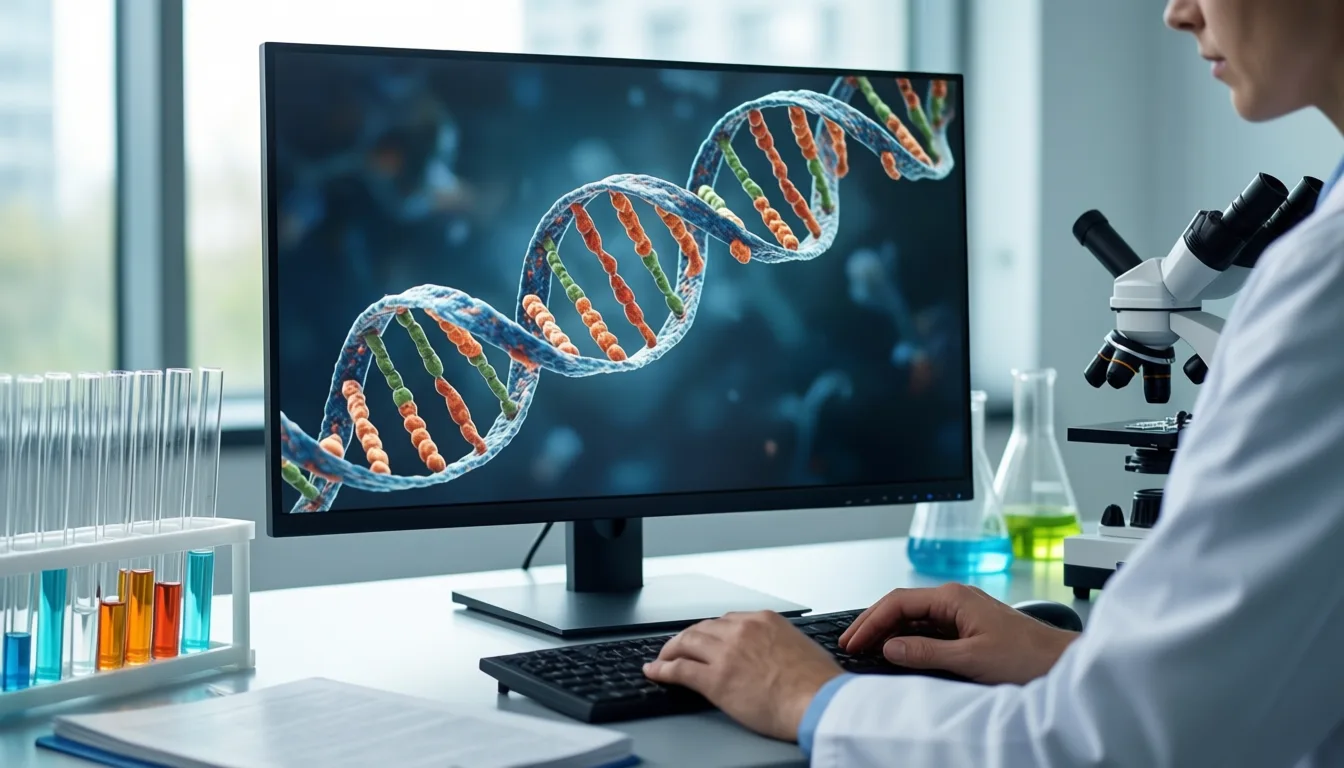
AI Rewrites the Peptide Drug Pipeline
Three recent papers show machine learning moving from hype to workflow in peptide therapeutics — compressing discovery cycles and flagging safety risks earlier. Here's what changes for a field bottlenecked by synthesis and red-cell toxicity.
Peptides are having a moment, but not the one most headlines suggest. While the consumer conversation fixates on GLP-1s and gray-market vials, the real story sits upstream — in the discovery pipeline itself. Three recent papers, taken together, point to a structural shift: artificial intelligence is no longer a slide in a biotech pitch deck. It is becoming the workflow that decides which peptide candidates get made, which get killed, and which ever reach a human trial.
- Safety triage is moving earlier. Deep-learning models can now flag likely red-blood-cell toxicity from a peptide sequence before synthesis.
- Multifunctional peptides are becoming searchable. Attention-based models are surfacing candidates that hit more than one therapeutic target at once.
- The cycle is compressing. A 2024 review argues AI is meaningfully shortening peptide R&D timelines and cost — though most evidence is computational, not yet clinical.
- Evidence is moderate, not settled. These are benchmark gains and review-level claims. Human trials of AI-designed peptides remain early.
Why peptides have always been hard
Peptides — short chains of amino acids — sit in a useful sweet spot between small molecules and full-size biologics. They can be specific, potent, and tunable. They are also notoriously difficult to develop. Synthesis is expensive. Many candidates degrade quickly in the body. And a stubborn share of the most promising ones, particularly antimicrobial peptides (AMPs), turn out to rupture red blood cells at therapeutic doses — a problem called hemolysis that has quietly killed more programs than most clinicians realize.
That is the bottleneck AI is now squeezing. A 2024 review in Heliyon frames the shift plainly: machine learning is being integrated across the peptide pipeline — target selection, activity prediction, toxicity screening, and metabolic profiling — with the explicit goal of cutting cost and time in a field where both have been punishing. The authors argue this matters most for antimicrobial peptides, where the urgency of antibiotic resistance has outpaced traditional discovery.
Antimicrobial peptides are a leading test case for AI-assisted design — broad-spectrum activity, but a long history of failing on safety.
The hemolysis problem, finally tractable
The most concrete of the three papers tackles that red-blood-cell problem head-on. Published in BMC Bioinformatics in late 2024, the team built a convolutional neural network that reads a peptide's amino-acid sequence and predicts whether it is likely to be hemolytic. On the cleanest benchmark dataset (HemoPI-1) the model hit a Matthew's correlation coefficient of 0.9274 — a strong signal — and outperformed prior published methods across six datasets in total.
For a busy 40-year-old reader, the practical translation is this: a lot of the peptides that might one day replace failing antibiotics get discarded today because they damage blood cells. A model that can flag that risk from sequence alone, before anyone synthesizes anything, changes the economics of the hunt. It does not guarantee a drug. It does mean the candidates that survive into a wet lab are more likely to be worth the effort.
The candidates that survive into a wet lab are more likely to be worth the effort.
Peptides that do more than one thing
The second paper goes after a different frontier: multifunctional peptides. A growing body of work suggests that a single peptide sequence can carry more than one therapeutic activity — antimicrobial and anti-inflammatory, for example, or antiviral and antioxidant. Finding those overlaps by hand is brutal. The search space is too large and the signals are too entangled.
An attention-based model called AMHF-TP, published in Quantitative Biology in 2025, uses pretrained representations, convolutional layers, self-attention, and a hypergraph module to pull multi-granularity features out of peptide sequences and their secondary structures. The authors report improved precision, accuracy, and coverage compared with five contemporary models on multifunctional therapeutic peptide recognition tasks. It is an incremental but real step — the kind of model that turns "maybe this peptide does two things" from a hunch into a rankable hypothesis.

Attention-based models are starting to surface peptides that hit more than one target — a long-standing aspiration of the field.
What this actually changes
Three caveats are worth keeping front of mind. First, the evidence here is moderate, not strong. The hemolysis paper and AMHF-TP are computational benchmarks — better numbers on curated datasets, not yet human outcomes. The Heliyon review synthesizes the field's direction but is, by design, a survey rather than a clinical result. Second, none of this delivers a finished drug. It delivers better odds at the front of the funnel. Third, peptide therapeutics still face the same downstream realities — manufacturing, stability, delivery, regulatory review — that no model has yet rewritten.
What it does change is the slope of the pipeline. Fewer dead-end syntheses. Earlier safety triage. A real shot at identifying multifunctional candidates that the previous generation of tools simply could not see. For readers who follow this space because they care about the next decade of antimicrobials, metabolic drugs, and targeted therapies, that is the signal worth tracking — not any single molecule, but the fact that the search itself is getting smarter.
The honest read on 2024–2025 is that AI in peptide discovery has moved past the demo phase. It is showing up as the default toolkit in serious labs, with measurable gains on the specific problems — hemolysis prediction, multifunctional recognition, cycle compression — that have held the field back. Whether any of this produces a blockbuster therapeutic is a question for the next five years. Whether it changes how the next generation of peptide drugs gets found is no longer in serious doubt.
Frequently asked questions
What is hemolysis, and why has it been such a problem for peptide drug development?
Hemolysis is the rupture of red blood cells, which can occur when certain peptides — particularly antimicrobial peptides — are used at therapeutic doses. According to the article, this toxicity issue has quietly ended more development programs than most clinicians realize, making it one of the central bottlenecks in the field.
How well did the deep-learning model for predicting hemolysis actually perform?
The convolutional neural network published in BMC Bioinformatics in late 2024 achieved a Matthew's correlation coefficient of 0.9274 on the HemoPI-1 benchmark dataset and outperformed prior published methods across six datasets in total. The model predicts hemolysis risk from a peptide's amino-acid sequence before any synthesis takes place.
What is a multifunctional peptide, and why is finding one so difficult?
A multifunctional peptide is a single peptide sequence that carries more than one therapeutic activity — for example, being both antimicrobial and anti-inflammatory at the same time. The article explains that finding these overlaps by hand is extremely difficult because the search space is too large and the relevant signals are too entangled.
Does any of this AI research mean new peptide drugs are ready for patients soon?
No — the article is explicit that the hemolysis paper and the AMHF-TP model are computational benchmarks, not human clinical results. It also notes that peptide therapeutics still face the same downstream hurdles of manufacturing, stability, delivery, and regulatory review that no model has yet resolved.
Is the AI-assisted peptide research described here connected to the peptide products sold in consumer or gray-market channels?
The article states directly that these are two separate conversations: AI-assisted discovery is producing candidates for formal drug development, not unregulated injectables. It advises anyone considering a peptide product for personal use to have that discussion with a clinician rather than looking to internet sources.
Sources
- Therapeutic peptide development revolutionized: Harnessing the power of artificial intelligence for drug discovery. — Heliyon
- Enhanced prediction of hemolytic activity in antimicrobial peptides using deep learning-based sequence analysis. — BMC bioinformatics
- AMHF-TP: Multifunctional therapeutic peptides prediction based on multi-granularity hierarchical features. — Quantitative biology (Beijing, China)
Join the conversation
Comments are moderated and reviewed before they appear. Be constructive — this is health information.
Add your comment