
GLP-1's Expanding Frontier: Type 1 Modeling and the Brown-Fat PET Surprise
GLP-1 receptor agonists keep pushing into new clinical territory. Two 2025 papers — a modeling review for type 1 diabetes and a case report where semaglutide lit up brown fat on a PET scan — hint at what's next.
Every few months, the GLP-1 story gets bigger. What started as a type 2 diabetes drug has rolled through obesity medicine, cardiovascular risk, addiction research, and now — quietly, in the back pages of specialty journals — type 1 diabetes simulators and PET imaging suites. Two 2025 papers caught my eye because they tell you something honest about where this drug class actually is: deeply useful, still being mapped, and capable of surprising even the radiologist reading your scan.
- Type 1, not just type 2. Researchers are building mathematical models to test GLP-1 receptor agonists alongside automated insulin delivery in T1D — but a 2025 review found zero existing models actually designed for T1D.
- The brown-fat surprise. A case report describes a semaglutide patient whose PET scan showed extensive brown adipose tissue (BAT) uptake that nearly read as metastatic cancer.
- Evidence rating: moderate. Modeling reviews and single case reports are signal, not proof. Treat both as 'watch this space,' not protocol.
- Tell your imaging team. If you're on a GLP-1 and scheduled for PET/CT, the scan reader should know.
The T1D modeling gap
GLP-1 is the gut hormone that prompts insulin secretion, slows gastric emptying, and tells glucagon to stand down. That trifecta is why GLP-1 receptor agonists became blockbuster type 2 diabetes drugs, and why the obesity world rebuilt itself around them. The newer question — the one a 2025 narrative review in the Journal of Diabetes Science and Technology takes seriously — is whether those same drugs belong in the type 1 diabetes toolkit, paired with the closed-loop automated insulin delivery systems that increasingly run T1D care.
To test that pairing safely, researchers lean on in-silico simulators: mathematical models of a person with diabetes you can run trials against before touching a human. The review screened more than 1,500 papers, narrowed to 39 for full review, and identified 23 mathematical models describing GLP-1 pharmacokinetics and pharmacodynamics. The headline finding is the absence: none of those 23 models was designed for type 1 diabetes. The plumbing for serious preclinical T1D + GLP-1 simulation simply isn't built yet.
Why this matters for anyone reading a peptide column: it's a reminder that the clinical extension of GLP-1s into adjacent territory is happening on the simulator and the case-report level first, not in finished consensus guidelines. The science is moving — the authors lay out which existing model features could be ported into a T1D-specific simulator — but a gap in T1D-specific GLP-1 modeling means the rigorous preclinical work has to be done before the rigorous clinical work even starts.
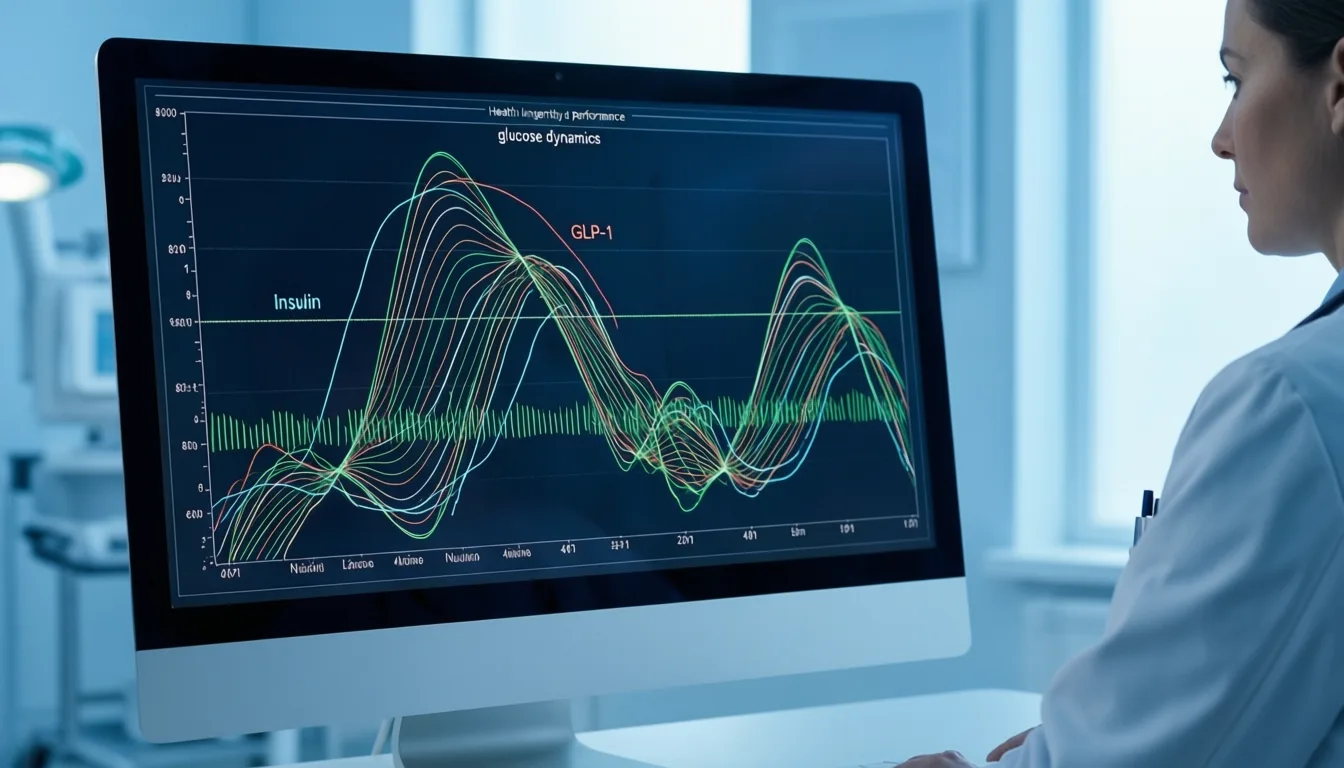
In-silico simulators let researchers run thousands of virtual trials before touching a human protocol — but only if a model for the right patient exists.
None of the 23 GLP-1 models the reviewers found was designed for type 1 diabetes. The plumbing isn't built yet.
The brown-fat PET surprise
Switch suites. A 61-year-old woman with Class III obesity drops significant weight on semaglutide, then presents with a right-sided neck mass. Workup includes a PET/CT. The scan shows FDG uptake in a right level II lymph node — and, per the Laryngoscope case report, extensive brown adipose tissue uptake throughout the neck and mediastinum. On the screen it looked, for a beat, like diffuse regional metastasis.
It wasn't. Brown fat — the metabolically active tissue lifters keep hearing about in cold-exposure podcasts — burns glucose to make heat. On a PET scan, which tracks where glucose is going, hot BAT looks a lot like hot tumor. The team had to carefully fuse anatomical and functional imaging to differentiate hypermetabolic BAT from malignant disease. The authors flag the GLP-1 connection directly: increased BAT FDG uptake, particularly in patients on GLP-1 receptor agonists, can complicate the evaluation of head and neck cancer, and awareness of the interaction is critical to avoid misdiagnosis and overtreatment.

Hot brown fat and hot tumor both light up on PET. The interpretive lift is separating the two.
One case is one case. But the mechanism is plausible and the lesson is cheap: if you're on a GLP-1 and headed for a PET/CT, tell the imaging team. A two-second note on the intake form is the difference between a clean read and a scary phone call.
What this actually means at the gym-floor level
Look — the GLP-1 hype cycle has produced a lot of dumb takes. These two papers are useful precisely because they're not hype. The T1D review is a literature audit that says we need to build the tools before we run the trials. The PET case report is a single patient whose radiologist had to work harder than usual. Neither paper tells you to take a peptide, stop a peptide, or change your training. Both tell you that this drug class is being pulled in new directions, and that the people writing the studies are still figuring out the edges.
The honest read on evidence here is moderate. A narrative review is a map of the literature, not a randomized trial. A case report is one patient, not a population signal. If you're a lifter watching the GLP-1 conversation because you're curious about body composition, cardiometabolic risk, or what your doctor might offer you in five years, the takeaway is the same one that's been true the whole time: the science is moving faster than the consensus, the surprises are real, and the people closest to the data are appropriately humble about what comes next.
That's the lane to stay in. Watch the literature. Tell your imaging team what you're on. Let your clinician make the calls. And keep training.
- Read the level of evidence. A narrative review and a case report are both worth reading — neither is a guideline.
- GLP-1 + T1D is a research frontier. The modeling infrastructure for safe preclinical work is still being built.
- BAT can mimic malignancy on PET. If you're on a GLP-1 and getting a PET/CT, disclose it.
- This is reporting, not prescribing. Talk to a clinician before starting, stopping, or changing any peptide therapy.
Frequently asked questions
Why can't researchers just run GLP-1 trials in type 1 diabetes patients right away?
Researchers rely on in-silico simulators — mathematical models of a person with diabetes — to test drug combinations safely before running human trials. The problem is that a 2025 review identified 23 GLP-1 pharmacokinetic and pharmacodynamic models, and none of them was designed for type 1 diabetes, meaning the preclinical simulation infrastructure still needs to be built first.
What exactly happened with the PET scan case described in the article?
A 61-year-old woman on semaglutide underwent a PET/CT scan after presenting with a neck mass, and the scan showed extensive brown adipose tissue uptake throughout the neck and mediastinum that initially looked like diffuse regional metastasis. Brown fat burns glucose to generate heat, and on a PET scan — which tracks glucose — metabolically active brown fat can appear nearly identical to a tumor. The imaging team had to carefully fuse anatomical and functional imaging to rule out malignant disease.
If I'm on a GLP-1 and scheduled for a PET/CT, what should I disclose to the imaging team?
The article recommends flagging three things: that you are on a GLP-1 receptor agonist and for how long, any recent significant weight loss (which independently increases brown adipose tissue activity), and cold exposure in the days before the scan, which can also recruit brown fat.
What does a GLP-1 receptor agonist actually do in the body?
According to the article, GLP-1 is a gut hormone that prompts insulin secretion, slows gastric emptying, and signals glucagon to stand down — a combination the article describes as the reason GLP-1 receptor agonists became blockbuster type 2 diabetes drugs and reshaped obesity medicine.
How strong is the evidence presented in these two papers?
The article rates the overall evidence as moderate and is explicit that a narrative review is a map of the literature rather than a randomized trial, and a case report represents one patient rather than a population signal. The article characterizes both findings as 'watch this space,' not established protocol.
Sources
- GLP-1 Receptor Agonists Models for Type 1 Diabetes: A Narrative Review. — Journal of diabetes science and technology
- Brown Adipose Tissue Mimicking Head and Neck Cancer on PET Scan in a Patient on GLP-1 Drug. — The Laryngoscope
Join the conversation
Comments are moderated and reviewed before they appear. Be constructive — this is health information.
Add your comment