GLP-1s Go Under the Knife: What New Surgical Data Mean for Ozempic-Class Users
Fresh cohort analyses say the perioperative picture is procedure-specific — reassuring at the hip, worrying at the shoulder — and shortages keep complicating the calculus.
The GLP-1 conversation has moved past the before-and-after photos. Millions of men in their late thirties and forties are now a year or two into semaglutide, tirzepatide or dulaglutide — and a meaningful slice of them will, sooner or later, end up on an operating table. Maybe a torn rotator cuff from years of overhead pressing. Maybe a hip that finally gave out. The question your surgeon now has to answer — and that you should be asking — is whether the drug in your fridge changes anything about the day you go under. Three 2025 cohort analyses just sharpened that picture, and the honest answer is: it depends on the procedure, and it depends on whether you can stay on the drug at all.
For years, the perioperative debate around GLP-1 receptor agonists has centered on a single anesthesia concern: delayed gastric emptying and the aspiration risk it creates on induction. That conversation isn't over. But the newer data look further down the timeline — at 90-day complications, readmissions, revisions — and they suggest the risk profile is not uniform across the body. It's joint-specific, and probably tissue-specific.
Hips: reassuring, even a small edge
Start with the good news. A retrospective national-database analysis of 14,065 patients with type 2 diabetes undergoing primary total hip arthroplasty between 2016 and 2021 used propensity score matching to compare 812 GLP-1 users against 3,248 non-users. The headline: no significant differences in 90-day surgical or medical complication rates, and no difference in one-year revision or periprosthetic joint infection rates. If anything, the non-GLP-1 group was more likely to have extended hospital stays of three days or longer (odds ratio 1.25).
That's a clean signal for the hip. For a 45-year-old diabetic patient staring down a THA, the current best evidence does not flag the GLP-1 as a reason to pause or panic.
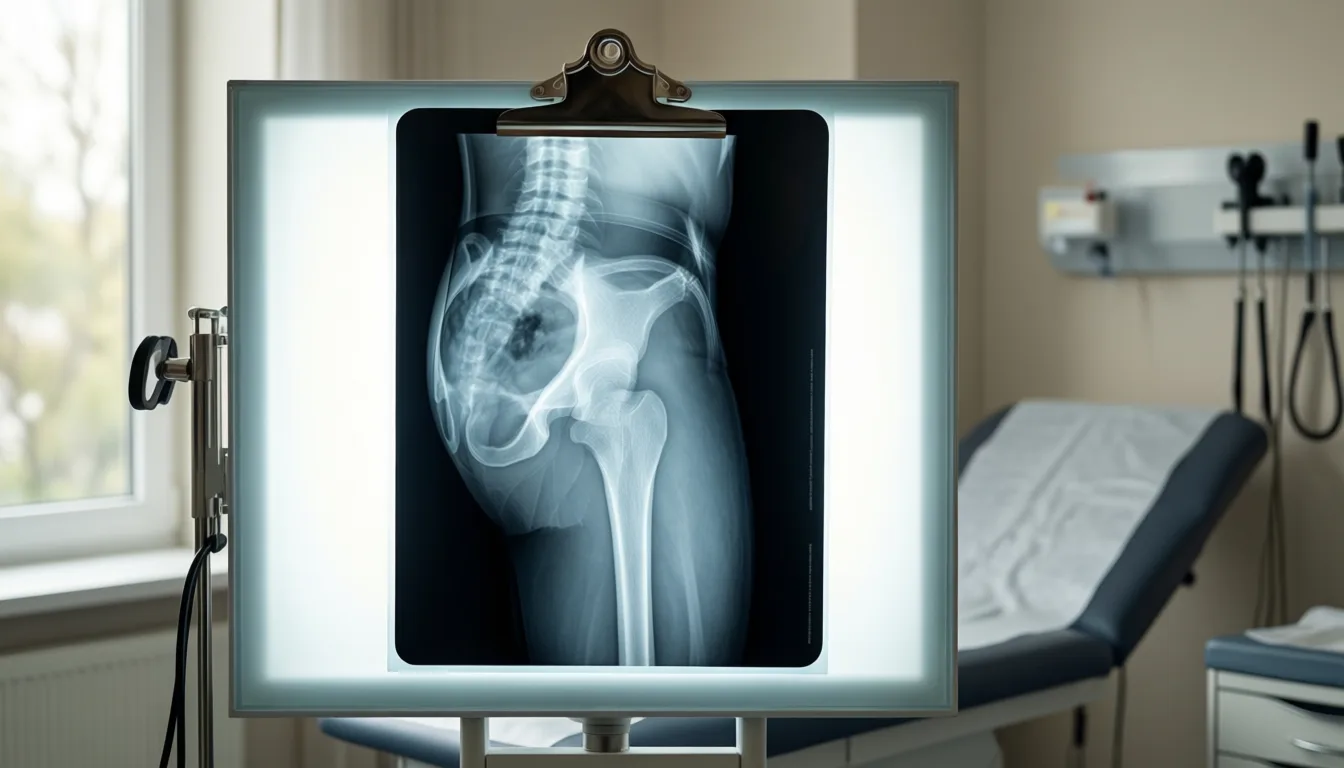
Hip arthroplasty outcomes in GLP-1 users tracked closely with matched controls — and in some measures, slightly better.
Shoulders: a different story
Now the part that should make you slow down. A separate 2025 analysis using the TriNetX database looked at total shoulder arthroplasty — anatomic and reverse — from 2010 to 2023. After 1:1 propensity matching, 1,259 GLP-1 users were compared to 1,259 controls. In the 90 days after surgery, GLP-1 users showed significantly higher rates of deep vein thrombosis (1.6% vs. 0.9%, OR 3.0), myocardial infarction (1.6% vs. 0.9%, OR 2.84), pneumonia (3.34% vs. 1.50%, OR 2.25), transfusion (7.1% vs. 4.3%, OR 1.7), and readmission (8.1% vs. 5.2%, OR 1.6). These held up after Bonferroni correction at a strict P<.005 threshold.
Why the shoulder and not the hip? The authors don't fully explain it, and neither will I — that's the honest answer at this stage. Possibilities range from differences in patient positioning and pulmonary mechanics during shoulder surgery, to the underlying populations selecting into each procedure, to residual confounding the propensity model couldn't catch. What's clear is that the assumption "GLP-1s look fine in knees and hips, so they're fine everywhere" doesn't hold.
The assumption that GLP-1s look fine in knees and hips, so they're fine everywhere, doesn't hold.
The shortage problem nobody schedules around
There's a third piece of 2025 data that doesn't fit neatly into a surgical checklist but matters enormously for anyone making a perioperative plan. A cohort study of 69 individuals with type 2 diabetes tracked what happened when patients had to stop dulaglutide during a global supply shortage. Within three months of discontinuation, average HbA1c rose from 7.0% ± 0.9% to 8.1% ± 1.4%, and fasting glucose climbed from 129 ± 31 to 156 ± 50 mg/dL. Switching to DPP-4 inhibitors or SGLT2 inhibitors did not fully compensate.
For a surgical patient, that's a real problem. Elevated perioperative glucose is itself an independent risk factor for wound complications and infection. If your surgeon asks you to hold your GLP-1 in the days before a procedure — a reasonable request given the aspiration question — and you can't easily restart it afterward because of a supply gap, you may be trading one risk for another. This is a conversation to have on the front end, not the day before.

Real-world supply gaps mean "pause and resume" isn't always a guarantee.
What this actually changes for a busy 40-year-old
None of these studies are randomized trials. They are retrospective, propensity-matched cohort analyses — strong enough to flag patterns, not strong enough to dictate a protocol. The evidence here is moderate, not settled. Mechanism is largely inferred, not demonstrated. And the shoulder data, in particular, will need replication and prospective work before anyone can say with confidence whether the drug, the population, or the procedure is doing the driving.
What does change today is the quality of the conversation you can have with your own clinician. If you're on a GLP-1 and you have elective surgery on the calendar, the procedure type matters. The continuity of your therapy on the back end matters. And the default assumption that "these drugs are universally safe around surgery" is no longer adequate — not because the drugs are dangerous, but because the picture is more granular than the marketing.
- Hips look clean. In matched diabetic patients, GLP-1 use was not associated with higher 90-day or one-year complication rates after total hip arthroplasty.
- Shoulders look different. Matched shoulder arthroplasty patients on GLP-1s had significantly higher 90-day rates of DVT, MI, pneumonia, transfusion, and readmission.
- Stopping has a cost. Discontinuation studies show meaningful glycemic backsliding within three months, and DPP-4 or SGLT2 substitutes did not fully cover the gap.
- Evidence is moderate. These are retrospective cohort analyses, not randomized trials — strong enough to inform planning, not strong enough to set protocol.
- Have the talk early. If surgery is on your calendar, ask your surgeon and prescriber jointly about hold timing, restart logistics, and supply continuity.
Frequently asked questions
What has traditionally been the main surgical concern for patients taking GLP-1 medications?
The longstanding perioperative concern has centered on delayed gastric emptying and the aspiration risk it creates during anesthesia induction. The article notes that conversation is not over, but newer research has begun examining complications further down the timeline.
How did GLP-1 users do after total hip replacement surgery compared to non-users?
A retrospective analysis of over 14,000 diabetic patients found no significant differences in 90-day complication rates or one-year revision and infection rates between GLP-1 users and matched non-users. Non-GLP-1 patients were actually more likely to have hospital stays of three or more days.
What complications were seen at higher rates in GLP-1 users after shoulder replacement surgery?
Within 90 days of total shoulder arthroplasty, GLP-1 users showed significantly higher rates of deep vein thrombosis, myocardial infarction, pneumonia, blood transfusion, and hospital readmission compared to matched controls. These findings held up after statistical correction.
What happened to blood sugar control when patients had to stop their GLP-1 medication?
A cohort study tracking patients who discontinued dulaglutide during a supply shortage found that average HbA1c rose from 7.0% to 8.1% and fasting glucose climbed meaningfully within three months. Switching to DPP-4 inhibitors or SGLT2 inhibitors did not fully make up for the loss of glycemic control.
How reliable is the evidence discussed in this article?
The studies cited are retrospective, propensity-matched cohort analyses rather than randomized trials. The article describes the evidence as moderate — strong enough to flag patterns and inform planning, but not strong enough to set clinical protocol or definitively establish cause.
Sources
- Glucagon-Like Peptide-1 Receptor Agonist Use Is Not Associated With Increased Complications After Total Hip Arthroplasty in Patients Who Have Type 2 Diabetes. — The Journal of arthroplasty
- Glucagon-like peptide-1 receptor agonist use is associated with increased risk of perioperative complication and readmission following shoulder arthroplasty. — Journal of shoulder and elbow surgery
- Metabolic Consequences of Glucagon-Like Peptide-1 Receptor Agonist Shortage: Deterioration of Glycemic Control in Type 2 Diabetes. — Endocrinology and metabolism (Seoul, Korea)
Join the conversation
Comments are moderated and reviewed before they appear. Be constructive — this is health information.
Add your comment