
The New GLP-1 Frontier: Combo Stacks, Cardio Synergy, and the Oral Pill Race
GLP-1s aren't just a shred-cycle headline anymore. The next wave — liver-targeting combos, cardiovascular synergy with training, and oral delivery — is rewriting what these peptides can do.
Walk into any serious gym in 2026 and GLP-1 receptor agonists are no longer a whispered topic between sets. The first-generation injectables — semaglutide, dulaglutide, liraglutide — went mainstream on the back of weight-loss headlines, and the lifting world quickly clocked them as the most disruptive metabolic tool of the decade. But the interesting story has moved on. The research front isn't about whether GLP-1s shrink a waistline anymore. It's about what happens when you stack them with a liver-targeting peptide, pair them with aerobic training, swallow them instead of inject them, or use them to rescue a stalled bariatric patient. The peptide class is growing up — and the data, while genuinely promising, still asks for a careful read.
- Combo therapy is real. A phase 2 RCT shows an FGF21 analog layered on top of a GLP-1RA was safe and well-tolerated in MASH patients with type 2 diabetes.
- Cardio synergy. A 2025 review maps overlapping pathways between GLP-1 signaling and aerobic training — including mitochondrial content, fiber-type shifts, and glucose uptake.
- Bariatric rebound. Endogenous GLP-1 dynamics post-surgery may explain who keeps the weight off — and who needs pharmacological backup.
- Oral delivery is coming. Protein-engineering work has produced a trivalent fusion candidate designed to survive the gut and bind albumin for half-life extension.
- Evidence rating: moderate. Most of this is small phase 2, mechanistic review, or preclinical. Promising direction, not settled science.
The combo stack: GLP-1 + FGF21 for the liver
If you're lean, lifting hard, and metabolically healthy, fatty liver probably isn't on your radar. It should be — at least conceptually. Metabolic dysfunction-associated steatohepatitis (MASH, formerly NASH) is the silent comorbidity riding shotgun with type 2 diabetes and visceral obesity, and there's still no widely approved drug for it. That's the gap the new combo work is targeting.
In a double-blind, placebo-controlled phase 2b study, 31 adults with type 2 diabetes and MASH fibrosis (stages F1–F3) who were already on a stable GLP-1RA — semaglutide, dulaglutide, or liraglutide — were randomized to add efruxifermin (an Fc-FGF21 analog) or placebo for 12 weeks. The primary endpoint was safety and tolerability, and the answer was clean: the addition was safe and well-tolerated, with mostly mild-to-moderate GI side effects and only one discontinuation for nausea. Secondary endpoints tracked liver fat fraction, fibrosis markers, and metabolic parameters.
Read that carefully. This is a 31-person, 12-week safety study, not a fibrosis-reversal blockbuster. But it's the proof-of-concept that the field needed: you can layer a second metabolic peptide on top of a GLP-1RA without the wheels falling off, in exactly the patient population most likely to need both. That's the template for the next decade of peptide medicine — combinations, not solos.
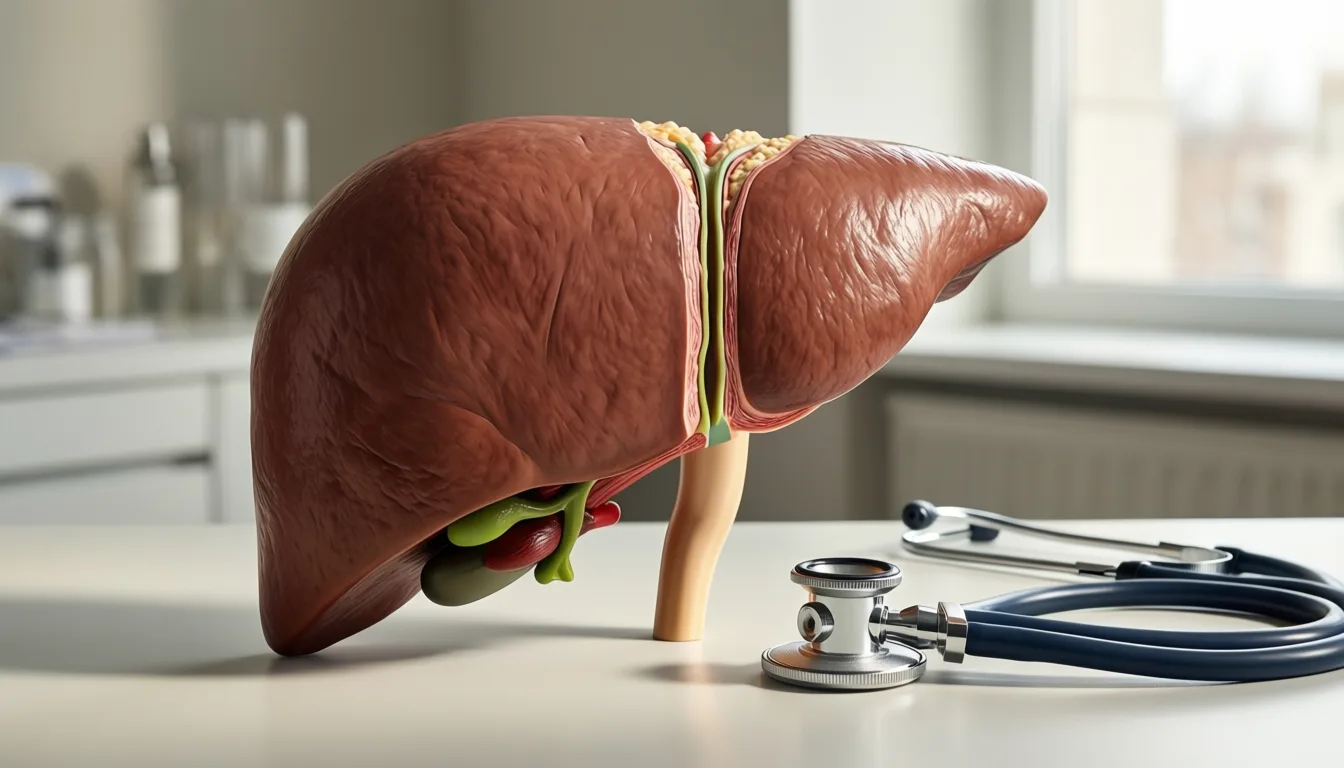
MASH has no approved drug. Combo peptide therapy is the most credible swing at it.
Cardio + GLP-1: the synergy that should interest lifters
Here's where it gets relevant to anyone who actually trains. A 2025 comprehensive review maps the neural circuits and peripheral pathways activated by both endogenous and pharmacological GLP-1, with a specific focus on what happens when you layer aerobic training on top.
The mechanistic picture the authors describe is the kind of thing that makes evidence-minded lifters sit up. Per the review, elevated GLP-1 levels — whether from overexpression models or training-driven signaling — are associated with higher skeletal-muscle glycogen, a shift toward endurance-oriented muscle fibers, increased mitochondrial content, and improved glucose uptake. The review also catalogs GLP-1's documented roles in endurance, muscle recovery, fiber-type distribution, muscle mass, and energy efficiency, alongside effects on bile acids, short-chain fatty acids, L cells, and G-protein-coupled receptors.
Important caveat: this is a review article synthesizing mechanism and animal-plus-human data, not a head-to-head trial of "GLP-1 plus zone-2 cardio" in humans. The authors themselves flag outstanding questions and future challenges in optimizing GLP-1R agonists for cardiovascular disease management. Translation for the gym-floor reader: the biology rhymes, but don't conclude that adding a GLP-1 to your training block is a documented performance stack. It isn't. Yet.
The peptide class is growing up — and the data, while genuinely promising, still asks for a careful read.
The bariatric rebound problem
This one matters because it explains why some people "can't keep it off." A 2025 review in the International Journal of Obesity walks through what happens to endogenous GLP-1 after metabolic bariatric surgery — Roux-en-Y gastric bypass and sleeve gastrectomy in particular — and why those dynamics may dictate long-term outcomes.
According to the review, postprandial GLP-1 rises sharply after these procedures, but fasting GLP-1 doesn't change much. Observational data link higher postprandial GLP-1 to more successful weight loss, and when patients regain weight, adding a GLP-1RA has produced significant additional loss in the studies surveyed. The authors hypothesize that maintaining higher basal-bolus GLP-1RA exposure may be a promising option for patients who plateau or rebound after surgery.
The takeaway isn't "surgery fails." It's that the body's own GLP-1 response appears to be one of the levers that determines durability — and when that lever weakens, pharmacology may be a legitimate rescue rather than a cop-out.

The cardio question isn't whether GLP-1s help — it's how they interact with the work you're already doing.
The oral pill race
Anyone who's done a weekly injection knows the friction. Native GLP-1 has an extremely short half-life and gets shredded by gut proteases, which is why current agonists are subcutaneous and engineered for persistence. A recent protein-engineering paper takes a swing at both problems at once.
The authors computationally designed trivalent fusion proteins that combine a protease-resistant modified GLP-1, a DARPin domain that binds human serum albumin (a known half-life-extension trick), and an approved cell-penetrating peptide. Molecular dynamics simulations and docking flagged one candidate — mGLP1-DARPin-Pen — as the most stable. They cloned it into E. coli, expressed and purified it, confirmed it by SDS-PAGE and western blot, and showed high-affinity binding to human serum albumin. Insulin secretion assays in mouse cells supported the bioactivity premise.
This is early-stage preclinical work — bench validation, not a human trial. But it shows the direction the field is engineering toward: a long-acting GLP-1 you could plausibly swallow. That would change adherence, access, and the conversation around these drugs entirely.
The bigger pattern
Step back and the four threads tell one story. First-generation GLP-1s proved the receptor was a legitimate metabolic lever. The current wave is about extending that lever: combining it with FGF21 to hit the liver, pairing it with training to hit cardiovascular and skeletal-muscle endpoints, using it to rescue post-surgical rebound, and re-engineering it so you don't need a needle.
For the evidence-first lifter, the right posture is the same one that's served you on every other supplement cycle: respect the mechanism, read the trial size, and don't confuse "promising direction" with "settled protocol." The peptide frontier is real. It's just still a frontier.
Frequently asked questions
What did the study combining a GLP-1 drug with efruxifermin actually show?
The phase 2b study found that adding efruxifermin to an existing GLP-1 receptor agonist was safe and well-tolerated in adults with type 2 diabetes and MASH fibrosis, with mostly mild-to-moderate GI side effects and only one discontinuation for nausea. However, it was a 31-person, 12-week safety study, not a fibrosis-reversal trial, so its significance is as proof-of-concept that two metabolic peptides can be layered safely in this patient population.
Does adding a GLP-1 medication improve athletic or gym performance?
The article describes a 2025 review linking elevated GLP-1 levels to higher skeletal-muscle glycogen, a shift toward endurance-oriented muscle fibers, increased mitochondrial content, and improved glucose uptake, but explicitly cautions that this is mechanistic and animal-plus-human data rather than a head-to-head human trial. The article states directly that adding a GLP-1 to a training block is not a documented performance stack.
Why do some patients regain weight after bariatric surgery?
According to a 2025 review cited in the article, postprandial GLP-1 rises sharply after procedures like Roux-en-Y gastric bypass and sleeve gastrectomy, and observational data link higher postprandial GLP-1 to more successful weight loss. When patients regain weight, the authors hypothesize that their endogenous GLP-1 response may have weakened, making pharmacological GLP-1 therapy a potential rescue option.
Is an oral GLP-1 pill available yet?
No — the article describes early-stage preclinical bench work in which researchers computationally designed and lab-validated a trivalent fusion protein candidate intended to resist gut proteases and bind albumin for longer activity, but no human trials have been conducted. The article characterizes this as showing the direction the field is engineering toward, not a product that currently exists.
How strong is the overall evidence discussed in this article?
The article rates the evidence as moderate, noting that most of the research covered is small phase 2 trials, mechanistic reviews, or preclinical work. It describes the findings as a promising direction rather than settled science.
Sources
- Safety and Efficacy of Efruxifermin in Combination With a GLP-1 Receptor Agonist in Patients With NASH/MASH and Type 2 Diabetes in a Randomized Phase 2 Study. — Clinical gastroenterology and hepatology : the official clinical practice journal of the American Gastroenterological Association
- A comprehensive review of GLP-1 and aerobic training in cardiovascular disease management. — Clinical hemorheology and microcirculation
- Post metabolic bariatric surgery weight regain: the importance of GLP-1 levels. — International journal of obesity (2005)
- A new trivalent recombinant protein for type 2 diabetes mellitus with oral delivery potential: design, expression, and experimental validation. — Journal of biomolecular structure & dynamics
Join the conversation
Comments are moderated and reviewed before they appear. Be constructive — this is health information.
Add your comment