
The New Peptide Pipeline: How AI Is Quietly Rewiring Drug Discovery
Computational design is pushing peptide therapeutics into oncology, infectious disease, and antimicrobial resistance. The early signals are real — and the caveats matter.
Peptides have been having a long moment. GLP-1 drugs put them on magazine covers; gym-floor chatter put fragments like BPC-157 into group chats. But the more interesting story is happening upstream of the hype: a wave of computational tools — topology-enhanced machine learning, reactive-force-field molecular dynamics, AI-driven repurposing — is starting to design and refine therapeutic peptides faster than wet labs alone ever could. The headline for a busy 40-year-old isn't that peptides will solve your Monday. It's that the pipeline behind the next decade of targeted therapies is being rebuilt, quietly, in silico.
Therapeutic peptides sit in a useful middle ground between small-molecule drugs and full antibodies: specific enough to hit a single target, small enough to be engineered at scale, and — increasingly — tractable for AI models that can screen millions of candidate sequences before a single one is synthesized. Across five recent reviews and methods papers, the same throughline keeps surfacing: computational design is becoming the engine, and peptides are the payload.
- Computation is moving upstream. AI and molecular-dynamics tools are now shaping which peptides get made, not just analyzing what's already in the freezer.
- Oncology is the proving ground. Peptides targeting HER2, VEGF, and EGFR are being explored as more selective alternatives or complements to conventional chemotherapy.
- Antimicrobial peptides are a credible answer to resistance — in theory. Their multi-pronged mechanisms make resistance harder to evolve, but most data are preclinical.
- Antivirals are getting smaller and sharper. A redesigned HIV-1 entry inhibitor was cut in half and reportedly gained over 100-fold potency in lab assays.
- Stability and cost are still the bottleneck. Enzymatic degradation, bioavailability, and manufacturing remain the unsexy problems gating real-world use.
Oncology: smarter targeting, fewer collateral hits
The pitch for peptides in cancer therapy is precision. A 2025 review argues that multifunctional peptides offer high specificity, minimized toxicity, and the ability to influence multiple pathways at once — including HER2, VEGF, and EGFR, three of the most consequential signaling axes in breast cancer. The same review describes peptide-based vaccines, immune-modulating sequences, and peptide-drug conjugates designed to drag chemotherapy payloads directly to tumor tissue while sparing healthy cells.
That's the promise. The honest reading is that most of this work is still in preclinical or early-clinical territory, and the authors are blunt about the obstacles: enzymatic degradation, limited stability, and high production costs remain the practical drag on the field. Engineering tricks — cyclization, stapling, cell-penetrating modifications — are the workarounds being tested.
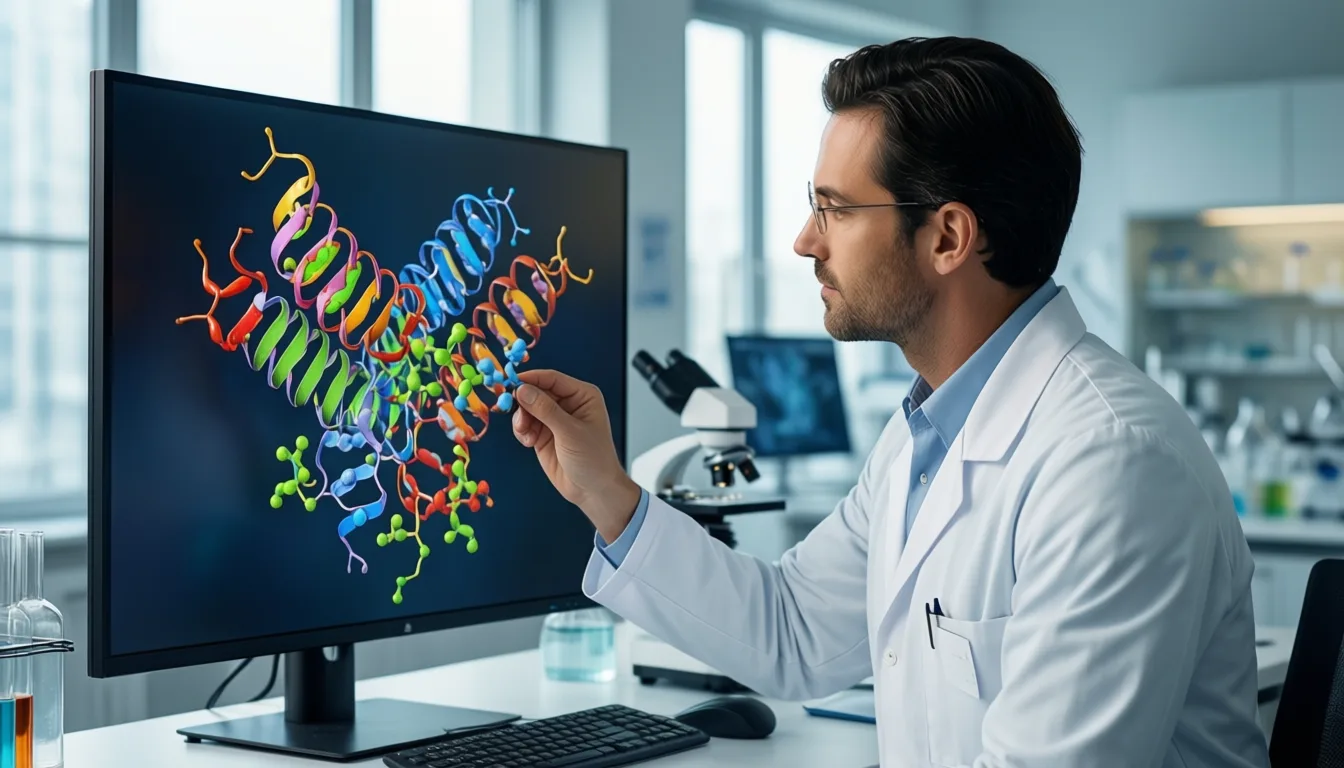
Computational screening lets researchers triage thousands of peptide candidates before committing to synthesis.
The machine-learning layer
The reason any of this is moving faster than it did a decade ago is that the screening bottleneck is loosening. A new method called Top-ML uses topological features derived from a peptide's sequence "connection" information to predict anticancer activity — and reportedly matches state-of-the-art deep learning performance on standard benchmark datasets while being more interpretable about why it picked a given candidate.
Interpretability matters more than it sounds. A model that flags a promising sequence and can explain which structural features drove the call is a model a medicinal chemist can actually act on. That's the quiet shift: from black-box screening to design tools that argue their reasoning.
The bottleneck used to be which peptides to make. Increasingly, it's which ones to believe.
Antivirals: shrinking the molecule, sharpening the hit
The most striking single result in this batch comes from HIV research. A team used ReaxFF molecular dynamics — a reactive-force-field simulation method — to dissect how each amino acid in VIRIP, a 20-residue natural fragment of α1-antitrypsin, contributes to blocking the HIV-1 gp41 fusion peptide. By trimming the peptide based on that analysis, they produced a 10-residue version (soVIRIP) with more than 100-fold higher antiviral activity than the original and an IC50 around 120 nM in infection assays. It was also reported as nontoxic in a zebrafish model.
The context for that number: a dimeric VIRIP derivative (VIR-576) has already cleared a phase I/II clinical trial for safety and efficacy, so this isn't a from-scratch program — it's an optimization of a peptide that already has human data behind it. Two things are notable for a non-clinician reader. First, smaller peptides are cheaper to manufacture and easier to formulate. Second, the design move was made in silico, then validated in the lab — the inverse of the usual workflow.
The same computational-repurposing logic is being applied to SARS-CoV-2. A 2025 review argues that AI-driven mass screening can support a peptide repurposing strategy analogous to small-molecule repurposing, identifying existing therapeutic peptides that might modulate immune responses, block viral entry, or disrupt replication. Stability, bioavailability, and viral mutation remain the open problems.
Antimicrobial peptides and the resistance problem

AMPs disrupt bacterial membranes directly — a mechanism that's harder for pathogens to evolve around than single-target antibiotics.
Antibiotic resistance is the slow-motion crisis that should be on every health-literate adult's radar. Antimicrobial peptides (AMPs) — small, often cationic sequences produced by the innate immune systems of organisms from frogs to humans — are one of the more credible candidates to back up a thinning antibiotic arsenal.
A 2025 review summarizes why: AMPs can permeabilize bacterial membranes, limit biofilm formation, and modulate immune responses, attacking pathogens on multiple fronts at once. That multi-mechanism profile is what makes resistance harder to evolve than against a conventional antibiotic that hits a single enzyme. The same review notes activity reported across bacteria, viruses, fungi, and cancer cells.
The caveats are the usual ones for this field: most of the strongest data are preclinical, clinical translation has been slow, and turning a promising AMP into a stable, affordable drug is still hard. The direction of travel is encouraging; the timeline for a pharmacy-shelf AMP is not next year.
What to actually take from this
The evidence rating here is moderate, and the language should match. Across oncology, antivirals, and antimicrobials, peptides plus computation look like a genuinely productive pairing — strong enough to take seriously, early enough that overclaiming would be dishonest. The most defensible read for a non-clinician: the design tools are real, some of the lab results are striking, and the translation to approved human therapies will take years and will not look like the consumer-peptide marketplace currently looks.
For now, the practical move is to update your mental model of where drug discovery is heading, not your supplement stack. The pipeline is being rebuilt. The shelf hasn't caught up yet.
Frequently asked questions
What makes therapeutic peptides different from other types of drugs?
Therapeutic peptides sit in a middle ground between small-molecule drugs and full antibodies: they are specific enough to hit a single target and small enough to be engineered at scale. They are also increasingly tractable for AI models that can screen millions of candidate sequences before a single one is synthesized.
What happened when researchers redesigned the HIV-fighting peptide VIRIP?
Using ReaxFF molecular dynamics to analyze each amino acid's contribution, researchers trimmed the original 20-residue peptide to a 10-residue version called soVIRIP, which showed more than 100-fold higher antiviral activity than the original and an IC50 of around 120 nM in infection assays. It was also reported as nontoxic in a zebrafish model.
Why are antimicrobial peptides considered a credible response to antibiotic resistance?
Antimicrobial peptides can permeabilize bacterial membranes, limit biofilm formation, and modulate immune responses, attacking pathogens on multiple fronts simultaneously. That multi-mechanism profile makes resistance harder to evolve than against a conventional antibiotic that hits a single enzyme.
What is Top-ML and why does the article highlight its interpretability?
Top-ML is a method that uses topological features derived from a peptide's sequence connection information to predict anticancer activity, reportedly matching state-of-the-art deep learning performance on standard benchmarks. Its interpretability matters because a model that can explain which structural features drove its prediction gives medicinal chemists something they can actually act on, unlike a black-box screening tool.
What are the main obstacles still preventing peptide therapies from reaching patients?
The article identifies enzymatic degradation, limited stability, poor bioavailability, and high production costs as the key practical barriers. Engineering approaches such as cyclization, stapling, and cell-penetrating modifications are among the workarounds currently being tested.
Sources
- Peptides in breast cancer therapy: From mechanisms to emerging drug delivery and immunotherapy strategies. — Pathology, research and practice
- Topology-Enhanced Machine Learning Model (Top-ML) for Anticancer Peptide Prediction. — Journal of chemical information and modeling
- ReaxFF-Guided Optimization of VIRIP-Based HIV-1 Entry Inhibitors. — The journal of physical chemistry. B
- Rerouting therapeutic peptides and unlocking their potential against SARS-CoV2. — 3 Biotech
- Antimicrobial peptides: a promising frontier to combat antibiotic resistant pathogens. — Annals of medicine and surgery (2012)
Join the conversation
Comments are moderated and reviewed before they appear. Be constructive — this is health information.
Add your comment