
The Next GLP-1s: Dual Fatty-Acid Conjugates and Combo Therapies Push Past Semaglutide
Two 2025 preclinical studies hint at where this class is heading — longer-acting molecules, beta-cell-protective stacks, and the first real challengers to semaglutide's throne.
Semaglutide changed the conversation. It didn't end it. If you spend any time in the corners of the internet where lifters argue about body composition and longevity nerds argue about insulin sensitivity, you already know the GLP-1 class has moved from diabetes drug to cultural phenomenon in under a decade. What's quietly happening now, in 2025 journals most gym-goers will never open, is more interesting: a new generation of molecules engineered to last longer, hit harder, and protect the pancreas itself. The data is early — preclinical, mostly rodent — but the direction is unmistakable.
Two papers published this year sketch the next chapter. The first introduces TE-8105, a re-engineered GLP-1 built on what its developers call a 2FA-platform — a multi-arm linker that bolts two fatty acids onto the peptide with precise control over spacing and chemistry. The second tests an unlikely stack — GABA plus a GLP-1 receptor agonist — in a rat model of Wolfram syndrome, a rare disease that destroys pancreatic beta cells. Different problems, different molecules, same underlying signal: the future of this class is combinatorial and structural, not just bigger doses of what we already have.
Before we go further, the necessary caveat. Everything below is preclinical. Mice are not men, rats are not humans, and the graveyard of metabolic drugs that crushed it in rodents and flopped in trials is deep. Treat this as a map of where the field is pointing, not a shopping list.
Why fatty acids matter
Here's the part most coverage skips. Semaglutide isn't just GLP-1 in a syringe — it's GLP-1 with a fatty acid chain attached that lets it cling to albumin, the abundant carrier protein in your blood. That sticky relationship is what stretches its half-life from minutes to roughly a week. Once-weekly dosing is a fatty-acid story.
So the obvious engineering question: what if you used two fatty acids instead of one, and got the geometry right? That's the bet behind TE-8105, described this year in the Journal of Medicinal Chemistry. The team built a multi-arm linker that lets them tune the spacing, chain length, and attachment point of two fatty acids on a modified GLP-1 backbone, then screened the resulting library for albumin affinity and pharmacodynamics. TE-8105 came out on top.
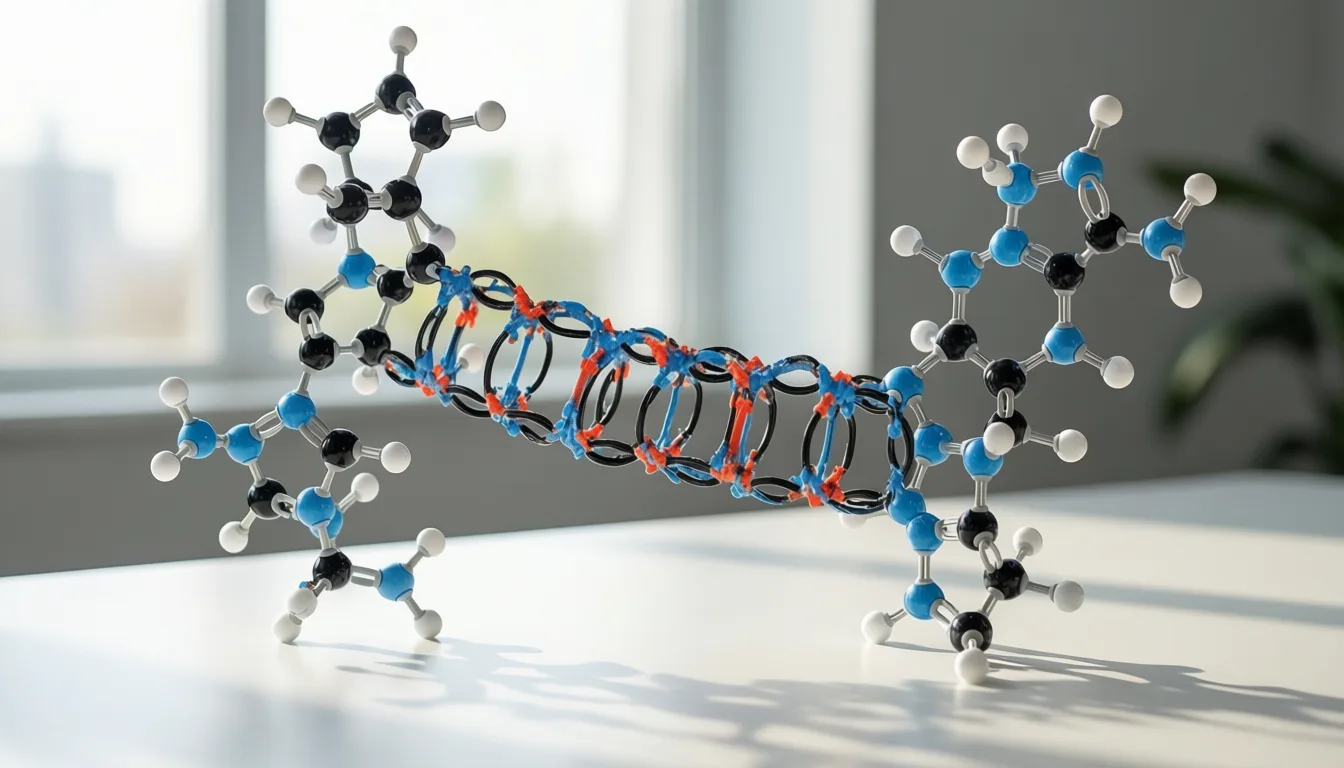
The 2FA-platform tunes the geometry of two fatty acids on a single peptide — a structural lever, not a dose lever.
In head-to-head animal work, TE-8105 outperformed semaglutide on the metrics that matter to anyone tracking this class. In diabetic mice, it delivered improved long-term glycemic control, more weight loss, and better liver health. In obese mice, it produced dose-dependent weight loss with favorable body composition changes — important language, because not all weight loss is created equal, and the lean-mass question is the one the lifting community keeps asking about this whole class.
The most distinctive finding may be the liver one. In a mouse model of nonalcoholic steatohepatitis — NASH, the aggressive fatty liver disease that's quietly become one of the biggest unmet needs in metabolic medicine — low-dose TE-8105 reduced liver steatosis and improved liver health. Semaglutide has shown liver-fat effects too, but a low-dose advantage is worth flagging.
The next wave of GLP-1s isn't louder. It's better engineered.
The combo therapy angle
While one team is rebuilding the molecule, another is rebuilding the protocol. A separate 2025 paper in Diabetology & Metabolic Syndrome tested GABA — yes, the same inhibitory neurotransmitter that turns up in sleep-stack supplements — alongside liraglutide, a first-generation GLP-1 agonist, in a rat model of Wolfram syndrome.
Wolfram syndrome is rare and brutal: a mutation in the WFS1 gene drives diabetes and neurodegeneration with no approved treatment. It's also a useful stress test for any drug claiming to protect beta cells, because in this model the cells are under genuine, genetically programmed attack.
The results were split in a telling way. GABA alone did nothing for the diabetic phenotype — a real divergence from conventional diabetes models, where GABA has shown islet-protective signals. Liraglutide alone delayed disease progression, consistent with what GLP-1 agonists have shown in other beta-cell-stress contexts. But the combination went further, modifying the cytoarchitecture of the Langerhans islets themselves — the actual cellular structure of the pancreas — in ways neither agent achieved alone.
What this means for the rest of us
Step back from the specific molecules and look at the pattern. Both papers are early — preclinical, animal models, small. Neither should change what anyone does this week. But they share a thesis that's worth internalizing if you follow this space: the second generation of GLP-1 therapy won't just be stronger appetite suppression. It'll be smarter pharmacokinetics, deliberate organ-level effects, and rational combinations that protect the very cells the disease is destroying.
For the evidence-first lifter watching this class with interest, that's a more useful frame than the breathless headlines. The interesting question isn't "how much weight can the next molecule make people lose." It's whether the next molecule preserves lean mass better, protects the liver at lower doses, and — when stacked with the right partner — actually rebuilds metabolic tissue rather than just suppressing appetite into it.
None of that is settled. All of it is testable. And both of these papers, for all their early-stage caveats, point at a class that's still very much accelerating.
- TE-8105 is a structural rethink, not a dose hike. Two fatty acids on a tuned linker beat semaglutide on glycemic control, weight loss, and liver health in mice.
- Low-dose liver effects stand out. TE-8105 reduced steatosis at low doses in a NASH model — a hint that next-gen GLP-1s may target fatty liver more efficiently.
- Combination therapy is the other frontier. GABA plus liraglutide remodeled pancreatic islet architecture in Wolfram syndrome rats beyond what either drug did alone.
- GABA monotherapy did nothing in this model. A reminder that islet-protective signals don't generalize across diseases — context matters.
- All of this is preclinical. Rodent data, not human trials. Promising direction, not a protocol.
- Talk to a clinician before changing anything. GLP-1 decisions are medical decisions, full stop.

The next generation of metabolic drugs may finally let body composition catch up with body weight.
Frequently asked questions
What makes TE-8105 structurally different from semaglutide?
Semaglutide uses a single fatty acid chain to bind albumin and extend its half-life to roughly a week, while TE-8105 uses a multi-arm linker that attaches two fatty acids to a modified GLP-1 backbone with precise control over spacing and chemistry. The article describes this as a structural rethink rather than simply a higher dose of an existing approach.
Why do fatty acids matter so much in GLP-1 drug design?
Fatty acids allow GLP-1 peptides to bind albumin, the abundant carrier protein in blood, which stretches the drug's half-life from minutes to roughly a week and makes once-weekly dosing possible. The article frames once-weekly semaglutide dosing as fundamentally a fatty-acid story, which explains why engineering better fatty-acid geometry is a central focus of next-generation development.
What did the GABA and liraglutide combination show that neither drug showed alone?
In a rat model of Wolfram syndrome, the combination modified the cytoarchitecture of the pancreatic islets — the actual cellular structure of the pancreas — in ways neither agent achieved independently. Liraglutide alone only delayed disease progression, while GABA alone had no effect on the diabetic phenotype in this model at all.
Why does the article say GABA's lack of effect in this study matters?
GABA has shown islet-protective signals in conventional diabetes models, so its complete failure to affect the diabetic phenotype in the Wolfram syndrome rat model is described as a real divergence from expectations. The article treats this as a reminder that protective signals seen in one disease context do not automatically generalize across diseases.
Why shouldn't readers act on these findings right now?
Both papers are preclinical, meaning all results come from mouse and rat models, not human trials. The article explicitly notes that many metabolic drugs that performed well in rodents have gone on to fail in human clinical trials, and it frames the research as a map of where the field is pointing rather than a basis for any personal protocol change.
Sources
- 2FA-Platform Generates Dual Fatty Acid-Conjugated GLP-1 Receptor Agonist TE-8105 with Enhanced Diabetes, Obesity, and NASH Efficacy Compared to Semaglutide. — Journal of medicinal chemistry
- GABA and GLP-1 receptor agonist combination therapy modifies diabetes and Langerhans islet cytoarchitecture in a rat model of Wolfram syndrome. — Diabetology & metabolic syndrome
Join the conversation
Comments are moderated and reviewed before they appear. Be constructive — this is health information.
Add your comment