
Ozempic on the OR Table: The New Pre-Surgery Fasting Playbook for GLP-1 Users
A 2026 systematic review reframes the pre-anesthesia question for semaglutide users — less about pausing the drug, more about clearing the stomach and checking it with ultrasound.
You finally got the shoulder scope on the calendar. You also happen to be one of the millions of men now taking a weekly GLP-1 for body composition or blood sugar. Somewhere in the pre-op phone call, a nurse asks when you last injected — and whether you've been eating solids. That awkward question has, until very recently, been answered with a shrug and a blanket order to stop the drug for a week. New evidence suggests the real answer is more interesting, more practical, and a lot less about pausing your peptide.
The concern is mechanical, not mysterious. GLP-1 receptor agonists — semaglutide, tirzepatide and their cousins — slow gastric emptying. That is part of why they work for appetite and glycemic control. It is also why anesthesiologists worry about residual gastric content (RGC): food or fluid still sitting in the stomach when you go under, which in theory can be regurgitated and aspirated into the lungs. A 2026 systematic review in Cureus pulled together nineteen clinical studies plus one large claims dataset to ask a sharper question: what actually reduces that residual content, and does it line up with the real, much rarer event of aspiration?
The headline finding for a busy 40-year-old is that fasting protocol may matter more than the heroic week-long drug hold everyone has been arguing about. In one retrospective study cited in the review, patients on a 24-hour clear-liquid diet before their procedure had high residual gastric content roughly one to two percent of the time, versus about ten percent on standard fasting — an odds ratio near 0.13. That is a large effect for a behavioral change you can actually execute the day before surgery.
The drug hold question, reframed
Society guidance over the last two years has swung between aggressive medication holds and a more measured "individualize it" stance. The Cureus synthesis lands somewhere pragmatic. In prospective ultrasound studies, withholding weekly GLP-1 RAs for seven to eight days before a procedure was associated with lower odds of high residual gastric content compared with shorter intervals. That is consistent with the long half-lives of these drugs and the time it takes gastric motility to normalize.
But — and this is the part the headlines keep missing — residual gastric content is a surrogate. It is what shows up on the ultrasound screen, not what shows up in the recovery room. Clinical aspiration is rare. The review is explicit that RGC and aspiration are distinct outcomes, and the evidence base does not yet prove that aggressive drug holds translate into fewer real aspiration events. For a healthy adult getting an elective procedure, that distinction matters: pausing your weekly injection has its own costs — rebound appetite, glycemic swings, missed momentum — and those costs only buy you something if the marginal aspiration risk is actually moving.
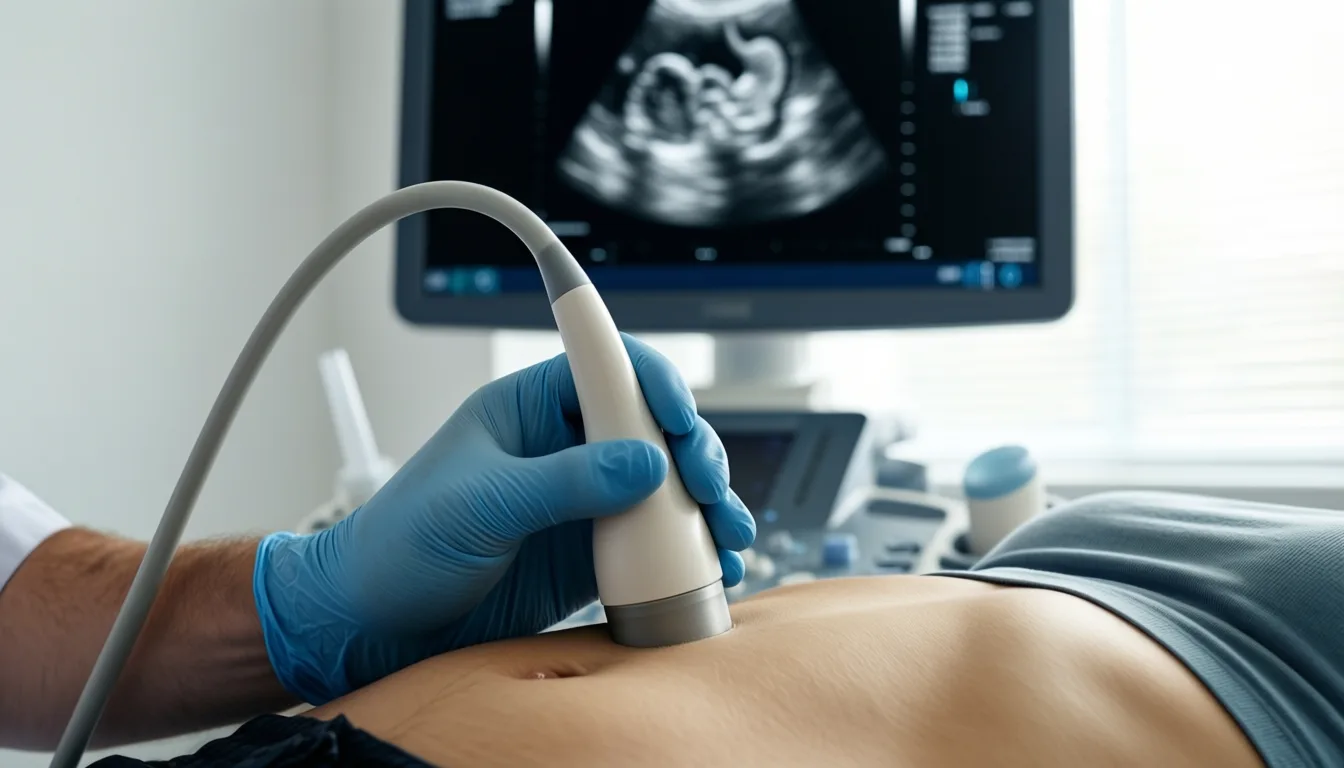
Point-of-care gastric ultrasound is moving from research tool to pre-op checkpoint.
Why ultrasound is quietly winning
The most interesting through-line in the review is the rise of gastric point-of-care ultrasound, or POCUS. Multiple studies used validated thresholds — broadly, an antral content estimate above roughly 1.5 mL/kg, or the presence of solid material — to decide, at the bedside, whether a given GLP-1 user actually has a full stomach right now. Instead of treating every semaglutide patient as a default aspiration risk and cancelling cases or delaying them by a week, the team scans, looks, and decides.
That is a meaningfully different posture. It moves the decision from a population-level rule ("hold the drug for everyone") to an individual-level measurement ("this stomach, today, is empty enough"). It also gives the anesthesiologist a clean Plan B: if the antrum looks loaded, you can postpone, switch to a rapid-sequence induction, or extend clear-liquid fasting and rescan. The catch is access. POCUS requires a clinician trained in the gastric protocol and a machine in the pre-op bay. Big academic centers increasingly have both. Your local ambulatory surgery center may not.
Residual gastric content is what shows up on the ultrasound screen. Aspiration is what shows up in the recovery room. They are not the same outcome.
What this actually changes for you
You are not the one writing the pre-op order. But you are the one who tells the surgical team you are on a GLP-1 — and that disclosure shapes everything downstream. The practical move, weeks before any elective procedure, is to flag the medication early, ask whether the facility uses gastric POCUS, and ask what fasting protocol they want from you. The review suggests an extended clear-liquid window the day before is a high-leverage, low-cost intervention. A longer drug hold is a separate decision that should weigh your metabolic situation, not just a default policy.
The honest read on the evidence is moderate, not definitive. Nineteen heterogeneous studies, no meta-analysis, surrogate outcomes, and a still-thin link between RGC and clinical aspiration mean the field is converging, not settled. Expect society guidelines to keep moving. What looks durable is the direction of travel: away from blunt week-long holds, toward smarter fasting plus a quick look with an ultrasound probe.
- Disclose early. Tell the surgical and anesthesia teams you are on a GLP-1 weeks before an elective procedure, not the morning of.
- Clear liquids do real work. An extended clear-liquid window before surgery was linked to a roughly 1–2% vs 10% rate of high residual gastric content in one cited study.
- The 7–8 day hold has evidence, but trade-offs. Longer holds of weekly GLP-1s lowered RGC odds in ultrasound studies; whether that prevents actual aspiration is not yet proven.
- Ask about gastric ultrasound. POCUS is emerging as a smarter individualized check than blanket medication holds — if your facility offers it.
- RGC ≠ aspiration. Residual content is a surrogate. Clinical aspiration remains rare, which is why aggressive blanket policies deserve scrutiny.
- Decide with a clinician. Drug-hold timing interacts with glycemic control and weight goals. This is a conversation, not a default.
Frequently asked questions
Why do anesthesiologists care that I'm on a GLP-1 like Ozempic before surgery?
GLP-1 receptor agonists slow gastric emptying, which is part of why they work for appetite and blood sugar control. Anesthesiologists worry that food or fluid may still be sitting in the stomach when a patient goes under, which can in theory be regurgitated and aspirated into the lungs — a condition called residual gastric content.
Does following a clear-liquid diet before surgery actually reduce the risk of a full stomach?
According to a retrospective study cited in the Cureus review, patients on a 24-hour clear-liquid diet before their procedure had high residual gastric content roughly one to two percent of the time, compared with about ten percent on standard fasting. The article describes this as a large effect for a behavioral change that can be executed the day before surgery.
What is gastric POCUS and how is it used for GLP-1 patients before an operation?
Gastric point-of-care ultrasound (POCUS) is a bedside tool that lets clinicians measure whether a specific patient's stomach is actually empty before a procedure, rather than applying a blanket policy to all GLP-1 users. If the scan shows concerning content, the team can postpone, switch to a different induction approach, or extend clear-liquid fasting and rescan. The article notes that access varies widely — large academic centers increasingly have it, but many ambulatory surgery centers may not.
Is residual gastric content the same thing as aspiration during surgery?
No — the article is explicit that residual gastric content (what shows up on an ultrasound) and clinical aspiration (what shows up in the recovery room) are distinct outcomes. Clinical aspiration remains rare, and the evidence base does not yet prove that aggressive drug holds translate into fewer actual aspiration events.
What should I do before a scheduled procedure if I take a weekly GLP-1 injection?
The article recommends disclosing the medication to the surgical and anesthesia teams weeks before the procedure — not the morning of — because that disclosure shapes everything that follows. You should also ask whether the facility uses gastric POCUS and what fasting protocol they want from you, since the appropriate drug-hold decision depends on your individual metabolic situation and should be made with a clinician.
Join the conversation
Comments are moderated and reviewed before they appear. Be constructive — this is health information.
Add your comment