
The Surgeon's New GLP-1 Problem: What Patients on Semaglutide Should Know Before the OR
A fresh systematic review consolidates the perioperative signals — delayed gastric emptying, hypoglycemia, anesthesia risk — that every patient on a GLP-1 should bring up before surgery.
The pre-op intake form has not yet caught up with the pharmacy counter. Somewhere between the line that asks about aspirin and the one that asks about herbal supplements, millions of patients are now ticking a box for a weekly injectable peptide — semaglutide, tirzepatide, liraglutide — and then walking into an operating room where the anesthesia team is still working out what, exactly, that means. A 2025 systematic review in the American Journal of Surgery is the clearest attempt yet to consolidate what the evidence actually says, and the headline for the quantified-self crowd is this: your GLP-1 is a perioperative variable, and it deserves the same pre-flight checklist as everything else on your stack.
The review, conducted under PRISMA 2020 guidelines, pulled twenty-one articles addressing GLP-1 receptor agonist (GLP-1RA) use in non-bariatric surgical contexts. That is a small corpus. It is also, at the moment, the most systematic look at a question that affects an extraordinary number of people: what happens when a drug class engineered to slow gastric emptying meets a procedure that assumes an empty stomach? The authors set out to map pre-, intra-, and post-operative implications for surgeons who are now seeing these patients on every list, and the picture they sketch is mixed — useful upsides, real signals worth respecting, and a lot of unsettled detail.
On the upside, the review found that GLP-1RAs can help patients meet BMI thresholds for surgery that would otherwise be out of reach, turning the drug into a kind of pre-operative conditioning tool. Intra-operatively, the same paper notes improved glycemic control and lower intraoperative insulin use in patients on these agents — meaningful for anyone who has watched a diabetic patient's glucose curve get jagged under general anesthesia.
The stomach that doesn't empty on schedule
The flip side is mechanistic and, for anesthesiologists, the part that has driven a year of professional-society back-and-forth. GLP-1RAs slow gastric emptying — that is part of how they work — and the systematic review flags delayed gastric emptying as a reported complication in the surgical literature. Translated into OR terms: a patient who has fasted by the clock may not be fasted by the stomach. The aspiration-risk concern that follows is not hypothetical hand-waving; it is the reason societies have been issuing — and revising — guidance about whether to hold these drugs before elective procedures.
The review also flags increased rates of hypoglycemic events among the reported complications. For readers who track continuous glucose monitor traces the way audiophiles track frequency response, that is a tractable variable — but it is one that interacts with fasting, with insulin sensitivity shifts after anesthesia, and with whatever else is in the perioperative cocktail.
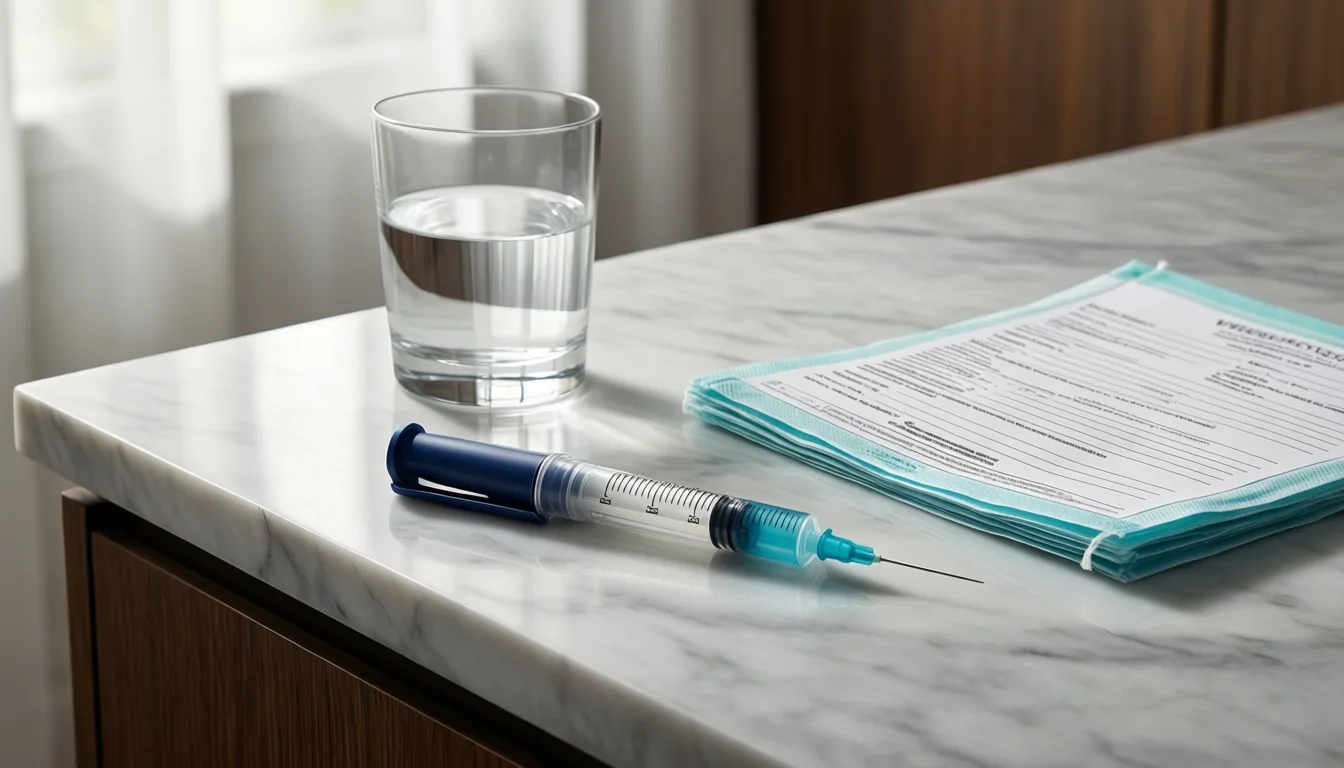
The pre-op question that didn't exist three years ago: when did you last inject?
What "Moderate" evidence actually buys you
It is worth being honest about the strength of this signal. Twenty-one papers, heterogeneous in design, synthesized into a narrative review is not the same as a multi-thousand-patient randomized trial. The authors themselves frame the work as a map of existing literature for surgeons who will likely encounter these patients — a scoping exercise that consolidates what is reported rather than a verdict on incidence or causality. The complications described are associated with GLP-1RA use in the included studies, not proven attributable in every case.
That matters because the loudest version of this story — the one circulating on social media — frames GLP-1s as a binary danger in the OR. The review does not support that framing. What it supports is a more boring, more useful one: these drugs change physiology in ways that are relevant to surgery, the relevance shows up in both directions (better glycemic control, slower stomachs), and the appropriate response is screening and shared decision-making, not panic.
A patient who has fasted by the clock may not be fasted by the stomach.
The questions worth bringing to your pre-op visit
None of what follows is medical advice, and the review is explicit that decisions about holding, continuing, or adjusting these medications belong to the team performing the procedure. But the authors' core conclusion — that surgeons should screen preoperative patients appropriately — implies a patient-side corollary: walk in with the data your team needs to make that screen meaningful.
That means knowing the specific molecule (semaglutide, tirzepatide, liraglutide, dulaglutide), the dose, the day of the week you inject, and how long you have been on it. It means knowing whether you have been escalating doses recently — relevant for tolerability and for gastric symptoms — and whether you have noticed reflux, early satiety, or post-meal nausea in the weeks before surgery. For diabetic readers, it means bringing a recent stretch of CGM data if you have it. None of these are exotic asks for the quantified-self reader; they are exactly the kind of telemetry you already collect.
- A 2025 PRISMA systematic review in the American Journal of Surgery is the most consolidated look so far at GLP-1RAs in non-bariatric surgery, drawing on 21 studies.
- Upsides are real: the review notes GLP-1RAs can help patients reach BMI thresholds for surgery and reports improved intraoperative glycemic control with lower insulin use.
- Signals to respect: delayed gastric emptying and increased hypoglycemic events were among the reported complications.
- Evidence is moderate, not definitive: a small, heterogeneous corpus — useful for screening, not a verdict on incidence.
- Bring data to pre-op: molecule, dose, last injection date, recent GI symptoms, and CGM traces if you have them.
- Hold/continue decisions belong to your surgical and anesthesia team — do not stop or adjust a prescribed medication on your own.

Screening, not panic: the review frames GLP-1s as a perioperative variable to manage, not a contraindication.
The broader story here is one biohackers will recognize: a peptide class moved from a narrow clinical indication into mass adoption faster than the surrounding infrastructure — intake forms, society guidelines, surgical workflows — could adapt. The systematic review is part of that infrastructure catching up. It will not be the last word, and the authors do not pretend otherwise. But it is a credible first map, and the most useful thing a reader on one of these drugs can do is treat it like one: a guide to the questions to ask, not a script for what to do.
Frequently asked questions
Why does being on a GLP-1 medication matter before surgery?
GLP-1 receptor agonists slow gastric emptying, which means a patient who has fasted by the clock may not be fasted by the stomach. This creates an aspiration risk concern for anesthesiologists, and the systematic review also flags delayed gastric emptying and increased hypoglycemic events as reported complications in the surgical literature.
Are there any benefits to being on a GLP-1 drug going into a procedure?
Yes. The 2025 systematic review found that GLP-1RAs can help patients reach BMI thresholds for surgery that would otherwise be out of reach, effectively serving as a pre-operative conditioning tool. The review also notes improved intraoperative glycemic control and lower intraoperative insulin use in patients on these agents.
What information should I bring to my pre-op appointment if I take a GLP-1?
The article recommends knowing your specific molecule (semaglutide, tirzepatide, liraglutide, or dulaglutide), your dose, the day of the week you inject, and how long you have been on it. You should also note whether you have recently escalated doses, whether you have experienced reflux, early satiety, or post-meal nausea, and bring CGM data if you use a continuous glucose monitor.
Should I stop my GLP-1 medication on my own before surgery?
No. The article is explicit that decisions about holding, continuing, or adjusting these medications belong to the surgical and anesthesia team performing the procedure. The recommended approach is to list the medication on every intake form, mention it at the pre-op anesthesia consult, and ask the team directly how they would like you to handle it in the days before the procedure.
How solid is the evidence linking GLP-1 drugs to surgical complications?
The evidence is described as moderate rather than definitive. The systematic review synthesized only 21 studies that were heterogeneous in design, which the authors themselves frame as a scoping exercise mapping existing literature rather than a verdict on incidence or causality. The complications reported are associated with GLP-1 use in the included studies, not proven attributable in every case.
Sources
- A systematic review of the use of GLP-1 receptor agonists in surgery. — American journal of surgery
Join the conversation
Comments are moderated and reviewed before they appear. Be constructive — this is health information.
Add your comment