The 24-Hour Movement Stack: Why Sedentary Time, Steps and Sleep Are the New Cardiometabolic Levers
A new randomized trial is testing whether reshaping the full day — not just the workout — can prevent recurrent strokes. A parallel Japanese dataset reveals the hidden forces shaping how much we actually move.
For a generation, the prescription for a healthier heart has been measured in workout minutes — 150 a week of moderate activity, give or take, plus a nod toward strength training. It's a tidy number, and it's not wrong. But it leaves roughly 23 of every 24 hours unaccounted for, and that quiet majority of the day is where two new research threads are converging. One is a large randomized trial in stroke survivors that treats sedentary time, activity, and sleep as a single, blended target. The other is a long-running Japanese smartphone dataset that exposes how weather, trains and household structure quietly dictate whether anyone walks at all. Together they hint at a more honest model of cardiometabolic risk — one where the protocol isn't a workout, it's a 24-hour budget.
- The full day is the unit of intervention. The RISE trial targets sedentary behavior, activity and sleep together — not just exercise minutes — for secondary stroke prevention.
- Evidence is still emerging. RISE is a protocol paper; outcomes on recurrent cardiovascular events are not yet in.
- Steps are environmental, not just motivational. Temperature, train usage and marital status track meaningfully with daily step counts in Japanese urban adults.
- Context shapes adherence. Any step or sedentary-time target lives or dies inside weather, infrastructure and household routines.
- This is educational, not prescriptive. Anyone with cardiovascular disease should work changes through a clinician.
The Day as the Dose
The framing behind the RISE randomized controlled trial, published in BMJ Open, is unusually ambitious. Rather than isolating exercise as the lever, the investigators treat the entire 24 hours — time spent sedentary, time spent moving, and time spent asleep — as a single behavioral system. Their hypothesis: that nudging the balance of all three, simultaneously, can lower the risk of a major adverse cardiovascular event (MACE) or death in people who have already had a first-ever stroke.
The trial is built at scale. It plans to enroll about 1,000 community-dwelling first-stroke survivors, with 752 of them — those whose 24-hour movement profile flags them for secondary prevention — randomized to either usual care or usual care plus the RISE intervention. RISE itself is a 15-week blended program: primary care physiotherapists coach participants at home using behavior change techniques, supported by an eCoaching stack that includes an activity monitor, a smartphone app with real-time feedback and e-learning modules, and a clinician dashboard. A close relative is folded in as social support — recognizing that movement behavior is rarely a solo project.
The protocol isn't a workout. It's a 24-hour budget.
For performance-minded readers, the design is worth dwelling on. Endurance culture obsesses over training stimulus — intervals, zone 2 volume, lactate thresholds — but largely ignores the texture of the other 22 hours. RISE inverts that. It assumes that long uninterrupted sitting, fragmented sleep, and low ambient activity may compound vascular risk in ways a single hard session can't undo. That's a plausible mechanism: prolonged sedentary bouts blunt postprandial glucose handling and lipoprotein lipase activity, while poor sleep nudges sympathetic tone and blood pressure upward. The trial's contribution will be empirical proof — or disproof — that bundling these levers changes hard endpoints.
The honest caveat: this is a protocol paper. RISE describes the design, sample, intervention and primary outcome — the effect on recurrent MACE and quality-adjusted life years — but does not yet report results. Treat the 24-hour framework as a promising organizing principle for behavior change, not as proven secondary prevention. That's why the evidence rating here is moderate, not strong.
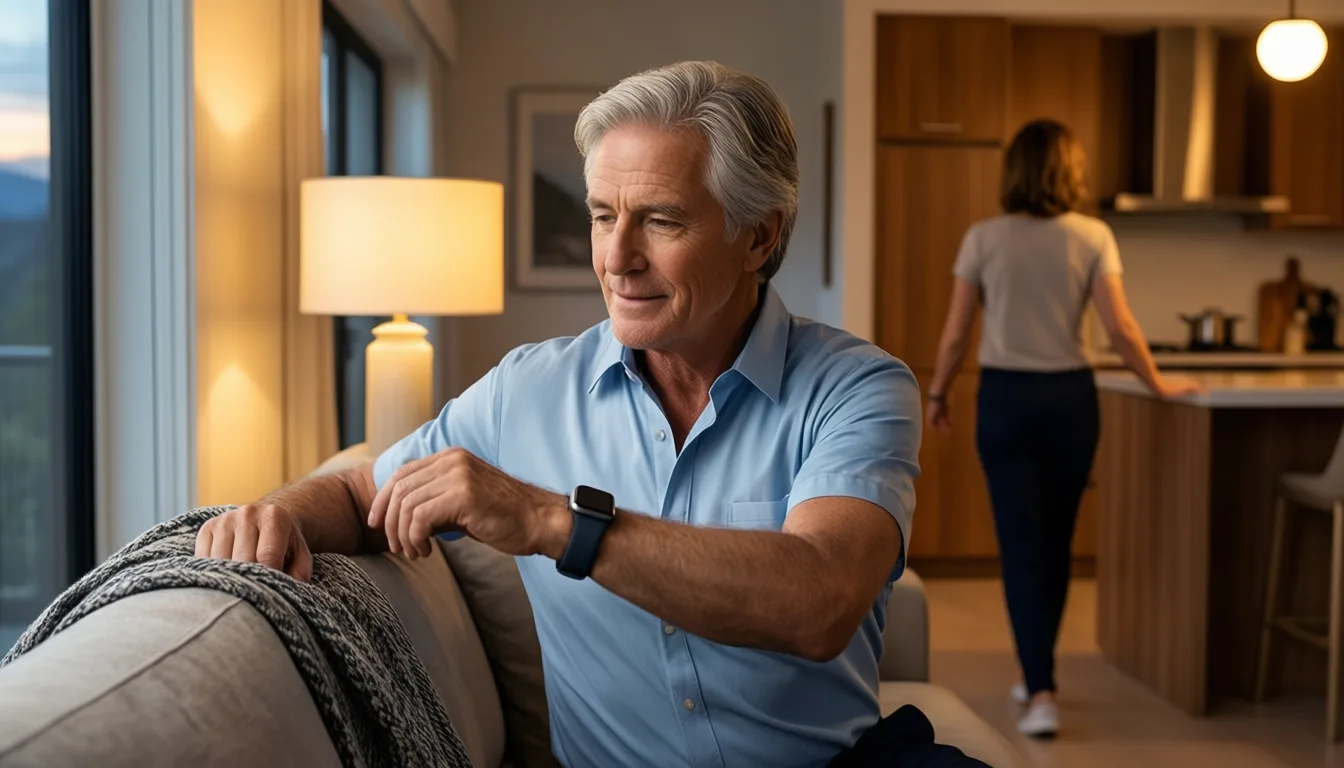
The RISE model treats the home environment, not the gym, as the primary venue for cardiometabolic behavior change.
What Actually Moves the Step Counter
While RISE tests whether the day can be reshaped, a separate time-series analysis from five Japanese cities — Fukuoka, Kawasaki, Kobe, Kyoto and Saitama — asks a quieter question: what already shapes it? Using built-in smartphone healthcare apps, the researchers pulled retrospective step data from 622 adults aged 40 to 79, with a mean observation period of 2,344 days per participant. That's a rare window into how movement behaves over years, not weeks.
The headline is that steps are not primarily a function of willpower. After seasonal-trend decomposition, the authors fit an absolute-value function between temperature and the seasonal component of daily steps with an R² of 0.798 — meaning that thermal comfort, in a deeply quantifiable way, drives when people walk. Step counts fall as the weather diverges from a temperate sweet spot in either direction. That single relationship explains roughly four-fifths of the seasonal variance.
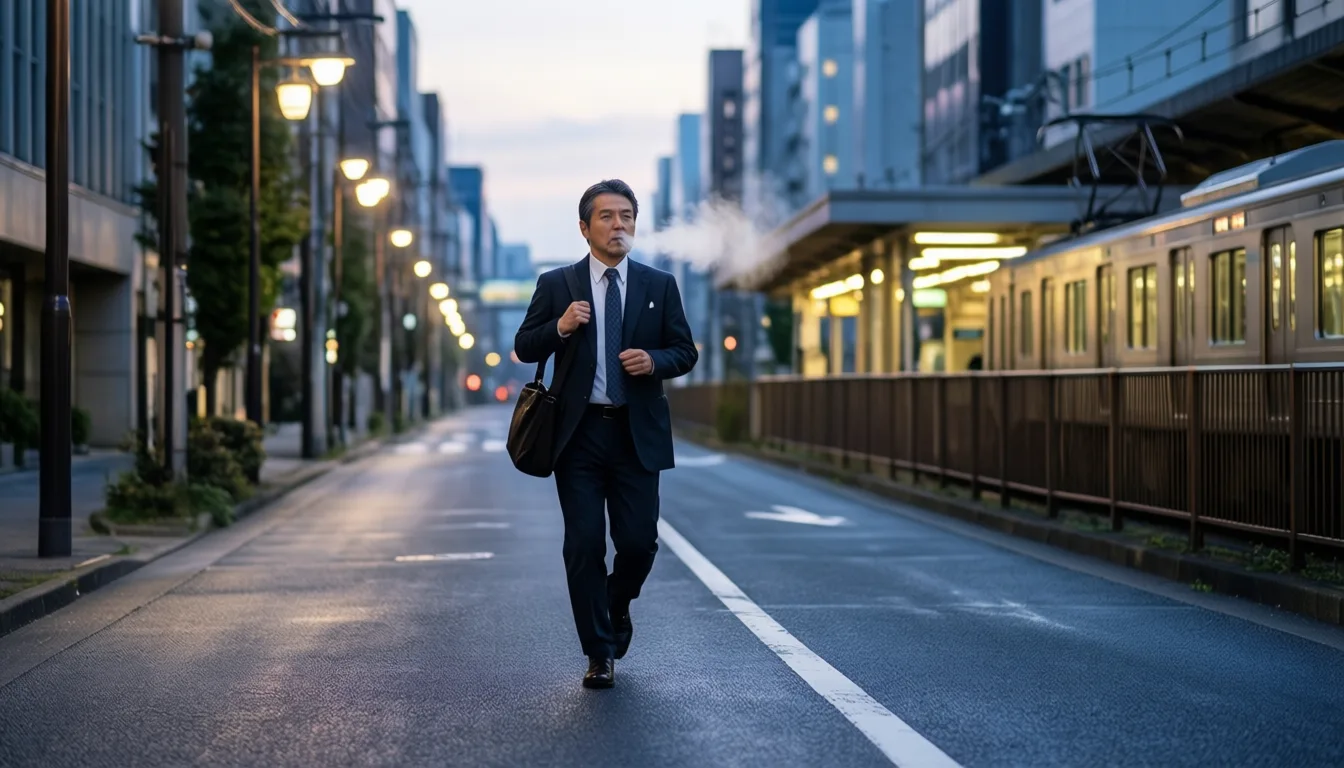
Infrastructure matters too. Ordinary train usage was significantly higher in Saitama, Kawasaki and Fukuoka than in Kobe and Kyoto by 14.1 points, and household structure tracked sharply with male step counts: married men out-stepped women by 1,832 steps per day, and divorced or bereaved men by 2,480. Those are descriptive, urban-Japanese associations — not causal mechanisms, and not portable to every culture — but they are striking.

Train-dependent commuting may quietly subsidize daily step counts in ways gym memberships cannot.
Reading the Two Studies Together
The interesting move is to hold both papers up at once. RISE assumes you can change the 24-hour movement budget through coaching, monitoring and social support. The Japanese dataset reminds us that the budget has powerful exogenous inputs — heat, cold, a train station within walking distance, whether someone shares your home. If thermal stress alone can account for the bulk of seasonal step variance, an intervention that ignores it is fighting physics. If train-using cities log more steps almost incidentally, infrastructure is already prescribing dose at population scale.
For an endurance athlete, the practical translation is less about copying the RISE protocol than about widening the analytic lens. Your zone 2 volume sits inside a 24-hour container that also includes desk hours, evening screen time, sleep architecture and the weather outside your door. Treat the container, not just the workout, as trainable.
A Smarter Way to Audit the Day
If there is a takeaway sturdy enough to act on now, it's conceptual rather than numeric. Stop treating exercise as a discrete event subtracted from an otherwise opaque day, and start auditing the 24 hours as one system. Where are the long uninterrupted sedentary bouts? Is sleep duration and timing stable, or chaotic? Are environmental cues — temperature, commute structure, who you live with — silently subsidizing or taxing your step count?
Trials like RISE will eventually tell us whether organized intervention on that whole budget shifts cardiovascular endpoints. Data like the Japanese smartphone series tell us where the leverage points sit in real life. Between them, the more honest performance-science story is finally taking shape: the protocol is the day.
Frequently asked questions
What is the RISE trial, and who does it target?
RISE is a randomized controlled trial that targets sedentary behavior, physical activity, and sleep together as a single behavioral system rather than isolating exercise alone. It is designed for people who have already had a first-ever stroke, with the goal of lowering their risk of a major adverse cardiovascular event or death. The trial plans to enroll about 1,000 community-dwelling first-stroke survivors.
Has the RISE trial proven that the 24-hour approach reduces stroke risk?
No. RISE is currently a protocol paper, meaning it describes the trial design, sample, and intervention but has not yet reported results. The effect of the 24-hour balance approach on recurrent stroke and other major cardiovascular events remains genuinely unknown until the trial reports out.
What does the RISE intervention actually involve for participants?
RISE is a 15-week blended program in which primary care physiotherapists coach participants at home using behavior change techniques. It is supported by an eCoaching stack that includes an activity monitor, a smartphone app with real-time feedback, e-learning modules, and a clinician dashboard. A close relative is also folded in as social support, recognizing that movement behavior is rarely a solo project.
What did the Japanese study find about what drives daily step counts?
The study found that steps are not primarily a function of willpower — temperature was the dominant factor, with thermal comfort explaining roughly four-fifths of the seasonal variance in daily steps (R² of 0.798). Infrastructure also mattered, as train usage tracked with higher step counts in some cities, and household structure was associated with differences in male step counts.
Why does the article say long uninterrupted sitting may compound cardiovascular risk?
The article explains that prolonged sedentary bouts can blunt postprandial glucose handling and lipoprotein lipase activity, while poor sleep nudges sympathetic tone and blood pressure upward. These are offered as plausible biological mechanisms for why the RISE trial bundles sedentary time, activity, and sleep together rather than focusing on exercise alone.
Sources
- Secondary prevention by striking the balance in 24-hour movement behaviour by empowering people at risk with a stroke: rationale and design of the RISE intervention randomised controlled trial. — BMJ open
- Built-in healthcare applications reveal step changes associated with temperature, transportation, and marital status among urban cities in Japan. — The Journal of frailty & aging
Join the conversation
Comments are moderated and reviewed before they appear. Be constructive — this is health information.
Add your comment