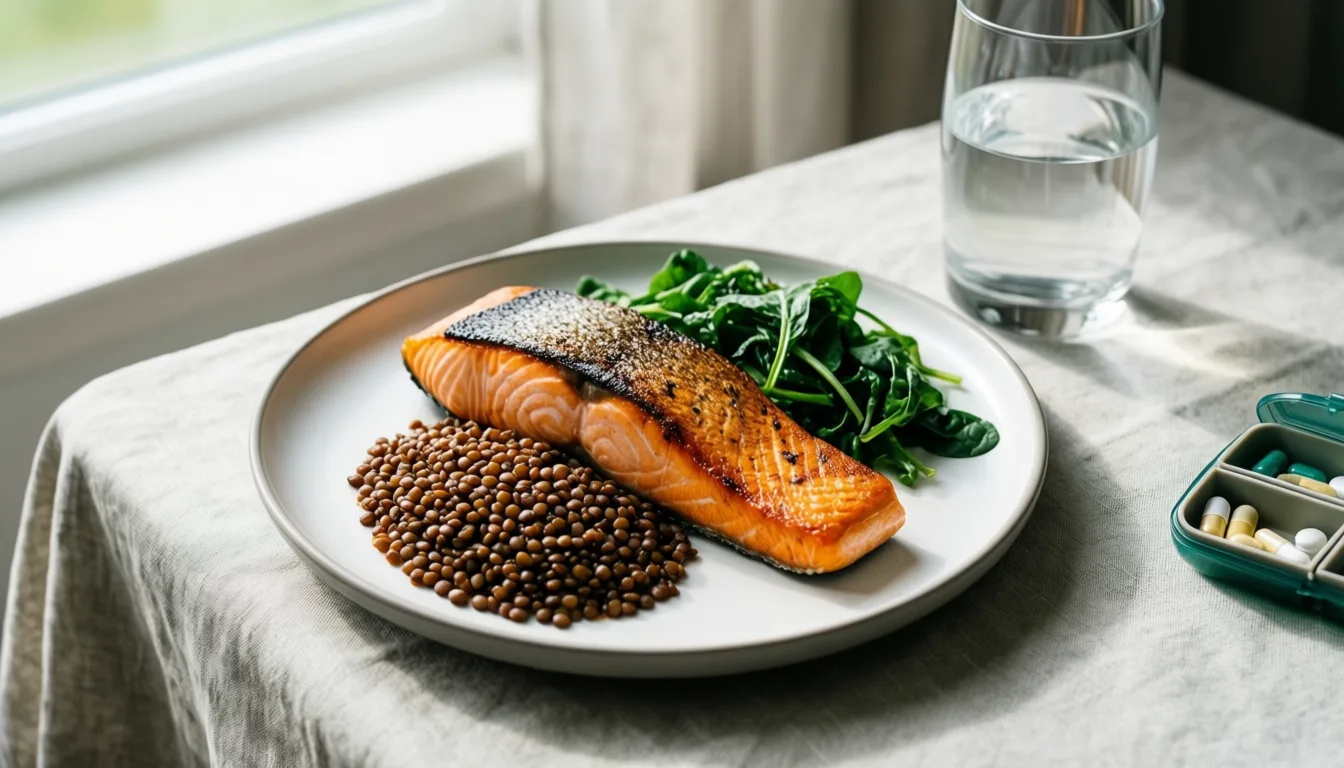
Nutrition as the Missing Half of GLP-1 Therapy
A new review argues the drugs only do half the work. The other half — protein, symptom management, and a maintenance plan — happens on the plate.
The GLP-1 era has been narrated almost entirely as a pharmacology story — milligrams, titration schedules, percentage points of body weight shed in trial graphs. But anyone paying close attention to the lived experience of these drugs knows the real story is messier. Patients report queasy mornings, shrinking appetites that border on indifference toward food, and a quiet erosion of the muscle they spent years building. And then, for many, the weight comes back. A new narrative review in Nutrients reframes the situation bluntly: the medication is doing its job, but the plate has been left out of the protocol — and that is where the unsolved problems live.
The review, authored by an international team led by researchers at the University of Salerno and Universidad UTE, synthesizes evidence across pharmacology, nutrition, gastrointestinal physiology, body composition, and clinical implementation. Its central argument is straightforward: GLP-1 receptor agonists and dual GIP/GLP-1 agonists have transformed obesity treatment, producing substantial weight loss during active therapy — but real-world effectiveness is constrained by four recurring problems the drugs alone cannot solve. Gastrointestinal adverse events drive discontinuation. Reduced dietary intake creates micronutrient and protein gaps. Fat-free mass loss is bundled into the topline weight number. And when therapy stops, weight tends to return.
For the performance-oriented reader, that third item is the one that should sting. Topline weight loss is a blunt metric. What an endurance athlete or serious lifter actually cares about is the ratio underneath it — fat mass down, lean mass preserved. The review notes that fat-free mass loss as part of total weight reduction is a feature, not a bug, of aggressive caloric deficits regardless of the mechanism producing them. GLP-1s induce that deficit pharmacologically by blunting appetite and slowing gastric emptying. Without a deliberate counter-strategy, the body cannibalizes what it is not being asked to use.
The four problems the drug doesn't solve
Start with the gut. The same mechanisms that make incretin therapies effective — delayed gastric emptying, central satiety signaling — also produce the nausea, early fullness, constipation, and reflux that show up in trial adverse-event tables and patient forums alike. The review frames these as meal-related symptom burden, and that phrasing matters: the symptoms are not random, they are tied to how, when, and what the patient eats. Which means they are, at least partly, a nutrition problem.
Second, intake collapses. When appetite drops, total food volume drops with it, and the casualties tend to be the foods that require chewing and planning — lean proteins, fibrous vegetables, legumes. What stays easy is liquid calories and soft, refined carbohydrates. The review's authors argue this is the inflection point where a structured plan stops being optional. Protein prioritization, hydration targets, and fiber management have to be deliberate, because they will not happen by appetite alone.
Third, body composition. The review folds in evidence from the broader caloric-restriction and resistance-training literature to make the case that lean mass during a pharmacologic deficit is protected by two levers: adequate protein and a meaningful resistance-training stimulus. Neither is novel science. What is new is the explicit insistence that both belong inside the GLP-1 care pathway, not as afterthoughts a patient might Google between appointments.
Fourth, the cliff. Discontinuation studies have shown weight regain is the rule, not the exception, and the review identifies weight regain after discontinuation as a core limitation of current practice. The framework's response is to treat maintenance as a phase that is planned for from day one — not improvised after the prescription ends.

Protein prioritization is the lever the review treats as non-negotiable — appetite suppression makes adequacy a planning problem, not an intuition problem.
The medication is doing its job. The plate has been left out of the protocol.
What a nutrition-first protocol actually contains
The review translates pharmacology into a set of practical strategies that, taken together, form what the authors call a nutrition-first framework. The components are familiar to anyone who has read serious body-composition literature, but the framing — explicitly paired with incretin therapy — is what is new.
The pillars are protein prioritization, structured meal patterns, hydration and fiber management, symptom-targeted interventions, resistance-training support, and maintenance planning. Structured meal patterns matter because appetite-blunted patients often default to one or two reluctant meals; spreading protein across the day is mechanically difficult when you are not hungry, which is exactly why the review treats meal timing as a planned variable rather than a preference. Symptom-targeted interventions — smaller portions on injection days, lower-fat choices when nausea spikes, careful fiber titration to avoid the constipation-bloating loop — are presented as adjustable dials, not blanket rules.
The honest caveat is right there in the paper. Direct trials of structured nutrition interventions in GLP-1RA- or dual incretin-treated populations remain limited, and several recommendations are extrapolated from adjacent literatures — general obesity care, caloric restriction studies, body-composition research, GI management, and expert consensus. That is why the evidence rating on this piece is moderate, not strong. The framework is a coherent translation of what we know; it is not yet a stack of randomized trials that tested the framework itself.
Why this lands harder for athletes
Most coverage of GLP-1s is aimed at a general weight-loss audience. For endurance and strength athletes, the calculus is sharper. A cyclist who loses ten percent of body weight but three percent of lean mass has not improved her power-to-weight ratio in the way the scale suggests. A masters lifter who lets protein intake drift below maintenance during a year of semaglutide is borrowing from a savings account he spent a decade funding. The review's emphasis on resistance-training support is the part performance readers should underline twice — the training stimulus is what tells the body which tissue to keep.
Hydration deserves a sidebar of its own. Appetite suppression often suppresses thirst cues, and endurance training piled on top of reduced intake is the kind of combination that produces preventable underperformance long before it produces a clinical problem. The review treats fluid adequacy as a first-order variable, not a footnote.
- Pharmacology is half the protocol. The review argues GI symptoms, lean-mass loss, and post-discontinuation regain are nutrition problems the drug cannot solve.
- Protein is the non-negotiable. Appetite suppression makes adequacy a planning problem; structured meal patterns matter more than they would in a non-medicated deficit.
- Resistance training is the lean-mass signal. The deficit is pharmacologic; the stimulus to preserve muscle still has to come from the gym.
- Symptoms are tunable. Meal size, fat content, and fiber are dials patients can adjust against nausea and constipation rather than enduring them.
- Maintenance starts on day one. Weight regain after discontinuation is the rule; a framework that plans the exit ramp early is the review's structural answer.
- Evidence is moderate, not settled. Direct trials in GLP-1 populations are limited; much of the framework is extrapolated from adjacent obesity and body-composition literature.
Frequently asked questions
Does the review say GLP-1 drugs cause muscle loss?
It frames fat-free mass loss as part of total weight reduction during therapy — a consequence of the caloric deficit the drugs produce, not a unique drug toxicity. The proposed countermeasures are adequate protein and resistance-training support.
How much protein should I aim for on a GLP-1?
The review prioritizes protein but this article does not prescribe a number, and you should not take a magazine target as a dose. Discuss a protein goal appropriate to your training load and clinical situation with your prescriber or a registered dietitian.
Will the weight come back if I stop?
The review identifies weight regain after discontinuation as one of the core limitations of current practice, which is why it treats maintenance planning as a pillar of the framework rather than a postscript.
What can I actually do about the nausea?
The review describes symptom-targeted interventions — adjustments to meal size, fat content, and fiber — as practical dials. Specifics should be worked out with your clinician based on your symptom pattern.
Is this framework proven?
Not in the strong sense. The authors are explicit that direct trials of structured nutrition interventions in GLP-1 and dual incretin populations are limited, and several recommendations are extrapolated from adjacent literatures. The evidence is moderate and the framework is a translation of current knowledge, not a tested protocol.
The most useful thing about the Nutrients review is not any single recommendation. It is the reframing. For two years the public conversation about GLP-1s has treated the drugs as the intervention and everything else as garnish. The authors are saying, politely but firmly, that the garnish is load-bearing — and that the unsolved problems of incretin therapy will keep being unsolved until the plate is treated as part of the prescription.
Join the conversation
Comments are moderated and reviewed before they appear. Be constructive — this is health information.
Add your comment