
The 250-Step Hour: Behavior-Change Science Targets Habitual Movement in Aging
Two new trials reframe exercise as a habit-engineering problem — one nudging dementia caregivers to walk every hour, the other asking which workouts actually extend healthspan.
The most interesting exercise prescription of the year may not involve a gym, a wearable, or a personal trainer. It may arrive as a text message — timed, personalized, and aimed at a deceptively small target: 250 steps in the next hour. That is the premise behind a 12-week trial now underway at Northwell Health, one of two early-stage studies signaling a quiet shift in how researchers think about movement and aging. The question is no longer only what to do, but how to make the doing automatic.
- Habit, not heroics. A Northwell trial is testing whether hourly text nudges can build automatic walking habits in dementia caregivers — a group with notoriously little time to exercise.
- The benchmark is modest. Researchers want to see if a multi-component behavior-change intervention can produce habitual hourly walking of more than 250 steps in half of participants.
- Not all exercise ages you well. A University of Valencia program is investigating which forms of neuromuscular training extend healthspan — and which, if poorly prescribed, may accelerate decline.
- Evidence is early. Both projects are active clinical trials; results, protocols, and population-specific guidance are not yet established.
- Talk to a clinician. Before changing an exercise routine — particularly mid-life and beyond — discuss intensity, recovery, and medical context with a qualified professional.
The automaticity problem
For the busy reader, the appeal of a hard workout is partly that it ends. You show up, you suffer, you go home. Habit research keeps suggesting that this is the wrong shape for long-term health. The behaviors that compound — light, frequent movement spread across the day — are precisely the ones that fail when willpower is the engine. They have to become automatic.
That is the explicit target of a new trial run by Northwell Health, which is testing a personalized, multi-component, text-message-delivered behavior change technique (BCT) intervention in caregivers of people with Alzheimer's disease and related dementias. The mechanism of interest is automaticity: the degree to which a behavior runs without conscious effort. The intervention's success metric is unusually concrete — whether at least half of caregivers develop a habitual pattern of walking more than 250 steps per hour over a 12-week program, according to the study registration.
The population matters. Dementia caregivers are time-starved, often older themselves, and at elevated risk of the very chronic conditions movement helps prevent. If a low-friction, message-based intervention can build a hourly walking habit in this group, the implication for less constrained professionals is obvious: the bottleneck on daily movement is rarely knowledge or motivation. It is the architecture around the behavior.
The bottleneck on daily movement is rarely knowledge or motivation. It is the architecture around the behavior.

The trial's intervention is delivered by text — a deliberately low-friction channel for a high-friction population.
Why "hourly" is the unit of analysis
Most public-health messaging still anchors on daily totals — the familiar 10,000 steps, or 150 minutes a week of moderate activity. The Northwell design quietly reframes the unit. By tying the prescription to each hour, it converts a daily aspiration into a series of small commitments, each one short enough to fit between meetings, medications, or caregiving tasks. The trial does not claim that hourly bouts are physiologically superior; it claims, more modestly, that hourly bouts may be buildable as a habit, and that the right cueing system can do the building. That is a behavior-change hypothesis, not a dose-response one — and it is exactly the sort of claim that needs a controlled trial to answer.
For an executive reader, the practical translation is restrained: the evidence base for hourly micro-walks is still forming. What is interesting is the bet underneath it — that habit infrastructure, not exercise intensity, is the lever most likely to move outcomes in people who already know they should be moving more.
The other half of the question: what to actually do
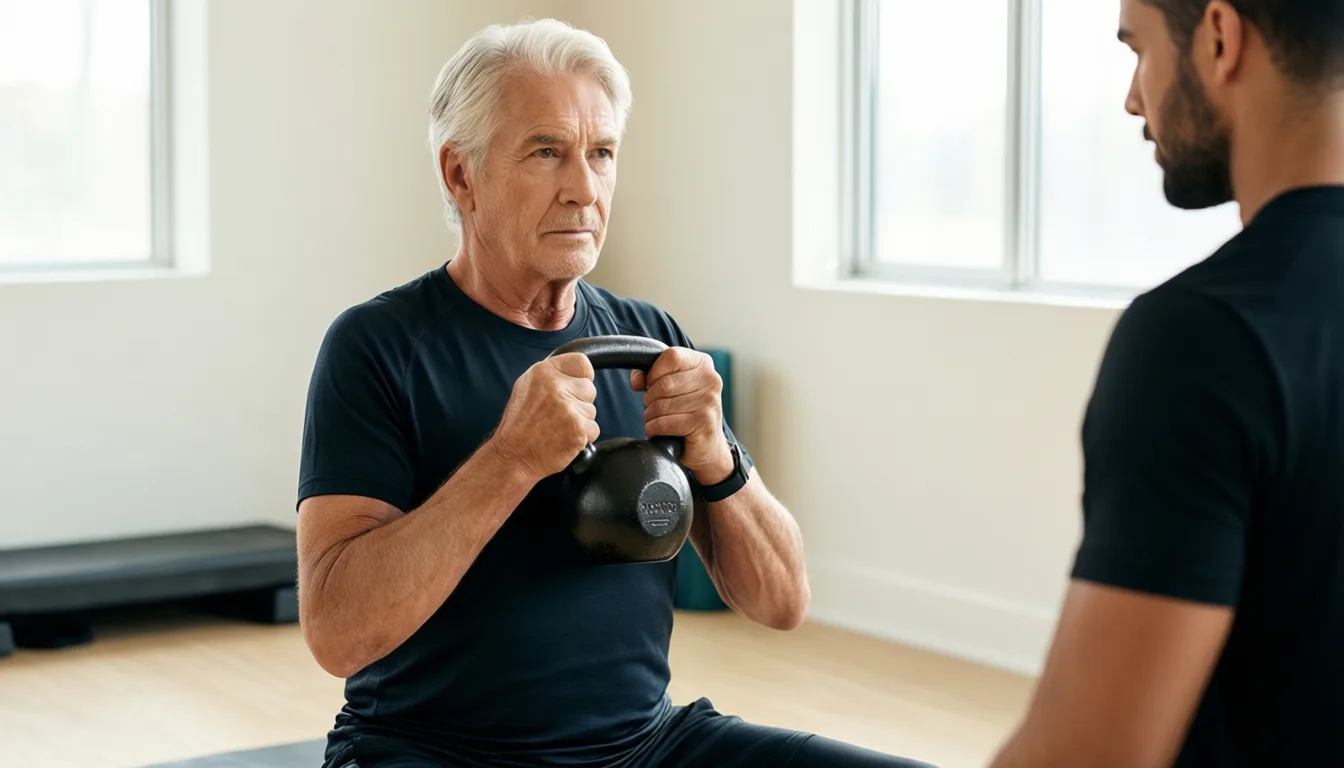
Habit engineering only matters if the behavior being engineered is the right one. A parallel question — which modes of exercise actually extend healthspan in older adults — is the focus of the NEUROmuscular Training for Enhanced AGE Longevity project at the University of Valencia. The framing is notable for what it concedes. The researchers, from the Prevention and Health in Exercise and Sport group, state plainly that while physical activity confers broad chronic-health benefits, exercise that is not properly prescribed can impair health and may even accelerate aging. That is a more honest starting point than most consumer fitness content allows.
The trial sets out to identify which forms of physical exercise — and which equipment and resources used to deliver them — produce the most beneficial adaptations for healthy aging. The premise is specificity: adaptations follow the form of the stimulus, so the choice of modality, load, and tool is not a stylistic preference but a clinical variable. The intended output is a set of concrete action plans for prevention and promotion of health through exercise, grounded in evidence rather than gym-floor convention.
For now, the operative word is intended. The Valencia program is a research agenda, not a finished protocol. Readers looking for a definitive answer to "which exercise should I do at 55, 65, 75?" will not find it here — but they will find a useful frame: the question itself is legitimate, and current consumer recommendations are not yet calibrated to it.
The convergence worth watching
Read together, the two trials sketch a more mature picture of exercise science than the one most readers encounter. The Northwell study takes the behavior change problem seriously: it assumes that knowing is not doing, and that the gap between them is engineerable with cues, personalization, and time-of-day specificity. The Valencia study takes the prescription problem seriously: it assumes that "exercise" is not a monolith, and that getting the modality wrong is not a neutral act.
Neither investigator group is promising a breakthrough. Both are doing the unglamorous work of asking better questions — what behavior, delivered how, at what dose, to which population — that the field has often skipped on its way to a headline. For a reader optimizing energy, focus, and durability across a long career, that is the more useful signal. The next decade of credible guidance on movement and aging will likely come from trials shaped like these: small, mechanistic, and honest about how early the evidence still is.
Until those readouts arrive, the conservative move is also the interesting one. Treat your day as a series of hours rather than a single block. Be skeptical of any program — your own included — that has not asked whether the form of exercise fits the goal. And resist the temptation to convert an early trial into a personal protocol before its authors have.
The next decade of credible guidance on movement and aging will likely come from trials that are small, mechanistic, and honest about how early the evidence still is.
- Watch the readouts. Both trials are registered and underway; their results will sharpen, not settle, the picture.
- Habit beats heroics — probably. The Northwell hypothesis is that automaticity, built by cues, is the missing ingredient in sustained activity.
- Modality is a clinical variable. The Valencia framing treats exercise selection as a prescription, not a preference.
- Hold your protocol loosely. Early evidence supports curiosity, not certainty.
- Personalize with a professional. Bring these questions to a clinician or exercise physiologist who knows your history.
Frequently asked questions
Who is the Northwell Health trial designed for, and why was that group chosen?
The trial targets caregivers of people with Alzheimer's disease and related dementias. The article explains that this population is time-starved, often older themselves, and at elevated risk of the chronic conditions that movement helps prevent, making them a meaningful test case for a low-friction intervention.
What does the Northwell trial define as a successful outcome?
Success is defined as at least half of the caregiver participants developing a habitual pattern of walking more than 250 steps per hour over the 12-week program. The intervention is delivered by text message and targets automaticity — the degree to which a behavior runs without conscious effort.
Why does the Northwell study focus on hourly step counts rather than a daily total?
The article explains that framing movement as an hourly commitment converts a daily aspiration into a series of small goals, each short enough to fit between meetings, medications, or caregiving tasks. The trial's claim is a behavior-change one — that hourly bouts may be more buildable as a habit — not a physiological claim that they are superior to other formats.
Can exercise actually be harmful for older adults?
The University of Valencia researchers state plainly that while physical activity confers broad chronic-health benefits, exercise that is not properly prescribed can impair health and may even accelerate aging. Their study aims to identify which specific forms of exercise produce the most beneficial adaptations, treating modality, load, and delivery tools as clinical variables rather than stylistic preferences.
Can I use either of these studies to build a new exercise routine right now?
Not yet — the article notes that both are early-stage clinical trials that have not reported results and do not establish a recommended protocol for the general public. It advises treating any headlines as hypotheses worth discussing with a clinician or qualified exercise professional, particularly for anyone managing cardiovascular, metabolic, or musculoskeletal conditions.
Sources
- A BCT Intervention for an Hourly Activity Habit Among Caregivers for Persons With AD/ADRD — Northwell Health
- NEUROmuscular Training for Enhanced AGE Longevity — University of Valencia
Join the conversation
Comments are moderated and reviewed before they appear. Be constructive — this is health information.
Add your comment