
Designing Fall Prevention That Sticks: Digital Coaching and the Neuromechanics of 'Timber Falls'
A randomized trial of a self-managed balance app and new neuromechanics research are reshaping how we think about preventing falls in older adults — and why some topple backward like felled trees.
Falls are the quiet productivity tax of later life — the one event that can turn an independent parent into a hospital admission overnight. For decades, the prevention playbook has been clear in theory and frustrating in practice: balance and functional exercise works, but only if people actually do it. Two new pieces of research, one a randomized trial of a self-managed exercise app and the other a neuromechanics study of why some older adults fall backward like timber, suggest the next chapter in fall prevention will be defined less by what we prescribe and more by how intelligently we deliver it.
- Digital balance coaching is plausible, not proven. A year-long randomized trial of the Safe Step app found measurable signals but stopped short of a definitive fall-rate verdict.
- Adherence is the real bottleneck. Self-managed home programs only work when people keep using them — the hard part technology is trying to solve.
- Not all falls are the same. New research identifies 'Timber falls' — backward topples driven by delayed muscle response — as a distinct pattern in older adults with mild cognitive impairment.
- Mechanism matters. Knowing why someone falls (slow muscle onset vs. altered coordination) opens the door to targeted, not generic, training.
- Ask a clinician first. Apps and at-home programs are adjuncts to, not replacements for, individualized assessment.
The adherence problem, repackaged
Exercise programs that combine balance and functional training have long been the most evidence-backed intervention for reducing falls in community-dwelling older adults. The catch has always been delivery. Group classes require transportation; physiotherapy visits require referrals and copays; and even motivated participants tend to drift away from home programs within months. Researchers behind the Safe Step randomized controlled trial, published in the Journal of Medical Internet Research, set out to test whether a self-managed digital app could carry that load.
The trial enrolled community-dwelling adults aged 70 and older who had either fallen in the past year or noticed their balance slipping. Participants were randomized to one of two arms: the Safe Step app paired with educational videos, or educational videos alone. Both interventions ran for a full year, with monthly self-reported fall diaries and quarterly check-ins on exercise adherence. It is a pragmatic design — closer to how the technology would actually be used than to a tightly supervised lab protocol.
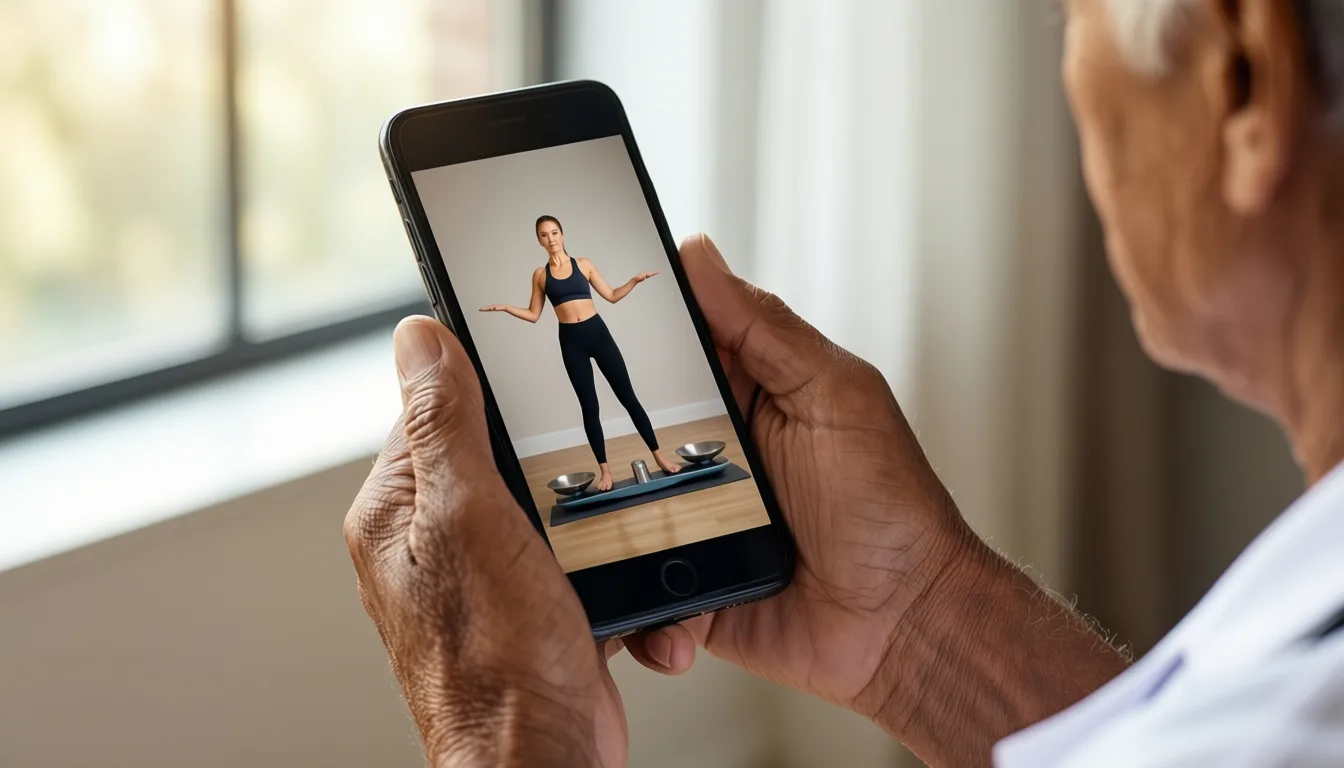
Self-managed apps shift responsibility — and the burden of consistency — onto the user.
What the trial actually showed
The honest read on the Safe Step results is that they are encouraging without being conclusive. The study modeled fall rates using negative binomial regression and fall risk using logistic regression — the right tools for the messy, count-based reality of fall data — and tracked attrition and adherence alongside the primary outcomes. As with most year-long digital interventions, the signal lives or dies on whether participants keep opening the app in month nine.
That is exactly why this trial matters more than a single effect size suggests. It is one of the first rigorous tests of a fully self-managed, unsupervised digital balance program in the population that actually needs it: older adults already showing the early markers of fall risk. Whatever the precise magnitude of benefit, the design tells us something about feasibility, dropout patterns, and the kinds of injuries that occur even within an actively exercising group.
Whatever the precise effect size, the question the field is finally asking is the right one: can a phone keep someone exercising for a year?
Why some people fall backward like trees
While the digital-delivery question plays out, a separate line of research is asking something more fundamental: why, exactly, do certain older adults fall in certain ways? A 2025 study in GeroScience zeroed in on a striking pattern the authors call the 'Timber' fall — a backward topple caused by reactive stepping that arrives too late, or not at all, after a sudden loss of balance.
The researchers exposed 36 older adults with mild cognitive impairment (OAwMCI), 38 cognitively intact older adults, and 20 young adults to a large forward-directed stance perturbation while recording muscle activity from the hamstring, quadriceps, calf, and shin. Timber falls — defined as failing to initiate a step within 430 milliseconds and ending up with more than 30% of body weight caught by a safety harness — occurred only in the cognitively impaired group. Within that group, 36% were Timber fallers; 64% stepped intact.
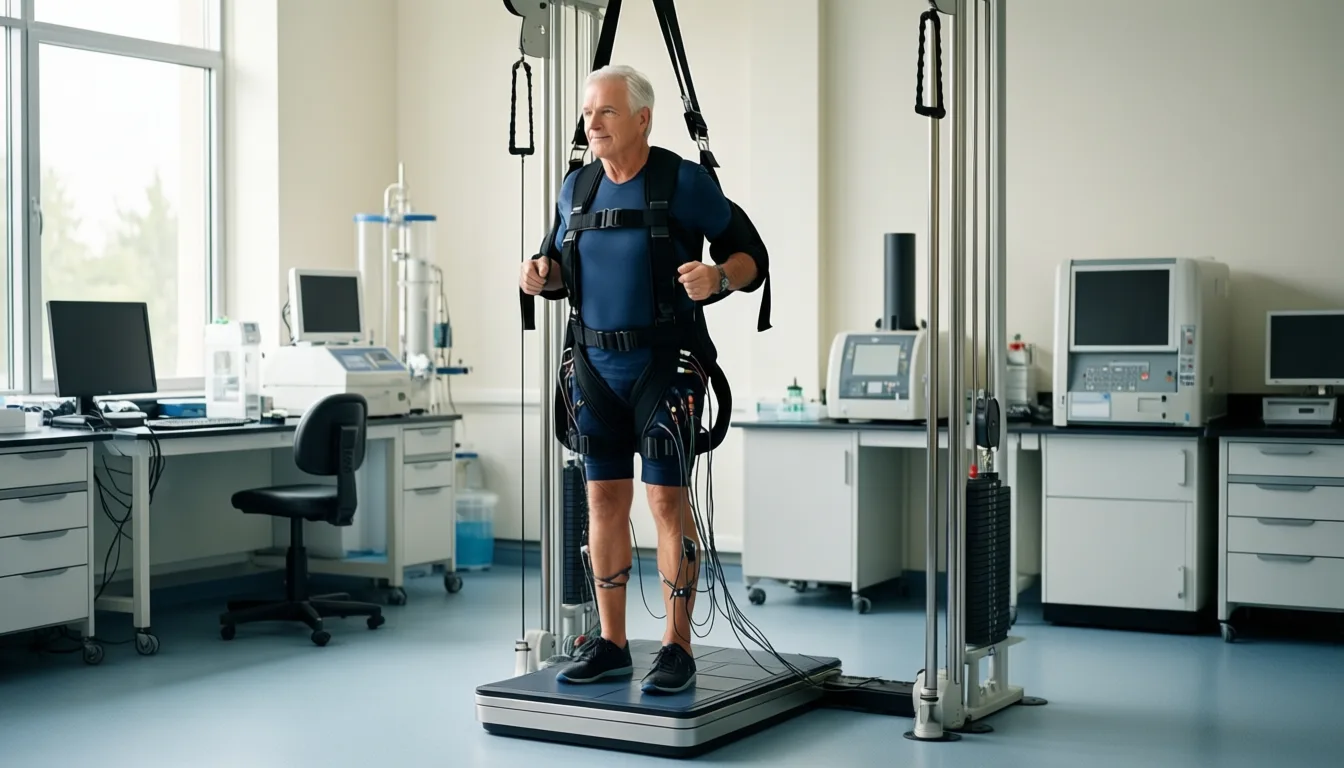
In the lab, a sudden platform shift reveals who can step in time — and who cannot.
Initiation, not execution
The team's central question was diagnostic: when a Timber fall happens, is the failure in starting the protective step or in executing it? Their data point toward initiation. Timber fallers showed longer step initiation times, shorter step lengths, lower reactive stability, and altered muscle onset latencies and synergies compared with peers who stepped successfully. The body knows the recipe; the start signal arrives late.
That distinction is more than academic. Generic 'do more balance work' advice treats all reactive deficits the same. If the bottleneck is response initiation — a delay between perturbation and the first muscle firing — then training that explicitly rehearses fast reactive stepping under unpredictable conditions becomes the priority, particularly for older adults with mild cognitive impairment.
The convergence: smarter, mechanism-aware prevention
Read together, these two studies sketch a more sophisticated approach to fall prevention than the field has historically offered. The Safe Step trial argues that delivery is a solvable problem — that a well-designed app can plausibly keep older adults engaged with balance training at scale. The Timber falls research argues that what we deliver should depend on the underlying neuromechanical signature. A program tuned for a cognitively intact 72-year-old recovering from a stumble may not be the right program for a 78-year-old with mild cognitive impairment whose protective stepping arrives 200 milliseconds late.
The future hinted at by both papers is not heroic. It is the unglamorous combination of consistent practice and the right kind of practice, mediated by tools that can meet people where they live.
The bottom line for busy families
For readers managing their own aging or a parent's, the practical signal is moderate but real. A self-managed digital balance program is a reasonable thing to ask a clinician about — particularly when the alternative is doing nothing because the nearest class is 40 minutes away. And as research like the Timber falls study continues to break 'fall risk' into mechanistically distinct subtypes, expect the next generation of these apps to get more specific: less generic balance content, more targeted reactive-stepping drills for the people whose nervous systems need them most.
The headline is not that technology has solved falls. It is that the question has finally narrowed from 'does balance training work?' to 'how do we get the right kind of balance training to the right person, often enough to matter?' That is a much better question.
Frequently asked questions
What exactly is a 'Timber fall,' and how is it different from other falls?
A Timber fall is a backward topple caused by reactive stepping that arrives too late, or not at all, after a sudden loss of balance. In the research it was defined as failing to initiate a protective step within 430 milliseconds and ending up with more than 30% of body weight caught by a safety harness. Unlike a generic stumble, the failure is specifically in the start signal — the body knows how to step, but the initiation is delayed.
Who is most at risk for Timber falls?
In the study described in the article, Timber falls occurred only among older adults with mild cognitive impairment, and within that group 36% were classified as Timber fallers while 64% were able to step successfully. Cognitively intact older adults and young adults in the same experiment did not experience Timber falls.
What did the Safe Step app trial actually show?
The article describes the results as 'encouraging without being conclusive.' The year-long randomized trial compared a self-managed balance app paired with educational videos against educational videos alone in adults aged 70 and older who had fallen in the past year or noticed balance changes, but stopped short of a definitive verdict on fall rates. The trial's main value, according to the article, lies in what it reveals about feasibility, dropout patterns, and adherence.
Why is adherence described as the real bottleneck in fall prevention?
The article explains that while balance and functional exercise programs are well-supported, delivery has always been the problem — group classes require transportation, physiotherapy visits require referrals and copays, and even motivated participants tend to drift away from home programs within months. Self-managed apps shift the burden of consistency onto the user, and the article notes that the benefit of a digital program 'lives or dies on whether participants keep opening the app in month nine.'
Should someone use a fall-prevention app instead of seeing a clinician?
According to the article, app-based programs and at-home routines are adjuncts to, not substitutes for, individualized evaluation. The article specifically recommends that anyone who has fallen in the past year, noticed balance changes, or has been diagnosed with mild cognitive impairment start with a clinician-led fall-risk assessment, which would also include medication review and vision and footwear checks.
Sources
- Effectiveness of the Safe Step Digital Exercise Program to Prevent Falls in Older Community-Dwelling Adults: Randomized Controlled Trial. — Journal of medical Internet research
- Neuromechanistic causes of timber falls in older adults with mild cognitive impairment: Is response initiation or motor execution the problem? — GeroScience
Join the conversation
Comments are moderated and reviewed before they appear. Be constructive — this is health information.
Add your comment