
Hidden Hearing Loss: Brain Signals Reveal Spatial-Sound Decline Before the Audiogram Does
Early research suggests event-related potentials can flag a quiet form of auditory aging that standard hearing tests miss — and that may matter for focus, conversation, and long-term cognitive health.
You pass the hearing test. The audiologist nods, the audiogram looks clean, and yet — at the long dinner, in the open-plan office, on the conference-room speakerphone — something is harder than it used to be. You lean in. You ask people to repeat themselves. You blame the room. New work in Trends in Hearing suggests the room may not be the problem. The brain's map of where sound is coming from appears to fray with age well before any clinical threshold slips, and researchers are now reading that decline directly off the scalp.
- The audiogram has blind spots. It measures whether you can detect tones in quiet, not how your brain organizes sound in space.
- Spatial hearing ages quietly. Adults with clinically normal thresholds still show measurable declines in spatial sensitivity and speech-in-noise comprehension.
- Brain signals track it. An early electrical response called the N100 correlates with age and with how well listeners separate competing sounds.
- This is early-stage science. ERPs are a promising research marker, not yet a clinic-ready diagnostic — but the direction of travel is clear.
- The cognitive link matters. Effortful listening taxes attention; protecting hearing health is increasingly framed as protecting brainspan.
What the audiogram doesn't hear
The pure-tone audiogram is a century-old workhorse. It asks a simple question — what is the softest tone you can detect at each frequency — and it answers it well. What it does not ask is how the auditory system fuses inputs from two ears into a three-dimensional scene: the cocktail-party trick of locking onto one voice while a dozen others recede into the background. That trick depends on binaural integration, the millisecond-level comparison of signals arriving at each ear, and it is exactly the function that appears to weaken with age even when the audiogram stays pristine.
The new study used a spatial oddball paradigm — sounds arriving from expected locations, occasionally interrupted by a sound from somewhere else — while recording electroencephalography from listeners with normal audiometric thresholds. The researchers reported declines in spatial auditory performance, in speech-in-noise comprehension, and in cognitive status across age, all in the absence of measurable hearing loss on the standard test. They also found a strong correlation between the amplitude of the N100, an early cortical response to sound onset, and chronological age, as well as a link between N100 amplitude and the brain's ability to unmask a target sound from competing noise.
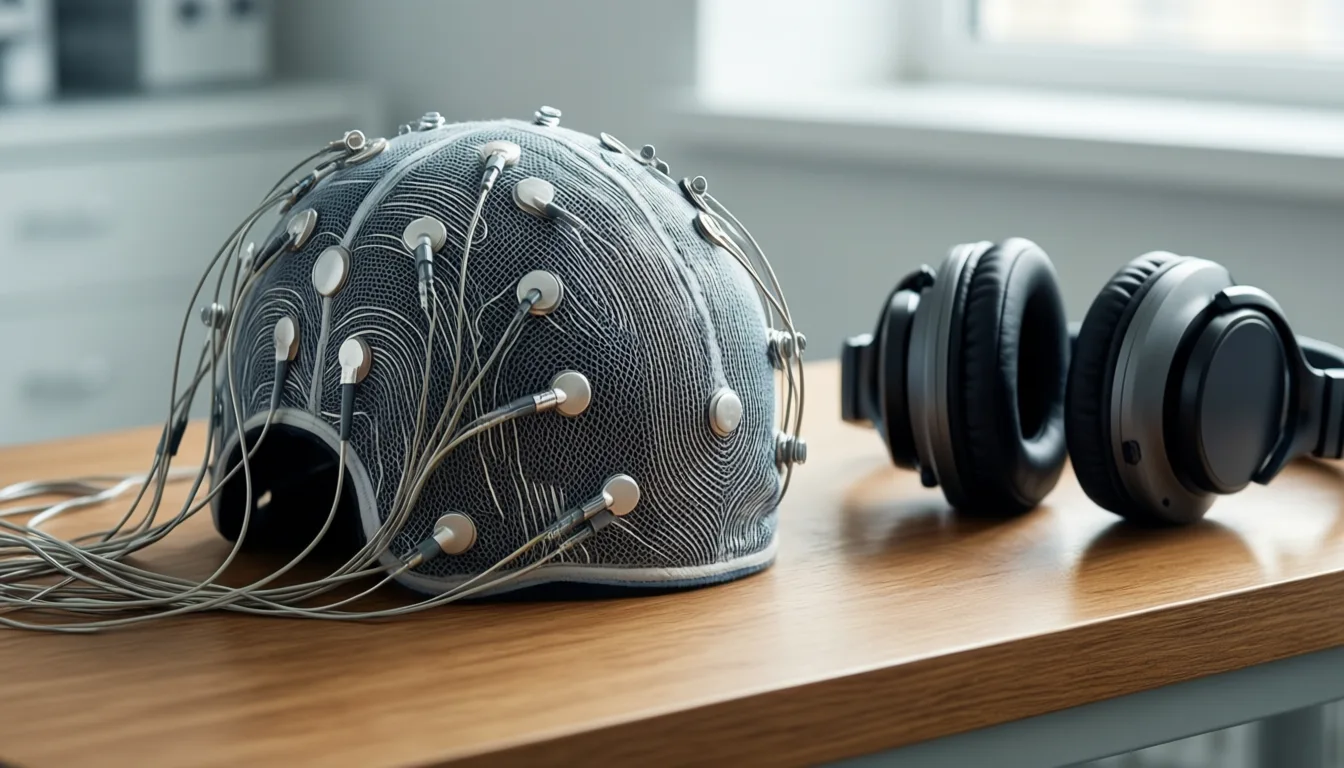
Event-related potentials are extracted from EEG by averaging the brain's response to many repetitions of a sound — a way of seeing signal beneath the noise.
Why the N100 is interesting
The N100 is one of the most studied components in auditory neuroscience: a negative deflection roughly a tenth of a second after a sound begins, generated largely in and around the auditory cortex. It is not a thought. It is closer to a reflex of attention — the brain registering that something has happened and orienting toward it. When the N100 shrinks or distorts in response to spatial change, the implication is that the cortex is no longer drawing as sharp a line between here and over there.
That matters because spatial separation is one of the main tools the brain uses to pluck a voice out of a crowd. If the cortical machinery that flags location is dulled, the listener can still hear the words — they will pass the audiogram — but the work of sorting which words belong to which talker gets harder. The researchers frame the N100 finding as evidence that ERP components are valid markers of spatial hearing performance and aging, even when the ear itself looks healthy on paper.
You can pass the hearing test and still be losing the part of hearing that does the heaviest lifting in real life.
The cognitive backdrop
None of this lands in a vacuum. The link between hearing health and cognitive aging has become one of the more durable themes in public-health research over the past decade, and the spatial-hearing story slots neatly into it. The authors observed that cognitive status itself tracked with age in their normal-hearing sample, alongside the auditory measures. They are careful not to claim causation — this is a correlational, cross-sectional snapshot — but the pattern is consistent with a broader hypothesis: that effortful listening drains cognitive resources, and that subtle auditory declines may be doing quiet work long before anyone calls them a hearing problem.
For a reader optimizing energy and focus, the practical translation is modest but real. If conversations in noisy rooms feel disproportionately tiring, that fatigue is not necessarily a character flaw or a sign of distraction. It may be the cost of a brain doing extra work to reconstruct a scene the ears are no longer delivering as cleanly.

Restaurants are the canonical stress test for spatial hearing: many voices, hard surfaces, no visual cue to which sound belongs to which speaker.
From research signal to clinic tool
It is worth being honest about where this sits on the maturity curve. A single study using a spatial oddball paradigm in a normal-hearing cohort is a proof of concept, not a diagnostic. ERP recording today still means an EEG cap, a quiet room, and an analyst willing to average hundreds of trials to coax a clean waveform out of the noise. None of that is coming to your annual physical next year.
What is plausible on a longer horizon is a generation of auditory assessments that look past threshold detection and toward the brain's handling of complex scenes — speech-in-noise batteries, spatial-release-from-masking tasks, and, eventually, objective neural markers like the N100. The direction is consistent with where consumer audio is already heading: hearables that personalize processing, apps that screen speech-in-noise, and clinical interest in hearing as a modifiable input to long-term brain health.
The takeaway for a packed calendar
The headline finding is narrow and the evidence is early: in a normal-hearing sample, an early cortical response to sound tracked with age and with the ability to separate signal from noise. The implication is broader. The standard hearing test, useful as it is, was not designed to catch the kind of decline that shows up first in restaurants and conference rooms. Research-grade tools are beginning to. Until they reach the clinic, the most useful move is unglamorous — protect your ears from chronic noise, take listening fatigue seriously as data, and treat hearing as part of the same long-arc investment as sleep and cardiovascular health. The audiogram is not the whole story. Increasingly, the brain is telling the rest of it.
Frequently asked questions
If I passed my hearing test, why do I still struggle to follow conversations in noisy restaurants or meetings?
The audiogram measures whether you can detect tones in quiet, not how your brain organizes sound in space. The ability to lock onto one voice while others recede into the background depends on binaural integration — the brain's millisecond-level comparison of signals arriving at each ear — and this function can weaken with age even when the audiogram stays normal.
What is the N100, and why does it matter for understanding hearing decline?
The N100 is an early cortical response to sound onset, occurring roughly a tenth of a second after a sound begins and generated largely in and around the auditory cortex. Researchers found that its amplitude correlates with chronological age and with the brain's ability to unmask a target sound from competing noise, suggesting it can reveal spatial hearing decline even in people whose standard hearing test looks clean.
Why do socially busy days leave me so mentally drained, even though my hearing seems fine?
According to the article, subtle auditory declines can force the brain to do extra reconstructive work to make sense of a complex sound scene, and that effort draws on cognitive resources. The authors suggest that disproportionate fatigue after noisy social or meeting-heavy days may reflect the real cost of effortful listening rather than a character flaw or lack of attention.
Can I ask for the N100 brain-signal test at my next hearing appointment?
Not yet — the article describes this research as a proof of concept, not a clinic-ready diagnostic. ERP recording still requires an EEG cap, a quiet room, and averaging hundreds of trials to produce a usable signal, and the authors explicitly note that this is unlikely to appear at routine annual physicals in the near term.
Does the study prove that hearing decline causes cognitive problems?
No — the authors are careful to frame their findings as correlational and cross-sectional, meaning they observed that cognitive status tracked with age alongside the auditory measures but did not establish causation. They describe it as consistent with a broader hypothesis that effortful listening drains cognitive resources over time, not as definitive proof of a causal link.
Join the conversation
Comments are moderated and reviewed before they appear. Be constructive — this is health information.
Add your comment