
The Frailty Playbook: How Nutrition and Training Can Rewind Age-Related Decline
A 2025 review in Advances in Experimental Medicine and Biology argues frailty — unlike aging itself — is reversible. The two levers: personalized nutrition and structured exercise.
Frailty has long been treated as the weather of old age — something to be endured rather than engineered. A 2025 chapter review in Advances in Experimental Medicine and Biology pushes back on that fatalism. Its authors argue that while aging itself cannot be undone, the syndrome of frailty — the loss of muscle, reserve, and resilience that turns a stumble into a hospital stay — can be both prevented and, in many cases, reversed. The two levers are unglamorous and well-known: what you eat and how you move. The novelty is in how precisely each must be tuned to the individual.
The stakes are demographic. The review notes that roughly 30% of Europeans over 65 are already dependent on the care of others, and projects that share could climb to 50% by 2050 as the population ages. For executives planning long careers, aging parents, or their own second acts, that trajectory reframes frailty as an infrastructure problem — one whose solution begins decades before a walker enters the picture. The encouraging counterpoint, the authors write, is that frailty responds to intervention in a way that chronological age does not (Millan-Domingo & Viña, 2025).
- Frailty is modifiable. The review frames it as a syndrome that can be prevented and reverted, distinct from aging itself.
- Two levers, used together. Personalized nutrition and structured physical training are the interventions repeatedly shown to help.
- Precision matters. The authors argue geriatrics should borrow oncology's personalization mindset — protocols tailored to the individual, not the cohort.
- Demographics are the deadline. Care dependency in Europeans over 65 could rise from ~30% today to ~50% by 2050.
- Start before symptoms. The most actionable window is the decades preceding overt frailty, not after it arrives.
Lever One: Nutrition, Personalized
The review's first prescription is dietary — but not in the form of a single recommended regimen. The authors emphasize that nutritional interventions for frailty must be personalized, taking into account the individual's baseline status, deficits, and goals (Millan-Domingo & Viña, 2025). That framing is significant. A great deal of consumer nutrition advice still treats older adults as a homogenous group; the review's argument is closer to the logic of precision oncology, where the protocol is built around the patient rather than the diagnosis.
What the chapter does not do is hand readers a universal dosing chart, and we will not invent one. The takeaway for a busy professional is structural: an aging-focused nutrition plan worth its name should be built with a clinician or registered dietitian who can assess actual intake, body composition, and bloodwork — not assembled from supplement-aisle guesswork.
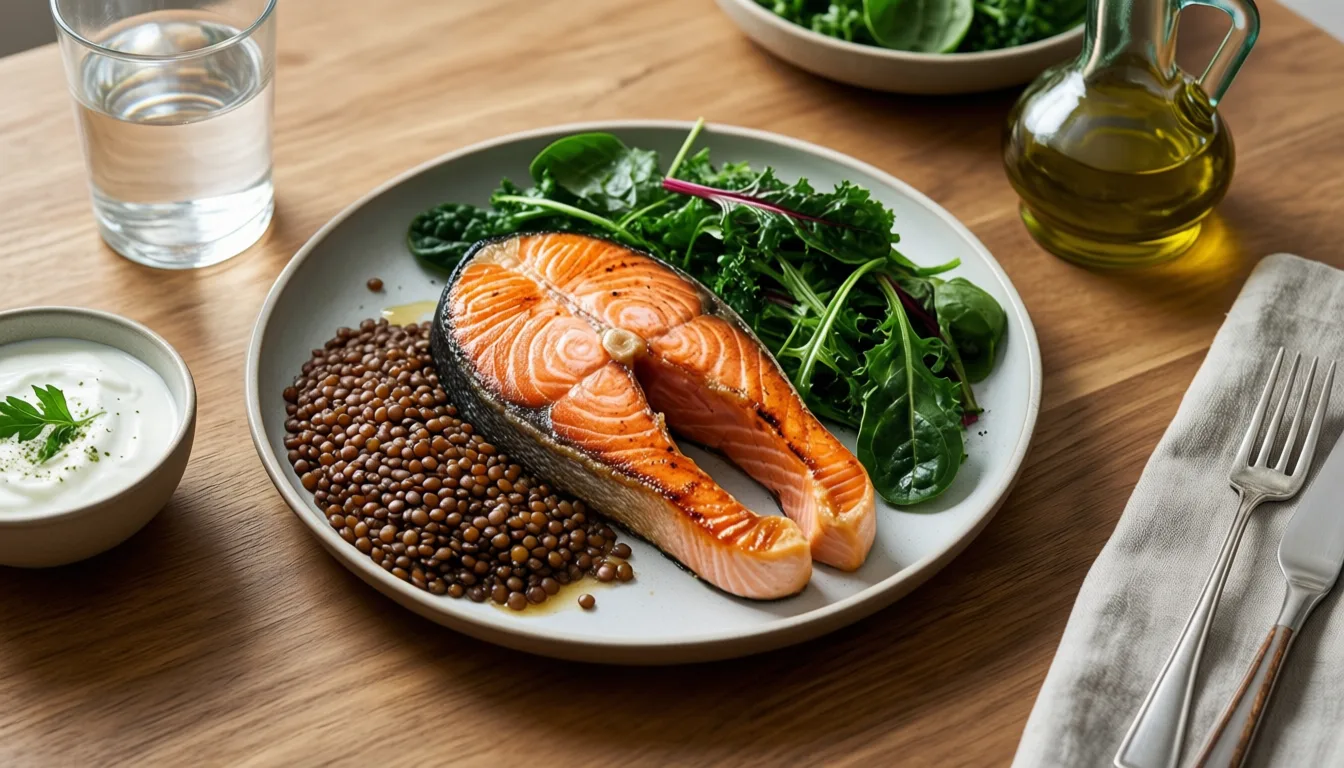
The review argues nutritional interventions for frailty should be built around the individual — not prescribed by category.
Lever Two: Structured Physical Training
The second lever is exercise, and again the emphasis is on structure and specificity. The authors identify physical training as one of the two major lifestyle changes useful in treating age-associated frailty, and apply the same personalization principle: programs must be tailored to the individual's capacity and trajectory (Millan-Domingo & Viña, 2025). For readers already running on packed calendars, the operational implication is that incidental movement — steps logged between meetings — is not the same intervention as a programmed regimen designed by someone who understands geriatric physiology.
The review treats nutrition and exercise as complementary rather than interchangeable. Eating well without training, or training without adequate fuel, leaves the other half of the equation unaddressed. That pairing — fuel plus stimulus — is the through-line of the chapter's argument.
Frailty, unlike aging itself, can be prevented and even reverted. Millan-Domingo & Viña, 2025

Structured, supervised training — not just incidental movement — is the form of exercise the review credits.
The Precision Turn in Geriatrics
Perhaps the chapter's most useful contribution is conceptual. The authors explicitly draw the parallel to oncology, where precision interventions are now routine, and argue geriatrics has been slower to adopt the same mindset (Millan-Domingo & Viña, 2025). For the reader, that reframing matters: it suggests the right question to bring to a clinician is not what should someone my age do? but what should I, specifically, do given my labs, my training history, my diet, and my goals?
It is worth being clear about the evidence rating here. This is a narrative review distilling a body of work, not a single randomized trial with a headline effect size. The direction of the evidence is consistent and the mechanistic logic is well established, but the strongest claim the chapter makes — and the strongest claim we will repeat — is that personalized nutrition and structured exercise are the most reliable levers currently available for prevention and reversal of frailty. Magnitude, timeline, and durability will vary by individual.
What to Do With This
The pragmatic read for a healthspan-minded reader is straightforward. First, treat frailty as a category worth thinking about now, in your fifties and sixties, rather than as a problem of your eighties. Second, resist the temptation to self-prescribe a protocol from a magazine — including this one — and instead use the review's framing to ask better questions of a qualified clinician. Third, recognize that nutrition and training are paired interventions: each makes the other more effective, and skipping one undercuts the other.
The most quietly radical line in the chapter is its premise: that the trajectory toward dependency is not fixed. For a population whose calendars are full and whose runways are long, that is the part worth holding onto.
Frequently asked questions
Is frailty just an unavoidable part of getting older?
The review makes a clear distinction between aging itself, which cannot be undone, and frailty, which it frames as a syndrome that can be both prevented and reversed. The two primary levers are personalized nutrition and structured physical training.
What does 'structured training' mean, and why isn't staying active enough?
The article specifies that the form of exercise the review credits is structured and supervised — not incidental movement such as steps logged between meetings. The distinction is that a programmed regimen designed by someone who understands geriatric physiology is a different intervention than general daily activity.
Can I just focus on diet or exercise, or do I need both?
The review treats nutrition and exercise as complementary rather than interchangeable. The article states that eating well without training, or training without adequate fuel, leaves the other half of the equation unaddressed.
Why does the article compare frailty care to cancer treatment?
The authors draw a parallel to precision oncology, where protocols are built around the individual patient rather than the diagnosis. Their argument is that geriatrics has been slower to adopt this personalization mindset, and that the right clinical question is what a specific individual should do given their own labs, training history, and goals — not what someone of a given age should do in general.
When should someone start thinking about frailty prevention?
The article identifies the most actionable window as the decades preceding overt frailty, not after it arrives. It specifically suggests that healthspan-minded readers in their fifties and sixties should treat frailty as a category worth addressing now, rather than viewing it as a problem of their eighties.
Sources
- Lifestyle Interventions in Frailty. — Advances in experimental medicine and biology
Join the conversation
Comments are moderated and reviewed before they appear. Be constructive — this is health information.
Add your comment