
Healthspan, Not Just Lifespan: A Whole-Life Blueprint for Aging Well
A new European synthesis maps the levers — personal, clinical, and environmental — that may compress the years we spend sick at the end of a longer life.
The headline number in human longevity hasn't changed shape in a generation: people in developed countries keep adding birthdays, but they aren't necessarily adding good ones. The gap between how long we live and how long we live well is widening — and that gap is where chronic disease, disability, and the quiet erosion of function take up residence. A 2025 review in the European Journal of Internal Medicine tries to do something the field has long needed: stop treating healthy aging as a single intervention and start treating it as a layered, lifecycle-long protocol that runs across the body, the clinic, and the city you live in.
- Lifespan is outpacing healthspan in developed countries, leaving more years lived with chronic disease and disability.
- No single lever is enough. The EJIM synthesis frames healthy aging as an integration of individual habits, healthcare delivery, and environment.
- Lifestyle is the foundation: diet, physical activity, and social connection remain the most consistently supported personal inputs.
- Systems matter: health literacy, vaccination, and screening determine whether biology gets the assist it needs.
- Geroscience is the next frontier — targeting the biology of aging itself, but most translation is still early.
- Evidence rating: Moderate. The framework is well-reasoned and consensus-aligned; specific personalized interventions are still maturing.
The widening gap
For the performance-minded reader, the framing is familiar: VO2 max declines, mitochondrial density drifts, lactate clearance slows, recovery windows stretch. What's less familiar is how those individual curves aggregate at the population scale. The EJIM authors describe a developed-world pattern in which advances in healthcare and living standards have extended lifespan without producing a matching extension of healthspan — the years lived free of significant disease and disability — leaving aging societies carrying a heavier burden of chronic illness and functional decline. The proposed response is not a supplement stack or a single biomarker to chase, but a comprehensive strategy that combines individual approaches, public health measures, innovative policies, and community support.
That layered framing is the piece's most useful contribution. It says, in effect: your training plan matters, your clinician matters, and your zip code matters — and none of them is sufficient alone.

Diet, movement, and connection remain the most reliably supported personal inputs to healthy aging.
Layer one: the individual protocol
At the individual layer, the review converges on inputs endurance athletes already respect: diet, physical activity, and social connections. None of these are novel, and that's the point — they keep showing up because the signal keeps replicating. For a reader who already trains, the relevant translation isn't "start moving." It's recognizing that the same physiological levers that drive a faster threshold pace in your forties — cardiorespiratory fitness, lean mass, metabolic flexibility, sleep architecture — are the levers that determine whether you're independently climbing stairs at eighty.
The social-connection input is the one performance culture tends to undercount. The EJIM authors place it alongside diet and exercise as a first-tier individual factor, reflecting a broader consensus that isolation behaves less like a mood variable and more like a physiological stressor over decades.
The same levers that drive a faster threshold pace in your forties decide whether you're climbing stairs unassisted at eighty.
Layer two: the healthcare assist
Personal optimization runs into a ceiling without a functioning clinical layer beneath it. The review flags health literacy, vaccinations, and screenings as the healthcare-side pillars — unglamorous but load-bearing. Health literacy is the rate-limiter on everything else: it determines whether a patient can act on a lipid panel, interpret a DEXA result, or weigh the trade-offs of a new medication. Vaccination and screening are the boring infrastructure that decides whether a preventable infection or an early-stage cancer becomes the event that ends a healthspan.
For a high-performing reader, the practical translation is to treat the clinical relationship as part of the training stack rather than a once-a-year obligation — and to expect a clinician who can read modern preventive evidence.
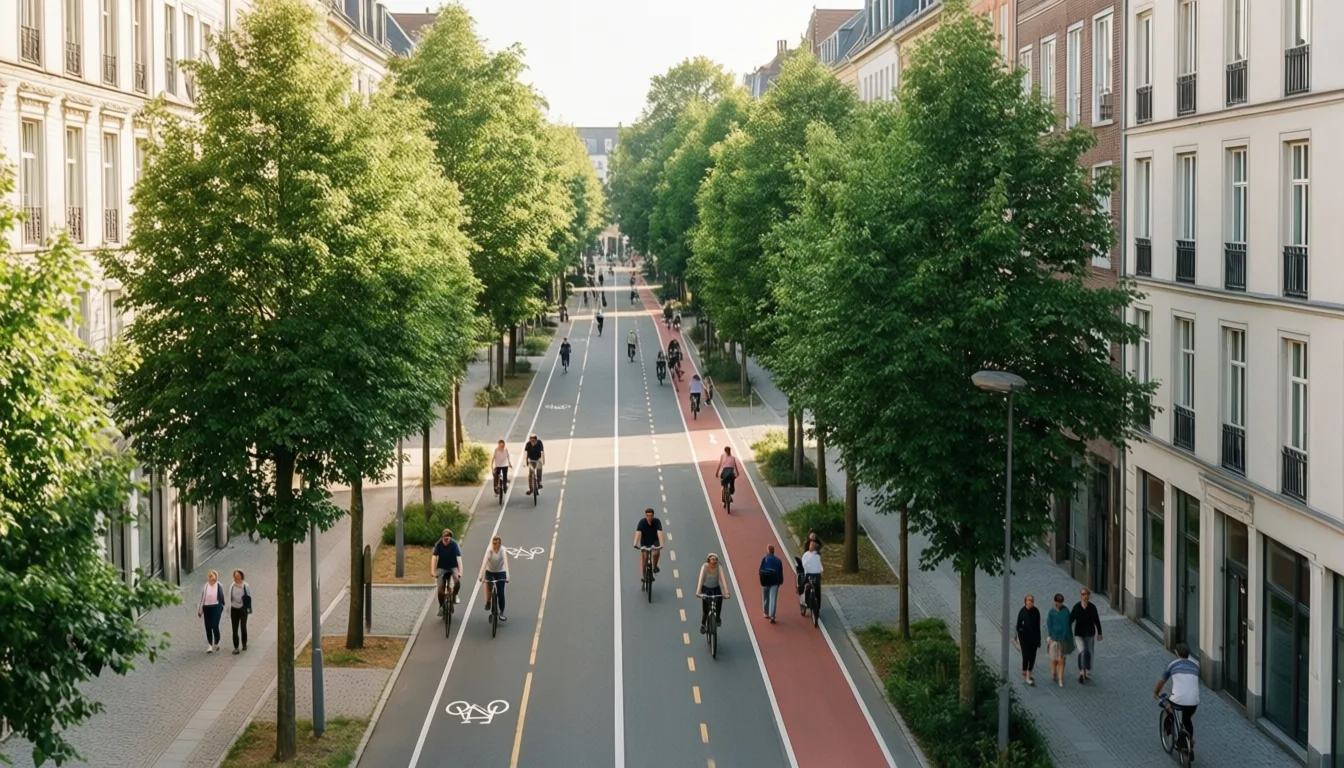
"Longevity-ready cities" — walkable, green, low-pollution — are framed in the review as healthspan infrastructure.
Layer three: the environment you can't out-train
The third layer is the one most easily ignored by individual-optimization culture. The EJIM authors argue that environmental factors — climate change, pollution, and the design of longevity-ready cities — belong in the same conversation as diet and exercise, because they set the ceiling on what individual behavior can accomplish. Air quality shapes cardiopulmonary trajectories. Walkability shapes baseline activity. Heat exposure, increasingly, shapes mortality risk in older cohorts. None of this is rhetorical: it's the substrate your protocol runs on.
The frontier: geroscience and AI
Looking forward, the review points to geroscience — the study of the biological and molecular mechanisms of aging — as the engine of more personalized interventions, with artificial intelligence as the analytical layer that may make individualized risk prediction practical at scale. This is the exciting part, and also the part where the strength of language has to match the strength of evidence. The framework is plausible and the early signals are real, but most translational geroscience interventions are still being characterized in humans. For now, the frontier informs strategy; it doesn't replace the foundation.
How to read this as a protocol
The most useful move a performance-minded reader can make with this paper is to stop ranking the layers against each other. The integrated lifecycle framing implies that marginal gains compound across layers: a well-trained cardiovascular system is more valuable in a city with clean air; a literate patient gets more from a competent clinician; a vaccinated, screened body gets more from a disciplined training week. Healthspan, in this telling, is less a destination than a portfolio — and the EJIM authors are arguing, persuasively, that we've been over-weighting some assets and ignoring others.
The compression of morbidity — fewer bad years at the end of a longer life — is still a hypothesis at the population level. But the levers the review identifies are, individually, among the best-supported in preventive medicine. The novelty is in the integration, not the ingredients.
Frequently asked questions
What is the difference between lifespan and healthspan, and why does it matter?
Lifespan is how long you live, while healthspan refers to the years lived free of significant disease and disability. In developed countries, advances in healthcare and living standards have extended lifespan without producing a matching extension of healthspan, leaving aging societies carrying a heavier burden of chronic illness and functional decline.
What are the three layers of the healthy aging framework described in the article?
The framework organizes healthy aging into three layers: the individual layer (diet, physical activity, and social connections), the healthcare layer (health literacy, vaccinations, and screenings), and the environmental layer (factors like air quality, walkability, and pollution). The article's central argument is that none of these layers is sufficient on its own, and that marginal gains compound when all three are addressed together.
Why does the article treat social connection as a first-tier factor alongside diet and exercise?
The article notes that isolation behaves less like a mood variable and more like a physiological stressor over decades, which is why the review's authors place social connection alongside diet and exercise as a first-tier individual factor. It identifies social connection as an input that performance culture tends to undercount.
What role does health literacy play in healthy aging according to the article?
The article describes health literacy as the rate-limiter on everything else at the healthcare layer, because it determines whether a patient can act on a lipid panel, interpret a DEXA result, or weigh the trade-offs of a new medication. Without it, even sound clinical infrastructure cannot translate into better outcomes.
How reliable are the geroscience and AI-driven interventions highlighted in the article?
The article characterizes geroscience and AI-driven personalization as an exciting frontier whose early signals are real, but cautions that most translational geroscience interventions are still being characterized in humans. It concludes that for now the frontier informs strategy but does not replace the established foundation of diet, movement, and clinical care.
Sources
- How to promote healthy aging across the life cycle. — European journal of internal medicine
Join the conversation
Comments are moderated and reviewed before they appear. Be constructive — this is health information.
Add your comment