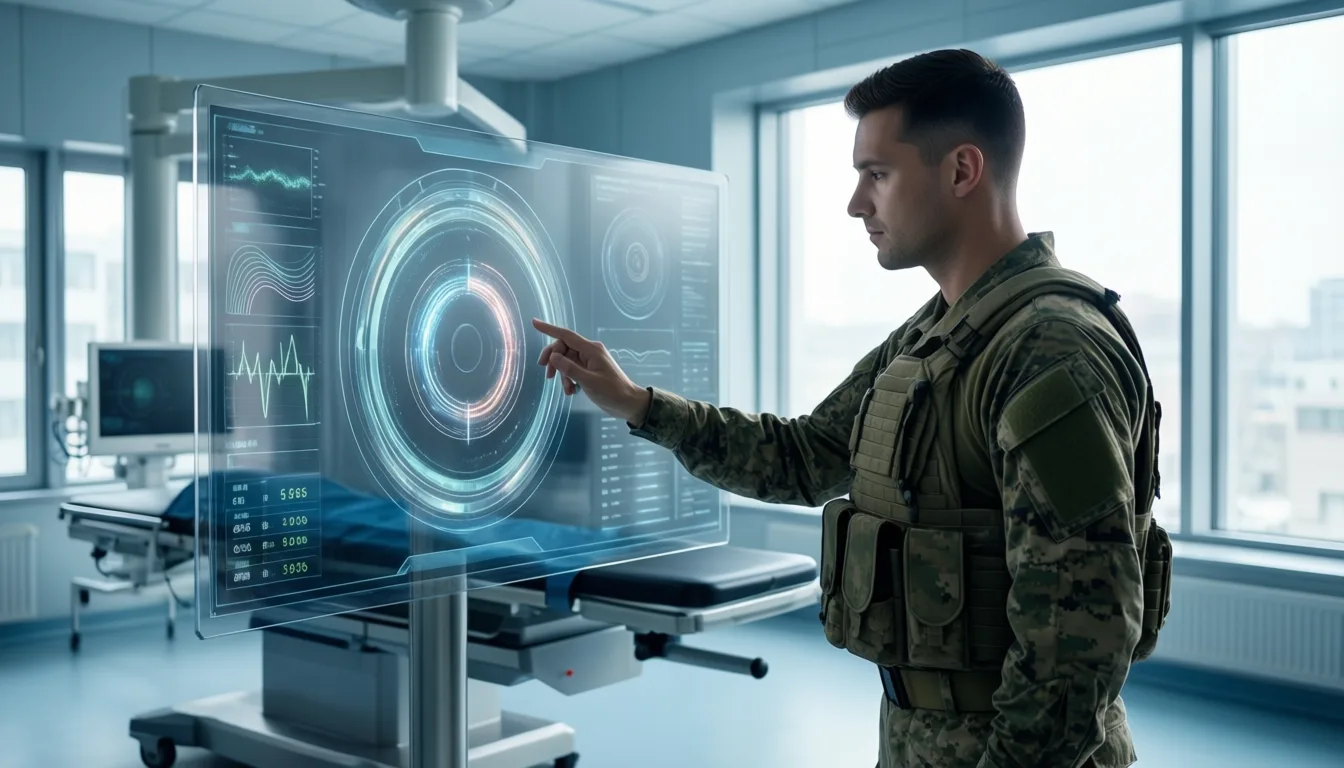
Inside the Army's Bid to Put Whole-Person Health on a Single Dashboard
The US Army's new Holistic Health and Fitness Management System tries to unify sleep, nutrition, biometrics and mental health for hundreds of thousands of soldiers. It's the largest real-world test yet of population-scale optimization.
For the past decade, the language of personal optimization has belonged to consumers — the executive with a ring on her finger, the founder tracking heart-rate variability before a board meeting, the coach quietly titrating magnesium and morning light. Now the same logic is being stress-tested at a scale the wellness industry has never approached: the entire active US Army. A 2025 review in BMJ Military Health describes the Holistic Health and Fitness Management System, or H2FMS, a cloud-based platform built to assess, coach and track soldiers across five readiness domains at once — physical, mental, spiritual, nutritional and sleep. For anyone who has ever wondered what 'whole-person' health looks like when it is funded, mandated and operationalised, this is the closest real-world answer we have.
- One dashboard, five domains. H2FMS unifies physical, mental, spiritual, nutritional and sleep data into a single role-based view.
- Population scale, not personal. It is designed for hundreds of thousands of soldiers and the interdisciplinary teams that support them — not a quantified-self individual.
- Inputs are mixed. Biometric wearables sit alongside self-reported psychometrics, performance tests and legacy Army systems.
- Evidence is architectural, not outcome-based yet. The published review describes design and intent; population-level health outcomes have not yet been reported.
- The signal for civilians. Integration — not more sensors — is becoming the frontier of credible health technology.
Why the Army stopped thinking in silos
For most of modern military history, soldier readiness was tracked the way corporate wellness is still tracked today: in disconnected silos. A physical fitness test lived in one system. Sleep complaints surfaced — if at all — in a clinic note. Nutrition was a dining-facility problem. Mental health sat behind its own door, with its own stigma and its own records. The premise of H2FMS, according to the BMJ Military Health review, is that those silos themselves are the problem: a soldier whose sleep is collapsing is also the soldier whose injury risk is climbing and whose cognitive performance is degrading, and no one downstream can see the whole picture in time to intervene.
The platform's response is structural. The authors describe a secure, cloud-based system that pulls together advanced biometric technologies, performance assessments, self-reported psychometrics and existing Army systems, then surfaces them through role-based dashboards — one view for the individual soldier, another for the Holistic Health and Fitness Performance Team, another for cadre and command. The point is not to give anyone more data. It is to give the right person the right slice, at the moment a decision is being made.

H2FMS combines wearable biometrics with self-reported inputs — an acknowledgement that no single signal captures readiness.
What 'holistic' actually means here
The word holistic has been so thoroughly laundered by the wellness market that it is worth pausing on what the Army means by it. The review defines five readiness domains: physical, mental, spiritual, nutritional and sleep. Spiritual readiness is the one that tends to surprise civilian readers — in the Army's framing it is closer to a sense of meaning, values and purpose than to religious practice, and it is treated as a measurable contributor to resilience alongside VO2 max and sleep efficiency.
What ties the domains together inside H2FMS is not a single score but a set of mechanisms: automated support actions that trigger when a metric drifts, domain-specific tools for clinicians and coaches, guided education and interactive coaching for the soldier, and integrated analytics that let teams allocate finite resources where the data says they will matter most. The platform is explicitly designed, the authors write, to enable data-informed interventions intended to boost performance, reduce injuries, speed rehabilitation and improve quality of service.
The frontier is no longer more sensors. It is whether anyone can act on what the sensors already say.
Population scale changes the math
Consumer optimization is a story of one person and their data. Military readiness is a story of resource allocation across a population that is too large to coach individually. The H2FMS authors describe the platform as a cost-efficient strategy for scaling Holistic Health and Fitness Performance Team access across the Total Army, framed as an equitable model meant to maximise both individual and organisational return on investment. In plainer language: every soldier gets on-demand access to expert-informed support, and the limited supply of human coaches and clinicians is steered toward the soldiers whose data suggests they need it most.
That logic has obvious parallels in civilian life. The most expensive parts of any health system — specialists, intensive rehab, time — are scarce. Platforms that triage attention based on integrated signals, rather than waiting for a complaint or a crisis, are precisely what large employers and health systems have been promising for a decade. H2FMS is one of the first credible attempts to actually build that architecture for a defined population at this scale.

The dashboard is meant for teams, not just individuals — the platform's leverage comes from coordinating specialists around the same view.
What the evidence does — and does not — say
This is where editorial honesty matters. The BMJ Military Health piece is a review of a system's architecture and intent, not a randomised trial of its effects. It describes what H2FMS is built to do — unify data, trigger support, inform decisions — and the rationale for why that design should improve outcomes. It does not yet report population-level evidence that injuries fell, that rehabilitation accelerated, or that quality of service measurably improved as a result of the platform. Those are the outcomes the system is designed to produce, and they remain to be demonstrated in published data.
That distinction is the whole game for readers trying to separate signal from hype in wellness technology. A platform can be well-architected and still under-deliver in the field; it can also quietly compound small gains across a population in ways that take years to surface in the literature. The honest read on H2FMS today is that it is a serious, well-specified bet on integration as the next lever in human performance — and that the proof will arrive, or fail to arrive, in the outcome studies that follow.
The signal for the rest of us
For PinnacleLife readers, the interesting thing about H2FMS is not that the Army is using wearables. It is that a large, conservative institution has concluded that the bottleneck in human performance is no longer measurement. It is the connective tissue between measurement, decision and action — and that connective tissue has to be built deliberately, with role-based views, automated triggers and humans in the loop. That is a quietly radical position in a market that still mostly sells more sensors.
If the platform works as designed, the lesson for the rest of us will be familiar but worth relearning: the best health technology is the kind that compresses the distance between a signal and a sensible response. If it does not work as designed, the lesson will be just as useful — that even with budget, mandate and scale, 'whole-person' optimization is harder to operationalise than the wellness industry likes to suggest. Either way, H2FMS is the experiment to watch.
Frequently asked questions
What are the five health domains tracked by H2FMS?
H2FMS tracks soldiers across five readiness domains: physical, mental, spiritual, nutritional, and sleep. These are unified into a single cloud-based platform accessible through role-based dashboards.
What does the Army mean by 'spiritual readiness' — is it about religion?
In the Army's framing, spiritual readiness is closer to a sense of meaning, values, and purpose than to religious practice. It is treated as a measurable contributor to resilience alongside metrics like VO2 max and sleep efficiency.
Has H2FMS been shown to reduce injuries or improve soldier health outcomes?
Not yet in published data. The BMJ Military Health review describes the system's architecture and intent, not a randomized trial of its effects. Population-level evidence that injuries fell, rehabilitation accelerated, or quality of service improved has not yet been reported.
Who can see a soldier's data on the platform?
H2FMS uses role-based dashboards, giving different views to the individual soldier, the Holistic Health and Fitness Performance Team, and cadre and command. The design goal is to give the right person the right slice of data at the moment a decision is being made.
How does H2FMS decide which soldiers receive the most attention from coaches and clinicians?
The platform uses integrated analytics so that the limited supply of human coaches and clinicians is steered toward the soldiers whose data suggests they need it most. The authors describe this as a cost-efficient, equitable model intended to maximize both individual and organizational return on investment.
Join the conversation
Comments are moderated and reviewed before they appear. Be constructive — this is health information.
Add your comment